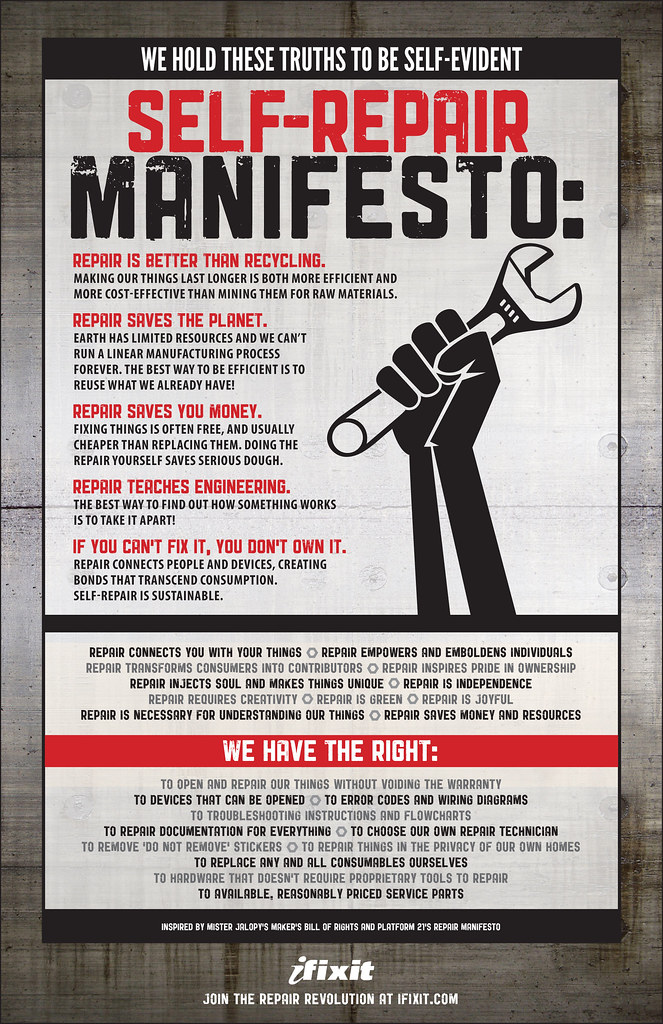
Over the last few decades, more and more companies have been discovering the financial wonders available to them if they separate the items they sell from the ability to repair those items … so you buy a widget but if it breaks, you have to pay the manufacturer to get it fixed. You have no option to fix it yourself — even if you have the technical know-how and the necessary tools — nor can you find a cheaper alternative, because the manufacturer has blocked any possible competition to their often highly profitable scam revenue stream. It’s bad enough in the civilian marketplace, where consumers are demanding the “right to repair” from legislators because the cost and inconvenience are far too high.
Now imagine you are onboard a US Navy ship in the western Pacific and some critical piece of technology breaks down … but you can’t fix it yourself because the manufacturer sells repair services and will have to be paid to send out a civilian repair crew with the necessary tools and parts. No need to imagine it: it’s the situation the US military is finding itself in more and more often:

If you want to get an otherwise reserved and laconic farmer to get excited and talkative about a subject, ask them about the issue of “right to repair“.
… Wilson and others accuse John Deere of blocking farmers and everyday mechanics from fixing equipment without going through John Deere dealers. Although the company doesn’t prohibit users from fixing equipment themselves, the lawsuit claims it locks users out of repairs because of the limited access to software that only dealerships can access. The lawsuit says that makes most fixes nearly impossible. A lot like cars, the farming equipment is equipped with sensors. The John Deere tractors, for instance, run on firmware that is necessary for basic functions, according to the lawsuit. If something is wrong with the equipment, a code will appear on a display monitor inside the machine. The suit says interpreting the error codes on tractors, for instance, requires software that “Deere refuses to make available to farmers”.
Right-to-repair advocates say the digitization of agricultural equipment — with its various computers and sensors — has made self-repair almost impossible, forcing farmers to depend on the manufacturers. Wilson, for example, said he has to rely on his local John Deere dealership, which he said takes longer and charges more than an independent repair worker.
… a pending lawsuit the Federal Trade Commission filed Jan. 15 claims the company falls short of that promise. The complaint accuses it of unlawful business practices that have “inflated farmers’ repair costs and degraded farmers’ ability to obtain timely repairs”.
“I would have some farmers close to tears recalling the time they lost a whole harvest because they weren’t able to fix their own tractor and weren’t able to go to a local repair shop,” said former FTC Chair Lina Khan, who helped launch the suit.
OK, it is bad enough to have to wait as through time and experiencing a degrading quality of harvest to repair your tractor … but what if instead of Mother Nature, you have to deal with 50,000 screaming Chinamen?
Senator Tim Sheehy (R-MT) is trying to get ahead of this problem.
U.S. defense contractors have launched a lobbying and public relations blitz to defeat a provision in the Senate-passed NDAA that would set strict new rules for how the Pentagon accesses their intellectual property.
The issue is among the last unresolved matters facing House and Senate negotiators who aim to reconcile before December the House and Senate fiscal 2026 NDAAs.
The Senate’s so-called right-to-repair provision states that the Pentagon may not, with certain exceptions, enter into a contract unless the deal requires the company to provide the government with the data needed to operate and sustain the equipment.
That data means a lot to the contractors because it is worth many billions of dollars over time. To a servicemember it also means a lot: Being able to fix a weapon can mean the difference between life and death. And the cost of such repairs is a major driver of defense budget growth, experts have long said.
These are the same defense primes who are spending billions of dollars on stock buybacks, and already have a track record of contract maintenance that is not impressive.
Update, 21 November: Welcome, Instapundit readers! Please do have a look around at some of my other posts you may find of interest. I send out a daily summary of posts here through my Substack – https://substack.com/@nicholasrusson that you can subscribe to if you’d like to be informed of new posts in the future.