Quotulatiousness

August 12, 2025

QotD: Rick Wakeman – “I was Spinal Tap for real”

Filed under: Britain, Business, Media, Quotations — Tags: , , — Nicholas @ 01:00

One afternoon [Wakeman] dropped by a local recording studio, where he spotted an odd little keyboard in the corner. The manager of the studio, Tony Visconti, told him it was a Mellotron, the spooky-sounding, electro-mechanical instrument made famous by the Beatles on “Strawberry Fields”. But it was so difficult to play that nobody in the studio could figure out how to use it. “Mind if I have a go?” asked Wakeman. Visconti and his recording crew watched in awe as the gawky kid made the mellotron sing.

“How’d you do that?” an engineer asked.

“Don’t tell him,” Visconti told Wakeman. “It’ll make you a fortune!”

Visconti asked Wakeman if he could come back to play mellotron for one of his artist’s recording sessions. After getting dropped off at the studio by his mother, Wakeman was greeted at the studio by a precocious young rocker whose eyes appeared to be two different colors. His name was David Bowie, and he wanted Wakeman to play mellotron on “Space Oddity”, the title track of his second album. “This will be a piece of cake for you,” he reassured Wakeman.

“Oh, okay,” Wakeman stammered.

“I take it you have played a piece of cake before?” Bowie replied. Wakeman, confused and nervous, offered no reply.

“Well,” Bowie went on, “maybe not then.”

The song launched a lifelong friendship with Bowie, and Wakeman’s career. He became rock’s go-to keyboardist, playing in countless sessions. In 1970, Melody Maker, at the time England’s most influential music publication, featured Wakeman on a cover story that anointed him “Tomorrow’s Superstar”. Bowie offered him a few key pieces of advice: get your own band, play with musicians who understand you, and, when it comes time to perform, “do what you want onstage, especially if you’re using your own money. Don’t let a promoter, agent, or manager tell you otherwise — they don’t have the imagination.”

Wakeman put the advice to use in the brashest of ways: He turned down Bowie’s offer to play in his sideband, the Spiders From Mars, and instead became the keyboardist for Yes. With its mystical lyrics, orchestral productions, Tolkienseque album art, and long, multipart songs, Yes exemplified progressive rock in all its technical breadth and portentous glory. Wakeman, who surrounded himself with keyboards and wore a cape to hide his arms after a critic said he moved like “a demented spider”, became prog rock’s most iconic star. “Here comes Rick, the caped crusader!” the band’s lead singer, Jon Anderson, recalls with a laugh. “He had a great sort of stance onstage, and very powerful energy. It really put him apart from any other keyboard player.” Or, as Wakeman deadpans, “I was Spinal Tap for real”.

David Kushner, “The Stranger-Than-Fiction Secret History of Prog-Rock Icon Rick Wakeman”, Vanity Fair, 2020-06-25.

August 10, 2025

Al Stewart – “Helen and Cassandra”

Filed under: History, Media — Tags: , , , , , — Nicholas @ 02:00

jonnoms
Published 19 Jun 2011

Slight re-working of ‘Where Are They Now?’ video to another, Al Stewart song.

August 6, 2025

QotD: Modern English night life

Filed under: Britain, Quotations — Tags: , , , , , — Nicholas @ 01:00

There are few sounds more frightening than that of the English young enjoying themselves. The English, it was once said, take their pleasures sadly; but now they take them loudly, which is far, far worse. Their pleasures are brutish, and the sounds the men emit while experiencing them are indistinguishable from those of a mob indignantly beating someone to death. As for the women, they never speak but they scream, as if being chronically raped. Of course, they all have to raise the level of their vocalizations because there is the perpetual background throb and thump of background music, or para-music, turned up to maximum volume, so that the ground vibrates beneath you like a ripple bed in an intensive care unit.

Recently I stayed overnight in a charming small cathedral city in England, genteel by day and Gomorrah by night. It is a little like H.G. Wells’ story The Time Machine, set 3,000 years hence, when humanity has divided into two: the effete, gentle, vegetarian diurnal Eloi, and the ugly, vicious, carnivorous nocturnal Morlocks, who emerge from underground once the sun goes down and prey on the Eloi.

I had booked no place to stay until the last minute, and found only a room above a cavernous, darkened bar, for me an antechamber of Hell, where the Morlock youth of the cathedral city gathered to enjoy themselves — or at least to pretend to do so, for I have long thought that those who cannot enjoy themselves without shouting and screaming are really hysterics, trying to convince themselves that they are enjoying themselves when actually they do not really know how to do so.

Theodore Dalrymple, “Evening Above the Hell-Bar”, Taki’s Magazine, 2019-12-16.

July 27, 2025

I’m sure I would never have heard of Sean Feucht until they tried to silence him

Filed under: Cancon, Government, Media, Politics, Religion, USA — Tags: , , , , , , — Nicholas @ 03:00

It’s hard to believe how Canadian municipal and provincial authorities deal so gently with disruptive pro-Hamas protests that regularly threaten the lives and property of Canadian Jews compared with the positively authoritarian way they are reacting to “MAGA” Christian performer Sean Feucht‘s concerts:

July 21, 2025

AI slop seems to have finally triggered significant pushback

Filed under: Business, Media, Technology — Tags: , , , , , — Nicholas @ 03:00

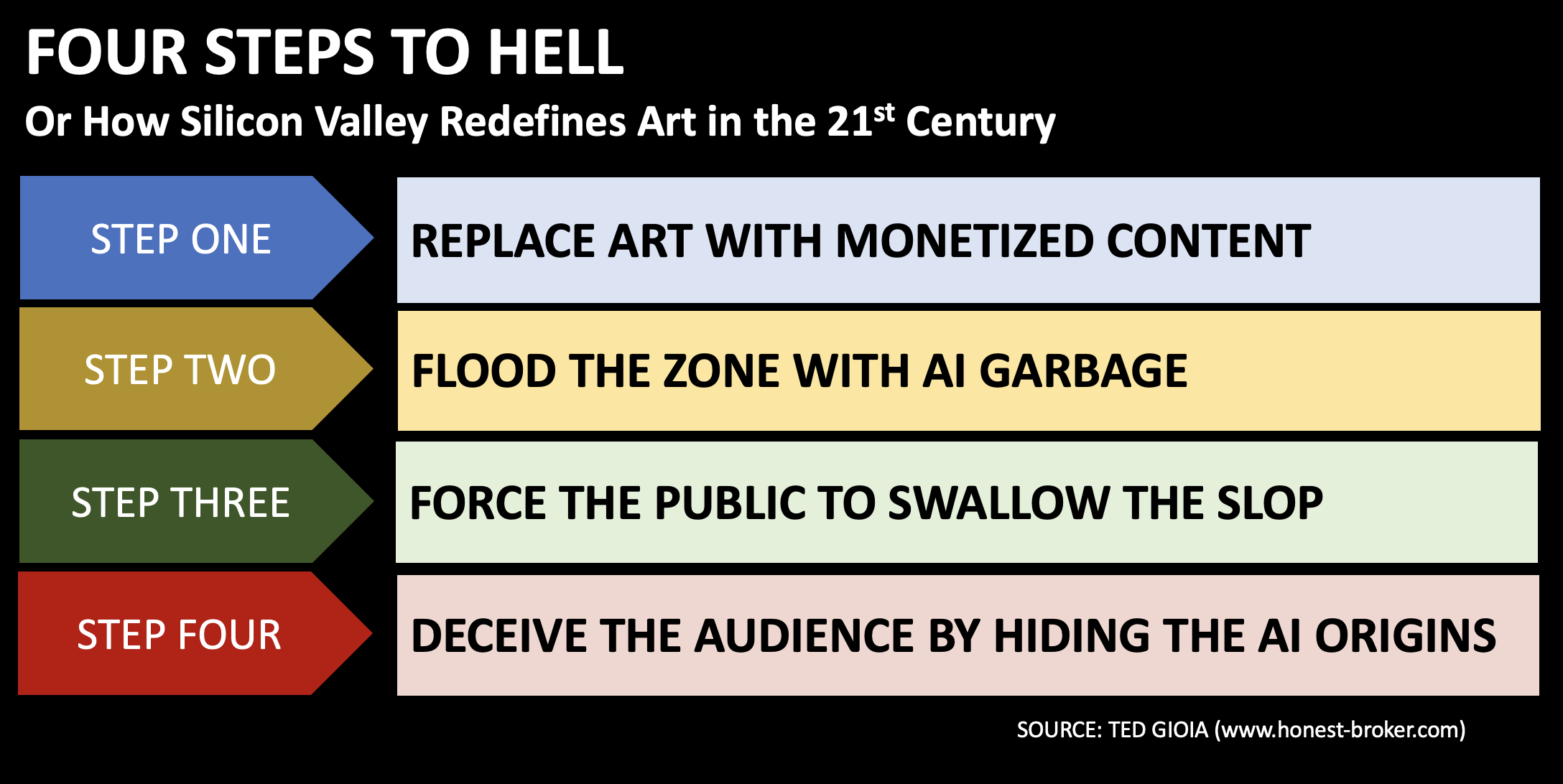
Ted Gioia says that he’s seeing strong indicators that the AI slop superabundance has helped create a widespread rejection of it and all its works:

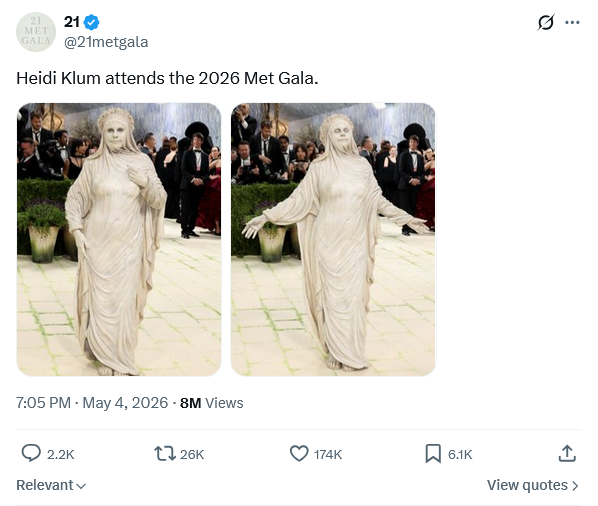
2025 has been the year of garbage culture.

Creators watch in horror as dismal AI slop threatens their livelihoods — and the integrity of their fields. It’s everywhere, spreading faster than a pharaoh’s plague.

In recent months, we’ve been bombarded with millions of lousy AI songs, idiotic AI videos, and clumsy AI images. Error-filled AI texts are everywhere — from your workplace memos to the books sold on Amazon.com.

Even my lowly vocation, music journalism, gets turned into a joke when it’s accompanied by slop images of fake events.

No, these things did not really happen.

But something has changed in the last few days.

The garbage hasn’t disappeared. It’s still everywhere, stinking up the joint.

But people are disgusted, and finally pushing back. And they are doing so with such fervor that even the biggest AI companies are now getting nervous and pulling back.

Just consider this surprising headline:

This was stunning news. YouTube is part of the biggest AI slop promoter of them all — namely the Google/Alphabet empire. How can they possibly abandon AI garbage? Their bosses are the biggest slopmasters of them all.

After this shocking news reverberated through the creative economy, YouTube started to backtrack. They said that they would not punish every AI video — some can still be monetized.

But even the revised guidelines are still a major blow to AI slop purveyors. YouTube made clear that “creators are required to disclose when their realistic content is altered or synthetic”. That’s a huge win—we finally have a requirement for disclosure, and it came straight from the dark planet Alphabet.

YouTube also stressed that it opposes “content that is mass-produced or repetitive, which is content viewers often consider spam”. This is just a step away from blocking slop.

Update, 22 July: Ted posted a follow-up with a bit more evidence that the pushback is working:

In my latest article I criticized Spotify for allowing uploads of unauthorized AI tracks to the profiles of dead musicians.

But the company may finally be listening to criticisms of its AI policies. In this case, Spotify has now taken steps to stop the abuses, and a spokesperson reached out to me today with an update and expressing a clear and proper policy on AI fraud.

I share it below (and have also updated my article):

    We’ve flagged the issue to SoundOn, the distributor of the content in question, and it has been removed. This violates Spotify’s deceptive content policies, which prohibit impersonation intended to mislead, such as replicating another creator’s name, image, or description, or posing as a person, brand, or organization in a deceptive manner. This is not allowed. We take action against licensors and distributors who fail to police for this kind of fraud and those who commit repeated or egregious violations can and have been permanently removed from Spotify.

They acted quickly, and I give them credit for that.

Update the second, 23 July: Ah, Spotify giveth and Spotify taketh away:

“Spotify is publishing new, AI-generated songs on the official pages of artists who died years ago without the permission of their estates or record labels,” reports 404 Media.

This scandal came to light because of an AI song attributed to Blaze Foley, who died in 1989. The bogus track is accompanied by an AI-generated image of a man who bears no resemblance to the singer.

What’s going on here? Is this just ignorance or carelessness at Spotify? Or does it represent something more sinister — another example of the company’s willingness to deceive users in the pursuit of profits?

These scams must stop. If Spotify doesn’t fix this mess immediately, courts should intervene.

But the dead musician scandal is just a start — because other bizarre things are happening at Spotify.

The whole situation is positively surreal.

July 15, 2025

QotD: Music on YouTube

Filed under: Media, Quotations, Technology — Tags: , , , , , , — Nicholas @ 01:00

High on my list of esoteric forgotten things that I still love is ’70s and ’80s electric jazz fusion and the more esoteric reaches of prog rock adjacent to it. Return To Forever, Brand X, Billy Cobham, Mahavishnu Orchestra, Weather Report, that sort of thing. Also its modern descendants like Planet X and Protocol.

I’ve spent years trying to encourage the YouTube algorithm to find me more stuff like this. Fairly successfully, until recently it seems all I can get is repeats of stuff I’ve already heard.

Could be the algorithm is stuck in a rut and underweighting novelty. Or it could be that YouTube’s coverage is inadequate. But this morning the truly horrifying possibility occurred to me. That YouTube’s coverage is complete, and …

Maybe … maybe I’ve heard it all.

ESR, Twitter, 2025-04-14.

July 5, 2025

“This is what happens when a major label morphs into a copyright and IP management business”

Filed under: Business, History, Media, USA — Tags: , , , — Nicholas @ 04:00

Ted Gioia reads the tea leaves of the big music labels and says that the future does not look good. At all:

I follow music industry news the way other people read obituaries.

Those two kinds of articles have a lot in common — both death notices and music biz news deal mostly with the past. The only new thing in the story is that something was living, and now it ain’t.

Here’s an example from yesterday:

This sounds like a happy story, no? These smart people are investing in music.

But it isn’t a happy story. They are investing in the rights to old music. They won’t spend any of that money on new music.

If you have any doubts about Warner’s priorities, here’s another headline — also from yesterday.

If you’re looking for a clear signal from a major record label, it won’t get any clearer than this.

This is exactly what a record label does when it no longer views music as a vital creative force in the current day. This is what happens when a major label morphs into a copyright and IP management business — which can be run by a small team of lawyers and accountants.

Yes, you can make money living off the past — but not for long.

I keep waiting to read a news story about a major label investing a billion dollars in developing new artists. But I never see that story.

I’ve written in the past about fans who prefer old music. But big record labels are even more obsessed with vintage and retro songs.

And it’s not just Warner Music. Universal Music is doing the same thing. So is Sony and Concord and other big labels.

That’s disturbing.

These are the same companies who should be creating the future of music. They should be convincing the public to listen to new songs and new artists. After all, if record labels don’t invest in the future of music, who will?

Maybe nobody.

A few years ago, investment firms started viewing old songs as investments. That didn’t work out very well. The most prominent song investment fund crashed and burned — as I predicted long in advance.

At that point, the smart money headed for the exits.

In the aftermath, the only enthusiastic buyers of old songs were the big record labels. They are the buyers of last resort.

July 1, 2025

The Maple Leaf Forever

Filed under: Cancon, History — Tags: , — Nicholas @ 02:00

Columbia Yore
Published 13 Jun 2018

The Maple Leaf Forever was written by Alexander Muir in 1867 and served as the unofficial anthem of Canada from 1867-1980.

June 25, 2025

Experts – “The shorter, the better”. Audiences – “Gimme more long-form, stat!”

Filed under: Books, Media — Tags: , , — Nicholas @ 03:00

At The Honest Broker, Ted Gioia notes that the experts are all-in on shorter videos, but actual audiences are clearly now more interested in much longer-form treatments:

When I saw the numbers, I couldn’t believe them.

Every digital platform is flooding the market with short videos, but the audience is now spending more time with longform video — and by a huge margin.

Source: Tubular Labs

Some video creators have already figured this out. That’s why the number of videos longer than 20 minutes uploaded on YouTube grew from 1.3 million to 8.5 million in just two years.

That’s a staggering six-fold increase. But even short videos are now getting longer. Social media consultants call this the “long short” format. Sometimes they are used as teasers to draw viewers to still longer media (often on another platform).

Movies are also getting longer. At first glance, that makes no sense — more people are watching films at home on small digital devices, where Hollywood fare has to compete with bite-sized junk from TikTok and Instagram.

You might think that filmmakers would feel forced to compress their storytelling, but the opposite is true. They are learning that audiences crave something longer and more immersive than a TikTok.

At first, Hollywood insiders tried to imitate the ultra-short aesthetic, but they failed — sometimes in colossal fashion. (Does anyone remember the Quibi fiasco?)

Now they not only embrace long films, but happily release sprawling mega-movies longer than the Boston Marathon. Dune Two ran for 166 minutes — not even Eliud Kipchoge does that. Oppenheimer clocked in at 180 minutes. Scorsese’s Killers of the Flower Moon lasted a mind-boggling 206 minutes.

The studios would have vetoed these excesses just a few years ago. Not anymore.

Songs are also getting longer. The top ten hits on Billboard actually increased twenty seconds in duration last year. Five top ten hits ran for more than five minutes.

Two of those long hit songs came from Taylor Swift — who has been a champion of longer immersive musical experiences, most notably in her insanely successful Eras tour. She set the record for the biggest money-generating roadshow in music history, and did it with a performance twice as long as a Mahler symphony.

These Swift concerts run for three-and-a-half hours (just like Scorsese at his most maniacal), and include more than 40 songs. They’re grouped in ten separate acts, each built around a different era in her career.

Ten acts? Really?

Even Wagner stopped short of that. But the Eras tour generated more than $2 billion in revenues. And all this happened while experts were touting 15-second songs on TikTok as the future of music.

I’ve charted the duration of Swift’s studio albums over the last two decades, and it tells the same story. She has gradually learned that her audience prefers longer musical experiences.

The New York Times complained about the length of her most recent album — calling it “sprawling and often self-indulgent.” It mocked her for believing that “more is more.”

It summed up her whole worldview with a dismissive claim that she has fallen in love with “abundance”. In fact, the Times opened its article with that accusation.

But I note that a year after the Times laughed at Swiftian abundance, the hottest topic in the culture is a book with that same word as its title. (Full disclosure: I’ll be doing a live Substack conversation with its co-author Derek Thompson in a few days.)

Abundance has dominated the New York Times non-fiction bestseller list for the last several months. Even more to the point, the word seems to tap into the public’s hunger for something bigger, deeper, and more expansive than it’s been getting.

June 23, 2025

80% of top-grossing movies are prequels, sequels, spin-offs, remakes or reboots

Filed under: Business, Media, USA — Tags: , , , , — Nicholas @ 05:00

Ted Gioia on the death of creativity in the movie business, which also seems to be tracking almost exactly with the trend in music business profits:

I’m not shocked when I look in the mirror. Yeah, the Honest Broker isn’t getting any younger. But that’s the human condition.

Maybe I should start using a moisturizer. What do y’all think?

Nah. I’ll just let this aging thing play out.

On the other hand, I’m dumbfounded at everything in public life getting older — even older than me! Consider the current political landscape.

With each passing year, the US Congress looks more like the College of Cardinals (average age =78) or the Rolling Stones (average age = also 78).

We’re gonna need a lot of moisturizer.

But Congress is young and spry compared to Hollywood.

Back in 2000, 80% of movie revenues came from original ideas. But this has now totally flip-flopped.

Today 80% of the movie business is built on old ideas — remakes, and spin-offs, and various other brand extensions. And we went from 80% new to 80% old in just a few years.

[…]

Look at music — and you see the same thing.

The share of old songs on streaming will soon reach 80%. It’s not quite there yet — the latest figures are 73%. But it was at 63% back in 2019. So it’s just a matter of time.

In 2000, streaming didn’t exist, so we looked to the Billboard chart to gauge a song’s success. And new music made up more than 80% of charted songs. So here — just like the movies — we’re flip-flopping from 80% new to 80% old over the course of a few years.

I don’t have good figures on publishing. But I’m pretty sure that AI-generated books and articles will soon represent 80% of the marketplace. Maybe we’ve already reached that threshold.

AI is deliberately designed to cut-and-paste, rehashing past work as its modus operandi. And it will do this to every field — replacing originality with repetition and regurgitation.

This is the new 80% rule.

Just imagine if traditional businesses operated this way.

  • “Welcome to our restaurant, 80% of the food is leftovers.”
  • “Welcome to our boutique, 80% of clothing is secondhand.”
  • “Welcome to our dating service, 80% of the choices are your ex-girlfriends (or ex-boyfriends).”

None of that sounds very appetizing.

May 23, 2025

Bill Bailey – The Doctor Who theme re-imagined as Belgian jazz

Filed under: Europe, Humour, Media — Tags: , , , , — Nicholas @ 02:00

Royal Ballet and Opera
Published 29 Jul 2021

Comedian Bill Bailey re-imagines the Doctor Who theme as Jacques Brel-esque Belgian jazz. Taken from his DVD Bill Bailey’s Remarkable Guide to the Orchestra.

May 19, 2025

1949: What are those kids listening to? – W2W 29

Filed under: History, Media, USA — Tags: , , , , , — Nicholas @ 04:00

TimeGhost History
Published 18 May 2025

There seems to be an evolution, that may one day become a revolution, in popular music in the US. Songs with amplified electric guitars, wailing saxophones, and backbeat rhythms are being released more and more often, but it’s not just R&B or jump blues, this is a bit of a different style — a new style. And it’s spreading quickly thanks to a vinyl record revolution that’s also getting in gear. Looks like exciting times ahead for the youth of America, and maybe even the whole world.
(more…)

May 8, 2025

Ted Gioia is apparently “the guy you consult about the total collapse of everything

Filed under: Books, History, Media, USA — Tags: , , , , , — Nicholas @ 03:00

I’ve been reading Ted Gioia‘s work for a few years now, but I somehow failed to pick up on the fact that he’s some kind of Bond supervillain:

Many articles have been written about me over the years. But I’ve never been hit with an opening sentence like the one published on Monday by The Atlantic.

    Last year, I visited the music historian Ted Gioia to talk about the death of civilization.

Whoa! That makes me feel like a Bond villain.

I need some henchmen — any volunteers?

Ted appears to like the classic goon uniforms for his to-be-recruited legion of minions.

What an unexpected turnabout! For many years, I was known as an expert on music, especially jazz and blues.

But now I’ve taken on a new guise. I’m the guy you consult about the total collapse of everything.

I don’t sing the blues. I don’t write about the blues. I now deliver the blues.

I originally declined the interview request from The Atlantic. But their staff writer Spencer Kornhaber pushed back, insisting that I was an essential source for his article.

The subject was, he explained, a “pervasive suspicion that we’re in an era of cultural decline, especially in arts and entertainment”.

He said that I needed to be part of the story — because everybody saw me as the decline-of-culture guy.

This caught me surprise. But I thought it over. maybe this is why I don’t get invited to many parties anymore.

Dammit, Ted, we’re trying to have some fun here — and you keep droning on about the collapse of the Roman empire.

I eventually agreed to a phone conversation with Spencer, and that went well. And this led to him getting on a plane, and visiting me at home here in Austin.

To help him in his research, I laid out more than 40 books on a countertop in my library — these were essential works, I explained, for anyone studying social or cultural decline.

[At a future date, I will provide more details about these books, and share a reading list on — to quote The Atlantic — the “death of civilization”.]

But this begs the question: Is our culture really collapsing?

I spoke with Spencer for many hours about this subject. But only a few of my comments found their way into the finished article.

So today I’ll offer a fuller diagnosis for your benefit.

May 1, 2025

QotD: The Eurovision Song Contest

Filed under: Europe, History, Media, Military, Quotations — Tags: , , , , — Nicholas @ 01:00

It was all more harmonious in the old days. One recalls the 1990 Eurovision finals in Zagreb, when the charming hostess, Helga Vlahović, presented her own fair country as the perfect Eurometaphor: “Yugoslavia is very much like an orchestra,” she cooed. “The string section and the wood section all sit together”. Alas, barely were the words out of her mouth before the wood section was torching the string section’s dressing rooms, and the hills were alive only with the ancient siren songs of ethnic cleansing and genital severing. Lurching into its final movement, Yugoslavia was no longer the orchestra, only the pits. In an almost too poignant career trajectory, the lovely Miss Vlahović was moved from music programming to Croatian TV’s head of war information programming.

The Eurovision Song Contest has never quite recovered, but oh, you should have seen it in its glory days, when the rich national cultures that gave the world Bach, Mozart, Vivaldi, Purcell, Debussy, and Grieg bandied together to bring us “La-La-La” (winner, 1968), “Boom-Bang-A-Bang” (1969), “Ding-Dinge-Dong” (1975), “A Ba Ni Bi” (1978), “Diggy Loo Diggi Ley” (1984), and my personal favorite, “Lat Det Swinge,” the 1985 winner by the Norwegian group Bobbysocks. The above songs are nominally sung in Spanish, Dutch, Swedish, and even English, but in fact it’s the universal language of Eurogroovy: “Ja, ja, boogie, baby, mit der rock ‘n’ roll”.

Mark Steyn, “Waterloo”, Steyn Online, 2020-05-17.

March 19, 2025

Solving the “Spotify problem”

Filed under: Business, Economics, Media, Technology — Tags: , , , — Nicholas @ 03:00

Sadly, as Tim Worstall explains, it probably can’t be done:

It’s that time of year for the ritual complaints about Spotify. Woes, musicians can’t get any money.

The reason for this is that we out here, the Great Unwashed, value recorded music at something just above toss. Therefore musicians get paid, on average, just above toss. And there we have it, there’s the whole and the complete of the thing.

    Spotify is trumpeting big paydays for artists – but only a tiny fraction of them are actually thriving

Yep.

    $10bn is a hefty number, but it needs to be closely examined. This money, around two-thirds of its total income, is what Spotify has paid through to record labels and music publishers. Spotify cannot be held responsible for egregious label and publisher contracts, but it needs reiterating that only a portion of that $10bn will make its way to the people who wrote and recorded the music.

    The company also says this $10bn is “more than any single retailer has ever paid in a year” and is “10x the contribution of the largest record store at the height of the CD era”. That may be true, but it says less about Spotify’s benevolence and more about how streaming’s market share has mostly consolidated into the hands of four global heavyweights – Spotify, Apple, YouTube and Amazon.

Only one part of that has any relevance. The $10 billion and the 2/3rds.

Obviously there are costs to running a company. To running the servers which hold near all of all recorded music. Of being able to get that out onto the internet.

The $10 billion (OK, 15) is about what people think music is worth to them.

[…]

The reason your really important socially relevant indie band is touring the upper peninsula, still after all these years, the bogs are your changing room and the only rider you’ve been able to achieve is access to tap water, is that the general public values your output at some fraction above toss. Therefore you earn that fraction above toss.

Really, that’s it. It’s not capitalism it’s general public indifference. Really, folk just don’t care.

« Newer PostsOlder Posts »

Powered by WordPress