
Quotulatiousness

February 10, 2026

Heightening tensions in the Indian Ocean

Filed under: Britain, China, Government, Military, USA — Tags: , , , , — Nicholas @ 04:00

On Substack, Fergus Mason updates us on what’s happening around the UK/US military base on Diego Garcia in the Chagos Islands in the Indian Ocean:

Diego Garcia

One of the great mysteries of Keir Starmer’s government is why he’s so determined to give the Chagos Islands to Mauritius, which is 1,200 miles away and has never owned them. Even now, as he desperately fights for his political survival, Starmer is pushing ahead with plans to give away the strategic archipelago then pay tens of billions of pounds to lease back one of the islands. It’s an odd thing to be so focused on — but whether his compulsion to surrender the islands is driven by corruption or naivete, it’s sending out signals of weakness. And those signals are being noticed.

The Maldives Makes A Grab

Last Thursday the Republic of Maldives announced that it had rejected the UN International Tribunal for the Law of the Sea’s ruling on its maritime boundaries, and sent an armed boat to carry out a “special surveillance operation” in the northern part of the Chagos island’s Exclusive Economic Zone (EEZ). The Chagos EEZ is claimed by Mauritius, but of course actually belongs to Britain until Starmer’s surrender deal is approved by Parliament. However, the Maldivian government has now decided to make its own claim on the area — and it’s very publicly doing something about it. The “coast guard vessel” CGS Dharumavantha — a former Turkish Navy fast attack craft — is now operating in the area, along with drones from the Maldives National Defence Force Air Corps.

Of course, the Maldives has no real claim to the Chagos islands or any part of their waters. The country — a tiny group of islands southwest of Sri Lanka, with a land area of just 115 square miles — was a British crown colony from 1796 to 1953, and a British protectorate until 1965. Like Mauritius, it has never owned the Chagos Islands. However, it’s just 300 miles away from them, much closer than Mauritius. It appears that its leader, President Mohamed Muizzi, has decided that if the key British territory is up for grabs the Maldives should be the ones to grab it. It’s true the Maldives doesn’t have much of a navy, but then Mauritius doesn’t have much of a navy either and is a lot further away. If the Maldives can seize control over part of the extremely valuable Chagos Marine Protected Area (MPA), and even possibly some of the northern islands, there isn’t a lot Mauritius can do about it.

Why would the Maldives be so keen to seize part of the Chagos EEZ? That one’s simple. Under British protection, the Chagos MPA (which is the largest marine nature reserve in the entire world) has been officially off limits to commercial fishing since 2010 but, in practice, has barely been fished at all since 1968. This makes it a unique and potentially lucrative resource in the Indian Ocean region, which has seen its ecosystems devastated by destructive fishing methods. The wealth of the MPA is the main reason Mauritius wants the Chagos islands. Its own coastal waters have been blighted by overfishing, including the destruction of coral reefs by explosives and bleach injection, and now it wants to plunder the MPA. The Maldives is also busily engaged in destroying its own fish stocks (fishing is the country’s largest industry and employs half the population) and is desperate for new waters to pillage. They don’t just want access for their own boats, either. Like Mauritius, the Maldives under Muizzi’s rule is an increasingly close ally of China.

The Scourge Of The Seas

China has the world’s largest fishing fleet, and it’s not even close. Over 44% of all commercial fishing is carried out by Chinese boats — and they’re notorious for flouting international law. Chinese boats regularly change their names and disable their satellite tracking systems to conceal their identity, then fish illegally in other countries’ waters. They violate quotas, catch protected species and strip whole swathes of ocean clean of any life much larger than plankton with massive, indiscriminate drift nets. Chinese fishing boats have also been implicated in people trafficking, drug smuggling and acting as spying and covert action platforms for the Chinese navy.

If either Mauritius or the Maldives gain control of the Chagos MPA it’s a certainty they will immediately give Chinese boats access, and this priceless nature reserve will rapidly be trawled and drift-netted into a barren, lifeless wasteland. From China’s point of view, of course, it doesn’t matter which of their lackeys takes over the Chagos islands as long as one of them does, so don’t expect them to step in to help Mauritius. They don’t care who they get the fishing rights from.

January 21, 2026

“It is a deal so bad that only Keir Starmer could have negotiated it”

In Spiked, Fraser Myers says that British Prime Minister Keir Starmer fully deserves to be humiliated over his give-it-all-away negotiations for the Chagos Islands, which includes the strategic naval base at Diego Garcia:

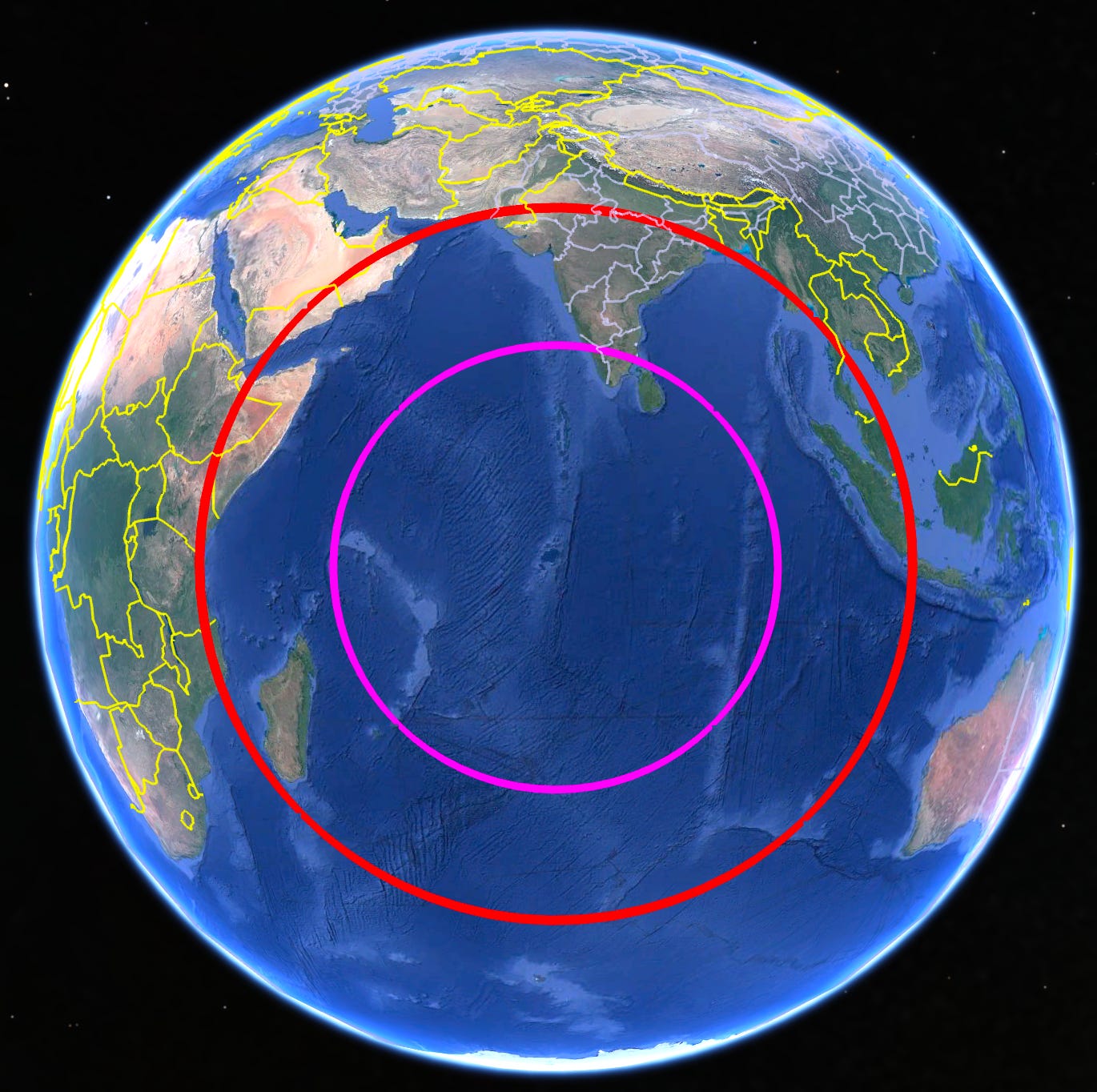
In the middle of that map is Diego Garcia, British Indian Ocean Territory and home to one of the most strategic airfields and anchorages on the planet. […] The red circle is 2,000 nautical miles from the island. The purple circle is 1,150 nautical miles, roughly the distance from London to Malta, that represents the distance from Diego Garcia. That circle is also the distance from Diego Garcia to the island of Mauritius.
Caption and image from CDR Salamander.

With the assistance of the brightest and best of the UK Foreign Office, the Labour government agreed to an arrangement that would hand over territory containing an Anglo-American military base to an unfriendly country, condemn its former inhabitants to permanent exile, and pay tens of billions of pounds for the pleasure.

I’m talking, of course, about Chagos (officially, the British Indian Ocean Territory), which has briefly caught the attention of the world’s most powerful man. This morning, amid a flurry of Truth Social posts about his designs on Greenland, US president Donald Trump’s gaze briefly alighted on this small, tropical archipelago on the other side of the planet. And he did not hold back in his criticism of Britain’s plans: “Shockingly, our ‘brilliant’ NATO Ally, the United Kingdom, is currently planning to give away the Island of Diego Garcia [the largest of the Chagos Islands], the site of a vital US Military Base, to Mauritius, and to do so FOR NO REASON WHATSOEVER”, he wrote. “The UK giving away extremely important land is an act of GREAT STUPIDITY”.

Trump’s reaction has widely been described as a major about-turn. But, in truth, his team has veered all over the place on the Chagos question. In October 2024, when Starmer initially agreed to hand over the islands, Marco Rubio, then still a US senator for Florida, reportedly warned that this would allow “Communist China” to spy on the US Navy, given Mauritius’s alliance with China. Yet in February 2025, when Starmer visited the Oval Office, the US president said he was “inclined to go along with” the UK’s proposals. And by May, when the deal was signed between the British and Mauritian governments, Rubio, by now US secretary of state, welcomed it. He claimed that Trump himself had “expressed his support for this monumental achievement”, hailing the deal that would cede sovereignty to Mauritius, while Diego Garcia would be leased to Britain for the next 99 years.

Of course, Trump’s motivation for bashing Starmer’s deal now has little to do with the Chagos Islands themselves. The real prize for the US president is in a different hemisphere entirely, as he freely admits. In a bizarre non-sequitur, the US president’s Truth Social post goes on to say that the Chagos deal is “another in a very long line of reasons why Greenland has to be acquired” by the US. This smackdown over Chagos, this attempt to humiliate Starmer and Britain on the global stage, is clearly part of Trump’s broader pressure campaign against the European powers, in his bid to seize Greenland for the US.

Nevertheless, it really should not have taken Trump’s intervention to put the brakes on the dreadful Chagos deal. Whichever way you spin it, this arrangement has never been in Britain’s national interest, nor the interests of the Chagossians who call the islands their home. It poses a risk to Western security interests, handing sovereignty over a territory, where almost 400 UK and US troops and 2,000 contractors are based, to a country that’s allied to China. The cost of leasing back Diego Garcia from Mauritius is also eye-watering. Although the Labour government tried to present the cost as just £3.4 billion, the true figure is believed to be 10 times as much, at around £34.7 billion.

So what on Earth possessed Starmer to sign up to such a risible deal? What leverage was a tiny island like Mauritius able to gain over Britain?

January 14, 2026

The Chagos Islands and the military base on Diego Garcia

The British government is engaged on a fantastic quest to subordinate the Chagos Islanders to a new foreign colonial government a thousand miles away who have never had any connection other than an earlier colonial convenience relationship. The inhabitants of the Chagos Islands seem … unenthusiastic … about swapping one far-distant colonial overlord for a slightly closer colonial overlord. In the “outside the paywall” section of this post, Nigel Biggar explains why he’s fighting against this transfer in the House of Lords:

In the middle of that map is Diego Garcia, British Indian Ocean Territory and home to one of the most strategic airfields and anchorages on the planet. […] The red circle is 2,000 nautical miles from the island. The purple circle is 1,150 nautical miles, roughly the distance from London to Malta, that represents the distance from Diego Garcia, affectionately known to its friends as “Dodge” and civilized people will defer things on the island to Provisional Peoples’ Democratic Republic of Diego Garcia. That circle is also the distance from Diego Garcia to the island of Mauritius.
Caption and image from CDR Salamander.

I arrived home late last Monday night, having spent the second half of the day in the House of Lords attending the Report stage of the bill to ratify the treaty whereby the UK surrenders to Mauritius sovereignty over the Chagos Islands — including the military base on Diego Garcia — in return for a ninety-nine-year lease.

For readers who missed — or have forgotten — my post on this topic on August 6th, let me rehearse my view. Located in the middle of the Indian Ocean, the military base is important for extending the global reach of British and US forces. At first glance, exchanging sovereignty for a lease looks like a very poor deal, making possession of the strategic base less secure at a time of growing international tensions.

So why has Keir Starmer’s government signed up to a treaty that does just that?

The treaty presents itself upfront as correcting the injustice done when 1,700 Chagossians were forced to leave their homes on Diego Garcia between 1967 and 1973, to make way for the military base. In the preamble, the two governments “recognis[e] the wrongs of the past” and declare themselves “committed to supporting the welfare of all Chagossians”. Yet the process that produced the treaty does not bear this out. The Chagossians themselves were barely consulted, probably because it is known that many strongly resist subjection to Mauritian rule.

Diego Garcia

Moreover, the treaty binds the Mauritian government to do little for them. Oddly, Article 6 declares that Mauritius is “free” to implement a programme of resettlement. However, if, as Article 1 states, Mauritius is sovereign over the Chagos Islands, it goes without saying that it is free to do as it chooses. It does not need stating. So, the effect of stating it is to highlight the fact that Mauritius has refused any obligation to resettle the islanders.

Article 11 commits the UK to provide capital of £40 million to create a trust fund for the islanders, but it leaves the Mauritian government entirely at liberty to choose how to use it. Yet, when it received £650,000 (equivalent to £7.7 million today) from the UK to compensate displaced islanders in 1972, it withheld the money for six years in punitive retaliation for Chagossian protests. And, again, nine years after it was given £40 million in 2016, to improve Chagossian welfare, it has only disbursed £1.3 million under restrictive conditions.

The treaty’s main concern lies elsewhere. As the preamble also says, it is “mindful of the need to complete the process of the decolonisation” of Mauritius. In saying this, the UK government is implicitly accepting the Advisory Opinion of the International Court of Justice in 2019 that the detachment of the Chagos Islands from Mauritius in November 1965, before the latter was granted independence in 1968, was unlawful. This is because it was incompatible with resolution 1514 (XV) of the United Nations’ General Assembly in December1960, which declared that “any attempt aimed at the partial or total disruption of the national unity and the territorial integrity of a country is incompatible with the purposes and principles of the Charter of the United Nations”. Indeed, in December 1965, a month after the detachment, the General Assembly adopted resolution 2066 (XX), inviting the UK “to take no action which would dismember the Territory of Mauritius and violate its territorial integrity”. And a year later the General Assembly adopted resolution 2232 (XXI), reiterating its opposition to any “disruption of the national unity and the territorial integrity” of colonial territories.

None of these resolutions makes good sense. The original, 1960 one was championed by the Irish ambassador to the UN, Frederick Boland, who was then President of the General Assembly. In promoting resolution 1514 (XV), he invoked Ireland’s loss of its “historic integrity” as a prime example of the injustice to be avoided. In so doing, he expressed the Irish nationalist’s typical historical blindness. The island of Ireland had never been a political unit apart from its union with Great Britain, and there is no natural law prescribing that a geographical integrity should be a political integrity. On the contrary, there can be very good reasons for dividing it. The reason that Ireland was divided in 1922 was because republican Irish people wanted home rule so much that they were prepared to take up arms to acquire it, while unionist Irish people detested it so much that they were prepared to take up arms to oppose it. Ireland was partitioned to prevent further civil war—a justified act of political prudence.

The 1965 and 1966 resolutions are no more sensible. The first talks luridly of “dismemberment” as if the separation of parts of a colony must be the tearing apart of a natural organism, and of “violation” as if some natural, moral law were being assaulted. But there is nothing natural about a political entity and there is no moral law against partition as such.

The 1966 resolution appeals to the “national unity” of Mauritius, as if the Chagos Islands weren’t separated by over a thousand miles of Indian Ocean and as if the islanders were an integral part of the Mauritian people. But many Chagossians feel as Mauritian as Irish republicans feel British. The only connection between Mauritius and the Chagos Islands is an accident of colonial, administrative convenience. Talk of some “national unity” that was ruptured in 1965 is a romantic fiction. Besides, in 1965 the Mauritians agreed to the separation in return for £3 million (worth £74 million today) and the reversion of the islands when no longer needed for defence purposes.

Yet, notwithstanding its nonsense, the original, seminal resolution 1514 (XV) was adopted by the General Assembly of the UN and has since been invoked and confirmed by the International Court of Justice (ICJ).

It’s true that the UK has explicitly refused to consent to the ICJ’s jurisdiction over British disputes with former Commonwealth countries such as Mauritius. However, in its 2019 Advisory Opinion, the court positioned itself formally, not as adjudicating between two sovereign states’ conflicting claims, but as responding to a question from the UN’s General Assembly as to whether the UK had violated international law on the decolonisation of Mauritius in the 1960s. Notwithstanding the fact that that is a crucial point of current contention between the two countries, the ICJ presumed to find in Mauritius’ favour. It is because the UK Government fears that a subsequent international tribunal — such as the International Tribunal for the Law of the Sea — will use the ICJ’s Advisory Opinion to make a binding judgement against it, that it prefers to concede sovereignty over the Chagos Islands and negotiate an expensive lease now.

But there is more to the Government’s motivation than fear. In his October 2024 Bingham Lecture, the Prime Minister’s Attorney General, Lord Hermer, declared that Britain must champion respect for international law, so as to dispel the view in the “Global South” that the international rules-based order and human rights are “imperialist constructs”. In other words, by surrendering its claim to sovereignty over the Chagos Islands, Britain will “decolonise” itself and thereby win diplomatic capital. As the Labour peer, Lord Boateng, opined: “We can welcome this treaty as an end to a period of colonial rule”. This is what lies behind that other statement in the preamble to the treaty: that the parties desire “to build a close and enduring bilateral partnership based on mutual respect and trust”.

October 8, 2024

Hats off to the brilliant negotiators of the Mauritian government

Filed under: Britain, Government, Military, USA — Tags: , , , , , — Nicholas @ 05:00

At The Critic, Yuan Yi Zhu salutes the negotiators who managed to get an amazing deal from the British government for the Chagos Islands (which contain the strategic US naval base of Diego Garcia):

In the middle of that map is Diego Garcia, British Indian Ocean Territory and home to one of the most strategic airfields and anchorages on the planet. […] The red circle is 2,000 nautical miles from the island. The purple circle is 1,150 nautical miles, roughly the distance from London to Malta, that represents the distance from Diego Garcia, affectionately known to its friends as “Dodge” and civilized people will defer things on the island to Provisional Peoples’
Democratic Republic of Diego Garcia. That circle is also the distance from Diego Garcia to the island of Mauritius.
Caption and image from CDR Salamander.

Donald Trump likes to brag about his prowess as a negotiator, but he has nothing on the government of Mauritius, which pulled one of history’s great diplomatic heists yesterday, when it announced that the British government had agreed to give it the Chagos Islands, which have been sovereign British territory without interruption since 1814.

To add insult to injury, not only will Mauritius gain a new colony, but it will collect large rents from the Americans for the military base on Diego Garcia, while the British government will pay hefty financial support to Mauritius (Africa’s third richest country on a per capita basis) for the honour of handing over to Mauritius one of the world’s most strategically valuable territories.

In other words, not only is Mauritius having its cake and eating it too, it has also extracted from the British taxpayer a new cake, to be savoured while it smugly lectures the world about the importance of decolonisation.

Never mind that Mauritius sold the Chagos Islands to the United Kingdom in 1965 for the-then astronomical sum of £3 million and a valuable British security guarantee. Its prime minister had described the islands as “a portion of our territory of which very few people knew … which is very far from here, and which we had never visited”, so it was no big loss.

In the 1980s, a new government changed its mind and decided to get the islands back. It alleged the British had threatened to withhold independence from Mauritius unless it agreed to sell the territory. The small problem was that every single surviving Mauritian negotiator cheerfully admitted that they didn’t care about the Chagos, whose inhabitants they regarded as half-civilised savages.

And the blackmail thesis suffered from the fact that Britain in the 1960s could not get rid of its remaining colonies fast enough — Mauritius had to wait a few more years for independence because part of its population wanted it to remain a British territory.

Mauritius then decided to wave the bloody shirt of the Chagossians, who had been callously expelled by the British to make way for the air base and dumped on Mauritius. The fact that the Mauritian treated them terribly — so terribly, in fact, that thousands of them left for the UK, the country which had deported them in the first place — was but a minor detail.

In 2019, Mauritius managed to get the International Court of Justice to say that the islands should be given to Mauritius. The ruling was not even legally binding, but Mauritius was somehow able to convince gullible Whitehall functionaries that Britain had no choice but to give the islands to Mauritius.

So far as I am aware, there is no truth to the rumour that Spain and Argentina are in negotiation with Mauritius to take over their respective territorial claims on Gibraltar and the Falkland Islands.

Powered by WordPress

