Quotulatiousness

May 16, 2012

Nanny knows best, part MCMLXII

Filed under: Books, Britain, Food, Health, Politics — Tags: , , — Nicholas @ 08:46

Chris Snowdon at the Adam Smith Institute blog:

When we scheduled the release of The Wages of Sin Taxes for 15th May, we did not guess that it would be sandwiched between the announcement of a 50p minimum price for alcohol in Scotland (Monday) and a new campaign for sin taxes on food and soft drinks (today). Writing in the British Medical Journal, two academics have just called for price hikes on sugar-sweetened beverages and ‘junk food’ as a way of dealing with Britain’s alleged obesity epidemic.

Obesity rates, like drinking rates, have not actually risen for ten years, but the same decade saw the medical profession gain an uncanny grip on the nation’s political process and they are in no mood to relinquish it. Taking a break from hassling smokers and drinkers, the mandarins of public health have taken the ‘next logical step’ and moved on to the general population.

“Economists generally agree,” they write, “that government intervention, including taxation, is justified when the market fails to provide the optimum amount of a good for society’s wellbeing.” Even if this dubious statement were true, there has never been a time when the market offered more choice in what we eat than drink than today. And, contrary to popular belief, it is much cheaper for a family to subsist on fresh fruit and vegetables than it is to eat out at McDonalds three times a day. For the spokespeople of public health, the problem is not that there is a lack of options, but that we plebs are not choosing the right ones.

Defining junk food is notoriously difficult. As Rob Lyons explains in his excellent book Panic on a Plate, a portion of McDonalds fries contains a quarter of an adult’s recommended intake of Vitamin C, while middle class favourites like olive oil, parmesan and pasta are rather fattening. A tax on “sugar sweetened beverages” will presumably leave apple juice and smoothies untouched, despite the fact that fruit juices are often sweeter and more calorific than Coca-Cola.

May 14, 2012

Scottish minimum alcohol pricing: “Health fascism is back with a vengeance”

Filed under: Britain, Bureaucracy, Government, Health, Liberty — Tags: , , , , — Nicholas @ 09:30

A released statement from Sam Bowman, Head of Research at the Adam Smith Institute, responding to Scotland’s minimum alcohol price decision:

“Minimum alcohol pricing is a miserable, Victorian-era measure that explicitly targets the poor and the frugal, leaving the more expensive drinks of the middle classes untouched. It’s regressive and paternalistic, treating people as if they’re children to be nannied by the government.

“To make things worse, all signs suggest that the minimum price will be successively raised once it’s in place. This is what happened in the UK with alcohol and tobacco taxes, which are now among the highest in the world. It’s like boiling a frog – bring in a low minimum price that only affects the most marginalized part of society, the poor, and raise it gradually every year without people noticing.

“The reality is that Britain does not have a drink problem. The definition of “binge drinking” has been redefined so that a grown man drinking more than two pints of lager is considered to be “binging”. The number of diseases defined as “alcohol-related” has tripled in the last twenty-five years. In fact, we drink less than we did ten years ago, less than we did one hundred years ago, and far less than we did in the 19th Century. Hysteria about drinking alcohol is a red herring invented by the health lobby. Health fascism is back with a vengeance, and minimum alcohol pricing is just another brick in the wall.”

May 9, 2012

Bishop Hill outlines the Yamal deception

Filed under: Environment, Media, Science — Tags: , , — Nicholas @ 08:22

At the Bishop Hill blog, the twisty-turny story of the bristlecone pine temperature reconstruction effort:

The story of Michael Mann’s Hockey Stick reconstruction, its statistical bias and the influence of the bristlecone pines is well known. Steve McIntyre’s research into the other reconstructions of the temperatures of the last millennium has received less publicity, however. The story of the Yamal chronology may change that.

The bristlecone pines that created the shape of the Hockey Stick graph are used in nearly every millennial temperature reconstruction around today, but there are also a handful of other tree ring series that are nearly as common and just as influential on the results. Back at the start of McIntyre’s research into the area of paleoclimate, one of the most significant of these was called Polar Urals, a chronology first published by Keith Briffa of the Climate Research Unit (CRU) at the University of East Anglia. At the time, it was used in pretty much every temperature reconstruction around. In his paper, Briffa made the startling claim that the coldest year of the millennium was AD 1032, a statement that, if true, would have completely overturned the idea of the Medieval Warm Period. It is not hard to see why paleoclimatologists found the series so alluring.

Yamal saves the day

Some of McIntyre’s research into Polar Urals deserves a story in its own right, but it is one that will have to wait for another day. We can pick up the narrative again in 2005, when McIntyre discovered that an update to the Polar Urals series had been collected in 1999. Through a contact he was able to obtain a copy of the revised series. Remarkably, in the update the eleventh century appeared to be much warmer than in the original — in fact it was higher even than the twentieth century. This must have been a severe blow to paleoclimatologists, a supposition that is borne out by what happened next, or rather what didn’t: the update to the Polar Urals was not published, it was not archived and it was almost never seen again.

With Polar Urals now unusable, paleclimatologists had a pressing need for a hockey stick shaped replacement and a solution appeared in the nick of time in the shape of a series from the nearby location of Yamal.

May 4, 2012

A skeptical review of Get Real

Filed under: Books, Environment, Media, Politics, Science — Tags: , , , , — Nicholas @ 08:14

Tim Black reviews the new book Get Real: How to Tell it Like it is in a World of Illusions by Eliane Glaser, calling it “enjoyably hyperactive”, but also pointing out some quite glaring flaws:

Politicians marshalling an army of PR consultants to appear authentic. Multinational companies selling products with folksy, homespun brands. Public inquiries that have nothing to do with the public. The paradoxes proliferate in journalist and academic Eliane Glaser’s enjoyably hyperactive new book, Get Real: How to Tell it Like it is in a World of Illusions. Her ambition is overarching: she wants to show us the way to the truth of the matter. She wants to cut through the crap. She wants us to follow the royal road of social critique. In short, she wants us to see things for what they are. (A bit rubbish, as it turns out.)

[. . .]

Glaser is even better when it comes to ‘scientism’. Awe-struck deference is everywhere, she argues, from Brian Cox’s television series Wonders of the Universe to the World of Wonders science museum in California. ‘Scientific wonder carries with it a sense of humility, which is ostensibly about meekness in the face of extraordinary facts’, she writes. ‘But it blurs into deference towards scientists, with their privileged access to those facts.’ Indeed, anything that Stephen Hawking says, be it about the existence of God or the plight of the planet, is treated as if it comes straight from the oracle’s mouth. ‘In modern culture, scientism is the new religion. God knows what happened to scepticism.’

This conflation of fact with value, this belief that science, having seemingly supplanted moral and political reasoning, can tell us what to do, is highly damaging, Glaser argues. Political decisions, necessitated by science, become a fait accompli. So when, in 2009, US President Barack Obama lifted the ban on federal funding for stem-cell research, he felt no need to make a moral, political case for the decision: ‘The promise that stem cells hold does not come from any particular ideology; it is the judgement of science.’ This is not to say that stem-cell research is a bad thing; rather, it is to say that a politician needs to make the case for it being a good thing.

Yet while there is plenty of critique in Get Real, there is plenty that is unquestioned, too. So no sooner has Glaser put scientism on the rack than, a few pages on, she’s espousing its most prominent manifestation: environmentalism. The chapter even begins with some all-too-persuasive facts from the mouths of Those To Whom We Must Defer: ‘Climate scientists generally agree that the safe limit for the concentration of carbon dioxide in the atmosphere is 350 parts per million (ppm). As I write this, we’re already at 390ppm.’ She soon proceeds to read off a number of Malthus-heavy assertions passed off as fact: ‘Global warming, population explosion, peak oil, biodiversity in freefall: Planet Earth is facing unprecedented and multiple crises. It is little wonder, therefore, that as the situation becomes more desperate, self-deception becomes more attractive. If the world is turning into a desert, it’s tempting to put your head in the sand.’

It’s a bizarre reversal. Having eviscerated the deference towards science in one section, in another she proceeds to lambast those who resist the science for their ‘denialism’. It does not seem to occur to Glaser that a principal reason for opposing the environmental orthodoxy is that it attempts to pass off a moral and political argument about how we should live our lives — low-consumption, little procreation and an acceptance of economic stagnation — as a scientific necessity. Could there be a more flagrant form of the scientism that Glaser so eloquently takes to task elsewhere?

April 23, 2012

Autism

Filed under: Health, Science — Tags: , , — Nicholas @ 08:41

Sandy Starr refutes the notion that “we are all on the autism spectrum now”:

Is autism a disorder? Is autism an identity? If you had asked me these questions a few years ago, before I became involved with the Autism Ethics Group at King’s College London, then my answer would have been a clear ‘yes’ and ‘no’ respectively. Clearly, autism is most usefully understood as a disorder. And clearly, it is not useful to understand autism as an identity.

If you were to ask me the same two questions today, then I would say exactly the same thing.
[. . .]

The whole concept of autism originates in psychopathology. Hans Asperger (after whom Asperger’s syndrome is named) talked about ‘autistic psychopathy’. Autism is found in the Diagnostic and Statistical Manual of Mental Disorders (DSM). And yet we now seem uneasy about the characterisation of autism as a disorder. Why?

For one thing, a disorder implies a lack of normal or typical function. The increasing numbers of people who are thought to warrant a diagnosis of either ‘classical’ autism, atypical autism or Asperger’s syndrome is now of a scale sufficient to make one ask whether autism is, in fact, exceptional. Only last month, there were newspaper headlines about the fact that about one per cent of schoolchildren in the UK are now recorded as having some kind of autistic spectrum disorder (double the figure from only five years previously). This was followed by the news that according to a new study by the Centres for Disease Control and Prevention, one in 88 children in the USA now have an autistic spectrum disorder (again, almost double the figure from five years previously).

We can speculate about the reasons for this recent upsurge, but, in order to understand it, I think it’s necessary to go back a little further and look at the broadening of autism through the concept of the ‘autism spectrum’, which is what has made it possible for autism to encompass high-functioning individuals such as myself. I think the potential for an unimpeded expansion of the category of autism, of the sort we are now seeing, may have already been there when autism was first conceptualised in the 1940s. It was certainly there once the notion of the ‘spectrum’ was introduced into psychiatry at the end of the 1960s.

I would argue that the category of autism has become less coherent, and consequently less meaningful and less useful, as a result of its expansion. And I think the osmosis into informal discourse and the pop culture of clinical terminology about autism has further undermined the category’s coherence. This has led to a situation where the ‘spectrum’ — once a categorical means of bringing together low- and high-functioning individuals who (arguably) have some features in common — is now routinely used to mean an uninterrupted continuum, ranging all the way from the pathological to the normal.

April 22, 2012

Earth Day: 42 years of crying “wolf”

Peter Foster piles on the scorn for the 42nd anniversary of Earth Day:

For more than 40 years, Earth Day has both reflected genuine environmental concern and mirrored the UN’s attempted eco power grab. Sunday’s Earth Day comes two months ahead of the vast, but significantly brief, UN Rio+20 conference. Both are pale reflections of their original radical aspirations. Earth Day is still celebrated, but 42 years of crying wolf have inevitably had an effect. The event has also been corporatized, greenwashed and taken over by such announcements as that of the “50 sexiest environmentalists.” Rio+20 will represent the graveyard of aspirations for all prospective — and inevitably less sexy — Captains of Spaceship Earth, Global Saviours, and High Priests of Gaia.

That Earth Day has gone Happy Face, and Rio+20 will be a farce, reflects the fact that their apocalyptic assumptions have turned out to be so wrong. In Canada, as in other developed countries, we can celebrate significant improvements in air quality, and success in coping with industrial impacts on water. The Great Lakes have been cleaned up, forest cover has been maintained, and the amount of “protected” land doubled. The use of toxic chemicals in industrial production has been slashed. Some credit must obviously go to activism, but the more radical end of the movement has always had a lot more than just the environment in mind.

[. . .]

That misunderstandings and misrepresentations were at the root of radical environmental thinking was exemplifed by an “equation-of-doom” hatched in the 1970s by two prominent radicals, Paul Ehrlich and John Holdren (President Obama’s current senior science and technology advisor). The equation was I=P x A x T: Human Impact (I) equals Population (P) times Affluence (A) times Technology (T). The formula was vague, but it clearly suggested that population, wealth and technology were all “bad” for Mother Earth.

Such thinking was based on a primitive, static, zero-sum view of economic development and a demonization of business. Since resources were “finite,” all development was claimed by definition to be “unsustainable.” Advancing technology merely chewed up resources faster and accelerated us down the road to exhaustion. All this came with biblical overtones. On the first Earth Day, Prof. Ehrlich thundered that “In ten years all important animal life in the sea will be extinct. Large areas of coastline will have to be evacuated because of the stench of dead fish.”

April 15, 2012

Implying a link between Walmart stores and hate groups

Filed under: Business, Politics, USA — Tags: , , — Nicholas @ 11:53

This is custom-made for drawing lazy conclusions:

Study Says The More Walmarts In The Area, The More Hate Groups There Are

This one’s sure to boil some blood over at Walmart headquarters: A new study says there’s a significant correlation between the amount of Walmart stores in an area and the number of hate groups existing in that same area. As the big-box stores proliferate, so do the groups.

LiveScience.com cites the study by professors at Penn State University, New Mexico State University and Michigan State University, which says that the amount of Wal-Mart stores in a county was more statistically significant than other factors usually associated with hate group participation. For example, the unemployment rate, high crime rates and low education.

As I’m just as lazy as the others who’ll jump on that eye-catching headline, here’s another lazy conclusion: because Walmart locates their stores in areas with growing population, so Walmart stores will also correlate with any number of other phenomena that require a minimum (but increasing) population.

April 12, 2012

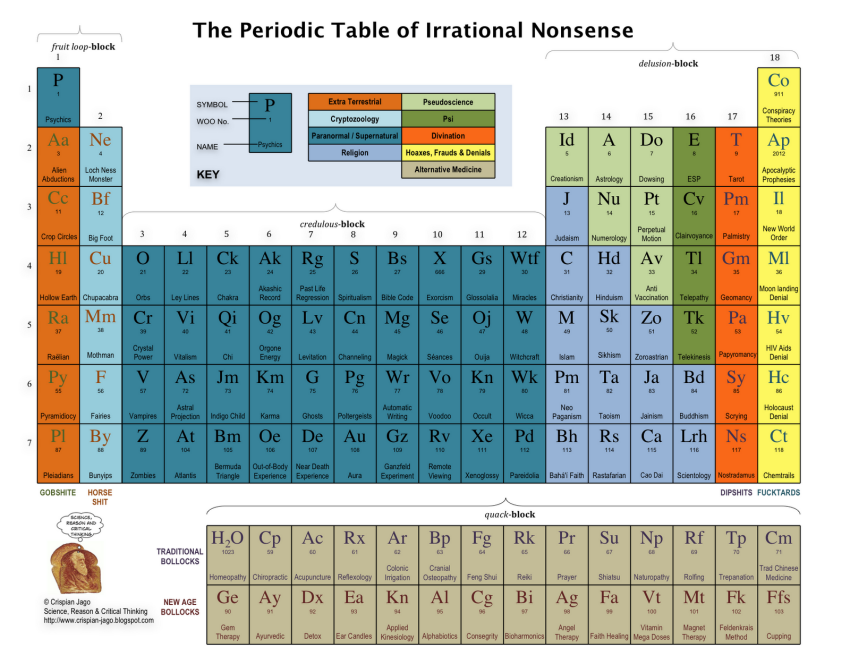
Crispian Jago’s Periodic Table of Irrational Nonsense

Filed under: Humour, Science — Tags: , — Nicholas @ 00:09


Click to see full size image at http://www.crispian.net/page2/page2.html

April 10, 2012

The 7 rules of bureaucracy

Filed under: Bureaucracy, Economics, Government, History — Tags: , , , — Nicholas @ 08:27

A long post by Loyd S. Pettegrew and Carol A. Vance at the LvMI blog explains the seven rules (and many sub-rules) of modern bureaucracy:

In order to understand the foundation of America’s morass, we must examine bureaucracy. At the root of this growing evil is the very nature of bureaucracy, especially political bureaucracy. French economist Frédéric Bastiat offered an early warning in 1850 that laws, institutions, and acts — the stuff of political bureaucracy — produce economic effects that can be seen immediately, but that other, unforeseen effects happen much later. He claimed that bad economists look only at the immediate, seeable effects and ignore effects that come later, while good economists are able to look at the immediate effects and foresee effects, both good and bad, that come later.

Both the seen and the unseen have become a necessary condition of modern bureaucracy. Max Weber, considered the father of modern bureaucracy largely in response to the Industrial Revolution, is credited with formalizing the elements of bureaucracy as a fundamental principle of organization. He was also painfully aware of the arbitrariness of bureaucratic decision processes.

[. . .]

One of the truisms of bureaucracies, be they government or private sector, is that if left to their own devices, they will grow bigger, bolder, and less manageable over time. Teasley has seen this happen over and over again and put his considerable intellect to how its apparatus works. John Baden has offered us one of the most promising, yet ignored, solutions to the bureaucratic leviathan. Baden (1993) puts the problem at the feet of politicians concentrating benefits and dispersing costs and believes “predatory bureaucracies” would allow bureaucracies to feed on themselves with the most effective and efficient bureaucracy taking money and responsibility away from those that are less efficient and effective. While a provocative theory, the problem lies in the very rules that underpin bureaucracies. Despite the concept being nearly 20 years old, it has not been attempted, let alone enacted in any meaningful or widespread way.

[. . .]

Rule #1: Maintain the problem at all costs! The problem is the basis of power, perks, privileges, and security. [. . .]

Rule #2: Use crisis and perceived crisis to increase your power and control. [. . .]

Rule 2a: Force 11th-hour decisions, threaten the loss of options and opportunities, and limit the opposition’s opportunity to review and critique. [. . .]

Rule #3: If there are not enough crises, manufacture them, even from nature, where none exist.

Bureaucracies are always on the lookout for a new crisis. In his “Guiding Principles of Politicians, Bureaucrats, and Bureaucracies,” Harry Teasley points to three examples:

  1. The Gulf of Tonkin incident, where an alleged attack took place on two US naval destroyers by a North Vietnamese torpedo boat, allowing President Johnson to deploy conventional military forces to Vietnam without congressional approval.
  2. The attribution of weapons of mass destruction (WMDs) to Saddam Hussein permitted President George Bush to invade Iraq (again, without the need of congressional approval), after which no WMDs were found.
  3. Man-made global warming. The first two resulted in loss of life and a terrible toll of people maimed and injured. We are still in the throes of discovering the effects of the third crisis.

[. . .]

Rule #4: Control the flow and release of information while feigning openness. [. . .]

Rule 4a: Deny, delay, obfuscate, spin, and lie. [. . .]

Rule #5: Maximize public-relations exposure by creating a cover story that appeals to the universal need to help people. [. . .]

Rule #6: Create vested support groups by distributing concentrated benefits and/or entitlements to these special interests, while distributing the costs broadly to one’s political opponents. [. . .]

Rule #7: Demonize the truth tellers who have the temerity to say, “The emperor has no clothes.” [. . .]

Rule 7a: Accuse the truth teller of one’s own defects, deficiencies, crimes, and misdemeanors. [. . .]

March 31, 2012

Warning: Despite a total lack of evidence, we still want video game “violence” warning stickers

Filed under: Gaming, Government, Liberty, Media, Technology — Tags: , , , — Nicholas @ 00:14

Erik Kain in Forbes on the latest attempt to put scare warnings on pretty much all video games sold in stores:

“WARNING: Exposure to violent video games has been linked to aggressive behavior.”

That’s the label Reps. Joe Baca and Frank Wolf want to place on every video game that hits store shelves.

Well okay, not every video game. Just every game with an E (Everyone) rating or higher. Only EC (Early Childhood) games would avoid the label. Every other game, regardless of content, would have the equivalent of cigarette warnings slapped on them.

This means that games like Tiger Woods PGA Tour would get a violence-warning label.

Can I humbly suggest that we sponsor a bill that would slap warning labels on all our elected officials?

“WARNING: May enact pointless, freedom-quashing laws based on bad data and lies due to sanctimonious pandering to special interest groups.”

The EFF is on the case.

EFF has put together an action alert that lets you to tell your Congressmember that you stand against the unnecessary and burdensome regulation of speech in video games, and that she should too.

Even though it is not required by law, many video game developers have been self-regulating games for age-level and content with Entertainment Software Ratings Board (ESRB) ratings since 1994. That system is widely understood in the marketplace, and allows consumers and parents to make informed decisions about their video game purchases.

March 22, 2012

Trends in education: “We are cultivating vulnerability in the classroom”

Filed under: Britain, Bureaucracy, Education — Tags: , , — Nicholas @ 10:16

As a follow-up to yesterday’s post on teachers discouraging students from having best friends, here is an article in the Independent by Amol Rajan on the same topic:

Some people argue this is all part of the feminisation of schooling. A reduction in the number of male teachers, as a proportion of the overall teaching population, has led to a greater emphasis on emotions and feelings in the classroom. I think this analysis is patronising, rude to women, and intellectually limited.

What we do know is that over the past few decades, there has been a gradual voiding of knowledge from our schools. Academic education has been systematically attacked, and while proper schooling — in the traditional sense of passing bodies of knowledge down the generations — has been preserved for the rich, what the poor have been given instead of schooling is skilling. The rise of vocational education and the rise of emotional literacy in the classroom are both a consequence of the flight from academic education.

But there is something more fundamental going on too, which Professor Frank Furedi, pictured, described in Paranoid Parenting more than a decade ago. We are cultivating vulnerability in the classroom, just like we’ve long cultivated it in the playground. “The teaching profession is being reformed as a therapeutic profession,” Dr Hayes, a close associate of Furedi’s, writes, “often prioritising the delivery of therapy over education to ‘vulnerable’ children and young people.”

The emotional policing of school children, including various bans on best friends, is designed to protect them from each other. Its main effect may ultimately be to stop them from protecting themselves.

March 21, 2012

Converting teachers into pre-grief counsellors

Filed under: Britain, Education, Health, Randomness — Tags: , , , , — Nicholas @ 08:51

Dennis Hayes on the recent trend in teaching: preventing children from having “best friends” because the emotional pain of losing a best friend is too much for kids to bear.

In some English schools, having best friends can now get you in serious trouble with teacher. At the weekend, it was reported that primary school children in certain areas are being discouraged from having best friends to avoid the ‘pain of falling out’. Gaynor Sbuttoni, an educational psychologist working with schools in south-west London, told The Sunday Times, ‘I have noticed that teachers tell children they shouldn’t have a best friend and that everyone should play together… They’re doing it because they want to save the child the pain of splitting up from their best friend.’ Sbuttoni is not the first to speak out against this trend in the UK, and ‘no best friend’ policies have been in place in some US schools for quite a while.

Reading the reports, it might seem like this is just a silly intervention by meddling teachers, which simply needs to be stamped out. But that underestimates what is going on in our schools. The teaching profession is being reformed as a therapeutic profession, often prioritising the delivery of therapy over education to ‘vulnerable’ children and young people. As this new therapeutic profession develops, more and more interventions like ‘no best friends’ will arise, either spontaneously in classrooms or as a result of conscious intervention by school heads, local authorities, government and, of course, Ofsted, which runs with every fad and fashion.

Meddling in young children’s emotional lives is the worst feature of contemporary schooling. Children are now trained to have ‘appropriate’ emotions through emotional literacy classes and so-called subjects like SEAL — the ‘Social and Emotional Aspects of Learning’. The training on offer in such sessions is nothing short of emotional manipulation. Children are taught to be moderate; empathy is good, anger is bad. They are taught to be emotionally dead, out of touch with all the emotions that make up human relationships, passion, anger, jealousy, hatred and even love, which is sentimentalised and sanitised. This is the anodyne therapeutic ethos that now dominates education at all levels.

March 16, 2012

“Strengthening the UN Agencies In Order To Protect The Authors’ Paychecks”

Filed under: Environment, Media, Science — Tags: , , — Nicholas @ 08:24

Willis Eschenbach reviews a paywalled article that isn’t actually called “Strengthening the UN Agencies In Order To Protect The Authors’ Paychecks” but really should be if articles were required to be truthful in their titles:

In fact it is called “Navigating the Anthropocene: Improving Earth System Governance” (paywalled), apparently named specifically so we won’t be forewarned what it’s about. It is a two page article produced by an entire alphabet of no less than 33 listed authors, from Abbott to Zondervan, supporting my theorem that V ≈ 1 / A^2. (Restated in English, my theorem says that the value V of a scientific article is inversely proportional to the square of the number of authors A … but I digress.)

So what is the huge problem they claim to be curing? First sentence of the article sez:

    Science assessments indicate that human activities are moving several of Earth’s sub-systems outside the range of natural variability typical for the previous 500,000 years (1, 2).

Gosh … really? “Science assessments”, that sounds impressive. You mean some scientists have actually falsified the null hypothesis, someone has actually shown that current climate is “outside the range of natural variability” for the last half million years?

Intrigued by claims that someone has completed the daunting task of figuring out how to measure the “variability typical for the previous 500,000 years“, and always willing to learn something new, I turned to references 1 and 2, expecting to find some irrefutable hard-hitting peer-reviewed scientific studies. After all, this is their excuse, the reason for their brilliant plan to redesign the world’s entire economy and governance systems, so it must rest on solid, verifiable science, no?

H/T to Matt Ridley for the link.

March 5, 2012

New TV shows to “glamourize” archaeology

Filed under: History, Media, Science, USA — Tags: , , , — Nicholas @ 14:26

This sounds particularly dire, on multiple levels:

On 20 March, Spike TV will premiere a new show called American Digger, while a show called Diggers on the National Geographic Channel made its debut 28 February. Both shows “promote and glorify the looting and destruction of archaeological sites,” Society for American Archaeology (SAA) President William F. Limp wrote in a message posted earlier this week to the SAA listserv.

The premise of American Digger, which is being hosted by a former professional wrestler, was laid out in a recent announcement by Spike TV. A team of “diggers” will “scour target-rich areas, such as battlefields and historic sites, in hopes of striking it rich by unearthing and selling rare pieces of American history.” Similar locales are featured in National Geographic’s Diggers. In the second episode, set in South Carolina, Revolutionary War and War of 1812 buttons, bullets, and coins were recovered at a former plantation.

After viewing the first two episodes of Diggers, Iowa’s State archaeologist John Doershuk posted a review to the American Cultural Resources Association listserv, in which he lamented: “The most damaging thing, I think, about this show is that no effort was made to document where anything came from or discussion of associations — each discovered item was handled piece-meal.”

H/T to A Blog About History for the link.

February 27, 2012

Matt Ridley reviews Watermelons by James Delingpole

In short, he likes it and thinks it deserves your attention:

With each passing year it becomes clearer that the cure for global warming is worse than the disease. While wind power and biofuels devastate ecosystems and economies, temperatures and sea levels rise ever more slowly, just as the greenhouse theory — minus feedbacks — predicts. As James Delingpole acutely observes, the true believers are left with a version of Pascal’s wager embodying a ‘dismally feeble grasp of cost-benefit analysis’: that, however unlikely it is, the potential cost of global warming is so high that anything is justified.

[. . .]

In keeping with that tradition, sometimes he goes too far. Before 2009, I had more sympathy for his targets. But the leaked emails of ‘Climategate’ — a word that Delingpole popularised — and the official whitewashes of that episode leave no doubt about the tactics that have been used by the climate orthodoxy to bully doubters and suppress dissent, while raking in money from carbon indulgences. This church deserves a rude Luther.

[. . .]

To Delingpole’s surprise as well as the reader’s, this book is not really about climate change after all. As he digs deeper into the writings of the Club of Rome and their ambitious disciples (such as John Holdren, science adviser to Barack Obama, and Maurice Strong, first director of the UN Environmental Programme, godfather of both the Rio Conference of 1992 and the Kyoto treaty of 1997, and deviser of the Earth Charter to replace the Ten Commandments — who moved to China at the moment that he was implicated in the Iraqi ‘oil for food’ scandal), Delingpole finds he cannot avoid an uncomfortable conclusion:

    Look, when I began researching this book, I thought it was going to be about Climategate and global warming — not some massive international plot to destroy Western Civilisation and replace it with some grisly New World Order based on rationed resources, enforced equality and the return of the barter system. Unfortunately, though, the weight of evidence was against me. So brazenly open are the leading ideologues of the green movement about their plans for New World Order, I’m not even sure the word ‘conspiracy’ properly applies.

The grand green faith has two commandments: that humanity is the problem not the solution; and that international central planning is the solution, not the problem.

« Newer PostsOlder Posts »

Powered by WordPress