
Quotulatiousness

January 15, 2013

Don Cherry: Canadian … icon?

Filed under: Americas, Cancon, Media — Tags: , , , , — Nicholas @ 09:34

In an article designed to stir up controversy over aid to Haiti, Kathy Shaidle provides a neat thumbnail portrait of Don Cherry:

The Canadian Broadcasting Corporation (CBC) says taxpayers must keep funding this great unwatched billion-dollar behemoth because the network has a never-hear-the-end-of-it “mandate” to “reflect Canadian values.”

Which “the Corpse” does indeed, but for just about nine minutes every Saturday night, and only during hockey season, and by accident rather than design.

That’s when Don Cherry’s red light goes on and the former Boston Bruins coach begins bellowing about the fruitcakes and foreigners destroying his beloved game.

He’s old, white, loud, and uneducated. He’s bigoted, mawkishly patriotic, and he dresses like an Edwardian time traveler stuck in 1970s Detroit trying to pass himself off as a pimp — and Don Cherry’s Coach’s Corner has also been the CBC’s highest rated… thing for generations. It’s not even a show, you see, just a segment — possibly the only “intermission” in history that prompts people to run to their seats instead of away from them.

By lucky chance, “shhhh!” is the same “word” in both official languages, and that’s the sound heard in sports bars and rec rooms across Quebec and the ROC (Rest of Canada) as the show’s familiar intro gallops into millions of ears.

To the countless Canucks who can’t stand him, however, Cherry is a perpetual outrage machine. The coach doesn’t make “Kinsley gaffes,” either — those “controversial” statements which accidentally reveal some embarrassing truth. Cherry tells embarrassing truths on purpose. His only “crime” is saying things lots of his countrymen agree with but aren’t allowed to say — or even let themselves think — anymore.
September 28, 2011

Toronto: paradise of the high-profit, cellar-dwelling sports franchise

Filed under: Cancon, Economics, Sports — Tags: , , — Nicholas @ 00:11

Last year, I posted a bit of Toronto-baiting, referring to the town as the place “where professional sports go to be embalmed”. In the comment thread to that post, “Lickmuffin” set me straight about just why Toronto teams are so bad — the answer is that Toronto fans expect no more of them, and are happy to pay for mediocrity. Stephen Marche goes a few steps further on that line (largely proving Lickmuffin’s point):

It’s a given that the true fan goes to games not for the necessarily occasional thrill of winning, but for the quotidian experience of losing — a truth articulated originally and beautifully by Nick Hornby in Fever Pitch. Losing in Toronto, however, is an unremitting condition. The CFL team, the Argonauts, is so bad that when I recently found a friend of mine betting on it, I immediately wondered if it was time for an intervention about his gambling addiction. As it stands, the Argonauts are 2 and 6 3 and 9. The Blue Jays this year aren’t completely terrible, but when you’ve said that, you’ve said everything. They may be a rising power in the East, as many claim, but they sure haven’t risen yet. The Raptors are still in their post-Bosh wilderness (not that the Bosh period was a golden age), and Toronto FC currently rests at the bottom of the Eastern Conference. The Leafs, who matter to Torontonians more than all the other teams combined, have not won the Stanley Cup since 1967, and they haven’t made the playoffs in a franchise-record six seasons. The only team with a longer dry spell is the Florida Panthers. The Leafs’ major source of hope seems to be Brian Burke himself, but when the major source of your dreams is a front-office guy, you are in a dark place. Cheering a GM, to me, is hitting rock bottom.

And this in Canada’s biggest city, where hockey matters more than baseball in Boston or basketball in Indiana or football in Texas. The only other places where sports dwell so near the most profound and abiding national questions are rugby in New Zealand, which recoups the warrior culture of the Maori, and football in Buenos Aires, where the slumdog Boca Juniors battle the uptown Millonarios in a never-ending class war. Maybe Real Madrid against Barcelona could be added to that list, but nobody else. People who were surprised that Vancouver burned after the Stanley Cup playoffs last year are unaware of the history of the sport in Canada. Of the 10 biggest riots in Canadian history, six began at hockey games.

[. . .]

So who can blame Maple Leafs Sports and Entertainment, the business that controls the Leafs and the Raptors, for following that oldest and truest of rules: Never give a sucker an even break? The most recently released financial reports, published by the Toronto Star in 2007 and which were neither confirmed nor denied by the privately held MLSE, suggest they run a profit margin of more than 20 percent. Before we start hacking away at the irresponsible evil-capitalist angle, however, we should recognize that the majority shareholder in MLSE is the Ontario Teachers’ Pension Fund (although they are currently looking to sell); the profits of MLSE have paid for the retirement of a lot of hardworking people, so it’s good that they’re good at business. And they are excellent business people.

August 19, 2011

Excellent news for players of impact sports

Filed under: Football, Health, Technology — Tags: , — Nicholas @ 12:04

It’s becoming more a topic of concern for players (and especially for the parents of younger players) in sports which feature significant amounts of contact: detecting when a player has suffered a concussion. Football and hockey players are often determined to prove how tough they are by “playing through” injury, but concussions are not like bruises or other injuries — they can have long-term dangerous side-effects. There’s now a product available at the retail level that may help:

Over the next few weeks, a U.S. company called Battle Sports Science is making its Impact Indicator available throughout Canada and the United States. It is a sensor that is fastened to a helmet chin strap and detects when the user’s head undergoes an impact likely to cause a concussion.

Football versions of this device should be on the way to Canada in two weeks, said Battle Sports CEO Chris Circo, and one for hockey is expected to be available in late September or early October.

When attached and operating, a green light will be illuminated at the player’s chin. If the light turns red, it’s indicating that the player has been hit hard and should be evaluated before returning to play.

Once the technology is widely available, the professional leagues and the college and university teams should adopt them as standard equipment. Junior players would have less reason to resist using the device if all the top-level players were seen to be using them. It’ll take longer to retrain sports announcers to stop glorify big hits and featuring them on slo-mo playbacks while saying things like “He got jacked-up”, “They blew him up” and “He got his bell rung on that hit”.

July 12, 2011

An amusing copyright tale (for a change)

Filed under: Cancon, Law, Media, Technology — Tags: , , , , , , — Nicholas @ 16:06

Jesse Brown has the most entertaining copyright story I’ve read in quite a while:

But some of the hooligans exposed on Youtube found a clever way to get the video removed—copyright claims. Under Youtube’s “Notice and Takedown” policy, all you need to do is claim you own the rights to a video and demand that it be removed, and Youtube will remove it. The video’s uploader will be informed of the allegation and then have a chance to challenge it.

But here’s the rub: in order to claim ownership of a video’s copyright, you have to identify yourself. And when Youtube informs the uploader that they’re being accused of a copyright violation, they have to tell them who their accuser is. So rioters are indirectly handing their names over to the very people who were trying to identify them.

June 16, 2011

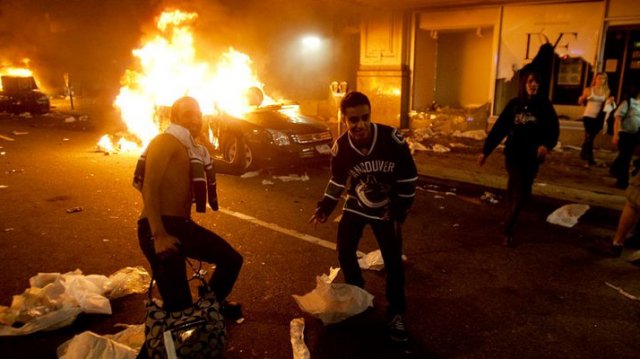
Welcome to Vancouver. Please ignore the rioters

Filed under: Cancon, Sports — Tags: , , , , , , , — Nicholas @ 08:02

Lord Stanley’s Cup won’t be coming back to Canada this year, but as Brian Hutchison points out, that’s only one of the losses sustained by Vancouver last night:

The season ends, and the worst does come to pass. Vancouver, you have lost. Twice. But the game hardly matters now, does it? The score? Who cares? As I write this, my eyes are stinging, my is throat sore, having breathed in some sort of dispersal chemical that police deployed — in desperation, and perhaps too late. There could be some residual effect from having inhaled acrid, toxic smoke from burning cars, exploding cars, destroyed by lunatics still running crazy on the city’s downtown streets.

Blood in our streets. I saw people on the ground, bleeding. Shattered glass everywhere. Police cars set alight. Major bridges are now closed, preventing public access into the downtown core. Transit is plugged up, there’s no way out. More police and fire crews are arriving, from the suburbs, but again, it seems too late.

And as I write this, the sun has just set. Vancouver, what a disgrace.

Update: A Tumblr page posting photos of the rioters and looters:

The National Post has more photos of the aftermath.

Update: Joey “Accordion Guy” deVilla points out that one of these riots is not like the others. Oh, and a commentary on the most famous photo of the riots (so far).

December 1, 2010

Toronto: where professional sports go to be embalmed

Filed under: Cancon, Economics, Soccer, Sports — Tags: , , — Nicholas @ 12:51

Scott Stinson looks at the less-than-impressive results turned in by Toronto’s various sport teams:

It makes business sense, of course, since Rogers, which already owns television networks and other content platforms devoted to sports, would own almost all the city’s sports properties, too. But would Toronto fans be any closer to a winner? Fans in this city have long lamented the inability of the bottom-line oriented current owners, dominated by the giant Ontario teachers’ pension plan and assorted business types, to build winners on the ice and the field. The franchises have been hugely successful in terms of making money, but woefully unsuccessful in the pursuit of championships.

Leafs: Zero playoff appearance since the NHL lockout of 2005. No Stanley Cups since 1967.

Raptors: In 15 years, they have won 11 playoff games. And lost three franchise players.

Toronto FC: Zero playoff appearance since club was formed in 2006.

[. . .]

So maybe Rogers would be different. Maybe it would want winners, since winners drive ratings. But the Jays haven’t sniffed the playoffs since Rogers bought them in 2000 (admittedly a tall order in a division that includes New York and Boston), and Rogers’ other sporting venture, the lease of eight Buffalo Bills games over five seasons, is thought to be a financial disaster.

It’s a pretty stark example of how disconnected the financial success of the business is from the sporting success of the team, isn’t it?

Update: Do check the comments, where “Lickmuffin” is holding forth about the iniquities of professional sports in general. It’s good, entertaining reading.

November 13, 2010

Some music just doesn’t belong in commercials

Filed under: Media — Tags: , , , , — Nicholas @ 11:44

By way of @muskrat_john (John Kovalic), who wrote “Love the Pogues. Love my Subaru Forrester. Saw Forrester commercial use Pogues song. Surprisingly, I died a little inside.”:

June 29, 2010

QotD: Canada’s ongoing self-esteem binge

Filed under: Cancon, Law, Quotations, Sports — Tags: , , — Nicholas @ 13:48

In light of Thursday’s Canada Day celebrations, pointing out that efforts to outlaw hurt feelings is now a regular part of this country’s modus operandi may make me a party-pooper. But waiting for another time won’t make the truth any easier to bear: From human rights commissions to hate crime laws to civil law suits, Canada has made an art of punishing otherwise perfectly legal behaviour simply because it happens to make someone feel bad. We’ve become a nation of petty grievance-hoarders and tip-toers terrified of offending.

The big problem with this state of affairs (besides how generally unbecoming it is)? It’s slowly making us a spiritless, brittle people. The ability to navigate the ups and downs of life — with a particular emphasis on the downs — is what fosters resilience and flexibility.

If you never have to face the consequences of getting cut from a team, or turned down for a job, or insulted by a heartless idiot, you never develop the sense of perspective (or sense of humour) that it takes to be a well-rounded and capable individual who has the confidence to handle defeat. That’s something parents have to teach their kids, and countries have to teach their citizens. Losing hurts, but you can’t expect mom and dad or a human rights commission to shield you from everything but sunshine and roses.

Marni Soupcoff, “Hockey dads need to grow up”, National Post, 2010-06-29

June 15, 2010

Instead of “Car!” they yell “Bylaw Officer!”

Filed under: Bureaucracy, Sports — Tags: , , , — Nicholas @ 18:25

Did you know that it’s against Toronto bylaws to play road hockey?

Ball hockey is played on streets across the city, but many people may be surprised to learn it’s not allowed.

Councillor Glenn De Baeremaeker certainly was. He looked around the room today at the public works and infrastructure committee, which he chairs, and pointed out that he was likely surrounded by “bylaw violators”.

He said banning the sport on roads is “just plain silly”.

“I don’t want to fill up our jails with ten and 11-year-old children whose great crime was to run around with hockey sticks and orange balls, yelling the word car all the time,” he said. “Kids can play hockey on the Internet but then they stay inside by themselves and eat marshmallows.” Violating the city bylaw won’t get you thrown in jail, but it could net you a $55 fine.

The only good news about the bylaw is that it (to date) has never been enforced.

March 11, 2010

Colby Cosh tries to introduce physics into hockey debate

Filed under: Health, Sports — Tags: , — Nicholas @ 07:37

Aside from women’s hockey at the Olympics, I don’t follow the sport, so I’m happy to depend on the educated opinions of those who do. Colby Cosh points out that the debate over blows to the head in hockey should concentrate on a simple, clearly defined rule:

A memo to those who are concerned with (hitherto) legal checks to the head in the NHL: I sure hope you’re not just fighting physics. Because you’ll lose.

I see nothing wrong with the proposed new rule against blind-side hits to the head. I’d be willing to take it even further, and adopt an easy-to-apply strict-liability standard; if you hit somebody in a way that induces unconsciousness, or causes a concussion, you sit out the next n games. This would spare us from adopting hard-to-apply rules whose enforcement might ebb and crest, vary between personalities, and differ between leagues and regions. (It would occasionally lead, like all strict-liability rules, to unfair-seeming results and punishments for actions that didn’t look unjust or vicious aside from the outcome. But almost anything is better, at least to my mind, than a rule defined by excessively complex language, taught by means of intuitive references to a mass of individual cases, and left to evolve so that everybody thinks he knows the offence when he sees it.)

[. . .]

It’s sometimes observed, for example, that the players are bigger and the game faster than 20 or 30 years ago. But nobody ever sorts out the relative importance of these effects; a player whose mass is 5% bigger has 5% more kinetic energy in open ice, but if his velocity is increased 5%, the energy varies according to the square, and thus increases by more than 10%. If you watch early ’80s hockey, what immediately strikes you, once you get past the sheer horribleness of the goaltending, is the relative slowness of the game. There’s no one reason for this: plenty of things have changed just a little bit, from the quality of icemaking to skate technology to the way skaters are trained. And the change isn’t that extreme, or else Chris Chelios, who actually played early ’80s hockey in the early ’80s, would be unable to draw a paycheque in his weak-bladder years. Still, it’s a factor with exponential weight.

Chris Chelios is nearly as ancient as I am . . . it’s utterly amazing that he’s still able to play at a professional level.

March 1, 2010

QotD: The game

Filed under: Cancon, Quotations, Sports, USA — Tags: , , — Nicholas @ 08:30

It may not have been the most important hockey game in Canadian history; the 1972 Summit Series has a pretty good argument, and does the 1987 Canada Cup. There were no political implications here, just sporting ones.

Nation-stopping sporting ones, true. If you ever wanted to knock off a bank in Lloydminster, Sask., this was probably a good day to try.

The game was played with a desperate ferocity, and at eye-watering speed. Every goal-mouth scrum was the fall of Saigon; bodies were being thrown around as if everyone involved forgot there is a quarter of the NHL season left to play. Every puck mattered; every play mattered. Everything mattered.

And there was hostility but no fighting; hitting but no headshots; talent so rich that when the NHL starts again today, it will look like a pale shadow of what the game can be.

“I think both teams are winners,” said Wilson. “And maybe more than anything, hockey in general.”

Bruce Arthur, “Crosby makes leap from superstar to legend”, CBC Vancouver Now, 2010-02-28

February 26, 2010

IOC to investigate scandal in women’s hockey: celebration

Filed under: Bureaucracy, Cancon, Sports — Tags: , , , — Nicholas @ 09:29

Well, I’m sure the IOC will quickly move to quash the scandalous behaviour of those hooligans on the Canadian women’s hockey team:

The International Olympic Committee will investigate the behaviour of the Canadian women’s hockey players who celebrated their gold medal at the Vancouver Games by drinking alcohol on the ice.

Several Canadian players returned to the ice surface at Canada Hockey Place roughly 30 minutes after their 2-0 win over the U.S. on Thursday night.

The players drank cans of beer and bottles of champagne, and smoked cigars with their gold medals draped around their necks.

Imagine that! Celebrating after winning a gold medal against their arch-rivals. And drinking alcohol, too. And to compound the outrage, they did it on the ice!!!

I’m sure the IOC will do the sensible thing and strip them of their medals. It’s the only logical thing to do, after all. And totally in proportion to the heinousness of their crime.

Even worse, they contributed to the delinquency of a minor:

Among those drinking were Marie-Philip Poulin of Quebec City, the youngest player on Team Canada and its fourth-line centre, who scored twice in the first period. The 18-year-old Poulin turns 19 next month, but right now she would be under the legal drinking age in B.C.

Because nobody in the entire history of the province of British Columbia has ever had the temptation to have a drink before the legal age. Even though in Quebec, “the legal drinking age is just a suggestion”.

Photos of the celebrations below the fold:

(more…)

February 25, 2010

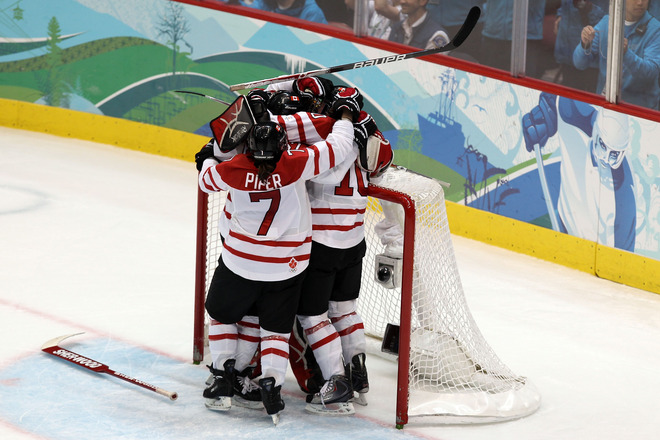
Canadian women beat US women for the hockey gold medal

Filed under: Cancon, Sports — Tags: , — Nicholas @ 22:25

A very hard-fought game, where Canada triumphed by the score of 2-0 to take the gold. Although the only goals were scored by Marie-Philip Poulin, for my money the star of the game was goalie Shannon Szabados:

The Canadian women’s hockey team defended the gold medals won at the 2002 and 2006 Olympic Games with a 2-0 win over archrival U.S. on Thursday at Canada Hockey Place.

Marie-Philip Poulin of Beauceville, Que., the youngest player on the Canadian team at 18, scored a pair of goals in the first period, showing off her soft hands and quick release. Edmonton goaltender Shannon Szabados stopped all 28 shots for the shutout.

Szabados was an intriguing choice in net for her first start in an Olympic or world championship final. Davidson went with the 23-year-old from Edmonton over veterans Charline Labonte, the winning goalie in the 2006 Olympic final, and Kim St. Pierre, the starter in the 2002 championship game.

Szabados showed no rookie nerves to start the game, however. She came out of her net to play the puck and made glove saves with confidence. She kept the Americans off the scoreboard during five-on-three chances at the start of both the first and second periods. U.S. goalie Jessie Vetter made 27 saves.

Centre Meghan Agosta of Ruthven, Ont., was named tournament MVP.


Photo by Alex Livesey/Getty Images

With this gold medal, Canada has now earned more gold than in any previous Winter Olympics (8, with the previous highs being 7 at both 2006 and 2002 games).

Macleans profiles Canadian Olympian Cherie Piper

Filed under: Cancon, Sports — Tags: , — Nicholas @ 12:54

Nancy Macdonald has an article up at Macleans about our favourite hockey player, Cherie Piper:

It all started with an ugly injury in a college game between her Dartmouth Big Green and Providence four years ago. When she tore her ACL, she says, everyone at the New Hampshire rink heard the “pop.” It came midway through Piper’s final NCAA season — just nine months after her triumphant return from Turin, where Canada won gold and she finished second on the team in scoring. Following surgery, Piper didn’t get back on the ice for six months, and missed a full year with the national squad.

And just as she was regaining her fitness and timing, her dad Alan died of a heart attack; he’d been Piper’s coach and mentor, had first put her on skates at age eight in a Toronto boys’ league, and ferried her across the city to games for years. “It was tough to finish the season,” says Piper, then with the Mississauga Chiefs of the Canadian Women’s Hockey League. The rink was no longer a refuge; hockey suddenly became a grim reminder of all she’d lost.

[. . .]

In the summer of 2008, she left Ontario for Calgary, joining the Oval X-Treme of the Western Women’s Hockey League, to focus solely on hockey. But it was too late. Last year, she was cut from Canada’s roster for the World Championships in Finland, where Poulin got her start with Team Canada. Piper, a two-time gold medallist, was devastated and considered giving up the game altogether. At the time, coach Mel Davidson didn’t know whether Piper would pack it in and go home, or “dig in, and say ‘Mel, you made a mistake and I’m going to prove it to you.’ ”

Cherie and her teammates take on the US women’s team for the gold medal tonight. We’re certainly going to be watching and cheering.

February 24, 2010

Tweet of the day

Filed under: Cancon, Humour, Sports, USA — Tags: , , , — Nicholas @ 17:37

colbycosh:
Remind me how this clownish, feeble US team beat us? Oh, right, our goalie in that game was 52 years old and tripping balls on peyote.

« Newer PostsOlder Posts »

Powered by WordPress


