
… Mycenaean Greece was as much an outlier as sub-Roman Britain: the civilizational collapse in the Aegean was unusually prolonged and severe compared to the fates of many of the other peoples of the Late Bronze Age. Here I have helpfully reformatted Cline’s chart of how resilient the various societies proved:
Let’s take a brief tour through the various fates of these societies. I’ll come back to the Phoenicians at the end, because their example raises interesting questions when considered in contrast with the Mycenaeans. For the moment, though, let’s begin like civilization itself: in Mesopotamia.
Before the Late Bronze Age Collapse, the Assyrian and Babylonian empires had numbered among the Great Powers of the age: linked by marriage, politics, war, and trade to the other mighty kings, they spent much of their time conducting high-level diplomacy and warfare. As far as we can tell, they did well in the initial collapse: there’s a brief hiatus in Assyrian royal inscriptions running from about 1208 to 1132 BC, but records resume again with the reign of Aššur-reša-iši I and his repeated battles with his neighbor to the south, the Babylonian king Nebuchadnezzar I (no relation). But although the kings of the late twelfth century continued much as their Bronze Age predecessors had — waging war, building palaces, going hunting, accepting tribute, collecting taxes, and ordering it all recorded in stone and clay — the world had changed around them. No longer were there huge royal gifts sent to and from fellow great kings, “My Majesty’s brother”1 overseas; now their diplomatic world consisted of tiny petty kings of nearby cities who could be looted or extorted at will.
Mesopotamia didn’t escape unscathed forever: beginning around 1080 BC, texts begin to record severe droughts, invading Aramaeans, and total crop failures. There was a major drought in 1060 BC, and then both the Assyrian and Babylonian records record further drought every ten years like clockwork — sometimes accompanied by plague, sometimes by “troubles and disorder” — until the end of the eleventh century BC. Most of the tenth century was equally dire, with chronicles recording grain shortages, invasions, and a cessation of regular offerings to the gods.
But unlike the Mycenaeans, and in spite of real suffering (ancient Babylonia is estimated to have lost up to 75% of its population in the three hundred years after the Collapse), both Mesopotamian empires were able to hang on to civilization. There were still kings, there were still scribes, and there were still boundary stones on which to record things like “distress and famine under King Kaššu-nadin-ahhe”. And when conditions finally improved, Assyria and Babylonia were both able to bounce back. When at last the Assyrian recovery began under Aššur-dan II (934-912 BC), for example, he (or more realistically, his scribe) was able to write: “I brought back the exhausted people of Assyria who had abandoned their cities and houses in the face of want, hunger, and famine, and had gone up to other lands. I settled them in cities and homes which were suitable and they dwelt in peace”. Clearly, Assyria still retained enough statehood to effect the sort of mass population transfer that had long been a feature of Mesopotamian polities.2
Over the next few centuries, the Neo-Assyrian Empire would come to dominate the Near East, regularly warring with (and eventually conquering) Babylon and collecting tribute from smaller states all over the region. At its peak, it was the largest empire history had ever known, covering a geographic extent unsurpassed until the Achaemenids. The Babylonians had to wait a little longer for their moment in the sun, but near the end of the seventh century they overthrew their Assyrian overlords and ushered in the Neo-Babylonian Empire. (Less than a century later, Cyrus showed up.)
So how did Babylon and Assyria hold on to civilization — statehood, literacy, monumental architecture, and so forth — when the Greeks lost it and had to rebuild almost from scratch? Unfortunately, Cline doesn’t really answer this. He offers extensive descriptions of all the historical and archaeological evidence for the diverse fates of various Late Bronze Age societies, but only at the very end of the book does he briefly run through the theories (and even then it’s pretty lackluster). He does have a suggestion about the timing — the ninth century Assyrian resurgence lines up almost perfectly with the abnormally wet conditions during the Assyrian megapluvial — but why was it the Assyrians who found themselves particularly well-positioned to take advantage of the shift in the climate? Why not, say, the Hittites?
Sometime around 1225 BC, the Hittite king Tudhaliya IV wrote to his brother-in-law and vassal, Shaushgamuwa of Amurru, that only the rulers of Egypt, Babylonia, and Assyria were “Kings who are my equals in rank”.3 A mere thirty years later, though, his capital city of Hattusa would lie abandoned and destroyed. Modern excavators describe ruins reduced to “ash, charred wood, mudbricks and slag formed when mud-bricks melted from the intense heat of the conflagration”.
And with that, the Hittites essentially vanished from history.
They were so thoroughly forgotten, in fact, that when nineteenth-century archaeologists discovered the ruins of their civilization in Anatolia, they had no idea who these people were. (Eventually they identified the new sites with the Hittites of the Bible, who lived hundreds of years later and hundreds of miles to the south, out of sheer ¯\_(ツ)_/¯.)4
What happened to the Hittites? Well, Cline suggests the usual mélange of drought, famine, and interruption of international trade routes, as well as a potential usurpation attempt from Tudhaliya’s cousin Kurunta, but the actual answer is that we’re not sure. Given the timing, they may have been the first of the Late Bronze Age dominos to fall; given the lack of major rivers in central Anatolia, they may have been uniquely susceptible to drought. Hattusa may have been abandoned before the fire — its palaces and temples show little sign of looting, suggesting they [may] already have been emptied out — but many other sites in the Hittites’ central Anatolian heartland were destroyed around the same time, and some of those have bodies in the destruction layer. But whatever the order of events, Hittite civilization collapsed as thoroughly and dramatically as the Mycenaeans’ had done, and with a similar pattern of depopulation and squatters in the ruins. Unlike the Mycenaeans, though, the Hittites would never be followed by successors who inherited their culture; the next civilization of Anatolia was the Phrygians, who probably arrived from Europe in the vacuum following the Hittites’ fall.
There was one exception: in the Late Bronze Age, cadet branches of the Hittite royal family had ruled a few small satellite statelets in what is now northern Syria, and many of these “Neo-Hittite” polities managed to survive the Collapse. A tiny, far-flung corner of a much greater civilization, they nevertheless outlasted the destruction of their metropole and maintained Hittite-style architecture and hieroglyphic inscriptions well into the Iron Age.5 (They would be swallowed up by the Neo-Assyrian Empire in the late eighth century BC.) And though the Neo-Hittite kings ruled over tiny rump states, we’re now able to translate inscriptions in which they referred themselves by the same titles the Bronze Age Hittite “Great Kings” had employed. The records of their larger neighbors, which had a much greater historical impact, seem to have followed suit: the Neo-Hittites in Syria probably actually were the Hittites of the Bible! Chalk up another one for nineteenth century archaeology.
Jane Psmith, “REVIEW: After 1177 B.C., by Eric H. Cline”, Mr. and Mrs. Psmith’s Bookshelf, 2024-07-08.
1. I really think we should bring back monarchs referring to themselves as “my Majesty”. So much cooler than the royal “we”. Or combine them: “our Majesty”!
2. The Babylonian Captivity, much later in the Iron Age, was far from historically unique.
3. The list actually reads, “the King of Egypt, the King of Babylonia, the King of Assyria,
and the King of Ahhiyawa” — the strikethrough appears in the original clay tablet! A generation earlier, under Tudhaliya’s father Hattusili III, the Hittite texts had consistently referred to the king of Ahhiyawa as a “great King” and a “brother”, but apparently the geostrategic position of the Mycenaean ruler had degraded substantially.4. We now know that the Hittites spoke an Indo-European language and referred to themselves “Neshites”, but the name has stuck.
5. I went looking for a good historical analogy for the Neo-Hittite kingdoms and discovered, to my delight, the Kingdom of Soissons, which preserved Romanitas for a few decades after the fall of the Western Roman Empire. The Neo-Hittites lasted a lot longer.
August 7, 2025
QotD: The lost-then-found-again Hittite civilization
December 27, 2022
Coming of the Sea Peoples: Part 5 – The Hittites
seangabb
Published 6 Jul 2021[Unfortunately, parts 3 and 4 of this lecture series were not uploaded due to sound issues with the recording].
The Late Bronze Age is a story of collapse. From New Kingdom Egypt to Hittite Anatolia, from the Assyrian Empire to Babylonia and Mycenaean Greece, the coming of the Sea Peoples is a terror that threatens the end of all things. Between April and July 2021, Sean Gabb explored this collapse with his students. Here is one of his lectures. All student contributions have been removed.
(more…)
December 20, 2022
Coming of the Sea Peoples: Part 2 – The Old and New Chronology of the Bronze Age
seangabb
Published 2 May 2021The Late Bronze Age is a story of collapse. From New Kingdom Egypt to Hittite Anatolia, from the Assyrian Empire to Babylonia and Mycenaean Greece, the coming of the Sea Peoples is a terror that threatens the end of all things. Between April and July 2021, Sean Gabb explored this collapse with his students. Here is one of his lectures. All student contributions have been removed.
(more…)
December 16, 2022
Coming of the Sea Peoples: Part 1 – Prelude
seangabb
Published 1 May 2021The Late Bronze Age is a story of collapse. From New Kingdom Egypt to Hittite Anatolia, from the Assyrian Empire to Babylonia and Mycenaean Greece, the coming of the Sea Peoples is a terror that threatens the end of all things. Between April and July 2021, Sean Gabb explored this collapse with his students. Here is one of his lectures. All student contributions have been removed.
More by Sean Gabb on the Ancient World: https://www.classicstuition.co.uk/
Learn Latin or Greek or both with him: https://www.udemy.com/user/sean-gabb/
His historical novels (under the pen name “Richard Blake”): https://www.amazon.co.uk/Richard-Blak…
June 23, 2022
1177 B.C.: When Civilization Collapsed | Eric Cline
Long Now Foundation
Published 19 Apr 2020Consider this, optimists. All the societies in the world can collapse simultaneously. It has happened before.
In the 12th century BCE the great Bronze Age civilizations of the Mediterranean — all of them — suddenly fell apart. Their empires evaporated, their cities emptied out, their technologies disappeared, and famine ruled. Mycenae, Minos, Assyria, Hittites, Canaan, Cyprus — all gone. Even Egypt fell into a steep decline. The Bronze Age was over.
The event should live in history as one of the great cautionary tales, but it hasn’t because its causes were considered a mystery. How can we know what to be cautious of? Eric Cline has taken on on the mystery. An archaeologist-historian at George Washington University, he is the author of 1177 B.C.: The Year Civilization Collapsed. The failure, he suggests, was systemic. The highly complex, richly interconnected system of the world tipped all at once into chaos.
“1177 B.C.: When Civilization Collapsed” was given on January 11, 2016 as part of Long Now’s Seminar series. The series was started in 2003 to build a compelling body of ideas about long-term thinking from some of the world’s leading thinkers. The Seminars take place in San Francisco and are curated and hosted by Stewart Brand. To follow the talks, you can:
Subscribe to our podcasts: http://longnow.org/seminars/podcast
Explore the full series: http://longnow.org/seminars
More ideas on long-term thinking: http://blog.longnow.orgThe Long Now Foundation is a non-profit dedicated to fostering long-term thinking and responsibility. Our projects include a 10,000 Year Clock, endangered language preservation, thousand year+ data storage, and Long Bets, an arena for accountable predictions.
Become a Long Now member to support this series, join our community, and connect with our ongoing work to explore and deepen long-term thinking: http://longnow.org/membership
Follow us on Twitter: https://www.twitter.com/longnow
Subscribe to our channel: https://www.youtube.com/longnow
April 5, 2021
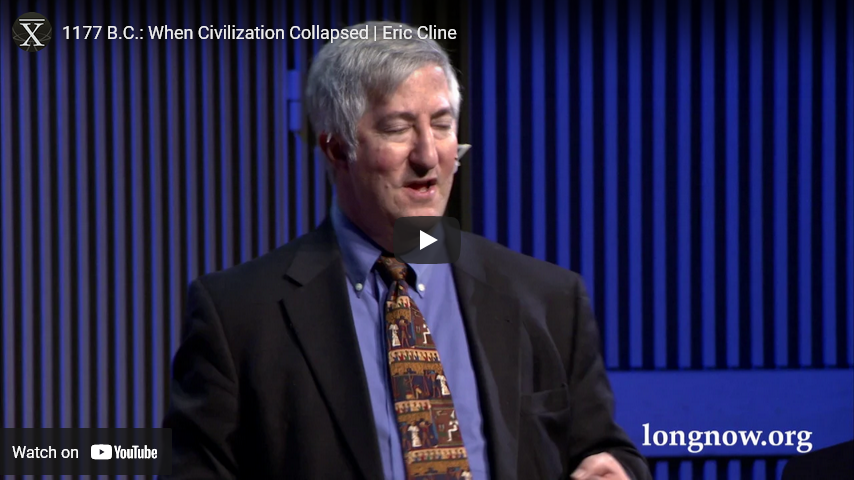
Did the Trojan War Really Happen?
Kings and Generals
Published 13 Aug 2020Kings and Generals’ historical animated documentary series continues with a video on the Trojan War, as we talk about the historicity of the conflict between Trojans and the Greeks depicted in the immortal Iliad of Homer. We also cover the Mycenaean and Hittite civilizations. How did this story come to be? Is it just a myth or is there historical proof that it happened? What does archeology tell us about the conflict at the end of the Bronze age? Were Hector, Achilles, Helen and Paris even real?
Support us on Patreon: http://www.patreon.com/KingsandGenerals or Paypal: http://paypal.me/kingsandgenerals We are grateful to our patrons and sponsors, who made this video possible: https://docs.google.com/document/d/1o…
Art and animation: Oğuz Tunç http://bit.ly/2H6oRjw
Script: Leo Stone
Narration: Officially Devin (https://www.youtube.com/user/OfficiallyDevin)✔ Merch store ► teespring.com/stores/kingsandgenerals
✔ Podcast ► Google Play: http://bit.ly/2QDF7y0 iTunes: https://apple.co/2QTuMNG
✔ Twitter ► https://twitter.com/KingsGenerals
✔ Instagram ► http://www.instagram.com/Kings_GeneralsProduction Music courtesy of Epidemic Sound: http://www.epidemicsound.com
#Documentary #Troy #Greece
March 1, 2021
Why the Bronze Age Collapse matters today. Dr. Eric Cline (If Civilization Collapsed Would We Know?)
Study of Antiquity and the Middle Ages
Published 13 Jun 2020Ladies and Gentlemen we arrive finally to the part of our series that you have all been waiting for! And that is the Bronze Age Collapse and here to guide us through it is none other than Dr. Eric Cline, the rock star archaeologist, historian and author of none other than 1177 BC!
He will give us an overview history of the collapse along with sharing his own personal views on the subject! Guiding us briefly through archaeology, trade, national politics, and contact in the ancient Mediterranean we will get a nice picture of the Bronze Age and how it all came crashing down in a perfect storm of events. But what is ever more awesome is he even gives us the inside scoop on why he wrote 1177 BC? And how he did it!
But at the end of this episode we come to our modern world and Dr. Cline explains why the Bronze Age Collapse matters today. What we need to look at when comparing it to our modern world and the current events and impacts affecting our world. Did the peoples living through the Bronze Age Collapse know they were living in a collapse? And he asks a delicate and intense question and that is if civilization collapsed today would we know?
Check out our new store! teespring.com/stores/the-history-shop
Support Dr. Eric Cline at the links below!
Personal web page: https://ehcline.com
Get all of his books here at his Amazon Author page:
https://www.amazon.com/s?i=stripbooks…GW pages:
https://cnelc.columbian.gwu.edu/eric-…https://anthropology.columbian.gwu.ed…
https://gwu.academia.edu/EricCline
Image credits: Manna Nader, Gabana Studios Cairo
Hittite 3D City and intro footage credits: 3D reconstruction of Imperial Hittite Karkemish by Giampaolo Luglio, Turco-Italian Archaeological Expedition to Karkemish directed by Nicolò Marchetti (University of Boologna)
KARKEMISH (Carchemish) 1300 BC (3D) – The Southern Capital of the Empire Hittite
Music Attribution: Herknungr – Megaliths | Dark Neolithic Meditive Shamanic Ambient Music https://youtu.be/oc8FQwNjPu0
November 18, 2020
Did the Sea Peoples Sack Troy? Dr. Eric Cline | 1177BC | Bronze Age Collapse
The Study of Antiquity and the Middle Ages
Published 17 Nov 2020In this episode the well renowned scholar and archaeologist Dr. Eric Cline (author of 1177BC) discusses his views on whether or not the Sea Peoples of the Late Bronze Age Collapse sacked Troy.
Basic overviews for beginners:
Trojan War Definition: a ten-year war waged by the confederated Greeks under Agamemnon against the Trojans to avenge the abduction of Helen, wife of Menelaus, by Paris, son of the Trojan king Priam, and ending in the plundering and burning of Troy.
The Late Bronze Age Collapse: This was a transition period in the Near East, Anatolia, the Aegean region, North Africa, the Caucasus, the Balkans and the Eastern Mediterranean from the Late Bronze Age to the Early Iron Age, a transition which historians believe was violent, sudden, and culturally disruptive.
The Sea Peoples: A purported seafaring confederation that attacked ancient Egypt and other regions of the Eastern Mediterranean prior to and during the Late Bronze Age collapse (1200–900 BCE).
Support Dr. Eric Cline at the links below!
Personal web page: https://ehcline.com
Get all of his books here at his Amazon Author page:
https://www.amazon.com/s?i=stripbooks…GW pages:
https://cnelc.columbian.gwu.edu/eric-…
https://anthropology.columbian.gwu.ed…
https://gwu.academia.edu/EricClineCheck out his lectures on the Great Courses! They are superb.
https://www.thegreatcourses.com/profe…Audio Book Formats of his work on audible.
https://www.amazon.com/s?k=Eric+Cline…Dr. Cline on the Modern Scholar:
History of Ancient Greece
https://www.amazon.com/Modern-Scholar…Archaeology and the Iliad: The Trojan War in Homer and History
https://www.amazon.com/dp/B001EI3IVU?…The History of Ancient Israel: From the Patriarchs Through the Romans
https://www.amazon.com/dp/B001JHT8CY?…Check out our new store! teespring.com/stores/the-history-shop
Get your SEA PEOPLES Mediterranean Tour Shirt Today!
teespring.com/sea-peoples-mediterrane…Hittite Coffee Mug: teespring.com/HittiteEmpireMug
To support the channel, become a Patron and make history matter! https://www.patreon.com/The_Study_of_…
Donate directly to PayPal: https://paypal.me/NickBarksdale
Enjoy history merchandise? Check out affiliate link to SPQR Emporium!
http://spqr-emporium.com?aff=3
*Dislaimer, the link above is an affiliate link which means we will earn a generous commission from your magnificent purchase, just another way to help out the channel!Join our community!
Twitter: https://twitter.com/NickBarksdale
Instagram: https://www.instagram.com/study_of_an…Image credits: Manna Nader, Gabana Studios Cairo
Hittite 3D City and intro footage credits: 3D reconstruction of Imperial Hittite Karkemish by Giampaolo Luglio, Turco-Italian Archaeological Expedition to Karkemish directed by Nicolò Marchetti (University of Boologna)
KARKEMISH (Carchemish) 1300 BC (3D) – The Southern Capital of the Empire Hittite https://youtu.be/RsTdoY__F4U
Music Attribution: Herknungr – Megaliths | Dark Neolithic Meditive Shamanic Ambient Music https://youtu.be/oc8FQwNjPu0
Trojan Horse Art: https://www.deviantart.com/keithwormw…
June 16, 2020
Plague and the Bronze Age Collapse ~ Dr. Louise Hitchcock
The Study of Antiquity and the Middle Ages
Published 16 May 2020Ladies and Gentlemen, welcome to the series NAUE II SWORDS, GERMS, & IRON brought to us by none other than Dr. Louise Hitchcock and this episode is going to be about plague and the Bronze Age collapse. This episode will also be drawing on modern parallels such as “What Covid-19 Can Tell Us About the Bronze Age (12th cent) Collapse?”
It will dive into the Bronze Age and discuss was plague a contributing factor in decline of the Bronze Age and the birth of the Iron Age? How familiar were the ancient peoples with plague and epidemics and what do the ancient literary sources tell us? From discussing plague in ancient Mesopotamia to the Philistine Plague to a Hittite King who falls prey to a deadly disease we explore new thoughts, theories and research involving a period that we all love and a subject that could not be more relevant and that is plague.
Check out the awesome work of Dr. Hitchcock at these links below!
Academia profile where you can access her work that is free to the public. https://unimelb.academia.edu/LouiseHi…
Get her books here!
Aegean Art and Architecture: https://global.oup.com/ukhe/product/a…
Minoan Architecture: A Contextual Analysis: http://www.astromeditions.com/books/b…
Theory for Classics: https://www.routledge.com/Theory-for-…
DAIS: The Aegean Feast https://www.peeters-leuven.be/detail….
Tell It In Gath: Studies in the History and Archaeology of Israel. Essays in Honor of Aren M. Maeir on the Occasion of his Sixtieth Birthday https://www.zaphon.de/epages/83179382…Follow her on Twitter: https://twitter.com/ashlarblocks
To support the channel, become a patron and make history matter!
Patreon: https://www.patreon.com/the_study_of_…
Donate directly to paypal: https://paypal.me/nickbarksdale
Enjoy history merchandise? Check out our affiliate link to spqr emporium! http://spqr-emporium.com?aff=3
*disclaimer, the link above is an affiliate link which means we will earn a generous commission from your magnificent purchase, just another way to help out the channel! join our community!twitter: https://twitter.com/nickbarksdale
instagram: https://www.instagram.com/study_of_an…Image credits: Manna Nader, Gabana Studios Cairo
Hittite 3D City and intro footage credits: 3D reconstruction of Imperial Hittite Karkemish by Giampaolo Luglio, Turco-Italian Archaeological Expedition to Karkemish directed by Nicolò Marchetti (University of Boologna)
KARKEMISH (Carchemish) 1300 BC (3D) – The Southern Capital of the Empire Hittite https://youtu.be/RsTdoY__F4U
Music Attribution: Herknungr – Megaliths | Dark Neolithic Meditive Shamanic Ambient Music https://youtu.be/oc8FQwNjPu0
Footage of Ugarit Credit goes to Ruptly. Video Title : Syria: Ancient city of Ugarit freed from Islamic State control https://youtu.be/XKzbk0PFvg0
June 2, 2020
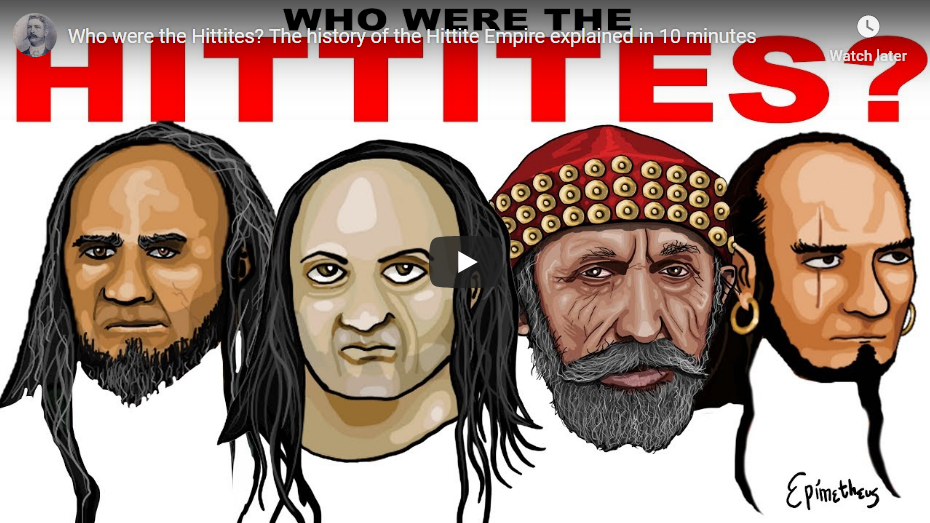
Who were the Hittites? The history of the Hittite Empire explained in 10 minutes
Epimetheus
Published 30 Nov 2018Who were the Hittites? (The Hittite Empire explained in 10 minutes) Animated history
Support new videos from Epimetheus on Patreon! 😀
https://www.patreon.com/Epimetheus1776
January 1, 2019
The Greatest Ancient Empire you have never heard of … The Mitanni
Epimetheus
Published on 4 Oct 2018The Greatest Ancient Empire you have never heard of … The Mitanni
The Mitanni capital city of Washukanni has never been identified although there are a few locations “mounds” where the city is most likely located. It will be one of the most exciting and illuminating discoveries when this ancient capital is unearthed — (I hope it happens in my lifetime) — if there are tablets there (maybe even a library!) that could very much rewrite the history of the middle east and civilization. I have been fascinated by the Mitanni for quite some time and I am very happy to share this video with you all 😊 I hope you enjoy, and it stirs your curiosity!
Support new videos from Epimetheus on Patreon! 😀
https://www.patreon.com/Epimetheus1776Mitanni, Hurrians, Mitanni empire, Egyptian empire, Hittite empire, Babylon, bronze age, bronze age collapse, bronze age empires, bronze age great kings, Mesopotamia, ancient middle east, ancient Mesopotamia, Mesopotamia documentary, Mitanni documentary, greatest ancient empire, most powerful ancient empire, Babylonian empire, bronze age diplomacy, Nefertiti, tushratta, Akhenaten, Suppiluliuma, Assyria, Assyrian empire, Washukanni, Kurtiwaza, Shattiwaza, Shaushtatar, chariots, chariot warfare, the Mitanni, Babylonian empire, ancient near east, Hurrian migration, documentary Mitanni, lost empires, ancient egypt, bronze age chariots, ancient civilization, lost civilization, lost empire, discovered civilization, most powerful ancient empire
March 10, 2018
Invasions of the Sea Peoples: Egypt & The Late Bronze Age Collapse
History Time
Published on 3 Sep 2017*****This was one of the first videos I ever made.******Subscribe for much better narration on the newer videos and tons more historical awesomeness*****
The years between around 1500 and 1200 BC are often cited as some of the most prosperous that the world had ever seen. The Eastern Mediterranean world inhabited by the Egyptians, the Hittites and the Minoans, as well as numerous smaller states around them, was a truly cosmopolitan system rarely seen in world history. Greek and Hittite trade goods regularly show up in archaeological sites in Egypt, whereas Egyptian hieroglyphs and trade goods are found in places such as the island of Crete and Mycenae. One shipwreck off the coast of Turkey carried goods from nine different states aboard.
As evidenced by substantial diplomatic communications as well as trade, the world of the Late Bronze Age was a vast interconnected system. The culmination of an unbroken cultural line which had existed since the first cities three thousand years before. Little did the inhabitants of these lands know however that from around 1200 BC their world would catastrophically and violently fall apart in a decades long cataclysm known as the Late Bronze Age Collapse.
Significant archaeological evidence relates that a huge number of cities and settlements were violently destroyed during the period 1210-1130 BC. In Asia Minor the mighty Hittite Empire collapsed. In Greece and the Mediterranean, the kingdoms and city states of the Mycenaean Greeks and the Minoans similarly fell apart. In Canaan and Syria vast and ancient city states were razed, with half written SOS messages written in cuneiform left to be discovered thousands of years later. In scenes reminiscent of the fall of the Western Roman Empire vast numbers of people throughout the eastern Mediterranean fled from their settlements by the shore to take refuge on fortified hill tops.
Just one of the great civilisations of the late Bronze age survived the collapse and told the tale of what happened. Egypt. Led by the Pharoah Ramesses III, often regarded as the last of the great Egyptian Pharaohs, and certainly the last New Kingdom ruler to wield any substantial authority. Inscriptions written during his reign tell of a vast coalition of warlike peoples who descended upon the civilised world during his reign, destroying it entirely and leaving just Egypt to stand alone against the coming enemy. Those enemies are known today as the Sea Peoples, and they remain one of the greatest enigmas of history.
July 10, 2017
The Bronze Age Collapse – I: Before the Storm – Extra History
Published on Jun 24, 2017
Egyptians. Hittites. Assyrians. Myceneans. Long ago, these four Bronze Age civilizations lived together in a healthy system of trade, agriculture, and sometimes warfare. But then, everything changed when the Sea People attacked.


