Forgotten Weapons
Published 10 Sep 2016http://www.armamentresearch.com
This is a basic instructional video on unloading and clearing the four most common types of rifles that will be encountered by journalists, aid workers, and other non-combatants in conflict zones today.
Armament Research Services (ARES) is a specialist technical intelligence consultancy, offering expertise and analysis to a range of government and non-government entities in the arms and munitions field. ARES fills a critical market gap, and offers unique technical support to other actors operating in the sector. Drawing on the extensive experience and broad-ranging skillsets of our staff and contractors, ARES delivers full-spectrum research & analysis, technical review, training, and project support services. Our services are often delivered in support of national, regional, and international initiatives, and can be conducted in both permissive and non-permissive environments.
ARES is an apolitical, policy-neutral organisation, providing technical assessments to legitimate customers. We reserve the right to decline any engagement we deem ethically problematic.
United Nations Global Marketplace (UNGM) number: 358103
August 10, 2020
How to Safely Unload & Clear the Four Most Common Rifles
August 7, 2020
Myth and Reality of the Ross MkIII Rifle
Forgotten Weapons
Published 16 Jun 2013There is a long-standing urban legend about the Canadian Ross rifle, a straight-pull bolt action that was used in lieu of the SMLE by Canadian troops early in World War One. The story is that the Ross would sometimes malfunction and blow the bolt back into its shooter’s face, with pretty horrible results. Well, I wanted to learn “the rest of the story” — could this actually happen? What caused it? How could it be prevented? In short, what would a Ross shooter need to know to remain safe? And if I could get some cool footage of a bolt blowing out of a Ross in the process, all the better.
Well, reader Andy very generously provided a sporterized Ross for the experiments, and I started reading into what the issue really was. Turns out that the legend was quite true — you can put a Ross MkIII bolt together the wrong way, and it will allow you to fire without the locking lugs engaged, thus throwing the bolt back out of the gun at high velocity. However, the issue was recognized fairly quickly, and the vast majority of Ross rifles were modified with a safety rivet to prevent this from happening. It is also quite easy to determine if a Ross is assembled correctly, once you know what to look for.
August 4, 2020
Sturmtruppen Firepower: The Artillery Luger
Forgotten Weapons
Published 4 Apr 2020https://www.instagram.com/rockislanda…
https://www.youtube.com/user/RockIsla…
This is lot #3569 in the upcoming RIA Premier Auction. It was scheduled for April, but has been postponed — check their web site for upcoming Online Only auctions every month, though!
The lP08 (Lange pistole 08) was formally adopted in 1913 to replace the Reichsrevolver for the field artillery. These were the German light artillery troops, who were specifically given a pistol caliber carbine to provide maximum firepower in a very compact package. They were made by the Erfurt Arsenal in 1914, and by DWM throughout the war, with a total of about 180,000 made.
What is most interesting to me is the evolution of the use of the “artillery Luger” throughout the course of World War One. Starting as simply a compact weapon for artillery, it was quickly recognized by aviators as an ideal weapon for aircraft before the mass introduction of aerial machine guns. The stock allowed more accurate fire, and the semiautomatic operation minimized the handling movements required to fire. More substantially, it was adopted by the German Sturmtruppen for maximizing the striking power of small and flexible units. It is for these men that the 32-round drum magazine was developed in 1916. This represents one of the very few formal military uses of a pistol-caliber semiautomatic carbine, as it was superseded by the advent of the submachine gun in 1918.
A few small batches were made in the 1920s and 1930s, but it would not see significant use in World War Two – leaving it a weapon specifically iconic to the Great War.
http://www.patreon.com/ForgottenWeapons
https://www.floatplane.com/channel/Fo…
Cool Forgotten Weapons merch! http://shop.bbtv.com/collections/forg…
Contact:
Forgotten Weapons
6281 N. Oracle #36270
Tucson, AZ 85740
August 1, 2020
Secret Briefing: The Pedersen Device
Forgotten Weapons
Published 8 Aug 2016http://www.patreon.com/ForgottenWeapons
Welcome to your briefing on the new equipment we are issuing for the Spring Offensive of 1919. With this new secret weapon, we can finally push the Germans out of France and end the war!
July 29, 2020
America’s First Assault Rifle: Burton 1917 LMR
Forgotten Weapons
Published 4 Jul 2016http://www.patreon.com/ForgottenWeapons
https://centerofthewest.org/explore/f…America’s first assault rifle? Well, it does meet all the requirements — select-fire, intermediate cartridge, and shoulder-fired. It was never actually fielded, though.
The Burton Light Machine Rifle was developed during World War One, with the firing model completed in 1917. It was intended as an aircraft observer’s weapon for attacking balloons — a role which required incendiary ammunition. With this in mind, Winchester’s Frank Burton adapted the .351 WSL cartridge from his 1905 and 1907 self-loading rifles into the .345 WSL, with a spitzer bullet. He designed an open-bolt, select-fire shoulder rifle to fire it, which became known as the Light Machine Rifle.
Burton’s rifle was to be usable both in an aircraft where it could be fixed to a Scarff mount for a wide field of fire or used by an individual on the ground, fired from the shoulder. It weighed in at just about 10 pounds (4.5kg) and had a pistol grip and straight-line design to bring the recoil impulse directly into the shooter’s shoulder and minimize rise during automatic fire. The barrel was finned for better cooling, and infantry barrels were equipped with bayonet lugs.
The most distinctive elements of the design, of course, are the dual top-mounted magazines. Each one holds 20 rounds, and each has a pair of locking catches. One position locks the magazine into a feeding position, and the other holds it up above the cycling of the bolt. The idea here was to keep a second loaded magazine easily accessible for an aerial observer, so they could reload without having to find another magazine somewhere in the aircraft. Contrary to some speculation, there is no automatic transition between magazines. When one is empty, the shooter must pull it back to the second locking position (or out of the gun entirely) and then push the second magazine down into feeding position.
Despite Burton’s work — which was well ahead of its time — the LMR had been rendered obsolete for its primary role by the time it was ready. Synchronized, forward-mounted Vickers machine guns firing 11mm incendiary ammunition were being mounted on aircraft, and were more effective on balloons and airplanes than Burton’s weapon would have been. Only this single example was ever made, and it was not presented for infantry consideration as far as I can tell. It was lost for many years before being discovered in a Winchester building, and eventually ending up in the Cody Firearms Museum with the rest of the Winchester factory collection.
July 26, 2020
Gewehr 98: The German WWI Standard Rifle
Forgotten Weapons
Published 11 Jun 2016Sold at auction for $1,840 (w/ 5 other rifles).
The Gewehr 1898 was the product of a decade of bolt action repeating rifle improvements by the Mauser company, and would be the standard German infantry rifle through both World Wars. Today we are looking at a pre-WWI example (1905 production) that shows all the features of what a German soldier would have taken to war in 1914.
July 23, 2020
Pattern 1913 Enfield Trials Rifle
Forgotten Weapons
Published 28 Apr 2016http://www.patreon.com/ForgottenWeapons
Sold at auction for $6,325.
One of the lessons learned by the British military in the aftermath of the Boer War was that modern Mauser rifles were superior to their Lee-action rifles and carbines. In response, British ordnance began experimenting with a Mauser-pattern rifle, ultimately finalized as the Pattern 1913. This rifle would also leave behind the obsolescent .303 rimmed cartridge, in favor of a new rimless .276 Enfield round.
The Pattern 13 rifle itself was excellent — it balanced and handled well, it had very good sights, and a smooth and fast bolt throw. However, the .276 Enfield cartridge was really more potent than it needed to be, and caused problems. The cartridge threw a 165 grain bullet at just under 2800fps, pretty close to the ballistics of today’s 7mm Remington Magnum. Loaded with Cordite propellent, this led to excessive barrel wear and unpleasant recoil, along with some parts breakage. However, as final testing was being done in the first half of 1914, the Great War broke out.
At this point, plans for using a new cartridge were abandoned. The rifle itself was redesigned in the .303 cartridge, to be manufactured in large numbers by American firms under contract. It would also be refitted for the .30-06 cartridge and used in large numbers by the American armed forces as the M1917 Enfield rifle. According to General Julian Hatcher (who ought to know), it was the best rifle of the First World War.
July 21, 2020
Enfield L85A1: Perhaps the Worst Modern Military Rifle
Forgotten Weapons
Published 29 Dec 2016http://www.patreon.com/ForgottenWeapons
Cool Forgotten Weapons merch! http://shop.bbtv.com/collections/forg…
If you enjoy Forgotten Weapons, check out its sister channel, InRangeTV! http://www.youtube.com/InRangeTVShow
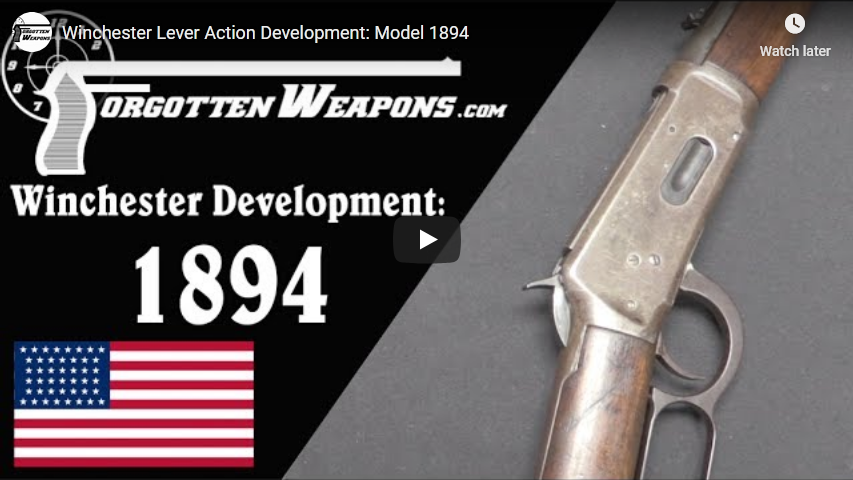
The L85A1 (part of the SA80 small arms family) was adopted by the British military in 1985 as a new generation of small arms to replace the L1A1 FAL (one quick note, where “A1” indicates a revision in American designations, it is simply the first iteration in British ones — there was no “L85”). As a bullpup rifle, the L85A1 was intended to replace both the FAL and Sterling SMG, similar to the French replacing the MAS 49/56 and MAT 49 with the FAMAS.
Unfortunately, the L85A1 had massive problems of both reliability and durability. They were kept pretty much hidden until Desert Storm, when it became unavoidably clear that the weapon was seriously flawed. The UK government denied the problems for several years, until finally contracting with H&K (then owned by Royal Ordnance) to redesign and rebuild the rifles. The result, after changes to virtually every part of the rifle, was the L85A2 — a much better rifle that will be tainted with its predecessor’s reputation regardless.
Mechanically, the L85A1 and A2 are basically copies of the Armalite AR-180, with a multi-lug rotating bolt and a short stroke gas piston. It feeds from STANAG magazines, and it universally fitted with the heavy but rugged SUSAT optical sight.
Thanks to the Institute of Military Technology for allowing me to have access to this rifle (which is extremely rare in the US) and bring it to you! Check them out at:
July 17, 2020
L96A1: The Green Meanie – the First Modern Sniper Rifle
Forgotten Weapons
Published 16 Feb 2019http://www.patreon.com/ForgottenWeapons
Cool Forgotten Weapons merch! http://shop.bbtv.com/collections/forg…
The Accuracy International Precision Marksman rifle was the winner of the British MoD’s competition to replace the L42A1 as the standard British sniper rifle, and was accordingly adopted as the L96A1. It was the vanguard of the modern sniper rifle, with a highly modular chassis design, and it revolutionized British sniping performance. Thanks to Steve Houghton, was have access today to one of a tiny number of original L96A1 rifles in private hands. If you are interested in learning more, I highly recommend checking out Steve’s newly released book, The British Sniper: A Century of Evolution. It can be found at:
https://www.swiftandboldpublishing.co…
Contact:
Forgotten Weapons
PO Box 87647
Tucson, AZ 85754
July 14, 2020
British EM-2: The Best Cold War Battle Rifle that Never Was
Forgotten Weapons
Published 12 Jul 2017Armament Research Services (ARES) is a specialist technical intelligence consultancy, offering expertise and analysis to a range of government and non-government entities in the arms and munitions field. For detailed photos of the guns in this video, don’t miss the ARES companion blog post:
http://armamentresearch.com/british-j…
The EM-2 was the rifle that the British pushed for NATO trials in 1950. It was a rifle well ahead of its time in several areas — as a select-fire bullpup rifle, it was intended to replace both the infantry rifle and the submachine gun. Its .280 caliber cartridge was designed with combat ranges of 600 yards and less, acknowledging the reality that engagements beyond even 300 yards were extremely rare, and not important enough to base rifle design on. It was also designed to use primarily optical sights, long before this concept would be embraced elsewhere. Unfortunately, the potential of the EM-2 was lost to the political decision that compatibility with American ordnance choices was a more significant benefit than an improved infantry rifle.
Mechanically, the EM-2 is heavily based on the German G43 flapper-locking system. It uses a long stroke gas piston in place of the G43’s short stroke one, though. To help account for the slower handling of a bullpup configuration, the EM-2 would both lock open when its magazine was empty and also automatically close the bolt and chamber a round when a fresh magazine was inserted. The safety was much like that of the M1 Garand, and the selector lever was of the push-through type like on the German Sturmgewehr.
The optic on the EM-2 is quite tiny, and offers no magnification. Its purpose is to reduce the two-element sight picture of traditional iron sights to a single plane that can be more quickly and easily placed on the target.
In total, only 55 EM-2 rifles were manufactured, including the paratrooper model in this video and a number of 7.62mm NATO examples made as a last ditch effort to remain competitive in NATO trials. Where most failed prototype rifles were rejected for very legitimate technical shortcomings, the EM-2 is (I believe) a prime example of an outstanding weapon that fell victim to politics unrelated to its actually qualities.
http://www.patreon.com/ForgottenWeapons
Cool Forgotten Weapons merch! http://shop.bbtv.com/collections/forg…
If you enjoy Forgotten Weapons, check out its sister channel, InRangeTV! http://www.youtube.com/InRangeTVShow
July 11, 2020
H&K G3: The Very First Import (3/62)
Forgotten Weapons
Published 6 Mar 2016http://www.patreon.com/ForgottenWeapons
Sold for $32,200.
We have all seen plenty of sporter CETME rifles and civilian HK-91s, but when the G3 was new to the Germany military, there was already an interest in bringing semiauto versions into the US. The Golden State Arms Corporation was the first to do so, with three batches of imports in 1962 (just 3 years after the G3 was adopted). The first of these came into the US in March, and was basically identical to the military G3 except with a two-position semiauto-only fire control pack.
Later imports had to be made more and more distinct from the military G3s, which leaves these 3/62 guns as the closest thing to the real G3 available to the non-NFA US shooter.
Video on the development of the roller-delayed blowback system:
July 8, 2020
US M2/M2A1 Flamethrower
Forgotten Weapons
Published 12 May 2016http://www.patreon.com/ForgottenWeapons
After a dismal first attempt at designing a flamethrower (the M1) in 1941, the US Chemical Corps along with several universities and industrial partners put in a lot of research to develop a more usable and effective flamethrower. The result was the M2, which went into production in early 1944. It would prove to be an exceptionally effective weapon in the island-hopping campaign towards the end of the war.
The M2 was arguably the best flamethrower fielded by any military during the war, with a number of excellent design features. These included:
* A constant-pressure regulator to ensure that the range stayed the same from the first to the last shot of a tank of fuel
* An on/off main valve easily accessible to the operator
* A supremely waterproof and reliable pyrotechnic cartridge ignition system
* An auto-shutoff valve which sealed at the nozzle, preventing dribble (and cutting off fuel flow should the operator lose control of the weapon)The M2 would see service into the Vietnam War even as its successor the M9 was being issued. It was a truly outstanding design, and remains viable to this day.
Thanks to Charlie Hobson for showing us the unit and teaching me to fire it, and also thanks to Adaptive Firearms for letting us use their range facilities!
You can find Charlie Hobson’s book, US Portable Flamethrowers here:
http://amzn.to/1SP9yc5
July 5, 2020
Light, Mobile, and Deadly: the French Mle 1937 25mm Puteaux AT Gun
Forgotten Weapons
Published 20 Mar 2020http://www.patreon.com/ForgottenWeapons
https://www.floatplane.com/channel/Fo…
Cool Forgotten Weapons merch! http://shop.bbtv.com/collections/forg…
After World War One, the French military set up a program to modernize all of its weaponry, and that included a replacement for the Mle 1916 light infantry cannon. An anti-tank gun had not been necessary during the Great War, as Germany never fielded tanks in substantial numbers — but as a pioneer of the modern tank, the French recognized the need for a good AT gun. Taking a lesson from World War One, they wanted a light gun that was flexible and mobile, easily moved around the battlefield and easily concealed from enemy fire. A 25mm cartridge was specified, and both the Hotchkiss company and the Puteaux arsenal created guns to use it. Both were adopted into service, with the Hotchkiss Mle 1934 being a bit heavier and the Puteaux Mle 1937 being a bit lighter, at only about 600 pounds. The Puteaux gun was quite small, easily moved by a horse or virtually any motorized vehicle. It had a long barrel and the 25mm AP projectile had a muzzle velocity of about 3150 fps, making it quite effective on the light and medium tanks of the 1930s. It was also remarkably accurate, and the long barrel and flash hider gave it a very small firing signature. Aiming was done with either a 4x magnified optic or a set of backup iron sights.
A total of 1285 of these guns were made before the armistice of June 1940, and they served ably in the Battle of France. A few were also used by the British before Dunkirk, and after the armistice they were used by German forces in limited numbers, and also supplied to Spain and Finland as military aid (this particular one has a Finnish property tag on it).
Thanks to DriveTanks.com in Uvalde Texas for giving me access to film this Puteaux cannon for you!
Contact:
Forgotten Weapons
6281 N. Oracle #36270
Tucson, AZ 85740
July 2, 2020
Early Automatic Pistol Cartridges – What, When & Why?
Forgotten Weapons
Published 12 Oct 2016http://www.patreon.com/ForgottenWeapons
Cool Forgotten Weapons Merch! http://shop.bbtv.com/collections/forg…
In discussion with a friend recently, the topic of early automatic pistol cartridges came up. Specifically, looking at the context of which cartridges were actually available at which times, and how this might provide helpful context for understanding why particular cartridges were adopted (or commercially successful) or were not.
I decided to see if I could put together a useful video on the subject, and this is the result. We will look at the cartridges available prior to 1900, the ones developed or introduced between 1900 and 1904, and then a few followups which appeared between 1905 and 1910.
Some cartridges became popular because of their ballistic characteristics — like the 7.63mm Mauser and the C96 “Broomhandle” — while others became popular because of the handgun much more than the cartridge itself — like the Browning 1900 and the .32ACP / 7.65mm Browning.
June 28, 2020
British 1942 Prototype Simplified…Enfield?
Forgotten Weapons
Published 18 Nov 2018https://www.forgottenweapons.com/brit…
http://www.patreon.com/ForgottenWeapons
Cool Forgotten Weapons merch! http://shop.bbtv.com/collections/forg…
In 1942, the British government instituted a development program to design a new simplified rifle to replace the No4 MkI Lee Enfield. The CSAD (Central Small Arms Department) came up with a design using a quite simple receiver machined form a small steel billet. It was a rifle wholly distinct form the Enfield, although both were chambered for the .303 British cartridge. The simplified rifle used a front-locking bolt, a simplified cocking piece, and had a magazine holding just 6 rounds. The sights were a simple 300/600 yard rear aperture, and a crude spike bayonet could be fitted either forward for use or rearward for storage.
The project never got as far as serial production, or even field trials as far as I can tell, and only a handful of prototypes were made.
Contact:
Forgotten Weapons
PO Box 87647
Tucson, AZ 85754