Quotulatiousness

April 4, 2021

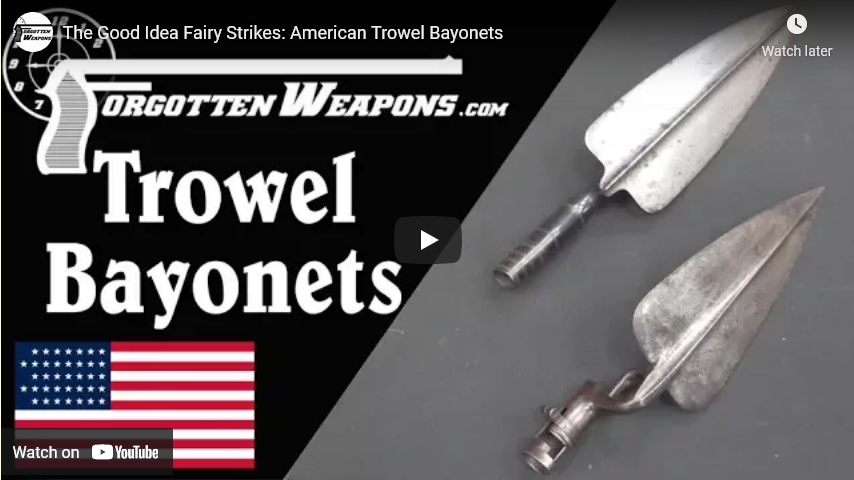
The Good Idea Fairy Strikes: American Trowel Bayonets

Filed under: History, Military, USA, Weapons — Tags: , , , , — Nicholas @ 02:00

Forgotten Weapons
Published 13 Nov 2017

The United States first experimented with a combination trowel and bayonet in 1868, producing 200 experimental examples made from standard socket bayonets. This was immediately followed by an additional 500 Model 1869 trowel bayonets made new. These were distributed to a few companies of the infantry to test in the field. Remarkably, the trials reports were overwhelmingly positive.

The US infantryman at that time did not carry any sort of entrenching tool, and so even an awkward combination tool was an improvement over a canteen cup or other ad hoc tool for digging. The bayonet was seen by some officers as becoming obsolete with the introduction of breechloading rifles, so the reduced effectiveness of the new item as a bayonet was not a substantial concern. The intended use of these tools was not to dig elaborate trenches, but rather to hastily construct a shallow ditch and embankment which would provide just enough cover to shelter a prone soldier.

With the trials reports in, the government purchased 10,000 of the improved 1873 pattern trowel bayonet, which featured a stronger blade and a much more comfortable handle for digging. These were issued and used in the field (and in several combat engagements), but the developmental direction turned towards combination knife trowels instead of bayonets, and there would be no further development or issue of these tools after the 1870s.

See the full trials report here: https://books.google.com/books?id=qUE…

http://www.patreon.com/ForgottenWeapons

Cool Forgotten Weapons merch! http://shop.bbtv.com/collections/forg…

If you enjoy Forgotten Weapons, check out its sister channel, InRangeTV! http://www.youtube.com/InRangeTVShow

March 31, 2021

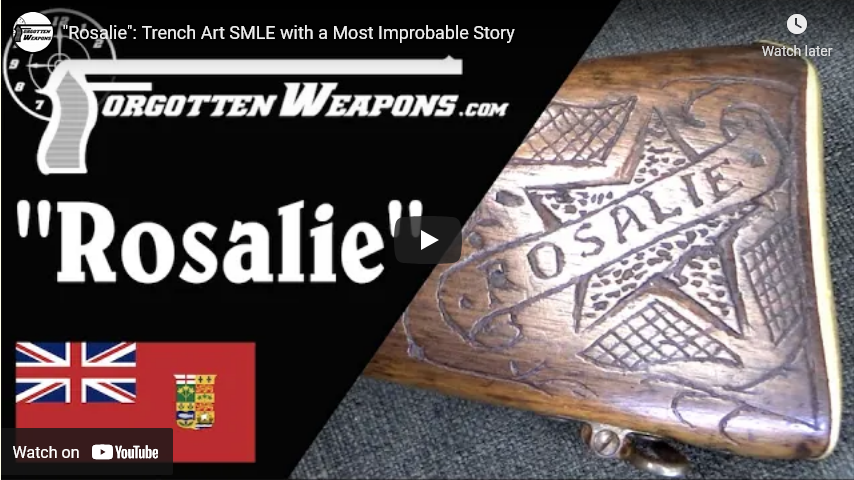
“Rosalie”: Trench Art SMLE with a Most Improbable Story

Filed under: Cancon, History, Military, Weapons, WW1 — Tags: , , , , , — Nicholas @ 02:00

Forgotten Weapons
Published 21 Dec 2020

http://www.patreon.com/ForgottenWeapons

https://www.floatplane.com/channel/Fo…

Cool Forgotten Weapons merch! http://shop.bbtv.com/collections/forg…

Henri Lecorre was a French immigrant to Canada who enlisted in the 22nd Regiment of the Canadian Army in April, 1915. He had a knack for carving things in his rifles, which he started right in basic training, with a Ross rifle he named “Josephine”. That got him sternly rebuked by his Colonel, but he would take up the habit again in 1916 when he arrived in France and began to see combat. At this point the Canadians were issuing SMLE rifles, and Lecorre named his “Rosalie”, after the French bayonet’s nickname.

Lecorre served through 14 major campaigns, and carved each name into his rifle as the years of the war dragged on. He was twice caught and punished for destruction of government property and fined for the cost of the rifle, although he managed to avoid more serious punishment both times. He only embellished the left side of Rosalie, so that his work would be hidden against his leg when standing at attention. By the summer of 1918, Rosalie’s service record included Vimy, Kemmel, St. Eloi, Hoodge, Zellebeck, Courcelette, Bully Grenay, Neuvilles Vaade, Mericour, Lievin, Lens, Cote 70, Passchendaele and Arras.

Fate eventually caught up to Private Lecorre, and in mid-1918 he was seriously wounded in an attack, and woke up in a military hospital in Dieppe. Rosalie was long gone, and Lecorre did not return to combat again.

The story is far from over, however. Rosalie was recovered from the battlefield, and sent back to Enfield with a batch of damaged rifles for refurbishment and reissue. Someone in the factory noticed the carving on it, and it was set aside. The arsenal commander took a liking to it, and it was hung in his office — where it remained for some 30 years. A Canadian officer from the 22nd Regiment noticed it at Enfield — thanks to Lecorre carving his unit’s name into it — during the Second World War, and thought it would be appropriate to return it to the unit’s home town, where the Citadelle Museum was established in 1950, with Rosalie as one of its original exhibits.

In 1956, Lecorre himself happened to visit an exhibition near Quebec City where the museum had set up, and was shocked to see his own Rosalie on display. After some understandable difficulty convincing the officer on duty that it was actually *his* rifle (which Lecorre did by reciting back its serial number unseen), a remarkable reunion took place. The rifle remained with the museum, but now with its full story known. It remains there to this day, on permanent display.

The Citadelle Museum commissioned a reproduction of Rosalie to be used for demonstrations, and it is this rifle which was graciously made available to me for filming, as the original is inaccessible on short notice because of its display case. Many thanks to the Citadelle for the opportunity to present it to you! If you are in Quebec City, make sure to take time to visit them:

https://www.lacitadelle.qc.ca/en/

Contact:
Forgotten Weapons
6281 N. Oracle #36270
Tucson, AZ 85740

March 27, 2021

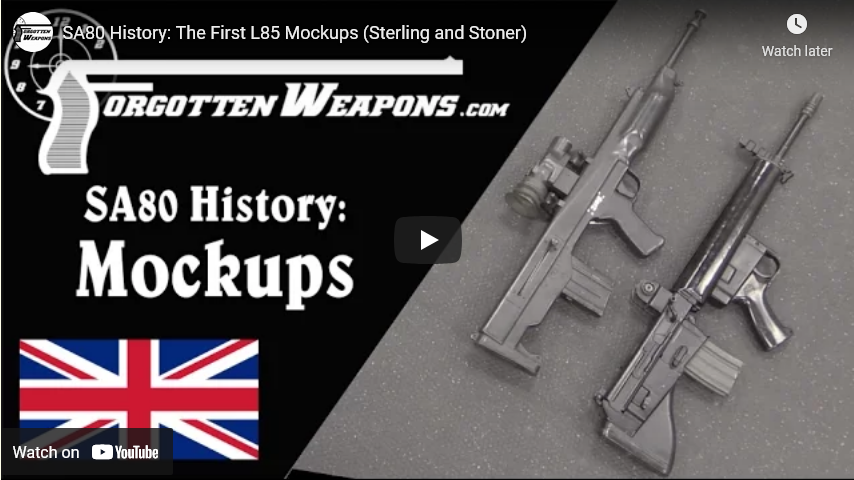
SA80 History: The First L85 Mockups (Sterling and Stoner)

Filed under: Britain, History, Military, Weapons — Tags: , , , , , — Nicholas @ 02:00

Forgotten Weapons
Published 5 May 2017

Armament Research Services (ARES) is a specialist technical intelligence consultancy, offering expertise and analysis to a range of government and non-government entities in the arms and munitions field. For detailed photos of the guns in this video, don’t miss the ARES companion blog post:

http://armamentresearch.com/british-e…

The British military had been working towards a reduced-power cartridge since the end of World War 2, and the ultimate adoption of the FAL/SLR in 7.62x51mm NATO did not end their interest in the concept. It would not be long before the roots of SA80 would take hold, and today we are looking at the very first mockups of the concept that would become the L85A1 and L86A1.

As part of a preliminary study to decide the basic layout and capabilities of a future new individual weapon and light support weapon, five wooden and metal mockups were produced in conventional and bullpup layouts, and also with/without “dropped” stocks to facilitate sighting. The favored mockup was the bullpup seen here, which gave rise to the whole Enfield Weapon System/SA80 family. It is relevant to note that the concept included a universal standard optical sight from the very outset, as this was a cutting edge concept at the time. In addition, note the small features like safety, sling swivels, and magazine catch, as these would vary back and forth through the development program.

After the wooden guns, two functional (or mostly functional) guns were produced. These were standard off-the-shelf rifles converted into bullpup configuration – one Stoner 63 and one Sterling AR18. Neither company was contacted for licensing or technical assistance.

http://www.patreon.com/ForgottenWeapons

Cool Forgotten Weapons merch! http://shop.bbtv.com/collections/forg…

If you enjoy Forgotten Weapons, check out its sister channel, InRangeTV! http://www.youtube.com/InRangeTVShow

March 23, 2021

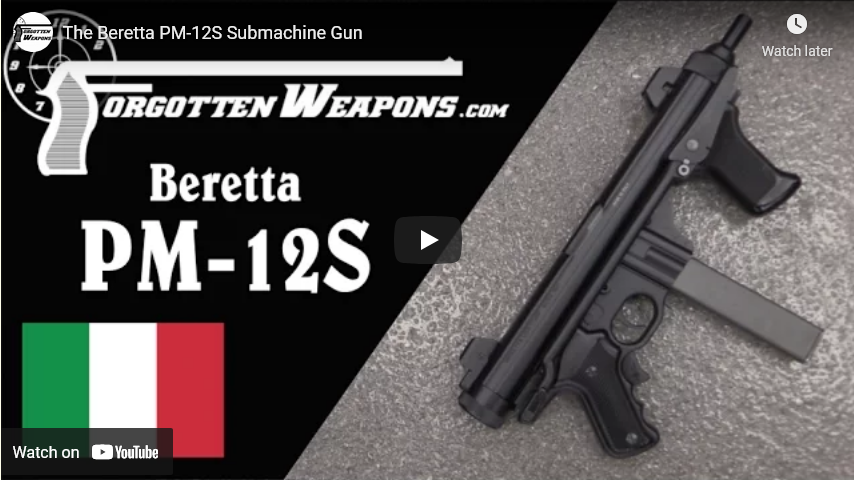
The Beretta PM-12S Submachine Gun

Filed under: Europe, History, Italy, Military, Weapons — Tags: , , , — Nicholas @ 02:00

Forgotten Weapons
Published 22 Apr 2017

For several decades, the Beretta company’s handguns and submachine guns were nearly all designed by the very talented Tulio Marengoni … but nothing can last forever. After World War 2, Beretta engineer Domenico Salza began working on a new SMG design, one which would be more compact and more controllable that the M38 family. At roughly the same time, Beretta changed its naming convention to avoid looking like it was still marketing old guns; the Model 38/49 become the Model 1. Each new design took the next number, until in 1958 the Model 12 was introduced.

The Model 12 (and this improved Model 12S) has both forward and rear pistol grips, and a bolt which wraps around the barrel well forward of the chamber. This movement of the reciprocating mass forward helps reduce the gun’s tendency to climb, and makes the Model 12 a quite capable design. It is still in common use with a variety of military and police forces today — including being a common sight in the hands of security guards in Italy today.

http://www.patreon.com/ForgottenWeapons

Cool Forgotten Weapons merch! http://shop.bbtv.com/collections/forg…

If you enjoy Forgotten Weapons, check out its sister channel, InRangeTV! http://www.youtube.com/InRangeTVShow

March 22, 2021

Apocrypha: Tour of the Kyrö Distillery

Filed under: Business, Europe — Tags: , , , — Nicholas @ 04:00

Forgotten Weapons
Published 21 Mar 2021

While I was in Finland for Finnish Brutality 2021, I took a day to hitch a train ride up to Isokyrö, about 400km northwest of Helsinki. The Kyrö distillery was founded there in 2012, making single malt Finnish rye whiskey and several varieties of gin.

Their own video does a fine job describing the origins of the distillery:

https://youtu.be/6Q35akNanEs​

But I wanted to get a look at the production process — and it’s impressively well set up! The rye is made in a pair of imported Scottish pot stills, and the gin uses a combination of pot and column distillation. They were kind enough to give me a tour of the whole place, so let’s have a look around!

They are distributed throughout the EU, and to a limited extent in the US.

https://kyrodistillery.com

(Apocrypha is a behind-the-scenes periodic series normally only available to Patreon supporters of Forgotten Weapons. Want to see more? Sign up to help support me directly at http://www.patreon.com/forgottenweapons​)

March 20, 2021

The Uzi Submachine Gun: Excellent or Overrated?

Filed under: History, Middle East, Weapons — Tags: , , , — Nicholas @ 02:00

Forgotten Weapons
Published 5 Mar 2018

The Israeli Uzi has become a truly iconic submachine gun through both its military use and its Hollywood stunts — but how effective is it really?

I found this fully automatic Uzi Model A to be actually rather better than I had expected. Despite the uncomfortable sharp metal stock, the rate of fire and large sights make this a relatively easy gun to shoot. Not one of the absolute best, but certainly above average.

http://www.patreon.com/ForgottenWeapons

Cool Forgotten Weapons merch! http://shop.bbtv.com/collections/forg…

If you enjoy Forgotten Weapons, check out its sister channel, InRangeTV! http://www.youtube.com/InRangeTVShow

Contact:
Forgotten Weapons
6281 N Oracle #36270
Tucson, AZ 85704

March 17, 2021

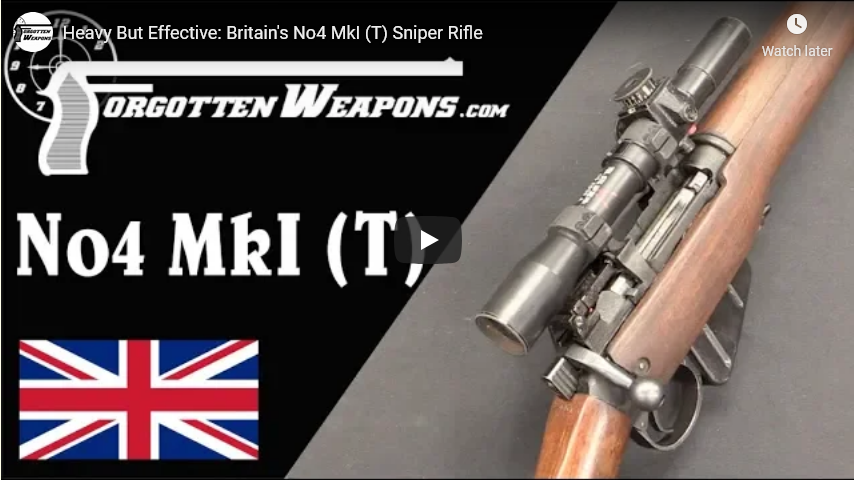
Heavy But Effective: Britain’s No4 MkI (T) Sniper Rifle

Filed under: Britain, History, Military, Weapons, WW2 — Tags: , , , , — Nicholas @ 02:00

Forgotten Weapons
Published 29 Aug 2018

http://www.patreon.com/ForgottenWeapons

Cool Forgotten Weapons merch! http://shop.bbtv.com/collections/forg…

The main British sniper rifle of World War Two, and arguably one of the best looking military sniper rifles of all time, the No4 MkI (T) was something the British military knew they would want even before the No4 MkI rifle had gone into real production. The first No4 snipers were built on leftover trials rifles from Enfield, and the pattern was formally introduced in February of 1942. First use was in North Africa, but the fighting there was not really suited to sniper rifles, and the weapon’s practical combat debut was in Italy in 1943.

The No4 MkI (T) was a conversion of a standard No4 MkI rifle, using examples chosen for particular good accuracy. They were sent to Holland & Holland to have scope mount bases added and No32 telescopic sights fitted (along with cheek risers on the stocks and having the battle sight aperture ground off to allow room for the scope bell). Between 23,000 and 26,000 were made during the war, and they would continue to be used in the British military for decades, including later conversion into 7.62mm NATO L42A1 rifles [which Ian discusses here].

Contact:
Forgotten Weapons
6281 N Oracle #36270
Tucson, AZ 85704

March 14, 2021

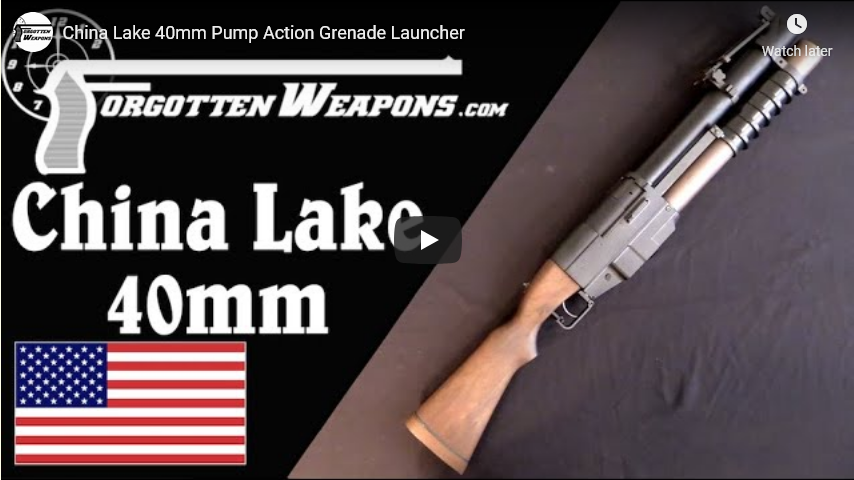
China Lake 40mm Pump Action Grenade Launcher

Filed under: Asia, History, Military, USA, Weapons — Tags: , , , , — Nicholas @ 03:00

Forgotten Weapons
Published 11 Dec 2020

http://www.patreon.com/ForgottenWeapons

https://www.floatplane.com/channel/Fo…

Cool Forgotten Weapons merch! http://shop.bbtv.com/collections/forg…

Possibly the coolest small arm used by the United States in the Vietnam War was the China Lake 40mm pump action grenade launcher. Only 24 of these were made, each fitted by hand. Of those, 2 went to MACVSOG, 2 to Army Force Recon, and the remaining 20 the the Navy SEALS. They were used as an ambush initiation weapon, with 4 rounds of rapid-fire 40mm HE grenades available.

Only five original examples survive today; four in US museums and military institutions and one in a museum in Saigon. An effort was made in 2004 to build reproductions, it is one of those used in this video. This project was not ultimately successful, but did lead to a very interesting series of events with the Airtronic company and the US Marine Corps, which will be detailed in a following video. Special thanks to Dutch Hillenburg and Kevin Dockery for making this video possible!

Contact:
Forgotten Weapons
6281 N. Oracle #36270
Tucson, AZ 85740

March 11, 2021

Italy’s WW1 Heavy Machine Gun: FIAT-Revelli Modello 1914

Filed under: Europe, History, Italy, Military, Weapons, WW1, WW2 — Tags: , , , — Nicholas @ 02:00

Forgotten Weapons
Published 9 Dec 2020

http://www.patreon.com/ForgottenWeapons

https://www.floatplane.com/channel/Fo…

Cool Forgotten Weapons merch! http://shop.bbtv.com/collections/forg…

Italy was the first major adopter of the Maxim heavy machine gun and had several hundred by 1914 — but wanted to have a domestic design in production as well. The Italian government and military put a lot of resources into the Perino machine gun, but kept it so secret that it was never properly tested and development was very slow. By the time war broke out, the Perino was clearly not ready for field use — and Maxims (along with other foreign designs) were no longer available for commercial sale as production was being taken up by warring nations. This led Italy to adopt a private design of Bethel Revelli in partnership with the FIAT company.

Adopted as the Modello 1914, Revelli’s machine gun was a delayed blowback system with a wedge under mechanical disadvantage holding the bolt closed long enough to safely cycle. Its most unique element was the 50-round mousetrap-type box magazine that used 10 independent stacks of 5 rounds each (a 100-round version was also made). This was a very complex magazine to produce, and much more delicate than the other machine gun feed systems in use at the time. The Revelli is also notable for being the only major machine gun of the period to have a circulating water jacket, operated by a small hand-cranked pump on the condensing tank.

The FIAT-Revelli would see service as both and aircraft and ground gun through World War 1, and was updated in 1935 to an air cooled pattern that would serve through World War 2. These guns are very scarce in the United States today, and I am grateful to the collector who owns this one for providing access to it!

Contact:
Forgotten Weapons
6281 N. Oracle #36270
Tucson, AZ 85740
March 8, 2021

M79: The Iconic “Bloop Tube” 40mm Grenade Launcher

Filed under: History, Military, USA, Weapons — Tags: , , , , — Nicholas @ 02:00

Forgotten Weapons
Published 4 Dec 2020

http://www.patreon.com/ForgottenWeapons

https://www.floatplane.com/channel/Fo…

Cool Forgotten Weapons merch! http://shop.bbtv.com/collections/forg…

Combat experience with the bazooka rocket launcher in World War Two and its larger versions in the Korean War convinced the US military that a better weapon was needed to give front-line troops a direct-fire way to attack enemy strong points. The bazooka was bulky, not particularly accurate, and created a lot of backblast signature when fired. This led to a multi-part development effort involving design of a small grenade body, reliable but cheap fusing system, and a cartridge design that could launch it.

The result was the 40x46mm grenade. It uses a “high-low” system (originally developed by Rheinmetall during World War Two) in which a powder charge is fired in a small compartment within the cartridge case. The initial pressure in this compartment is some 35,000 psi, which is plenty high to ensure complete and repeatable powder burn. At peak pressure, the internal compartment ruptures, allowing the propellant gasses to expand into the full case volume, which lowers the pressure to about 3,000 psi. This lower pressure is safe to use with an aluminum barrel, and propels the grenade at about 250 fps, giving it a range of about 400 yards without generating excessive recoil.

The M79 proved to be very accurate and reliable. Its downside was the need for the grenadier to carry a backup sidearm, as the M79 could not be used at close range. Almost as soon as it was introduced, work began on developing a launcher which could be attached to the M16 service rifle. This would first be the XM-148, and then ultimately the M203 that would replace the M79 in service. M79 launchers can still be found all over the world, however, as they are robust and reliable.

Contact:
Forgotten Weapons
6281 N. Oracle #36270
Tucson, AZ 85740
March 4, 2021

Teenagers vs the British Empire: Smith Bateman’s Hall Rifle

Filed under: Britain, History, Military, USA, Weapons — Tags: , , , , — Nicholas @ 02:00

Forgotten Weapons
Published 24 Nov 2020

http://www.patreon.com/ForgottenWeapons

https://www.floatplane.com/channel/Fo…

Cool Forgotten Weapons merch! http://shop.bbtv.com/collections/forg…

On May 20, 1826 the United States Congress formally presented Model 1819 Hall rifles with personalized silver plaques to the 20 members of Aikin’s Volunteers, for their “Gallantry at the Siege of Plattsburg”. The Volunteers were a group of 20 boys, aged 14-17, from the Plattsburg Academy who joined up under 21-year-old Martin Aikin to help in the Defense of Platssburg during the British Invasion in 1814. The boys acted as valuable scouts in the days leading up to the battle, and on the main day of fighting they manned positions at a mill on the Saranac River, preventing British troops from crossing under rifle fire. The American General Macomb commended the boys’ contribution to the battle, and promised each a rifle as a token. Of thanks. It would take Congress 14 years to fulfill that promise, but they finally did in 1826, with the only rifles ever presented to civilians by Congress before or since.

Contact:
Forgotten Weapons
6281 N. Oracle #36270
Tucson, AZ 85740

March 1, 2021

Solothurn S18-1000: The Pinnacle of Anti-Tank Rifles

Filed under: Europe, History, Military, Weapons, WW2 — Tags: , , , , , — Nicholas @ 02:00

Forgotten Weapons
Published 13 Oct 2017

Among all the antitank rifles developed between the World Wars, the highest quality and most sophisticated was the Solothurn S18-1000. It fires the 20x138B cartridge which was also used in the Finnish Lahti L-39 and the German 20mm Flak guns, and it does so using a semiautomatic action and an 8-round box magazine. It is a short-recoil system, with a rotating bolt rather similar to that of the MG-34 machine gun.

The recoil-operated action of the Solothurn helps dampen its recoil more than the Lahti, and is definitely a more comfortable gun to shoot. The Solothurn is equipped with both iron sights and an optical sight (we used the irons in this shooting, because the rubber eye cup on the scope is fairly hard and brittle on this example). Remarkably for its 100+ pound weight, the gun definitely jumps back a few inches when fired unless one has firmly sunk the bipod feet into the earth. However, the recoil force is really more of a push than a sharp impact, and combined with the large surface area of the shoulder pad it is not at all a bad experience.

A number of different countries bought the S18-1000 (and many others bought the smaller S18-100), including the Italians and Hungarians. The only combat account I was able to find was from a Dutch antitank gun team that used one to successfully engage several German armored cars during the invasion of the Netherlands in 1940.

http://www.patreon.com/ForgottenWeapons

Cool Forgotten Weapons merch! http://shop.bbtv.com/collections/forg…

If you enjoy Forgotten Weapons, check out its sister channel, InRangeTV! http://www.youtube.com/InRangeTVShow

February 26, 2021

Germany’s First Smokeless Carbines: the Kar 88 and Gewehr 91

Filed under: Germany, History, Military, Weapons — Tags: , , — Nicholas @ 02:00

Forgotten Weapons
Published 27 May 2018

http://www.forgottenweapons.com/germa…

http://www.patreon.com/ForgottenWeapons

Cool Forgotten Weapons merch! http://shop.bbtv.com/collections/forg…

With the development of the smokeless Gewehr 88 “Commission Rifle”, the German Army finally made a serious effort to bring their cavalry units up to a modern standard. There had never been a carbine variant of the Mauser 71/84 produced, and even by the late 1880s many German cavalrymen were still carrying single shot Mauser 71 carbines — or worse, converted captured Chassepots from the Franco-Prussian War. While the Karabiner 88 wasn’t in production quite as quickly as they would have liked, guns were coming off the factory line in quantity by the summer of 1890. The factories tasked with this production were not actually the major state arsenals, but rather two private companies in Suhl — CG Haenel and VC Schilling (although the Erfurt Arsenal would step in in 1891 to make a batch of 25,000 carbines).

The Kar 88 was remarkable light and handy, and designed for use in a cavalry scabbard, meaning that it had a nice slick profile. This became a problem when the Army wanted to issue the carbines for foot artillery crews as well, because it gave them no way to stack the rifles while tending to their artillery pieces. The result was the Gewehr 91, which was identical to the Kar 88 in every way except for the addition of a stacking rod under the muzzle.

Both the Kar 88 and Get 91 were already being slowly taken out of service before World War One, as the new Mauser 98 pattern carbines introduced in 1909 or 1910 were taking their place. This would change with the outbreak of war, of course, and every one of the 88 pattern carbines in German inventory would be issued out during the Great War. Their size and weight made them ideal for the troops who needed a personal weapon but were unlikely to actually have to fight with it (artillery crews, cyclists, supply drivers, balloon crews, etc). After the war, they all disappeared from military service, though. The arms limitations of the Treaty of Versailles gave Germany no reason to keep obsolescent arms, and they were discarded in favor of keeping Mauser 98 pattern rifles and carbines.

Contact:
Forgotten Weapons
6281 N Oracle #36270
Tucson, AZ 85704

February 22, 2021

The Best BAR: Luxembourg .30-06 FN-D at the Range

Filed under: Europe, History, Military, Weapons — Tags: , , , , — Nicholas @ 02:00

Forgotten Weapons
Published 17 Nov 2020

http://www.patreon.com/ForgottenWeapons

https://www.floatplane.com/channel/Fo…

Cool Forgotten Weapons merch! http://shop.bbtv.com/collections/forg…

I normally want to have something specific to demonstrate when I take a gun to the range, but today I don’t. What I have today is and FN-D, the very best iteration of the Browning Automatic Rifle (BAR) — and I just wanted an excuse to take it out to enjoy. Specifically, this is a Luxembourg contract FN-D chambered for .30-06. So, please pardon my flimsy excuse, and enjoy!

Contact:
Forgotten Weapons
6281 N. Oracle #36270
Tucson, AZ 85740

February 19, 2021

Krupp 50mm Mountain Guns for Siam (Thailand)

Filed under: Asia, Germany, History, Military, Weapons — Tags: , , — Nicholas @ 02:00

Forgotten Weapons
Published 16 Nov 2020

http://www.patreon.com/ForgottenWeapons

https://www.floatplane.com/channel/Fo…

Cool Forgotten Weapons merch! http://shop.bbtv.com/collections/forg…

Edit: The three interlocking rings are Krupp’s logo, not a Thai property mark — sorry!

In 1906, Siam (now Thailand) purchased a batch of 50mm mountain guns from Krupp of Germany. These were simple fixed-barrel guns with steel-belted wooden wheels. Designed to be carried by elephant, mule, or even soldiers, the guns disassemble into a number of man-portable pieces. Two different styles of rear sight were used, although it is unclear when one replaced the other. Today, these guns are a great choice for the cannon enthusiast as they have been specifically exempted from the NFA and thus transfer like any simple firearm (no tax stamp required).

Contact:
Forgotten Weapons
6281 N. Oracle #36270
Tucson, AZ 85740

« Newer PostsOlder Posts »

Powered by WordPress