
Christopher Hitchens used to have a cast-iron rule when it came to hardline Christians and the condemnation of some very particular sins of the flesh. […] I am beginning to wonder whether a similar trend is not emerging with another group, specifically that variety of men whom the internet — with its unerring ability to get to the cruel point — has come to describe as the “creepy male feminist”.
It is a distinctly 2010s phenomenon: the sort of chap who likes to present himself as a great spokesperson for, and defender of women and overdoes it so much that you just know that something else is going on.
He will invariably go beyond the usual courtesies and head some way past the point of merely regarding women as his equal. Instead, the creepy male feminist pulls a number of simultaneous moves. These include (though are not limited to):
- Presenting the plight of women in our society as distinctly worse than it is.
- Suggesting that everybody knows this but that some people (especially men) are deliberately covering for that fact.
- Making the suggestion — sometimes insinuated, often explicit — that nothing and nobody is more willing to stand between women as a whole and such rampaging patriarchs than the male in question. Anyone still unfamiliar with the type might recognise it under another entry in the lexicon of modern ignominy: “White knight” (n).
And a trend can now be observed, which is that with unnerving regularity the type of man who presents himself as the foremost protector of the entire female sex is precisely the person who shortly thereafter is exposed as having tried to help himself in distinctly un-gentlemanly ways.
Douglas Murray in “Beware the creepy male feminist: ‘White knights’ like Robert De Niro often turn out to be less than chivalrous”, Unherd, 2019-11-15.
May 23, 2024
QotD: The “creepy male feminist”
May 6, 2024
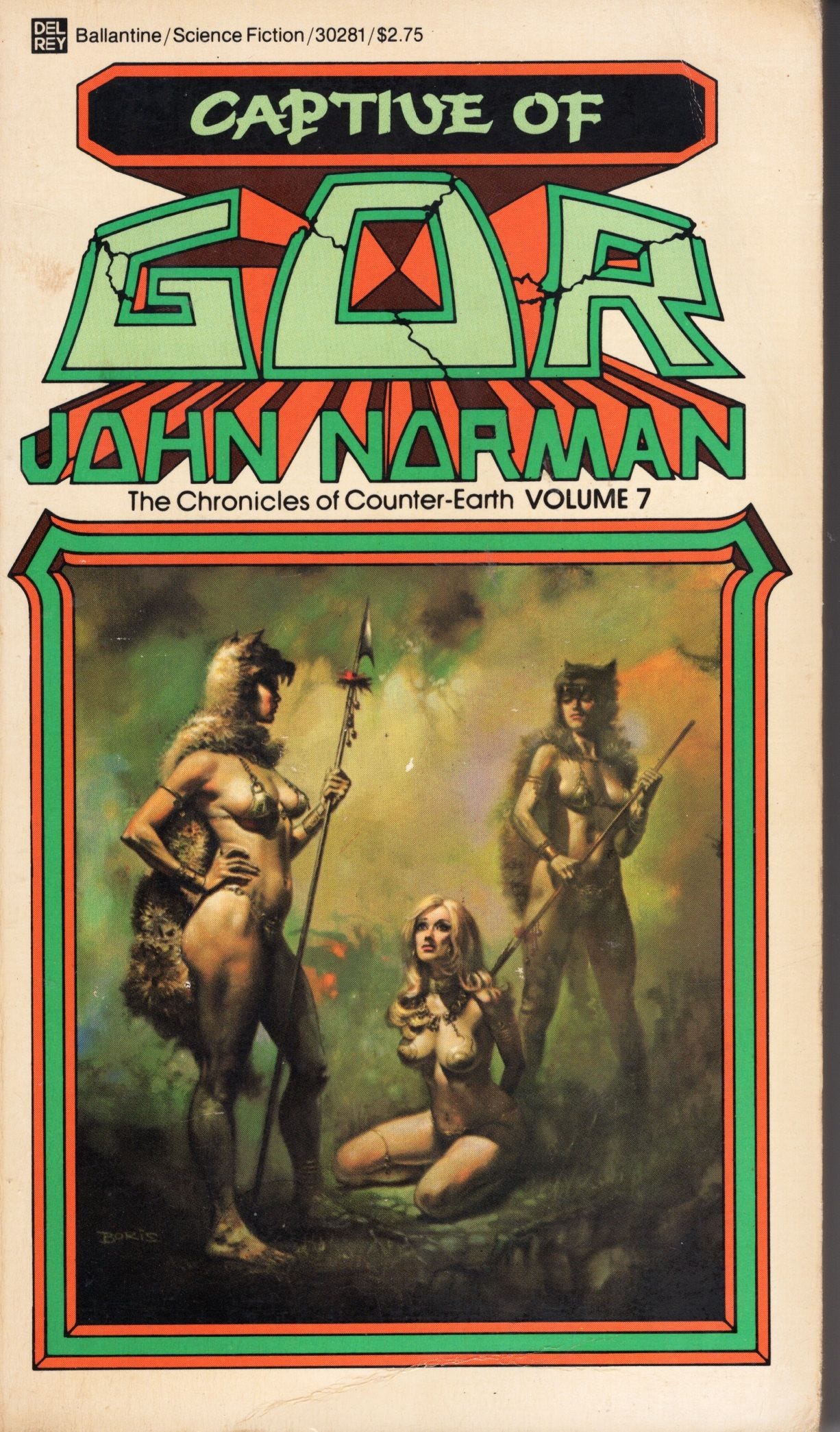
Kulak on banned fantasy novels hated by Feminists
There are books that get banned for all sorts of reasons — histories that tell the “wrong” facts, books beloved by terrorists, political tracts by wild-eyed fanatics, etc. — but they’re not the ones Kulak is talking about here:
… the fiction books that are banned are usually fictionalized versions of those, works like Camp of the Saints, or The Turner Diaries, despite their ability to move people emotionally are not banned for their emotional content but for their political content (and in the case of The Turner Diaries its accurate instructions on bomb making)
HOWEVER! There is one series that was driven from bookstores, and by the late 90s was almost totally disappeared based purely on the … “feelings” … it generated in its readers. A fantasy series set entirely on another world with more or less nothing to say about politics back on earth, awakened … stirrings … in its readers so disturbing to the powers that be it had to be stopped.
The Chronicles of GOR by John Norman (Pen-name of Philosophy Professor John Lange)
Begun in 1966 and continuing to … today (he’s 92), the 38 book series is a Pulp Science Fantasy series in the vein of Edgar Rice Burroughs’ “Barsoom” series (shout out to John Carter of Postcards From Barsoom)
It has a lot of neat fantasy/historical/military hypotheticals to get the young male mind going “what if Vikings raided Japanese samurai cities with flying monsters?” but the thing that outraged the feminists and what they’d never admit enraged them, was its effect on female readers.
Norman has a lot of theories about sex … theories which his millions of books sold suggest are very true. Theories which recent DNA discoveries have confirmed.
At SEVERAL points in the genetic record you and nearly everyone on earth, have approximately 17 female ancestors for every 1 male ancestor.
This was of course the result of patriarchal warfare, polygamy, and sexual slavery … The kind familiar to any readers of the Iliad.
Indeed Norman cites Homer, Freud, and Nietzsche as the primary influences on his philosophy.
But whereas this produced the ancient and then modern warfighting man boys and young men idolize from the Iliad, through Rome, to the Mongols, to the adventures and conquests of early modern Europe. And whose feuds and daring consume half the plot of Norman’s stories …
The real controversy is what it produced of the women.
Women are natural slaves Norman tells and in the later books shows (the books greatly improved over time: don’t read them in order)
While these periods of slaving warfare between peoples and tribes produced modern technical, competent, highly coordinated and cooperative man … In women it produced natural slaves. Women who’d long for the chain, women who’d desire nothing so much as to be owned and to submit to a powerful violent man not of their choosing … women who’d never feel so “””empowered””” as when they obey, and surrender the spirits, bodies, and wombs which they cannot defend. Who’d never feel so loved and wanted as when they are abused and disdained.
This is the world and theory of mind Norman paints with a philosopher’s attention to completeness … 38 books deconstructing and undoing not only modern feminist ideas of equality, but Christian ideas of the equality of the soul and nobility of the feminine spirit. By any standard maybe the most sexist misogynistic books ever written, not out of ignorance or resentment but a philosopher’s indifference to any social or ethical preening that might impede the truth …
And women freaking loved it.
I encountered Captive of Gor at a mainstream book store in Mississauga in about 1975, and I was amazed that it was available for sale in still-pretty-conservative Ontario. I read several of the other books in the series, but I had no idea the author was still adding new volumes down to the present day. I can’t remember the last time I saw one for sale, but I guess the fans can still get their hands on them even if ordinary book stores no longer carry them.
QotD: Confident cultures … unlike our modern one
Only in the modern period do we feel we need black-letter law for everything. And once we’ve got formal law, of course, the very next thing we do is start carving out penumbras and emanations, because we are so far from a self-confident culture that we must constantly prove to ourselves what clever, clever boys we are …
Severian, “Barely Legal”, Rotten Chestnuts, 2021-06-21.
April 11, 2024
Disney: go woke, go broke?
spiked
Published Apr 10, 2024
The Walt Disney Company has gone from being an international treasure to an international laughing stock. Its films are flopping at the box office and fans are fuming. All because it has gone ridiculously woke, to an almost comical degree. No Disney film, franchise or TV series is now complete without clunky “progressive” messages about diversity, feminism and gender. The company has even started picking fights with anti-woke politicians. Here, Lauren Smith documents Disney’s Great Awokening – and the fan revolt against it. Watch, share and let us know what you think in the comments.Support spiked:
https://www.spiked-online.com/support/
Sign up to spiked’s newsletters: https://www.spiked-online.com/newslet…
Check out spiked’s shop: https://www.spiked-online.com/shop/
April 5, 2024
In the still-ongoing “war of the sexes”, when can women just accept they’ve won and cease hostilities?
At the amusingly named Handwaving Freakoutery, you can see a scorecard for the war of the sexes that has been ongoing since I was a child and seems no closer to ending than back in the 1960s:
I say this to make it absolutely clear that unlike a lot of boorishly banal material you might encounter within the wretchedly named “Manosphere”, this is not intended to be a whiny article. I’m not complaining, nor am I calling for societal change or action. I’m simply wondering exactly how dominant female privilege has to get before they declare victory and take their boot off the necks of men. I really don’t know the answer to this question, but we’ll speculate about that below after the wall of graphs. HWFO loves graphs.
Herein we will go point by point through as many measurable societal markers as I can think of, leaving no marker unmarked, and put together a Gender War Scoreboard describing as accurate a snapshot as possible of the current state of the United States. Then we’ll close with some analysis about how badly it would have to get before the women finally just declare victory and move on. This post shall be too big for email.
To assign our score, we will look at sets of data that fall generally into two categories. For victimization ratios and similar, we’ll just look at percentage by gender. For comparing two uncapped sets of data, such as life expectancy, we’ll look at a ratio and make them both add to 100 for an apples-to-apples comparison. Then we’ll add them all up at the end to tally the score.
Salary
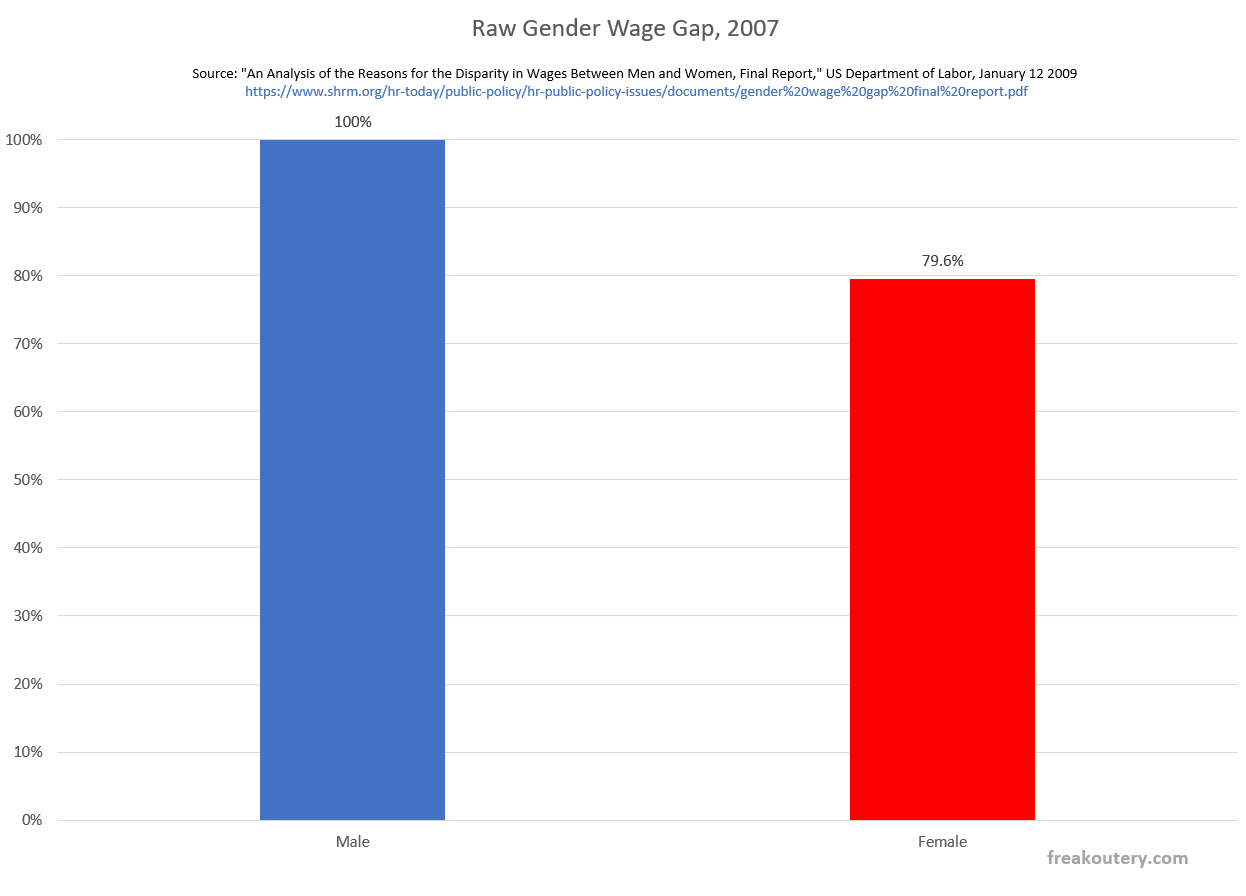
HWFO covered the gender wage gap in 2022, but I’ll summarize it here so you don’t have to read back. According to a 2008 analysis by the Department of Labor, now 16 years old, the raw gender wage gap was 20.4% in 2007:
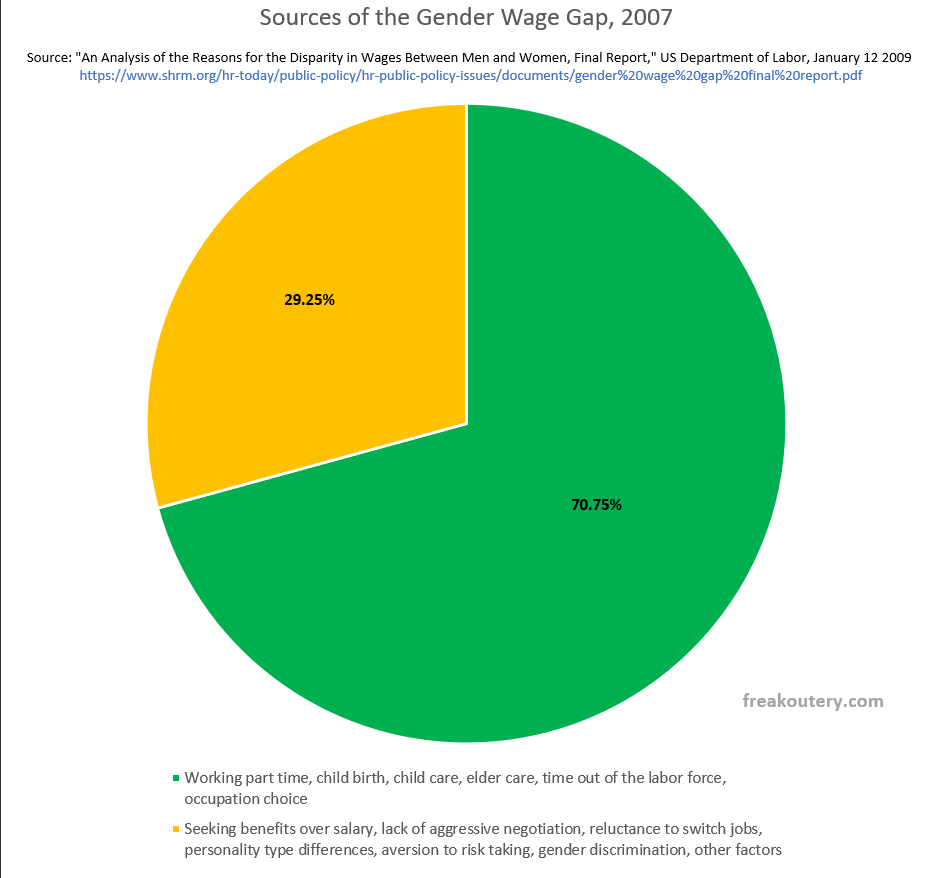
Most of the gap was explainable by career choice and lifestyle choice differences:
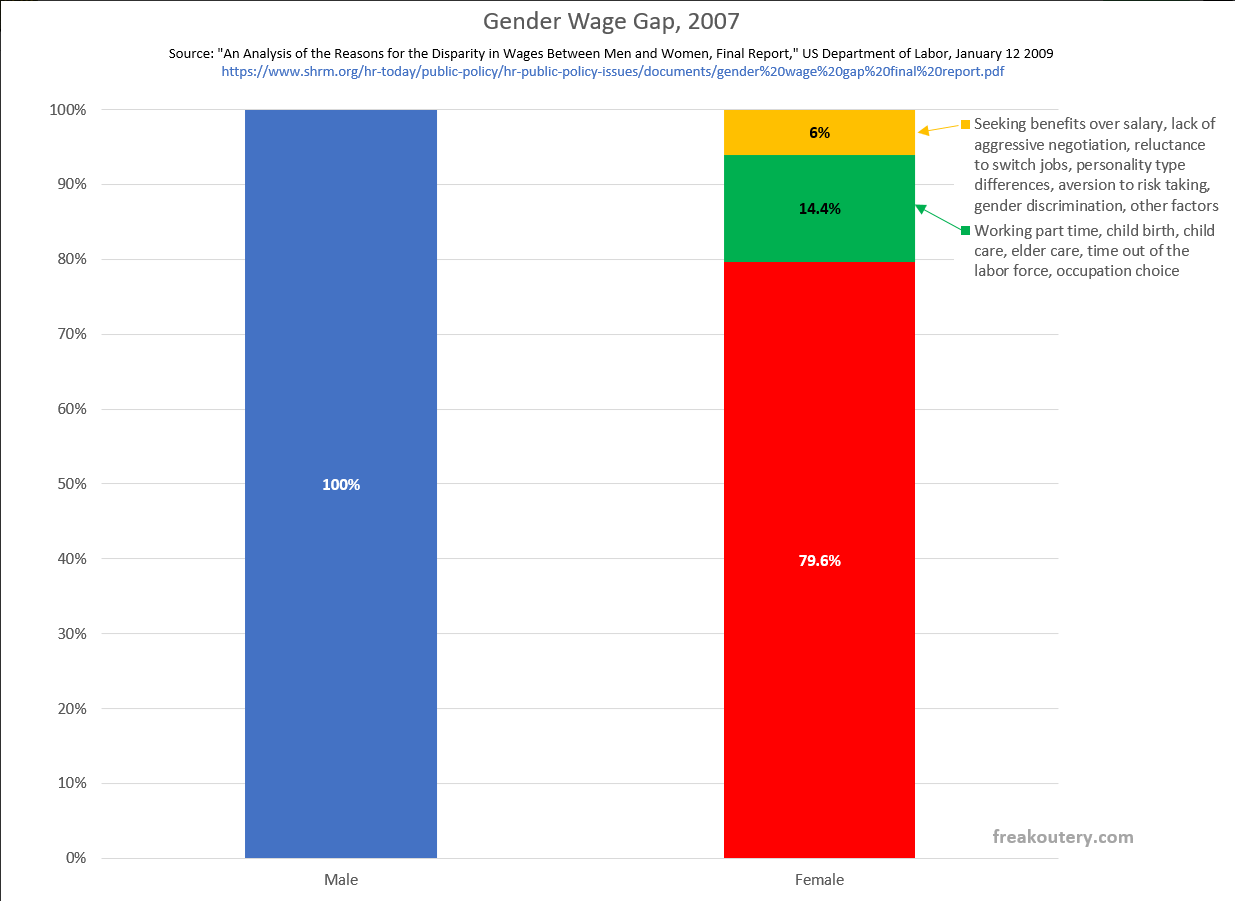
When compared properly that looks like this:
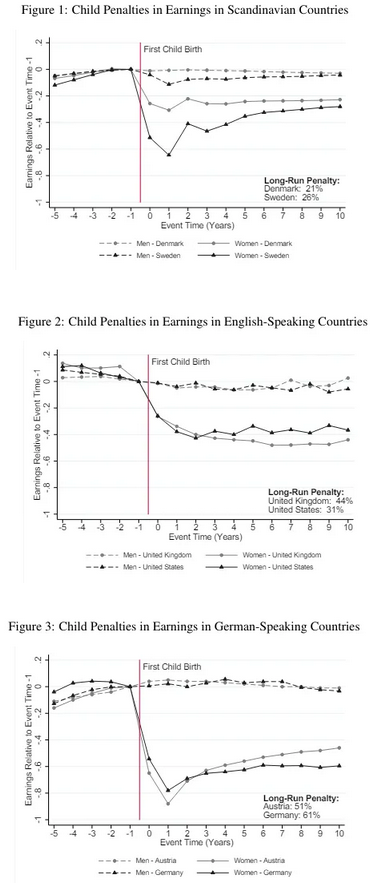
Sixteen years ago, the bits of the gender wage gap that weren’t explained by career and life choice differences only totaled 6%. This fact has been known for a decade and a half and is constantly hidden from view by Pew, the NLWC, and any other major organization that profits from the perception that this gap is large and persistent. It has also assuredly closed to narrower than that 6% in the ensuing decade and a half, but nobody’s replicated the Department of Labor analysis. Look closely at the effects in the green bar identified by the Department of Labor. “Child birth” is how you become a mother. “Child care” is something mothers do. “Working part time” is something mothers do. “Time out of the labor force” is something mothers take. “Occupational choice” is something women change when they become mothers. Here are some graphs from Kleven et al, March 2019:
The solid lines are women. In every studied area, the women make equal or more than the men do up until the birth of their first child, and then they make less. The gender wage gap difference is in the choice to have children. Women choose to make professional concessions to raise a family while the men don’t. Is this fair? Some might say no, but only if they also don’t want to be the primary caregiver for their kids. Some would say yes, for the following two reasons: (1) women choose this, especially in feminist societies, but also (2) men are punished socially for choosing this. If you do not believe me, go make two fake male Tinder profiles with identical cute photos in them, and in the bio of one say “corporate lawyer” and the other say “part time daycare worker” and see which one gets more hits. Then do the same with a female profile. Men are socially punished by women for making the career concession, women are not socially punished by men for making it.
Often when these sorts of “equal pay for equal work” studies are properly controlled for mothering and career choice, they find that men are paid less than women for equal work. Google was pretty famously forced by their neo-progressive staff to do an internal analysis of the subject, and uncomfortably discovered they were overpaying women for being women on an “equal work” basis. The results were twofold. First Google paid all the men a one time bonus, then Google quietly never investigated it again so they could get back to paying women more.
March 19, 2024
QotD: “Not In Our Name”
Mark Steyn, “Omar’s Girls”, National Post, 2001-11-29.
February 22, 2024
The feminization of movies – the Luke Skywalker Effect
Like Lorenzo Warby, I was a fan of the first three Star Wars movies, but rapidly lost interest as the series progressed (I think I watched about half of Attack of the Clones before giving it up as a hack job). Here he gives his opinion on one of the biggest reasons why the later movies sucked:

I am, in many ways, a Stars Wars kid. I can remember sitting in a cinema in 1977, listening to the music play as the opening words flowed across the screen and the sound of the Star Destroyer rumbled out of the speakers and thinking “Yes, a film by One of Us”. That is, a film made by a genuine fan of SF.
A film, moreover, that gave us epic characters. Luke Skywalker: young, eager, physically skilled, charmingly gormless. Han Solo: charismatic rogue (who definitely shot first, that’s what charismatic rogues who read the room do). Princess Leia: the epitome of the competent-beyond-her-age young woman making sure the boys don’t get above themselves. Darth Vader: the looming — and yes charismatic — menace. Chewbacca: scary loyal sidekick. Obi-wan Kenobi: wise, world-weary, teacher with intriguing powers. Grand Moff Tarkin: the ruthlessly competent minion that autocrats both want and fear.
A film that was fun, that was embedded in an intriguing universe. A film that understood the need for training, the hero’s journey, building teams. The briefing of the fighters before the attack on the Death Star is a classic example of informing the audience by letting them see the process of getting everyone on the same page.
I loved the first three films: yes The Empire Strikes Back (1980) is the best of them. I was not entirely sold on the Ewoks, but they were fun. Those films were a huge success for very good reasons.
I was less impressed with the prequels. I described The Phantom Menace (1999) as “Star Wars for six year olds”. Lucas should have stuck with the pattern that worked so well for The Empire Strikes Back — get a good director and have good scriptwriters tighten up his story.
When Lucasfilm was sold to Disney, I was actually pleased. Disney, I thought, knew how to tell stories. Rogue One (2016) seemed to be a vindication of that.
When The Force Awakens (2015) came out, I was so happy to have a big screen Star Wars epic film, I just went with it. There were huge problems with the character of Rey, but I wanted to be taken for a ride, and so was: in so many senses.
Looking back, the writing down of the character of Han Solo was a big red flag. In the original trilogy, he grew as a character, as a person. In the first of the sequel trilogy, we were presented with a broken down, ageing failure as husband and father who had decayed to less than what he was when we first met him.
Meanwhile, we had the Mary Sue of a Rey who was just better than the boys as everything, including running the Millennium Falcon. She didn’t need training or experience, she was just naturally awesome because … girl.
Hollywood pretending that women have the same upper body strength as men is pretty pathetic, but never as pathetic as in the light-sabre fight between Rey and the Emo-Teenager Discount Darth Vader aka Kylo Ren. Yes, Ren was wounded, but years of experience and training counted for naught against Rey because … girl.
The Last Jedi (2017) was so much worse. Again, I wanted to like it, but things just niggled at me all the way through, despite my wish to enjoy the ride.
Once I got out of the cinema and began to consider what I had watched I became very angry. The chubby Chinese girl and belittled Black guy side plot was tired agitprop. Snope had been built up as epic villain but was disposed off with ridiculous expedition without any backstory explanation. Admiral Gender Studies was a study in pathetically bad leadership who clearly had no idea of how to build a team yet presented as a righteous authority. Poe Dameron was diminished into Male Initiative Is Bad Because Toxic Masculinity morality-play persona.
Epic military scenes do not work as parables. Parables subordinate story and character to didactic purpose. Epic military scenes really do not work as parables when the didactic purpose itself is so pathetic.
This is all bad enough, but the unforgivable crime against the entire legacy of Star Wars was what was done with Luke Skywalker’s character.
The original Luke Skywalker was a study in epic heroism. Yes, he was genetically advantaged, but he also trained to hone those advantages. He was not only physically brave, he was morally brave. Alone, captive, in the hands of his enemies — having deliberately surrendered to save his friends — he refuses to strike his father down. Alone, he defies the Emperor to his face and suffers terribly for his decision. He earned his capacities and his heroic standing.
What are we presented with in The Last Jedi? A broken and pathetic shadow of his former self. The offhand disposal of Snope has the effect of belittling the characters of Han Solo and Luke Skywalker even further. Their son, nephew and disciple had defected to the Dark Side because of … an explanation that made no character sense at all.
Seriously, the man who had shown that level of moral courage decided to kill his disciple and nephew because he had disturbing visions? It was an insult to the character, to the legacy and to the audience.
The sequel trilogy, particularly The Last Jedi, was a profound insult to legacy. To the legacy of Star Wars and to legacy within Star Wars. Thus was another parable pushed: legacy is pathetic and needs to be abandoned and subverted. The contemporary progressive contempt for all past human striving — it’s so full of male faces don’t you know, and (in the West) white ones — in fictional form.
We were presented with a universe where men fail as mentors and examples and women don’t need such. The later added-in training of Rey in The Rise of Skywalker was a pathetic patch on a deeper story-telling failure.
Any white male was pathetic, a failure, evil, stupid, toxic or some combination of the same. Meanwhile, the protagonist was great because … girl.
This was a vision that is sexist-racist, in a quite deliberate fashion.
The completion of the trilogy in The Rise of Skywalker (2019) had interest only to see how they were going to resolve (or not) all the story-telling holes The Last Jedi had lumbered the trilogy with. Bringing back Ian McDiarmid’s Palpatine — easily the best thing in the prequel trilogy — was a sign of desperation, of creative exhaustion.
Each of the films in the sequel trilogy did worse than at the box office than the one before. A very clear statement of a legacy being run down.
January 11, 2024
The Canadian Armed Forces believe “that they – and the country they serve – are irredeemably racist and oppressive”
The official journal of the Canadian Armed Forces has a … woke … view of themselves and the nation:
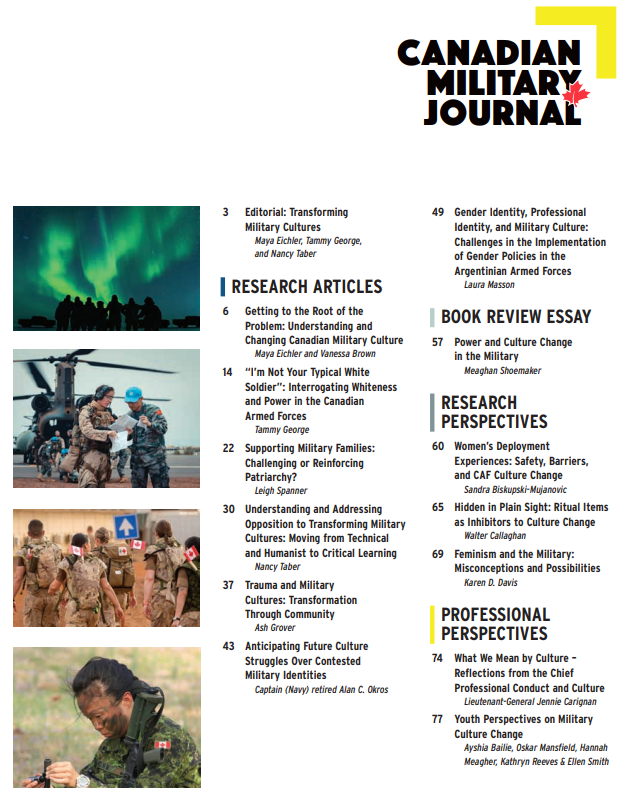
… the latest edition — which was just posted online — contains little to no mention of strategy, geopolitics or the avalanche of contemporary problems facing the Canadian Armed Forces. There’s not a single reference to the recruiting crisis, which has left vacancies of up to 40 per cent in some departments. No mention of the plummeting maintenance standards that recently prompted the commander of the Royal Canadian Navy to declare that his fleet was in a “storm” with no end in sight. No discussion of why Canada is slashing its military budget even as its peer countries do the exact opposite.
Instead — in a signal of just how far the Canadian Armed Forces has embraced far-left “anti-racist” ideology — the entire issue is devoted to how the Canadian military is a racist, patriarchal den of colonialist oppression that needs to be torn down and remade from scratch.
After devoting extended paragraphs to each cultural infraction, Eichler concludes that the Canadian Armed Forces must be remade via an “anti-oppression framework” of “feminist, decolonial, critical race, queer, critical disability, and critical political economy theories”.
Eichler notes this is “not an easy task, but a necessary one if DND/CAF wants to move the yardstick on culture change.”
Another feature, by York University psychotherapist Tammy George, frames the Canadian Armed Forces as being poisoned by “institutional whiteness”.
“In order for meaningful, sustained culture change to occur, there must be a recognition by the white majority of the way in which whiteness organizes lives,” she writes.
Leigh Spanner, a feminist postdoctoral research fellow, wrote that the CAF’s system of supporting military families was anti-feminist and patriarchal.
Ash Grover, a researcher in “feminist anti-militarism”, argues that the military might have fewer instances of post-traumatic stress disorder if they paid closer attention to “anti-oppressive theory” and how “acts of ‘othering’ can result in responses typically associated with post-traumatic stress disorder”.
December 14, 2023
Whatever it is, it sure ain’t Stoicism …
Freddie deBoer doesn’t have a catchy name for this, but you’ll recognize it instantly from the description:
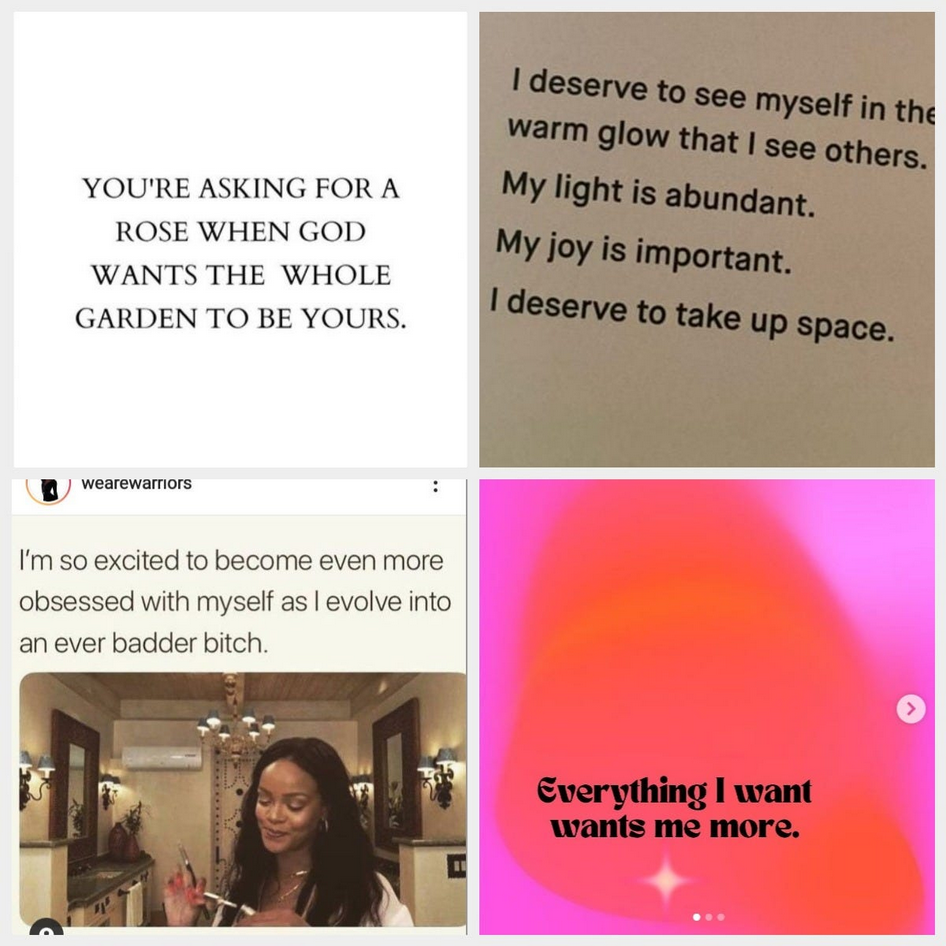
For years now, I’ve written once or twice annually about a phenomenon that I’ve struggled to name but which everyone understands. It’s a particular kind of social and aesthetic culture, not exclusive to Instagram but very heavily associated with it, that merges girlboss feminism with the contemporary therapeutic imperative, a strange syncretic mysticism involving horoscopes and “manifesting”, and a blanket excuse for narcissism and selfishness dressed up in quasi-political and self-help terms. You know what I mean.
Some of these memes are comically ridiculous, most of them are fairly innocuous, and a few of them make me deeply sad. But they all reveal a tangle of conflicting attitudes and ideas that are quite confused. You would never assemble these various impulses into a life philosophy on purpose; they’ve been grafted together mostly thanks to the weird rhythms and path dependence of social media. Either way, I’ve argued that they present an essential problem with any kind of “I can have it all” philosophy — millions of people absorb this stuff, and because many of the things we want in life are zero sum, not all of them in fact can have it all. Almost all of them, in fact, will get very much less than it all. You have this absurd manifesting/The Secret stuff, where grown adults genuinely convince themselves that they can will what they want into being simply through wanting it. Well, alright: what if two people want the same promotion at work, and they’re both manifesting it? The clod philosophy this is all attached to says that whoever wins wanted it more, and since wanting can’t be quantified, no one can ever prove that isn’t true. (Convenient!) Regardless, in the case of the singular promotion and two people manifesting for it, only one of the people who has read endless memes like these actually ends up being self-actualized by success. This is OK; life can be full of contentment and disappointment at the same time. Part of what makes this kind of messaging pernicious, though, is that it suggests that not getting everything you want is always a personal failure you shouldn’t accept.
It is not possible that God promised the whole garden to everyone. (That’s not how fractions work, even for God.) It is not socially responsible to believe that you are entitled to the whole garden. And setting yourself up to see anything short of the whole garden as failure is a recipe for making yourself miserable.
That’s related to another point I’ve made, which is that these memes create an unachievable expectation that healthy, successful women aren’t in possession of ordinary confidence but of lunatic confidence, a kind of confidence rarely seen outside of Michael Jordan or bipolar mania. In a particularly perverse irony of the sort that seems to usually afflict women, this demand for outrageous self-confidence becomes just another bar that women feel like they can’t meet. A whole affirmational culture that ostensibly exists to help and affirm and praise women ends up being just one more on the long list of expectations that our society heaps on them: hard-charging and career-oriented but always putting family first, well put-together but always effortless, sexy but not slutty, Madonna and whore, you know the whole deal. I’m sorry that this stuff is so gendered, but it is, and I’m sorry that I’m the wrong messenger on this topic, but no one else is making these arguments, so I must. Yes, I concede that for most people who indulge in this stuff, it’s a harmless hobby that maybe pushes them to be a little better to themselves. But as time goes on, the messaging has grown more and more deranged, and young people are very susceptible to this sort of thing. And my job is to worry.
November 18, 2023
Believe all women … unless they’re Israeli
In The Line, Kristin Raworth and Ariella Kimmel protest against the objectively pro-Hamas silence of so many feminist organizations about the terror attacks of October 7th:

On October 7th, 2023, Hamas terrorists infiltrated Israel and committed the worst massacre of Jews in a single day since the Holocaust. More than just a massacre, Hamas tortured their victims, including brutally raping women, young and old. Yet the silence of many women’s organizations and leading voices who stand tall, claiming to be “strong feminists”, is deafening.
When the #MeToo movement started, the mantra was “believe all women”. As high-profile women spoke out, the feminist movement stood with them. So why, in the wake of the most horrific terrorist attack in Israel’s history, which included rape, do these women not deserve the same solidarity?
A month later it is not just the complete silence of the women’s organizations that causes pain, it is the active justification and gaslighting of the Jewish community, which has including denying the truth of what happened on October 7th, by demanding proof, rather than believing survivors. Many may recognize these tactics as those used as abusers against their victims in cases of domestic and sexual violence, a tactic that has become known as “DARVO” — Deny, Attack, and Reverse, Victim Offender.
When reports first surfaced of the sexual assaults committed by Hamas, many of us took to Twitter, the only place where we knew to raise our voices. Immediately our replies were filled with folks who otherwise would believe survivors, but were seemingly comfortable demanding immediate forensic evidence in this case. Survivor accounts were not enough; even a video released by the Israeli government that painted a clear picture of Hamas’ brutality was not enough. Hamas terrorists themselves recounting their actions was not enough.
Sarah Jama, an MPP in Ontario, has gone so far to publicly state that the accounts of rape are a lie pushed forward by the “zionist lobby”.
We have seen people like Ghada Sasa, a former board member of Canadians for Justice and Peace in the Middle East, going on a podcast and not just claiming that Hamas treated civilians fairly, but that Israel was to blame for the massacre at the Nova music festival.
Meanwhile member of Parliament Niki Ashton claimed that a “feminist government” would call for a ceasefire; yet she has not once condemned the use of rape by Hamas as a war crime. This is a highly selective read of feminism.
November 13, 2023
Winners and losers of the “sexual revolution”
Janice Fiamengo missed her trip to London this week due to illness, so she also missed a panel discussion at the ARC (Alliance for Responsible Citizenship) Conference that raised her ire:
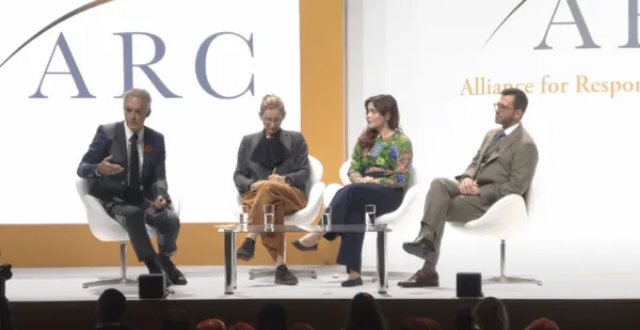
On the subject of widespread sexual promiscuity, family breakdown, and fatherless homes, pundits Jordan Peterson, Louise Perry, Mary Harrington, and Stephen Blackwood carefully ignored the hulking feminist elephant in the room, arguing that the primary victims of the sexual revolution have been women (and children as well, as something of an afterthought). The primary beneficiaries have been a few psychopathic men who have left a trail of broken hearts and rudderless children in their wake. It’s a convenient thesis in a culture terminally averse to criticizing women, but it avoids some important facts.
The whole discussion, actually, begins from a false premise. If there was ever a sexual revolution in which we all simply consented to do what we wanted sexually, as Louise Perry claimed, that revolution ended over 30 years ago when Anita Hill complained before a Senate Judiciary Committee that Clarence Thomas, former chair of the Equal Employment Opportunity Commission, should not be confirmed as a Supreme Court Justice because he had once joked to her about a pubic hair floating on his Coke. At that point, the alleged sexual vulnerability of women, whose sensitive ears must not be subject to comments by male colleagues about pornography or penis size — and the need for legislation to protect and accommodate them at the expense of male freedom of expression — reasserted itself with a vengeance. The feminist claim that women merely wanted equal rights and an end to sexual double standards was exposed as a feeble lie.
Sexual harassment legislation soon made it a potential firing offence for a man to make a female workmate uncomfortable, whether by standing too close, looking too intently, or making the wrong joke or comment. Later, the #MeToo movement proclaimed it righteous that any man who had ever been sexual with any woman (or even just any man, who didn’t even have to know the woman smearing his name) could be accused of sexual misconduct, fired from his job, and permanently disgraced (the DAMN Handbook contains an extraordinary list of celebrity men destroyed by allegations in 2017 alone; see pp. 8-17). Free love, if it ever existed, has been dead for a long time, and some of the same women who cheered on the idea of sexual freedom were the ones who killed it.
But #MeToo, false allegations, the ever-expanding territory of sexual misconduct, and the anti-male tenor of nearly every public discussion about sex—these were emphatically not the focus of the ARC panel, which zeroed in on female sexual victimization. The goals that countless women have proclaimed necessary—sexual freedom, abundant birth control, single motherhood—were criticized as harms for women. We heard that the medium to long-term well-being of women and children has been sacrificed to the short-term gratification of a minority of men; and that these men also tend to be, according to Peterson, possessed of psychopathic, Machiavellian, narcissistic, and sadistic tendencies. Amongst the fallout are the 50% of British children raised in homes without fathers.
It was stirring stuff, certainly, though not exactly a new proposition. Radical feminists like Sheila Jeffries have long argued (in her book Anticlimax: A Feminist Perspective on the Sexual Revolution and elsewhere) that the sexual revolution merely affirmed and updated the victimization of women by men while conservative non-feminists like Phyllis Schlafly pointed out how feminist policies and laws have disadvantaged women.
Yet even those of us without doctorates in psychology might wonder how it could be true that so many women have been the innocent and unwitting victims of men even when they themselves chose those men. Are there not women who engage in abundant casual sex with as much blithe indifference as the men; some of them too psychopathic, narcissistic, Machiavellian and cruel? Why have so many women over the years championed the loosening of sexual mores — including the availability of abortion, never mentioned by any of the panelists — if it was not in their own best interests to do so?
Or are these panelists saying that women cannot be trusted to know their own best interests and those of their children? Why do so many women continue to embrace sexual hedonism, abortion, and divorce? In reality, the epidemic of fatherlessness, as nobody on the panel was interested in exploring, is not the result of the sexual revolution per se, but was made possible specifically by the rise of no-fault divorce and child support laws that, in feminist-compliant family courts, made it highly attractive for women to discard their husbands while still living off his earnings (divorce is today initiated by women in about 70% of cases, and is one of the major reasons so many young men today are averse to marriage). It may well be that nobody’s long-term well being is served by this reality, but it is what women have been choosing with their eyes wide open for many years, and it is a bit rich now to pretend it was something done to them without their consent.
October 17, 2023
Those problematic “AI girlfriends” – men suck and women suffer because of it
Janice Fiamengo discusses a recent CNN program that woman-splained why young men paying for “AI girlfriends” are yet another way that misogynistic men are harming women:
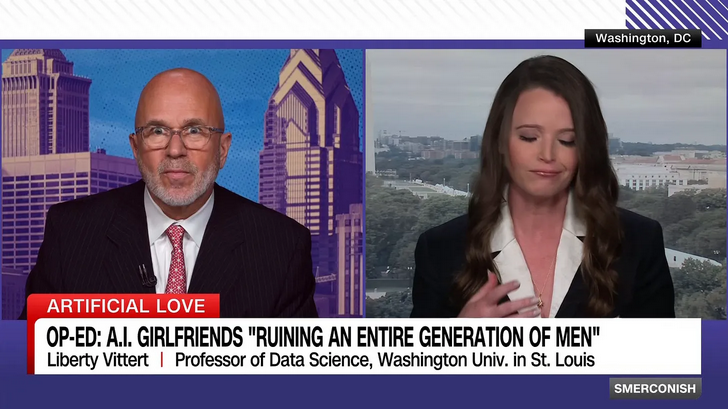
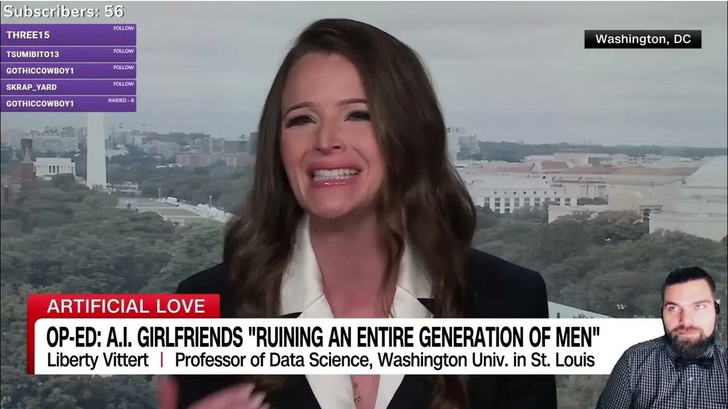
Last week, CNN aired a must-watch episode with the somber headline, “AI girlfriends are here and they’re posing a threat to a generation of men”. If that sounds as if the show might possibly express some compassion for young men and for the “epidemic of loneliness” referred to in the show, it was not to be. Even an expert, Scott Galloway, profiled briefly on how society is “failing men”, felt the need to express contempt for their alleged conspiracy theories, online misogyny, and even (gasp!) climate change denial. With friends like these …
The segment is fascinating, however, for its revelation of some pundits’ uneasy awareness of male discontent.
[…] The expert is Liberty Vittert, a statistician and professor of data science at Washington University’s Olin Business School. But she might as well be an AI feminist, so predictable was her analysis of the male entitlement allegedly driving the turn to AI girlfriends. Though a statistician, Vittert gave no data about the numbers of men who are paying to access AI content. While the CNN host, Michael Smerconish, seemed open to the possibility of exploring men’s points of view, the expert could only emphasize male failure.
She condemned young men for “choosing AI girlfriends over real women”. The choice means, according to Vittert, that “they don’t have relationships with real women, don’t marry them and then don’t have and raise babies with them”.
But wait, aren’t marrying and raising babies a patriarchal imposition on women — part of the “comfortable concentration camp” that Betty Friedan so memorably indicted?
Professor Vittert says nothing about the decreasing number of young women willing to marry and procreate. Her (botoxed) mouth turns down in disapproval as she explains that the increasing realism of AI is “enabling this entire generation of young men to continue in this loneliness epidemic”. It seems that men prefer sterile self-pleasuring and facile scopophilia to the “hard work” of relationships with real women. Like Joaquin Phoenix’s hapless character, these men, she says, are so fixated on perfection that they “are not able to deal with ups and downs, not only in a relationship, but in life in general”. The glibness of the condemnation is remarkable, though far from unusual.
It’s not clear if Professor Vittert has ever talked to actual men about why some of them (not “an entire generation”) might choose an AI relationship. Does she know any young men who have tried for years without success to find a marriageable girlfriend? Many discover that such prizes are remarkably thin on the ground, many of them unsuitable to be considered as future mothers. Even worse, perhaps, does Vittert know anything about what can happen to an inexperienced young man who pursues the wrong woman or women (there are a couple of heartbreaking examples in Sons of Feminism)? How many times does a young man who has failed repeatedly need to hear that no woman owes him love or sex before he starts thinking that giving up on them might not be a bad idea? Meanwhile, women laugh at his loneliness and drink “I bathe in male tears” mugs.
To give him credit, CNN’s Smerconish asks a few questions about the male point of view: “What’s going on with the women?” Has the power dynamic shifted in their favor? Are they less approachable than formerly? These only scratch the surface, but he’s chosen the wrong expert for such a conversation.
Vittert freely admits that there are now many more women than men at university (thanks, affirmative action!) and that far more women than formerly are choosing career over homemaking (thanks, feminist propaganda!). But those are good things, and young men simply need to adapt. Calling any of this debacle women’s fault, she declares, would not be “the right way to go”.
October 9, 2023
Janice Fiamengo finds a reason to watch the Barbie movie
I generally don’t watch movies these days, so I was never in the target audience for Barbie, but Janice Fiamengo has changed her mind about whether you should watch it:
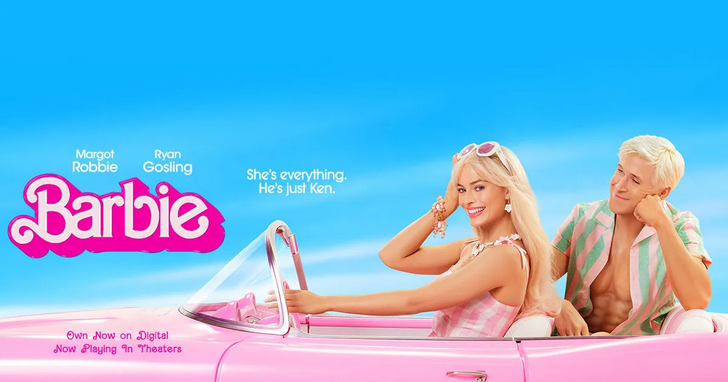
I have changed my mind about Barbie. When I discussed it last week with my good friend Tom Golden (you can see our conversation here), I advised against viewing it.
I now recommend giving it a watch, not for pleasure or even ideological interest — it is too dull and humorless for that, with a senseless plot, wooden dialogue, and a coy voice-over — but for clarification. The high-grossing movie offers a vivid encapsulation of our culture’s view of men and women, complete with its own inadvertent self-subversion. Watching it is a leaden but useful reminder that feminists really are this self-destructively stupid, and really do want to destroy “patriarchy”, by which they mean masculine freedom, self-respect, and leadership. They no longer even pretend to value equality.
Men and boys (and the women who love them), take a good look.
In Barbie, men are at best second-class citizens who by movie’s end, in an improvement over their former nullity, are content to follow banal female directives about their attitudes and identity. In a jaw-droppingly condescending scene after the failed Ken Rebellion, Ken is counseled on how to find himself. He is told that it’s okay to cry (as he bawls like a baby) and is admonished to “figure out who you are without [Barbie/woman]”. He and the other Kens seem grateful for the puerile admonition and willing to be male on Barbie terms: sexless, rudderless, effeminate. They certainly can’t be equal, the film makes clear, because they make a mess when they’re in charge.
Keeping men in check means shielding them even from images of patriarchal (meaning competent, self-directed, masculine) men: Ken runs amok only after seeing a world (the “real world”) in which men are allegedly respected merely for being men, one of the more risible feminist lies in the movie. Feminists have never understood that men earn respect. But in the feminist vision, any possibility that men may perceive themselves as essential to their society — and as owed acknowledgement for the goods they bring — must be suppressed. Only women are essential.
Perhaps the feminist director of Barbie intended the portrayal of the Kens to reflect the situation of women under patriarchy (one searches in vain for a coherent analytical perspective). In Barbie Land, Kens are objects (not sex objects since there is no sex or even heterosexual desire) who exist only to compete, fruitlessly, for Barbies’ attention.
In the real patriarchal past, of course, women were never so reduced precisely because of male sexual longing, love, familial affection, chivalry, religious ideals, empathy, reasoning about justice, and the desire for procreation. All such longings or allegiances are absent from Barbie life. If the Barbies desire children and family — never made clear in the movie, though perhaps gestured to in the final scene when Barbie, now human, visits her gynecologist — theirs will likely be families without Kens. Whether in the real world or in Barbie Land, men are peripheral at best, dangerous at worst, and often mildly contemptible and tiresome with their “egos and petty jealousies”. The only good thing about Kens is that they are easy to manipulate.
The disdain is fathoms deep.
Women, in contrast, are complete in themselves, sufficient for each other in a world in which all positions of power — from President to CEO, doctor, pilot, astronaut, ambulance worker, professional athlete, and Nobel Prize-winning journalist — are occupied by women (and a few trans people, it seems), and in which neighborhoods function without any dirty, dangerous jobs, external threats, heavy machinery, complex repairs, or strenuous labor.
This aspect of the movie, by the way, is a striking illustration of the inability of the feminist mind to remember or even understand what men actually do: the risky, body-wearying and ingenuity-demanding work that feminists only rarely, if ever, advocate for women and which they are frequently hard-pressed even to name. One of the many magic tricks of feminism is its continual disappearing of distinctive male inventiveness, skill, adaptability, and heavy-lifting.
September 26, 2023
“Passport Bros”
Few online people are less tuned-in to the mainsteam zeitgeist than me, so perhaps I’m once again one of the last people to be clued-in about “passport bros”. Here’s Janice Fiamengo‘s post on the “bros” and the women who apparently spend a lot of time criticizing them:

Female commentary on so-called Passport Bros is not hard to find on the internet: women are angry, contemptuous, and incredulous that men are looking for women overseas and encouraging other men to do the same — not for sex tourism (which feminists loved to criticize until they discovered that women are doing it too, in which case it is acceptable), but for a long-term relationship, including, in many cases, marriage and children. These men will partially or entirely relocate to the women’s home country in order to start a new, non-western (and non-feminist) life. The angry internet women claim not to care personally: let the losers go is their expressed attitude. Yet the sheer number and vehemence of their responses suggests they do care.
The angry commentary follows a standard pattern in which the women claim to know why a significant minority of men are giving up on western women as mates. The reason never has anything to do, of course, with faults in western women or their unrealistic expectations […]
Likewise, the reason never has anything to do with western divorce laws — in which a man can be ejected from his home, imprisoned, forced to undergo a psychiatric exam, fleeced, and deprived of his children by a grasping ex-wife — or with the fact that women are the ones who initiate divorce in upwards of 70% of cases (and are often applauded for doing so).
The reason has nothing to do with women’s openly expressed attitudes of superiority, resentment, and anti-male bigotry, which are rampant in western cultures, especially Anglophone ones. It has nothing to do with the #MeToo/Believe Women climate of baseless accusation that regularly sees men accused and disgraced purely on a woman’s say-so. It has nothing to do with the institutionalized discrimination of “equity” hiring that makes it difficult for men to find and advance in careers in order to be acceptably successful to the kind of women who now deride them for their failure.
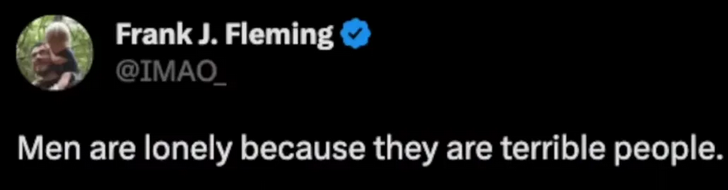
According to the angry women online, men are leaving the west (particularly North America) to find partners because they aren’t good enough for western women. The men are allegedly “terrible, and don’t want to stop being terrible”, according to one gleefully irate commentator. Their only chance is with women so poor as to be grateful for a “terrible” man; in return, such women will have to “subject themselves to [his] advances”, according to another critic’s Victorian-style phrasing.
[…]
Many such women — protected by our pro-woman culture and deferred to by men terrified of female wrath — reach adulthood without ever having received any serious criticism. If and when they are criticized, their response is a howl of outrage and wounded self-regard. This is precisely what is happening in reaction to the Passport Bros.
Underneath the anger, there is perhaps a hint of fear. It’s not fear that men will leave the west in droves (they don’t see that happening yet, and neither do I), but it’s fear that men are not, after all, entirely under female control. Not yet, and maybe never. Some men are sick of the anti-male abuse and starting to do something about it. They are critically examining women’s characters and attitude; they’re drawing back from the acquiescence they’ve always been expected (and been willing) to give. Some are walking away and telling other men to do the same.
These women are used to dishing out the denunciation, reveling in justified grievance; they are infuriated to find that now they are the ones being judged and found wanting.
Don’t be that girl.
July 5, 2023
The “orgasm gap”, yet another problematic front in the war of the sexes
Janice Fiamengo discusses the faked orgasm scene in When Harry Met Sally and its role in the ongoing arguments over the “orgasm gap”:
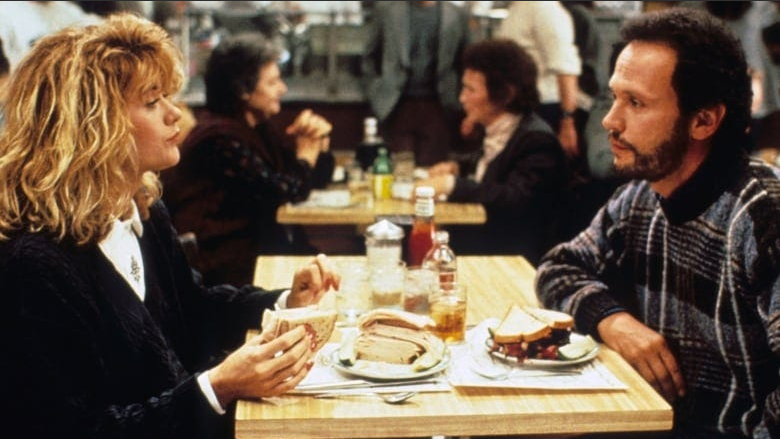
An iconic moment in modern movie history is the diner scene from When Harry Met Sally (1989), when Sally stuns an incredulous Harry with her rendition of a convincing orgasm. Her bravura performance causes shocked silence in the restaurant until one woman, sitting nearby, says admiringly (or enviously), “I’ll have what she’s having.”
The scene and the woman’s amused reaction told of a simple reality with wit and without judgement: some portion of women — perhaps many — are convincing fakers, and even a sexually experienced man will find it hard to be sure.
Many women in the movie audience laughed in recognition, and many men likely scratched their heads, wondering why anyone would need to fake sexual enjoyment. Some men may have remembered times when they faked it too. In the romantic-comedic world of the movie, the scene symbolized one of the differences between the average woman and the average man that only a generous and committed love could bridge.
A few years ago, When Harry Met Sally turned 30 years old, and its anniversary prompted a number of reflection pieces, some turning a harsh feminist lens on the film’s gender politics. In “‘I’ll have what she’s having’: How that scene from When Harry Met Sally changed the way we talk about sex,” Lisa Bonos at The Washington Post found in the fake climax scene a salutary revelation of male sexual arrogance. For Bonos, Harry is a typical macho man, someone who doesn’t care about a woman’s pleasure. The fact that the whole point of his conversation with Sally had been his confidence that he was giving women pleasure simply confirmed his emetic masculinity.
According to Bonos, the fact that some women fake orgasm supposedly reveals that women’s sexual pleasure is “not prioritized” in heterosexual relationships, and Sally’s performance gave sobering evidence of a gendered pleasure gap. It was implicitly the man’s fault that his partner felt the need to lie to him about her sexual satisfaction, and his desire for her to orgasm proved his typically male ego. Bonos’s analysis was an egregious violation of the spirit of the movie but was eminently faithful to the feminist perspective. The politics of grievance had come a long way in three decades.
Right on cue, studies in human psycho-sexuality are now taking up the same theme, alleging a culturally imposed “orgasm gap” between men and women in which men outpace women in the frequency with which they report orgasm during sexual intercourse (86% for men vs. 62% for women, according to one national survey).
Remembering how consistently feminist pundits have expressed outrage at male incels‘ (alleged) sense of “entitlement” to sex, I cannot help but find it ironic how unapologetically researchers assume a female entitlement to orgasm. Apparently, the whole society is to be concerned if women fail to climax every time they have sex, while no one has compassion for young men who face a lifetime of sexlessness. The prime exhibit is “Orgasm Equality: Scientific Findings and Societal Implications“, a paper published in 2020 by three female researchers at the University of Florida. The paper not only surveys the literature on the subject but also makes recommendations for “a world of orgasm equality”.


