Quotulatiousness

January 3, 2012

It’s not safe to go back in the water . . . because of Climate-Change-induced mutant SHARKS!

Filed under: Australia, Environment, Humour, Pacific — Tags: , , , — Nicholas @ 09:45

James Delingpole has all the scary details:

It had to happen. As if the plight of the polar bear wasn’t punishment enough for our evil, selfish, refusing-to-change-our-lifestyle-because-we’re-addicted-to-oil ways, it now seems that Mother Gaia may have a deadly new weapon up her sleeve: KILLER MUTANT SHARKS!!! (H/T Brown Bess)

So far, admittedly, Mother Gaia is in the very earliest stages of her experimentation:

    Scientists said on Tuesday that they had discovered the world’s first hybrid sharks in Australian waters, a potential sign the predators were adapting to cope with climate change.

    The mating of the local Australian black-tip shark with its global counterpart, the common black-tip, was an unprecedented discovery with implications for the entire shark world, said lead researcher Jess Morgan.

    “It’s very surprising because no one’s ever seen shark hybrids before, this is not a common occurrence by any stretch of the imagination,” Morgan, from the University of Queensland, told AFP.

    “This is evolution in action.”

But those of us who have seen Deep Blue Sea (not the feeble Terence Rattigan rip off, obviously; the proper version, about the mutant killer sharks bred in an undersea laboratory who escape and hunt down the scientists one by one) will know that this is just the beginning.

December 3, 2011

Steve Jones: The problem with belief

Filed under: Britain, Education, Religion, Science — Tags: , , , — Nicholas @ 11:06

In the Telegraph, Steve Jones talks about the growing problem that many British students have when the science conflicts with their religious beliefs:

I have tried asking students at quite what point they find my lectures unacceptable: is it the laws of inheritance, mutation, the genes that protect against malaria or cancer, the global shifts in human skin colour, Neanderthal DNA, or the inherited differences between apes and men? Each point is, they say, very interesting — but when I point out that they have just accepted the whole truth of Darwin’s theory they deny that frightful thought. Some take instant umbrage, although a few, thank goodness, do leave the room with a pensive look.

The problem is not with any particular belief system but with belief itself. Sir Francis Bacon once said that: “If a man will begin with certainties, he shall end in doubts; but if he will be content to begin with doubts, he shall end in certainties.” In other words, if you are absolutely sure that you are right whatever the evidence, you will end up in trouble; but if you are always willing to change your mind when the facts change you will emerge with a robust view of how the world works.

I sometimes wonder how many of those who pour their inane opinions about creationism into their young pupils’ ears ever consider the damage they are doing; not to my science, but to their religion. Why, when a student begins to learn the simple and convincing facts, rather than the fantasies, about how life emerged, should he believe anything else that his pastor, his rabbi or his imam has told him? Why build a philosophy based on fixed untruths, when we have so many truths, and so many things still to find out?

It’s one thing to be unhappy when the facts change, and quite another to refuse the facts because they conflict with your beliefs.

February 25, 2011

Friday fun link: BoxCar2D

Filed under: Randomness, Science — Tags: , , — Nicholas @ 07:48

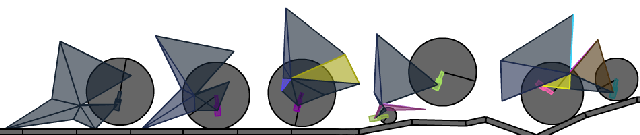
Watch the Darwinian struggle of car evolution: http://www.boxcar2d.com/.

The program learns to build a car using a genetic algorithm. It starts with a population of 20 randomly generated shapes with wheels and runs each one to see how far it goes. The cars that go the furthest reproduce to produce offspring for the next generation. The offspring combine the traits of the parents to hopefully produce better cars. Now with the button at the bottom left u can choose to input cars and different terrains. This lets people post their results and even design a car by hand.

It uses a physics library called box2D to simulate the effects of gravity, friction, collisions, motor torque, and spring tension for the car. This lets the car be a wide range of shapes and sizes, while still making the simulation realistic. This is based on the AS3 box2D flash port of the library. Watch the demo of some of its capabilities.

My inspiration for this project comes from qubit.devisland.net/ga. My implementation uses the physics library to make the car a real object instead of two point masses. There are also many extra variables because of the complicated car and axles and the color cleary illustrates the evolution.

H/T to DarkWaterMuse for the link.

February 14, 2011

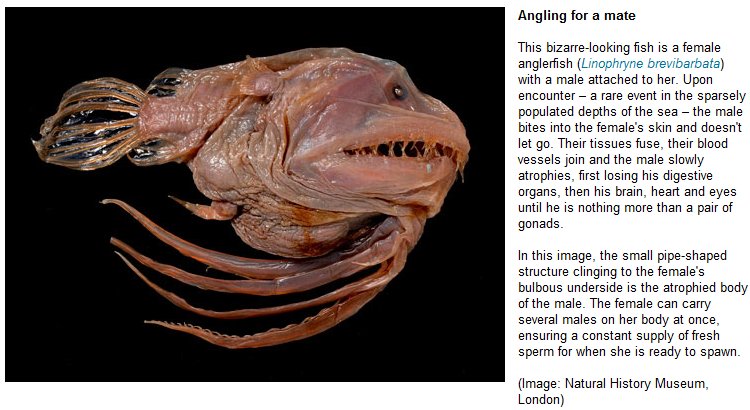
Your Valentine’s Day date could be worse: you might be a male Anglerfish

Filed under: Randomness, Science — Tags: , — Nicholas @ 12:19

More bits of mating lore from the animal kingdom here.

December 23, 2010

“Henry . . . mated with an 80-year-old female named Mildred, and last year became a first-time father — at the age of 111”

Filed under: Science — Tags: , — Nicholas @ 11:30

Meet the Tuatara:

Tuataras are living fossils in more than one sense of the term. Through long-term capture, tag and recapture studies that were begun right after World War II, researchers have found that tuataras match and possibly exceed in attainable life span that other Methuselah of the animal kingdom, the giant tortoise. “Tuataras routinely live to 100, and I couldn’t tell you they don’t live to 150, 200 years or even more,” said Dr. Daugherty.

They live, and live it up. “We know there are females that are still reproducing in their 80s,” said Dr. Daugherty. At the Southland Museum and Art Gallery in Invercargill, New Zealand, a captive male tuatara named Henry, a local celebrity that had been nasty and unruly for decades until a malignancy was removed from his genitals, mated with an 80-year-old female named Mildred, and last year became a first-time father — at the age of 111.

In every way, tuataras are late bloomers and passionate procrastinators. They don’t reach sexual maturity until age 15 to 20. A female needs two or three years to grow a clutch of eggs internally, and takes another seven or eight months after mating before she finally lays those fertilized eggs. Then the eggs incubate in the ground for yet another year before a brood of finger-size baby tuataras will finally hatch. By comparison, the incubation time for the average North American lizard is only four to six weeks. “If these were plants, most lizards would be like weeds, and the tuatara like a sequoia,” said Dr. Daugherty. For all the nobility of the comparison, the tuatara’s stately pace is also its Achilles’ heel, he added. That’s why the reptile today is found only on diligently monitored islands away from the New Zealand mainland, protected from mammals like rats, pigs or stoats that within months could reduce every sequoia equivalent and its seedlings to so much sawdust.

H/T to DarkWaterMuse for the link.

December 1, 2010

This should be good for stirring up spirited debate

Filed under: Media, Science — Tags: , , , — Nicholas @ 09:52

Sarah Bee reports on the kerfuffle around Satoshi Kanazawa’s book Ten Politically Incorrect Truths About Human Nature:

Women long for the classic Barbie figure with big boobs, long blonde hair and blue eyes because it makes men want to impregnate them, an evolutionary psychologist has proclaimed.

London School of Economics reader Satoshi Kanazawa has successfully manipulated the more malleable and shameless news outlets into excitedly regurgitating the provocative theories contained in his book, Ten Politically Incorrect Truths About Human Nature. He explains that the traditional attributes of the buxom blonde babe have evolutionary advantages, as the Daily Mail duly recounts.

Big boobs are supposedly indicative of fertility, along with a large waist-to-hip ratio. Blonde hair displays grey hairs less obviously, thus concealing age — men prefer the younger bird for a better shot at passing on their DNA, sensibly enough.

Blue eyes, Kanazawa points out, more clearly display pupil dilation, which occurs when the peepers’ owner sees something she likes. Thus a man can tell more quickly if a blue-eyed woman fancies a bit or not, saving precious sharking time at the bar.

Kanazawa further postulates that women are getting hotter and having lovelier daughters, while men are regrettably as fugly as ever they were. Beautiful women have more children than the overlooked homely types, and also have more female children, and on it goes in a wondrous babeification of the species.

This is a case where the science may point in a direction that is so politically and socially unwelcome that everyone just ignores it. Or it could be a huge joke to put the politically correct folks into a lather. Pick your option and season to taste.

August 9, 2010

Not news: many Americans prefer religious to scientific answers

Filed under: Religion, Science, USA — Tags: , , — Nicholas @ 09:35

Scientific American pretends to be surprised by these findings:

When presented with the statement “human beings, as we know them today, developed from earlier species of animals,” just 45 percent of respondents indicated “true.” Compare this figure with the affirmative percentages in Japan (78), Europe (70), China (69) and South Korea (64). Only 33 percent of Americans agreed that “the universe began with a big explosion.”

Consider the results of a 2009 Pew Survey: 31 percent of U.S. adults believe “humans and other living things have existed in their present form since the beginning of time.” (So much for dogs, horses or H1N1 flu.) The survey’s most enlightening aspect was its categorization of responses by levels of religious activity, which suggests that the most devout are on average least willing to accept the evidence of reality. White evangelical Protestants have the highest denial rate (55 percent), closely followed by the group across all religions who attend services on average at least once a week (49 percent).

I don’t know which is more dangerous, that religious beliefs force some people to choose between knowledge and myth or that pointing out how religion can purvey ignorance is taboo. To do so risks being branded as intolerant of religion.

H/T to Doug Mataconis for the link.

May 26, 2010

Evolutionarily speaking, everything old is new again

Filed under: Science — Tags: , , , , , — Nicholas @ 12:46

An idea that seemed fairly common in the 1960s and 70s appears to be regaining credibility:

When two drunken men fight over a woman, alcohol and stupidity may not be the only things at work. Sadly, evolution may have shaped men to behave this way. Almost all of the traits considered to be masculine — big muscles, facial hair, square jaws, deep voices and a propensity to violence — evolved, it now seems, specifically for their usefulness in fighting off or intimidating other men, allowing the winner to get the girl.

That, at least, is the contention of David Puts, an anthropologist at Pennsylvania State University, in an upcoming paper in Evolution and Human Behavior. Dr Puts is looking at how sexual selection gave rise to certain human traits. A trait is sexually selected if it evolved specifically to enhance mating success. They come in two main forms: weapons, such as an elk’s horns are used to fight off competitors; and ornaments, like a peacock’s tail, which are used to advertise genetic fitness to attract the opposite sex.

Researchers have tended to consider human sexual selection through the lens of the female’s choice of her mate. But human males look a lot more like animals designed to battle with one another for access to females, says Dr Puts. On average, men have 40% more fat-free mass than women, which is similar to the difference in gorillas, a species in which males unquestionably compete with other males for exclusive sexual access to females. In species whose males do not fight for access to females, males are generally the same size as, or smaller than, females.

September 14, 2009

How to sell a film to a major studio

Filed under: Media — Tags: , — Nicholas @ 18:36

John Scalzi provides some helpful hints to the producers of Creation, who are complaining that they can’t get a US distributor to pick up the movie (because of all the Christian fundamentalists, y’see):

. . . leaving aside any discussion of the actual quality of the film, it may be that a quiet story about the difficult relationship between an increasingly agnostic 19th Century British scientist and his increasingly devout wife, thrown into sharp relief by the death of their beloved 10-year-old daughter, performed by mid-list stars, is not exactly the sort of film that’s going to draw in a huge winter holiday crowd, regardless of whether that scientist happens to be Darwin or not, and that these facts are rather more pertinent, from a potential distributor’s point of view.

The major US studios are no longer really tuned to distribute films like this in any event. Maybe if Charles Darwin were played by Will Smith, was a gun-toting robot sent back from the future to learn how to love, and to kill the crap out of the alien baby eaters cleverly disguised as Galapagos tortoises, and then some way were contrived for Jennifer Connelly to expose her breasts to RoboDarwin two-thirds of the way through the film, and there were explosions and lasers and stunt men flying 150 feet into the air, then we might be talking wide-release from a modern major studio. Otherwise, you know, not so much. The “oh, it’s too controversial for Americans” comment is, I suspect, a bit of face-saving rationalization from a producer flummoxed that such an obvious bit of Oscar-trollery such as this film has been to date widely ignored by the people he assumed would fall over themselves to have such a thing.

August 24, 2009

The trend to violence has actually been a trend away from violence

Filed under: Science — Tags: , , — Nicholas @ 11:56

Radley Balko links to this interesting article by Steven Pinker, which shows something that on the surface appears to fly in the face of the facts: we’re not becoming more violent, we’re becoming more peaceful:

Our seemingly troubled times are routinely contrasted with idyllic images of hunter-gatherer societies, which allegedly lived in a state of harmony with nature and each other. The doctrine of the noble savage — the idea that humans are peaceable by nature and corrupted by modern institutions — pops up frequently in the writing of public intellectuals like, for example, Spanish philosopher José Ortega y Gasset, who argued that “war is not an instinct but an invention.”

But now that social scientists have started to count bodies in different historical periods, they have discovered that the romantic theory gets it backward: Far from causing us to become more violent, something in modernity and its cultural institutions has made us nobler. In fact, our ancestors were far more violent than we are today. Indeed, violence has been in decline over long stretches of history, and today we are probably living in the most peaceful moment of our species’ time on earth.

July 30, 2009

Another argument against “intelligent design”

Filed under: Science — Tags: — Nicholas @ 07:36

Actually, ten arguments:

1 Sea mammal blowhole. Any animal that spends appreciable time in the ocean should be able to extract oxygen from water via gills. Enlarging the lungs and moving a nostril to the back of the head is a poor work-around.

2 Hyena clitoris. When engorged, this “pseudopenis,” which doubles as the birth canal, becomes so hard it can crush babies to death during exit.

3 Kangaroo teat. In order to nurse, the just-born joey, a frail and squishy jellybean, must clamber up Mom’s torso and into her pouch for a nipple.

« Newer Posts

Powered by WordPress