Quotulatiousness

September 7, 2011

How much more will “green” renewable power cost?

Filed under: Britain, Economics, Environment, Government, Technology — Tags: , — Nicholas @ 09:37

In short, lots more than ordinary power generation:

The Telegraph has obtained a policy document, dated July, that seems to suggest that the government is considering a walk away from the most expensive renewables — and now we can see the full copy online. Two No 10 advisers challenge the Department of Energy and Climate Change’s utopian cost predictions, and say energy bills will be much bigger than we’ve been told.

What isn’t in contention is that energy itself will be much more expensive. DECC’s argument is that we’ll all start insulating our homes more — so our utility bills won’t reflect the higher per-unit energy costs. No 10’s energy expert thinks this is nonsense.

The Cameron advisors also suggest that government policy should be “open” to ditching some of the most expensive renewables — such as offshore wind power.

What’s the real cost of wind and solar?

     The former power director of the National Grid, Colin Gibson, now estimates that the lifetime per unit cost of onshore wind is £178 per megawatt hour (MWh), and offshore wind at £254/MWh. Nuclear is £60/MWh. The figures DECC provides don’t account for the huge additional transmission costs of wind.

     Note how much more expensive reality is than the clean, green vision. Government figures reckoned onshore wind cost £55/MWh and offshore wind £84/Mwh [. . .] compared to gas at £44/Mwh. Politicians seeking to dump the renewables policy could argue that green-minded civil servants sold them a pup. They’d be right.

September 4, 2011

James Delingpole forced to offer an apology

Filed under: Britain, Environment — Tags: , , — Nicholas @ 11:45

Yes, it’s true. Delingpole made an error in a recent column and has to make a full apology for the error:

It has been brought to my attention that this blog owes Sir Reginald Sheffield, Bt. an apology. In a recent column entitled Green Jobs? Wot Green Jobs? (Pt 242), I carelessly suggested that Sir Reg — beloved dad of the famous environmentalist “Sam Cam”; distinguished father-in-law of the Prime Minister of Great Britain and Northern Ireland, no less — is making nearly £1000 a week from the wind turbines on his estates.

The correct figure is, of course, nearly £1000 a day.

In other words, Sir Reginald is making the equivalent of roughly 1000 looted widescreen plasma TV screens every year from the eight 400 foot wind turbines now enhancing the view for miles around on his 3,000 acre Normanby Hall estate, near Scunthorpe.

There will be those who suggest that my mistake is a resigning matter. I do share their concern. However it is my view that if a journalist is going to resign on a point of principle these days, it has to be over something immeasurably trivial, rather than over something merely quite trivial. What I do nevertheless agree is that I owe Sir Reginald Sheffield, Bt, an apology.

A big apology.

UK “will lose 2 to 3 per cent GDP a year for around 20 years” on renewable energy subsidies

A report in The Register says that the subsidies for green renewable energy will be a big net drain on the national economy:

The UK’s headlong rush into renewable energy — one ignored by the rest of the world — will hit British jobs and then general incomes, an economic study finds.

The report, The Myth of Green Jobs by economist Professor Gordon Hughes of Edinburgh University, examines the long-term impacts of subsidising expensive “green” renewable energy projects. It says that if the UK continues to do so, it will lose 2 to 3 per cent GDP a year for around 20 years. If reducing CO2 emissions is your goal, says Hughes, your economy really can’t afford renewable energy.

[. . .]

“All forms of green energy tend to be substantially more expensive than conventional energy, so there is a trade-off between higher costs and lower emissions,” writes Hughes. “This trade-off is not specific to green energy, since there are many ways of reducing emissions of greenhouse gases. Hence, the starting point of any assessment of such programmes should be the total cost per tonne of carbon dioxide saved — or its equivalent — which will be incurred by relying upon different measures or policies to reduce emissions.”

September 2, 2011

Christopher Howse welcomes the new dark (ages)

Filed under: Environment, Europe, Humour, Technology — Tags: , , , — Nicholas @ 12:20

A welcoming column on the new “lights” of modern Europe:

Normally, to read a book, one turns on the light. I had thought of that, but the numerous light switches in the room only brought a dim glow from various lengths of compact fluorescent lamps, some shaped like paperclips, others coiled like something from the pavements of dog-loving Dijon. You could tell that they were switched on, but it was as if someone had given the lights several coats of opalescent lacquer. It almost seemed as if the lamps attracted light gravitationally from nearby parts of the room, which were consequently left in shadow.

[. . .]

Except for not emitting light, there is little wrong with the new energy-saving bulbs, apart from their causing night-time falls, triggering epilepsy and storing up deadly poisons. But we must expect to make little sacrifices to save energy.

All over Europe, people are tumbling down the stairs in the small hours, snapping their femurs like breadsticks when they venture out of their bedrooms, perhaps to go to the loo – it isn’t unknown. That is because the energy-saving bulbs in the landing light take time to warm up. Those who survive the nocturnal pitfall soon notice that the new kind of bulbs flicker. For some, this triggers migraine; for others, epileptic fits. For me, it merely induces nausea and a sensation that the room is moving backwards and forwards. So I should count my blessings.

As for the mercury that the energy-saving bulbs contain, I have always found it a most beautiful metal, aptly named quicksilver, shining like the moon. Certainly, the effects of mercury poisoning are no fun: shedding of skin, loss of teeth and hair, salivation, sweating and forgetfulness. Yet anxiety about such matters is soon dispelled by the FAQs on the Energy Saving Trust website. “Energy-saving bulbs contain only tiny traces of mercury,” it says soothingly. “Imagine a pellet smaller than the tip of a Biro.” Yes, I’ve imagined that. It sounds ideal for the tip of a blowpipe-arrow or a Bulgarian secret service umbrella.

So remember to be very careful when you dispose of these wonderful new high-tech devices.

     . . . each fluorescent light bulb contains about 5 milligrams of mercury. Though the amount is tiny, 5 milligrams of mercury is enough to contaminate 6,000 gallons of drinking water, according to the Environmental Protection Agency (EPA).

     Low level mercury exposure (under 5 milligrams) can cause tremors, mood shifts, sleeplessness, muscle fatigue, and headaches. High level or extended length exposure can lead to learning disabilities, altered personality, deafness, loss of memory, chromosomal damage, and nerve, brain, and kidney damage, as stated by the EPA. There is a particular risk to the nervous systems of unborn babies and young children.

H/T to Chris Greaves for the link.

August 7, 2011

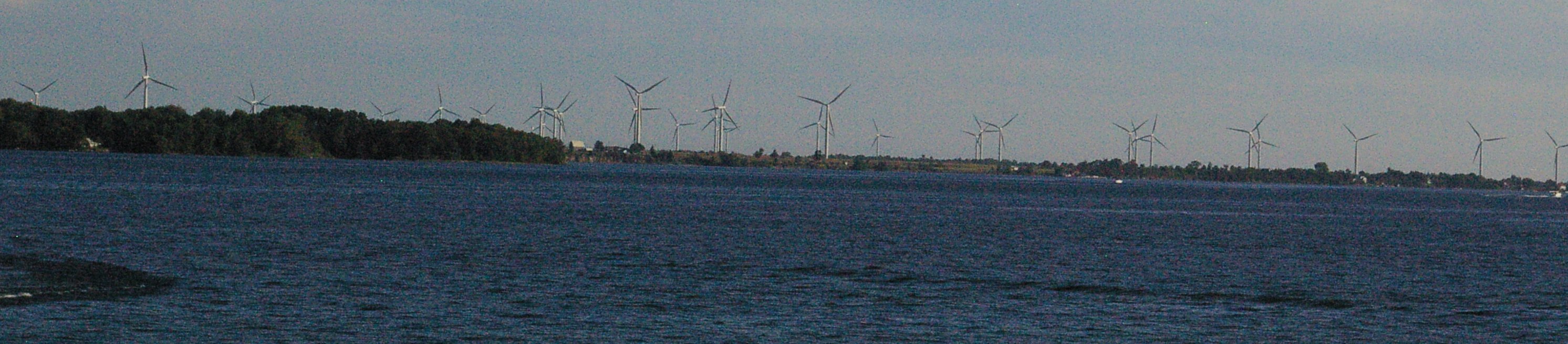
Wind turbines totally dominate the skyline over Wolfe Island

Filed under: Cancon, Technology — Tags: , , — Nicholas @ 18:39


Click to see full-size (very wide) image

I took this photo from the Wolfe Island ferry on Friday. It amazed me how many wind turbines were in view (32, I think). I kept having images of James Blish’s “spindizzies“.

July 4, 2011

British Green activist recants opposition to nuclear power

Filed under: Britain, Environment, Technology — Tags: , , — Nicholas @ 09:51

Unlike Germany, which has announced it will be shutting down its nuclear power plants, Britain is considering a new generation of plants to provide an even greater share of their electricity needs. Even a few green activists are changing their tune:

Also, as much as Greens are enthusiastic about solar electricity, in cloudy countries such as ours it is extremely inefficient and expensive. Nuclear power, on the other hand, is one of the cheapest ways of producing electricity, and it is much safer than many environmentalists would have us believe.

The objection of environmentalists to nuclear power — fears about the dangers of nuclear waste and the cost of decommissioning it — are overblown, which explains why many people don’t like the Greens.

[. . .]

Solving many of the world’s most critical environmental challenges will, in some cases, involve doing the exact opposite of what most environmentalists want.

Rather than retreating into hair-shirt austerity, I believe that, just as technology got us into this mess, technology is vital to get us out of it.

That means embracing some things that will make a lot of Green believers choke on their organic muesli.

It has taken me a long time to reach this conclusion. I used to passionately oppose not only nuclear power but GM crops. I once even threw a pie in the face of a Danish scientist who dared to question the orthodox environmental line. So what changed?

Through research, I found that much of what I believed about environmental issues had little, if any, basis in science. Put simply, though my concerns were right, my solutions were wrong.

June 11, 2011

They “buried the ban in the 300-plus pages of the 2007 energy bill, and very few talked about it in public”

Filed under: Economics, Government, Law, Technology — Tags: , , — Nicholas @ 11:28

Virginia Postrel talks about the looming ban-that-isn’t-a-ban on incandescent lightbulbs:

One serious technophile, University of Tennessee law professor Glenn Reynolds, spent much of 2007 flogging compact fluorescents on his popular Instapundit blog, eventually persuading more than 1,900 readers to swap 19,871 incandescent bulbs for CFLs. To this day, the Instapundit group is by far the largest participant at OneBillionBulbs.com, a bulb-switching campaign organized by the consulting firm Symmetric Technologies. But Reynolds himself has changed his mind.

“I’m deeply, deeply disappointed with CFL bulbs,” he wrote last month on his blog. “I replaced pretty much every regular bulb in the house with CFLs, but they’ve been failing at about the same rate as ordinary long-life bulbs, despite the promises of multiyear service. And I can’t tell any difference in my electric bill. Plus, the Insta-Wife hates the light.”

That was our experience with the early CFL bulbs, too: they didn’t come close to achieving the longevity we were supposedly paying all the extra money for. And, as I’ve posted before, they’re not as easy to clean up after breakage as the older bulbs.

So the activists offended by the public’s presumed wastefulness took a more direct approach. They joined forces with the big bulb producers, who had an interest in replacing low-margin commodities with high-margin specialty wares, and, with help from Congress and President George W. Bush, banned the bulbs people prefer.

It was an inside job. Neither ordinary consumers nor even organized interior designers had a say. Lawmakers buried the ban in the 300-plus pages of the 2007 energy bill, and very few talked about it in public. It was crony capitalism with a touch of green.

Crony capitalism is what the general public is coming to think is the only kind of capitalism, because they have seen so much of it during the last few presidencies. Your business can be plagued with petty regulators enforcing nitpicking rules, while Congress showers money and special privileges on big businesses and banks.

But, as she points out, it’s not technically a true ban:

Now, I realize that by complaining about the bulb ban — indeed, by calling it a ban — I am declaring myself an unsophisticated rube, the sort of person who supposedly takes marching orders from Rush Limbaugh. In a New York Times article last month, Penelope Green set people like me straight. The law, she patiently explained, “simply requires that companies make some of their incandescent bulbs work a bit better, meeting a series of rolling deadlines between 2012 and 2014.”

True, the law doesn’t affect all bulbs — just the vast majority. (It exempts certain special types, like the one in your refrigerator.) The domed halogen bulbs meet the new standards yet are technically incandescents; judging from my personal experiments, they produce light similar to that of old- fashioned bulbs. They do, however, cost twice as much as traditional bulbs and, if the packages are to be believed, don’t last as long.

I keep hoping that LED lights will be able to produce the kind of long-life that we used to be able to depend upon from incandescents, as CFLs and halogen bulbs have not come close to living up to the promises. However, LEDs have not yet managed that trick in commercial applications.

So, aside from allowing lobbyists to flex their muscles, what is the ban attempting to achieve? That’s not quite clear-cut:

Though anti-populist in the extreme, the bulb ban in fact evinces none of the polished wonkery you’d expect from sophisticated technocrats. For starters, it’s not clear what the point is. Why should the government try to make consumers use less electricity? There’s no foreign policy reason. Electricity comes mostly from coal, natural gas and nuclear plants, all domestic sources. So presumably the reason has something to do with air pollution or carbon-dioxide emissions.

But banning light bulbs is one of the least efficient ways imaginable to attack those problems. A lamp using power from a clean source is treated the same as a lamp using power from a dirty source. A ban gives electricity producers no incentive to reduce emissions.

China finally admits to (some) problems at the Three Gorges megadam

Filed under: China, Environment, Government — Tags: , , — Nicholas @ 10:47

It’s been “officially” a wonderful thing with absolutely no negative attributes for so long that it’s almost refreshing that the Chinese government is finally admitting it’s not all good news around the massive Three Gorges dam and reservoir:

In private, officials have worried about the project for some time and occasionally their doubts have surfaced in the official media. But the government itself has refused to acknowledge them. When the project was approved by the rubber-stamp parliament in 1992, debate was stifled by the oppressive political atmosphere of the time, following the Tiananmen Square massacre three years earlier. Last July, with the dam facing its biggest flood crest since completion in 2006, officials hinted that they might have overstated its ability to control flooding. On May 18th, with the dam again in the spotlight because of the drought, a cabinet meeting chaired by the prime minister, Wen Jiabao, went further in acknowledging drawbacks.

Having called the dam “hugely beneficial overall”, the cabinet’s statement said there were problems relating to the resettlement of 1.4m people, to the environment and to the “prevention of geological disasters” that urgently needed addressing. The dam, it said, had had “a certain impact” on navigation, irrigation and water-supply downstream. Some of these problems had been forecast at the design stage or spotted during construction. But they had been “difficult to resolve effectively because of limitations imposed by conditions at the time.” It did not elaborate.

June 1, 2011

New report from the Obviousness Bureau: TEPCO underestimated earthquake/tsunami risks

Filed under: Bureaucracy, Japan, Technology — Tags: , , , , , — Nicholas @ 07:55

Hands up, anyone who didn’t see this coming? Okay, put your hands down board members of TEPCO:

Japan underestimated the risk of a tsunami hitting a nuclear power plant, the UN nuclear energy agency has said.

However, the response to the nuclear crisis that followed the 11 March quake and tsunami was “exemplary”, it said.

The Fukushima Daiichi nuclear plant, which was badly damaged by the tsunami, is still leaking radiation.

Japan’s Prime Minister Naoto Kan is facing a no-confidence vote submitted by three opposition parties over his handling of the crisis.

They say he lacks the ability to lead rebuilding efforts and to end the crisis at the Fukushima plant, public broadcaster NHK reported.

Some politicians from Mr Kan’s governing Democratic Party of Japan (DPJ), including former Prime Minister Yukio Hatoyama, are backing the motion.

If it is passed in a vote expected on Thursday, Mr Kan would be forced to resign or call a snap election.

However, given the thousands of dead and missing from the earthquake and tsunami, the attention paid to Fukushima has been rather disproportional. As someone joked yesterday, radiation from Fukushima has killed fewer people (none) than e.coli tainted food in Germany (16 at last report).

Update: In case I’m being too obscure, the “this” I refer to in the initial paragraph is the with-the-benefit-of-hindsight conclusion that the Fukushima plant was inadequately prepared for the earthquake and subsequent tsunami.

May 12, 2011

“It should have been called The Cell”

Filed under: Economics, Environment — Tags: , , , — Nicholas @ 12:30

That’s Rob Lyons and he’s talking about an eco-residence called The Cube:

I think estate agents would refer to it as ‘compact and bijou’. It’s The Cube, the eco-home that’s showing just what sustainable living is all about. It should have been called The Cell.

The tiny house, which was on show at April’s Edinburgh Science Festival and is the brainchild of Dr Mike Page of the University of Hertfordshire, has an internal footprint of just three metres by three metres, yet has all the modern conveniences. There’s a tiny lounge with a flat-panel TV. If you want to dine with a friend, you need to swap half the sofa round with the sliding table. On the next level — reachable by a staircase so tiny that there’s only enough room for one foot at a time — you’ll find the composting toilet, the walk-in shower and the kitchen. (Is that even legal?) From there, you can clamber into the narrow bed, which could only accommodate two people if they both happen to be skinny vegans who don’t suffer from claustrophobia.

Everything is extremely well-insulated, including triple-glazed windows. Heat is provided by a heat-pump attached to the outside wall while electricity is generated through solar panels on the roof. Of course, they won’t work during the night, but you’ll have made so much money flogging electricity to the grid during the day — thanks to the insane prices at which electricity companies are obliged to buy micro-generated power — that you could actually earn £1000 per year.

All this could be yours for £50,000, assuming you’ve got some land to stick it on and you’re prepared to live in such cramped conditions. Considering you could buy a far larger luxury caravan with better facilities for less money (though not so well insulated), you may wonder why you would bother. But Page isn’t really interested in building eco-homes; in fact, he’s a psychologist. What he’s really interested in is why there is no demand for such eco-living, given that we now have lots of technology available to reduce our ‘impact’ — our ‘ecological footprint’.

April 18, 2011

The Magic Washing Machine, by Hans Rosling

Filed under: Economics, Environment, Health, Technology — Tags: , , , — Nicholas @ 09:49

H/T to Jon for the link.

April 16, 2011

Sorry for the lack of blogging

Filed under: Administrivia — Tags: , — Nicholas @ 22:32

Sorry for the lack of blogging today: just after I posted the Guild Wars 2 round-up, we had a power outage that lasted a few hours. By the time the power came back on, I didn’t get any opportunity to get back to the blog. Normal blogging will resume on Sunday (I hope).

April 8, 2011

British study finds wind power even less economical than hoped

Filed under: Britain, Economics, Technology — Tags: , — Nicholas @ 09:56

The assumption was that wind farms would produce 30% of their theoretical maximum over time (the wind doesn’t blow all the time, so no wind farm will ever produce 100% for more than a short period of time). This number now appears to be too optimistic:

A new analysis of wind energy supplied to the UK National Grid in recent years has shown that wind farms produce significantly less electricity than had been thought, and that they cause more problems for the Grid than had been believed.

The report [. . .] was commissioned by conservation charity the John Muir Trust and carried out by consulting engineer Stuart Young. It measured electricity actually metered as being delivered to the National Grid.

[. . .]

In general, then, one should assume that a wind farm will generate no more than 25 per cent of maximum capacity over time (and indeed this seems set to get worse as new super-large turbines come into service). Even over a year this will be up or down by a few per cent, making planning more difficult.

It gets worse, too, as wind power frequently drops to almost nothing. It tends to do this quite often just when demand is at its early-evening peak:

At each of the four highest peak demands of 2010 wind output was low being respectively 4.72%, 5.51%, 2.59% and 2.51% of capacity at peak demand.

And unfortunately the average capacity over time is pulled up significantly by brief windy periods. Wind output is actually below 20 per cent of maximum most of the time; it is below 10 per cent fully one-third of the time. Wind power needs a lot of thermal backup running most of the time to keep the lights on, but it also needs that backup to go away rapidly whenever the wind blows hard, or it won’t deliver even 25 per cent of capacity.

April 2, 2011

QotD: The nature of Harper’s “slap in the face” to Quebec

Filed under: Cancon, Economics, Politics, Quotations — Tags: , , , , — Nicholas @ 12:19

I labour over this history to place in context the astounding, even outré, comments offered by Canada’s First Separatist, Gilles Duceppe, on hearing of the proposed arrangement — which, I hasten to mention, is merely a $4.2-billion loan guarantee from Ottawa, not some massive outright subsidy. Mr. Duceppe, with a logic that can only belong to a man who gets paid to be a separatist by the government he’s trying to extinguish, called the deal “a direct attack on Quebec.”

What really bothers Mr. Duceppe and other separatists is that they want to retain Quebec’s monopoly on southbound power sales to the United States — something the Lower Churchill project, including its 1,100 km of underwater transmission cables, would threaten. “By financing the Newfoundland project, Stephen Harper has given Quebec a slap right in the face,” the BQ leader declared.

It’s one of the continuing risibilities of the Canadian federation that we cosset and pamper and pay for the separatist faction in the House of Commons, and go along with the pretense that they’re parliamentarians like any other. They are not. They displace the natural balance of the federation. They have a vested interested in seeing the parliament they attend not working. And they leap to any perceived or manufactured imperfection in our system as evidence of dark perfidy or contempt for Quebec. They warp the system. Nowhere do these observations meet with greater validation than these ludicrous comments by Duceppe on the proposed assistance to the Lower Churchill.

Rex Murphy, “Newfoundland’s three-gigawatt insult to Gilles Duceppe”, National Post, 2011-04-02

March 28, 2011

TEPCO still seems to be more a hindrance than a help over Fukushima

Filed under: Bureaucracy, Japan, Technology — Tags: , , — Nicholas @ 12:36

A report from Kyodo News shows that Tokyo Electric Power Co. (TEPCO) is still not fully co-operating or providing all the information needed to clean up the Fukushima reactor sites:

While efforts at containing troubled reactors have not been making rapid progress at its Fukushima Daiichi nuclear power plant, signs were emerging that Tokyo Electric Power Co., in the absence of a top officer, is losing its grip on accurately informing the public about risks from radiation.

On Sunday, the utility, known as TEPCO, announced in the morning that the concentration of radioactive materials of water found inside a turbine building adjacent to a rector housing was ”around 10 million times (that of) water in a normal reactor core” but later corrected the information, saying it ”made a wrong estimation.”

[. . .]

On March 20, TEPCO said, ”There were no increases in radiation levels in adjacent areas.” But increases were logged in various parts of adjacent areas, prompting skeptical reporters to raise a series of questions at a news conference but TEPCO officials remained mum.

TEPCO has been giving a series of news conferences since Fukushima Daiichi got into trouble after the March 11 quake. Attending officials have not been able to provide satisfactory answers to a majority of questions raised, only repeating words of apology and, ”We will check it.” It has left the impression they are unable to reply to questions because they are not given enough information.

[. . .]

But on Saturday, it was disclosed that the company had not informed workers who suffered high levels of radiation at the No. 3 reactor unit about radiation levels of the place where they would be working. The government was also found to have not been informed.

Top government spokesman Yukio Edano expressed his displeasure, telling a news conference, ”We cannot give appropriate instructions unless accurate information is provided swiftly.”

TEPCO is allowed to monopolize the power utility market in Tokyo and surrounding regions by law. As the nation’s biggest utility, it has also been the key promoter of the nuclear power policy and one of the main employers of retiring bureaucrats.

Critics say the company lacks cost consciousness and apparently has no idea about what competition is. It is more like a bureaucracy rather than a business being run, they said.

« Newer PostsOlder Posts »

Powered by WordPress