Quotulatiousness

September 14, 2015

Trump and “middle class respectability”

Filed under: Media, Politics, USA — Tags: , , , — Nicholas @ 02:00

At Ace of Spades H.Q. last week, Ace explained what might eventually be the kryptonite that allows someone to defeat “el Donaldo” in the Republican race:

There is a notion of Middle Class Respectability. This notion is important to most members of my (your?) class. It can be put aside by highly-committed partisans who are intensely in favor of Trump (and who therefore don’t sweat negative information about him), but not by most people.

I have said before, in a line that I quite like, that Donald Trump is gloriously unburdened by respectability. Respectability is both a blessing and a curse.

Respectability, obviously, grants you some respect; you behave properly, according to the code of the class, and therefore are considered a member in good standing of that class.

But it is also very limiting. Many people will point out that GOP/RINO “pussies” will buckle and apologize at the first dirty look from a member of the liberal establishment.

That is the downside of respectability — people are afraid to lose it, and will quickly apologize when The Mob threatens to withdraw respectability from them.

And in America 2015, public respectability is granted by — controlled by — the college-educated upper-middle-class Media Class which controls most everything related to morals and manners.

The fact that Trump is gloriously unburdened by respectability makes him willing/able to say things that no Respectability-Craving politician ever could, like that yes, we need a border wall, and yes, we are permitted to, and should, be outraged by foreign criminals murdering Americans who are permitted to be here by Democratic mayors and presidents.

But the downside of his contempt for respectability is that he will obliviously trample things that are very important to the people whose support he will ultimately need, if he wants to do more than blow hot air.

Whether or not Trump thinks that upper middle class suburban Republicans are silly or not, whether or not he thinks they’re “losers” or not for owning only two cars, he will need that one third of the party that is currently dead-set against him.

And while Trump seems to either have a problem with women (how long did he spend attacking Megyn Kelly, versus how long did he spend attacking Chris Wallace?) or is simply unburdened by the Middle Class Respectability code of gallantry towards women, It is making a very large and influential block of people absolutely disgusted by him, repelled by him not a political level (which could always later be finessed or papered over) but on a personal level (which can never be repaired).

And.

He.

Won’t.

Stop.

I would venture to say he can’t stop — I would venture to say that in Trump’s world of yes-men and eternal entitlement, calling a woman ugly is just sort of something he casually does, and, like a high school super-jock who’s always been protected from the consequences of his actions, he just has never had reason to internalize that dismissing a woman as Sexually Not Up to My High Standards as an opening gambit in conversation is socially disfavored.

September 12, 2015

Trump isn’t a political candidate … he’s a political fireship

Filed under: Politics, USA — Tags: , , , — Nicholas @ 04:00

Grant McCracken explains why revelations of faults and gaffes not only don’t cost Donald Trump any support, they often increase his appeal to voters:

The answer, I think, is that his supporters don’t want a president. They want a fireship.

Fireships were instruments of destruction when the world was ruled by wooden ships. The idea was to pack a ship with flammables, set it ablaze, and send it in the direction of enemy ships in the hope that it would set these enemy ships ablaze. Fireships helped defeat the Spanish armada gathered in the English Channel.

Donald Trump promises to make a very good fireship. He lacks the subtlety, intelligence, breadth, and leadership we look for in a candidate. And that’s precisely what makes him such an effective instrument of political disruption.

Reckless, boorish, self centered? Perfect. Trump’s flaws make him a unassimilable. Washington is its own empire with formidable powers of hegemony. Many reformers go to Washington. Virtually all are claimed, colonized, incorporated. The Trumpians believes they have found a candidate so full of himself not even the Borg can absorb him. (If you can’t have incorruptible, unassimilable will have to do.)

But that’s just Step 1 of the Trump disruption, the passive play. Step 2, the active play, is a candidate who thinks he’s smarter than the system. Most Trumpians know that Trump isn’t smarter than the system. They just want him to act as if he is. That guarantees the destructive chaos they’re hoping for. I don’t think anyone doubts that Trump is a bully and a blow hard. They just want him to knock lots of things down when he throws his weight around. (If you can’t have cunning, clumsy will have to do.)

Trumpians don’t want a candidate. They want an agent of chaos. They don’t want to reform Washington. They want to burn it down.

A scenario that ends with a DraftLiz movment?

Filed under: Britain, Cancon, Politics — Tags: , , , , , , — Nicholas @ 03:00

Colby Cosh tries to explain some aspects of the ongoing Canadian federal election by pointing out parallels to the most recent British election (and aftermath) … and then must have dropped some acid to come up with this scenario:

The other day on Twitter you could catch some pundit types talking about Green Party Leader Elizabeth May becoming prime minister as an example of something zany that could absolutely never happen in Canadian politics. This raises an immediate question, for those of us who occasionally scan U.K. news: is May becoming prime minister any less likely than what is happening right now in the Labour Party?

Twenty weeks ago, Labour and its leader Ed Miliband were thought by pollsters to be slight favourites to win the May 7 national election. At noon yesterday, voting ended in the race to replace the defeated Miliband. The result will be announced Saturday. The almost certain winner — keeping in mind that Britain has deep betting markets, and punters are allowed to gamble unlimited sums on political outcomes — is Jeremy Corbyn, longtime MP for Islington North, an old Bennite ultra-radical who had attracted almost no public notice in British politics for the past 30 years.

So far, so reasonable, but then the rush hits:

I am not going to tell you to bet on Elizabeth May becoming prime minister of Canada. After all, in this country we don’t have betting shops on every corner — yet. What I notice we do have is a historically socialist party leading in the polls behind an awfully Blairish figure. All New Democrats are highly aware of Labour politics: Labour is their mother, in a way the Conservative and Unionist Party (U.K.) is not to our Conservatives. Although New Democrats may not admit it, the recent unearthing of Thomas Mulcair’s eulogy for Margaret Thatcher must have appalled and sickened many.

By opting for the ex-Liberal Mulcair as leader, the NDP chose the Blair approach to the future of the left. Mulcair now finds himself advancing a significantly more enthusiastic line on government austerity, somehow, than the Trudeau Liberals do. It is not clear who the NDP’s Corbyn might be if they had wanted one. But one notices that May is about the same age as Corbyn, and has the same kind of leftist street cred. She has spoken out for the same environmentalist and radically democratic principles over and over, grindingly, since she was a teenager.

You can already see the outlines of a political mini-thriller in this. Mulcair’s NDP is six or eight points ahead in the last polls before our October election. The pundits have the moving truck backed right up to 24 Sussex. But the Conservative get-out-the-vote machine proves itself again, as does the “shy Tory” polling effect. It’s a Harper landslide, bigger than before.

The recrimination within the New Democratic Party becomes general and open. Why, people ask, did we run to the right of Trudeau? Why did we choose a grumpy Thatcherite to challenge a grumpy Thatcherite government instead of keeping faith with our real identity? Insiders start to notice that Elizabeth May’s personal popularity is much greater than that of her kooky party. Someone buys the DraftLiz.com domain. May tells a reporter she would not be averse to talk of a merger, on her terms …

You can take it from there, can’t you? It’s a fantasy, of course. Such things never happen in the real world. Except when they do.

September 1, 2015

Bet you didn’t see this coming – Koch and Sanders working together

As everyone on the left knows, the Koch brothers are blackest avatars of evil incarnate and any of their works are tainted with pure, unadulterated evil … which might make some heads explode because The Intercept is reporting that the Koch fortune might be put to work to help elect Bernie Sanders:

I have a prediction: Charles and David Koch will soon announce they’re backing Bernie Sanders for president.

Here’s my logic, which is irrefutable:

We know the Koch brothers, and the organizations they fund, hate corporate welfare more than anything. They hate it!

The top priority of Freedom Partners, which oversees the Koch network of donors, is “tackling ‘rent-seeking,’ ‘corporate welfare,’ and other forms of cronyism.”

Charles Koch himself just told Politico’s Mike Allen that “We have to show that this corporate welfare and cronyism is unjust.” Sure, said Koch, it makes their friends unhappy, but “so what? You’ve got to do the right thing.” So as Allen wrote, “Rolling back corporate welfare is one of the top issues Koch is pursuing.”

Similarly, when Koch spoke recently to 450 of his fellow big donors at a recent Koch event in California, he demanded that “they have to start opposing, rather than promoting, corporate welfare.” In the Wall Street Journal, Koch wrote that “I have spent decades opposing cronyism and all political favors, including mandates, subsidies and protective tariffs.”

It might sound outlandish, but there aren’t many of the four hundred Republican candidates who are as staunch against crony capitalism, corporate welfare, and rent-seeking as good old self-declared socialist Bernie Sanders (aside from Rand Paul, I can’t think of any current Republican candidates who might even hint at biting the corporate hands that feed their campaigns’ insatiable demand for fresh funding…).

August 31, 2015

The NDP and federal corporate taxes

Filed under: Cancon, Economics, Government — Tags: , , , — Nicholas @ 04:00

In Maclean’s, Stephen Gordon looks at how the New Democratic Party is talking about their approach to corporate taxation during the current election campaign:

… the OECD says that the current combined (that is, federal plus state/provincial) corporate income tax rate in the US is 39 per cent. In Canada, it’s 26.3 per cent (the federal rate of 15 per cent plus an average provincial rate of 11.3 per cent.) Getting us up to something resembling the U.S. rate (in the absence of changes in provincial rates) would require increasing the federal rate to around 27 per cent.

The NDP has made use of several different reference points since then. For example, rolling back the cuts made under the Conservative government would bring the rate back up to 22 per cent. Increasing the federal rate to 19 per cent would bring us up to the average of the other G7 countries. The NDP’s target is apparently now down to 17 per cent or so.

As far as the prospects for Canadian economic growth go, this steady reduction is good news: corporate income taxes are the most harmful to economic growth. The growing recognition of the negative effects of corporate tax rates explains why Canada and other OECD countries have made it a point to reduce corporate income taxes over the past few decades […]

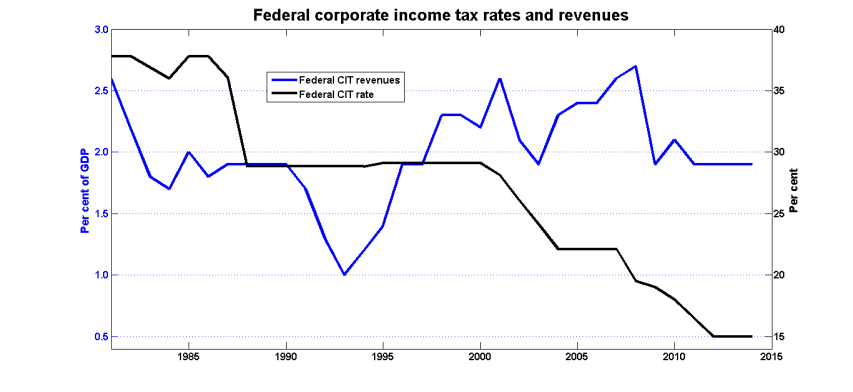
If you look at just the relationship between federal corporate income tax rates and federal income tax revenues, you get pretty much the same story. Even though federal corporate tax rates have fallen by more than half over the past 30 years, corporate income tax revenues have continued to fluctuate around two per cent of GDP.

Canadian corporate tax rates and revenue 1985-2014

There are at least two reasons why you might think that higher corporate tax rates might not result in higher corporate tax revenues:

  1. Higher corporate tax rates reduce the after-tax rate of return on investment. Everything else being equal, this reduces investment, capital accumulation and profits. Less profits means less corporate income to tax.
  2. Higher corporate taxes produce an incentive for multinational firms to shift taxable activities away from high-tax jurisdictions.

In the short and medium term, the second point is probably more important.

August 28, 2015

Slick political consultants horrified to discover what people are really thinking

Filed under: Politics, USA — Tags: , , — Nicholas @ 04:00

In a post earlier this week, Ace expressed his disdain for the members of the very-well-paid consultant class who are given a lot of money to advise politicians about what the “little people” are thinking:

No matter how low my estimations of our political class, they keep failing to meet my expectations.

I complained on Friday that the vaunted consultant class does not know the most elemental things about the “constituency” they’re paid to advise clients about. I put “constituency” in quotes because it’s quite plain they do not consider the actual grassroots voter as their constituency. In fact, they do not consider them at all.

I have previously said — and I’ve said this a dozen times before, especially in the 2007 amnesty fight — that the Establishment in DC, paid millions and feted as gurus of the political pulse of the nation — knows far, far less than the base than the average low-level blogger who bothers to read his comments and talk with them.

By the way, of course: That’s expressly the reason Andrew Breitbart read the comments, especially here. Well, one reason was that he simply enjoyed them. But the other reason, he told me, was to figure out where people, as a mass, were on issues, where their passion was, where they were going.

You would think that these well-paid consultants, claiming the ability to channel the sentiments of the party, would do this very most basic sort of research into the national mood.

It’s all open source, assholes. You don’t have to pay a dime to do what Breitbart used to, which is to use some program to suck up all comments into a file so he could read them when he didn’t have the internet (on a plane, etc.)

But no — High Guru Frank Luntz is shocked to the point of his legs shaking as the world reels beneath his feet to discover the grassroots really, really despises the Establishment, and no longer trusts them, and in fact considers them political enemies in the same way they consider the Democrats to be political enemies.

This is news to them.

Good work, assholes.

You’re the Smart Ones, right? The “political elite” who employ all sorts of sophisticated and cunning techniques to divine the national mood, huh?

Did you ever think to ask them, Geniuses?

August 26, 2015

Harper’s “boutique” tax credits

Filed under: Cancon, Economics, Government, Politics — Tags: , , — Nicholas @ 03:00

Colby Cosh explains why Stephen Harper is so fond of certain kinds of tax system distortions (tl;dr — they work … politically if not economically):

On Sunday, Conservative Leader Stephen Harper announced that his government, if re-elected, would introduce a tax credit for memberships in service clubs like the Canadian Legion or the Kiwanis. This modest measure — and Harper himself emphasized its modesty — is already being greeted with some derision. Apparently this is because a tax break for service clubs is an absurd, baroque complication of the tax code, unfit to stand alongside sensible traditions like the Prince Edward Island aerospace tax credit, the Nova Scotia digital media tax credit, the British Columbia book publishing tax credit, the Ontario computer animation tax credit, the Manitoba odour control tax credit for farms, Quebec’s tax credit “for the modernization of a tourist accommodation establishment” or the various items exempted almost randomly from the GST, such as condominium fees and music lessons.

One senses that the Canadian media have decided, curiously late in the country’s history, that tax-code wrinkles introduced with the aim of social engineering are ridiculous, if the aims thereof are conservative ones. Furthermore, we have concluded that lifting taxes on Elks or Knights of Columbus memberships, and thus putting them on more or less the same footing as religious tithes, is especially ridiculous.

The Conservative party will be awfully disappointed if the press does not engage in some snickering here. The work of the Kinsmen or Rotary is not especially visible if you never cross Eglinton Avenue; the very names of these groups have a rustic flavour on the tongue, carry a whiff of old-school WASP dominance and gray-flannel respectability. Break out into the smaller cities, if you dare, and the traces become somewhat clearer: a seniors’ centre here, an air-ambulance fundraiser there. In smaller towns, service clubs are often practically synonymous with capital-S Society. Laugh at the idea of a tax break for the Legion, but make sure you are still laughing on election night.

August 24, 2015

“If you want to understand American elections, read a comic book”

Filed under: Humour, Politics, USA — Tags: , , — Nicholas @ 03:00

Megan McArdle on the difference between what voters indicate they want from their elected representatives and what they actually get:

Now, you won’t learn much about how politics happens. Politics doesn’t have clear villains or decisive, powerful action. Politics muddles along on a heavily adulterated biofuel composed of interpersonal favor-trading, compromised ideology, soul-sucking proceduralism, and ponderous interest-group mobilization.

But elections — that’s where your back issues of Action Comics will come in handy. They tell you a lot about what voters think.

Voters rally to get a candidate elected, then call on the politician to stop technological change from tanking the local economy, to give them much more generous health care at half the cost of whatever they’ve currently got, to cut their taxes without touching Social Security or Medicare because they earned those benefits, to provide large new entitlements paid for entirely by taxing hedge fund managers, to reform the education system so that all the students will be above average, to defuse conflict in the Middle East and maybe leap some tall buildings in a single bound. You know, the usual.

Time passes. These voters notice that these things have not been done. Obviously, they have elected the wrong superhero. It is time to stop messing around with Squirrel Girl and Jack of Hearts and elect Superman, already. So the story starts all over again.

The tendency of American voters to treat political problems as if they were occurring in an alternate universe was first noted by Matthew Yglesias during the Iraq war debate, when he coined the Green Lantern Theory of Geopolitics, in which the US military has unlimited powers if only it is wielded by someone with sufficient will; Julian Sanchez expanded this to the home front with the Care Bear Stare Theory of Domestic Politics: “They’d line up together and emit a glowing manifestation of their boundless caring, which seemed capable of solving just about any problem.” Sound familiar? If only people cared enough.

August 23, 2015

Jeremy Corbyn and the British Labour party

Filed under: Britain, Politics — Tags: , , , , — Nicholas @ 03:00

In sp!ked, Mick Hume describes the state of the British equivalent to the NDP in their current leadership race:

Jeremy Corbyn has been a Labour member of parliament for a remarkable 32 years without ever leading anything or leaving any visible mark on British political life. How could such a veteran non-entity emerge overnight as favourite to be the new, left-wing, game-changing leader of the Labour Party?

Only because the Labour Party as a mass movement has not just declined, but effectively collapsed. The apparent rise of Corbyn is made possible by the disintegration of his party. The key factor in all of this is not any resurgence of radicalism, but the demise of Labourism.

Over the decades that Corbyn has been an MP, Labour has ceased to be the party of a mass trade-union movement with a solid working-class constituency. It has been reduced to an empty shell run by a clique of careerists such as Tony Blair, Gordon Brown, Ed Miliband – and the other three current candidates for the leadership – with no ambition beyond their own election.

This disintegration has left a space for Corbyn’s allegedly explosive rise in two ways. First, widespread dissatisfaction with the dire state of Labour and wider UK politics has created an appetite for something/anything that appears different. And second, the hollowing-out of the Labour Party – reflected in its desperation to give anybody a leadership vote for just £3 – has made it possible for relatively few Corbyn supporters to seize control of events.

For all that, however, the new profile of Corbyn the inveterate invisible man remains only a symptom of the wasting disease that has destroyed the Labour Party.

August 22, 2015

Coming soon to Massachusetts (maybe) – pot pubs

Filed under: Law, Liberty, USA — Tags: , , , — Nicholas @ 03:00

In Forbes, Jacob Sullum looks at the finalized ballot initiative to be presented to Massachusetts voters in the next general election:

When the Campaign to Regulate Marijuana Like Alcohol in Massachusetts unveiled the text of its 2016 legalization initiative this month, the group highlighted several features of the measure but omitted the most interesting one. The Regulation and Taxation of Marijuana Act would allow consumption of cannabis products on the premises of businesses that sell them, subject to regulation by the state and approval by local voters.

That’s a big deal, because until now no jurisdiction has satisfactorily addressed the obvious yet somehow touchy question of where people can consume the cannabis they are now allowed to buy. The legalization initiatives approved by voters in Colorado, Washington, Oregon, and Alaska all promised to treat marijuana like alcohol, which implies allowing venues similar to taverns where people can consume cannabis in a social setting. Yet all four states say businesses that sell marijuana may not let customers use it on the premises.

Although a few “bring your own cannabis” (BYOC) clubs have popped up to accommodate people who want to use marijuana outside their homes from time to time, the legality of such establishments is a matter of dispute. The result is that people can openly buy marijuana without fear, but they still have to consume it on the sly, just like in the bad old days. The problem is especially acute for visitors from other states, since pot-friendly hotels are still pretty rare.

Thomas Mulcair cracks down on dissent within the NDP

Filed under: Cancon, Politics — Tags: , , — Nicholas @ 02:00

Richard Anderson explains why it’s silly to blame Tom Mulcair for suppressing even minor deviations from the party’s main election message, which he calls the “iron fist in the orange velvet glove”:

What exactly did Bruce Hyer think he signed up for? He joined a political party not a social club. Perhaps he has no interest in sitting in cabinet but most of the NDP front bench does. That’s why they entered politics, it’s why they fight tooth and nail to win campaigns and why they elected Tom Mulcair leader, instead of an actual socialist. When you’ve joined a pack of jackals it’s a touch absurd to complain about the dining arrangements.

Politics is not about truth, justice or your particular understanding of the Canadian way. It’s about power. It has always been and always will be about power. Politics is answering the question of how the brute force of the state is to be imposed upon a country. Or to put it another way: What is to be done and who is to do it.

Behind the vapid speeches and focused group bromides all of it, down to the last Tweet and regulatory sub-clause, rests on the power of the gun. Politics is about deciding who controls the guns. In that stark light of day Mr Hyer doesn’t look like an idealist, instead he looks like a personality type quite common in the NDP: A fool on stilts.

August 21, 2015

Donald Trump didn’t say this … but it’s easy to imagine that he would

Filed under: Humour, Military, Politics, USA — Tags: , , , — Nicholas @ 03:00

It’s a tough life as a modern day satire writer, as what seems outrageously funny one day becomes news one short news cycle later. Here’s Duffelblog doing their best to get out ahead of the breaking news about Donald Trump’s GOP campaign:

Opinion: Everyone In The Military Is A Coward
The following is an op-ed written by Donald Trump, a candidate for President of the United States.

That’s right, I said it. All of you in the military and your veteran brothers and sisters are a bunch of cowards. More than that, you’re a bunch of damn pussies. I’m not telling you something we don’t all know — I just have the balls to say it. Pure titanium. Made in America. Patent pending.

Let’s look at your track record. You’ve been in Afghanistan over twice as long as that loser McCain spent being a bitch in Hanoi, and you still haven’t won the war.

Iraq is more fucked up than it was before we invaded. You burned children in Vietnam, and you still couldn’t win that war. At least there were whores in Vietnam, but you wouldn’t catch me dead there. The only whores I bang are grade-A Phillies.

In fact, when has America ever won a war? Don’t try and tell me World War II. Russia won that shit, and we had to drop an A-bomb because your pansy asses couldn’t finish the job. “The Greatest Generation?” Please. Those assholes got half a million Americans killed. I like drones that win.

And then Tamara K. linked to this in her Twitter feed:

Trump campaign parody

QotD: The lack of populism in Canadian politics

Filed under: Cancon, Media, Politics, Quotations — Tags: , , , — Nicholas @ 01:00

For all the talk we’ve heard in recent years about Canada’s slide into supposedly “American-style” gutter politics, the sort of garish gestures described above are completely unknown north of the border. The Canadian version of a controversial “stunt” involves Stephen Harper sitting down at a piano and playing a pop song. And when Elizabeth May embarrassed herself with her Welcome Back Kotter shtick, most observers responded to this brief spasm of theatricality with stunned mortification and pity.

I suppose the closest thing that the federal Tories have to a controversial populist is Minister of Employment and Social Development Pierre Poilievre, who shocked the Canadian pundit class by, wait for it, conducting a ministerial press conference wearing a golf shirt emblazoned with the Conservative Party logo. His party is so obsessed with milking partisan advantage from their expanded Universal Child Care Benefit that Poilievre actually travelled to a Winnipeg production facility so he could pose for pictures with the freshly printed cheques. The stunt was fantastically grubby. But the least that can be said for it was that the UCCB is an actual component of government policy. Better a printing press, I suppose, than a snowball, a chainsaw, a flame-thrower, or a gun.

As Canadians, we’d like to think that Donald Trumps don’t infect our politics because we are smarter and saner than Americans. But the real reason is structural. Republicans and Democrats elect their presidential candidates through the grass roots, which means that populists do occasionally hijack the process. In our parliamentary system, on the other hand, the major parties are heavily whipped entities obsessed with brand preservation. And the party leaders who go on to become premier or prime minister are selected at convention proceedings closely supervised by risk-averse party grandees. The result is a menagerie of bland, polished, disciplined wonks and career politicians such as Stephen Harper, Christy Clark, Rachel Notley, and Kathleen Wynne. (It’s no coincidence that the most interesting and thoroughly disgraced politician in modern Canadian history, former Toronto mayor Rob Ford, existed completely outside the party system.)

Most Republicans are appalled by Donald Trump, and rightly so: His comments about Mexico’s supposed criminal hordes only encourage the GOP’s reputation as a party for ageing white nativists. But his fifteen minutes of fame highlight the degree to which Americans trust ordinary yahoos to pick the person to run their country. It’s a right that our own yahoos will never ever have.

Jonathan Kay, “A Land Without Trump”, The Walrus, 2015-07-28.

August 20, 2015

It’s safe to come out now … the “libertarian moment” is over

Filed under: Liberty, Media, Politics, USA — Tags: , , — Nicholas @ 02:00

Well, that’s what the Washington Post says anyway. Reason‘s Nick Gillespie disagrees:

There’s no question that Rand Paul’s presidential campaign has hit a soft patch. He got the least amount of air time in the first GOP debate and his numbers have been slipping for a long time. I’ve been critical of some of his positions over the past few months but Weigel quotes me this way:

    “It’s a mistake to conflate Rand Paul’s electoral success with that of the libertarian moment,” said Nick Gillespie, the editor of Reason.com. (Disclosure: I worked for Reason from 2006 to 2008.) “Rand Paul’s high visibility is better understood as a consequence of the libertarian moment than its cause. There’s a reason why he’s been at his most electrifying and popular precisely when he is at his most libertarian: calling out the surveillance state, for instance, and leading the charge against reckless interventions in Syria and Libya.”

Libertarians such as Lawson Bader, president of the Competitive Enterprise Institute, and David Boaz, vice president of The Cato Institute, note that on fronts such as gay marriage, pot legalization, gun rights, criminal justice reform, general distrust of government, and more, things are going in the libertarian direction.

Full Weigel/Post piece here.

More important, broad indicators that Americans prefer social tolerance and fiscal responsibility continue to grow:

    According to a composite index of libertarian views on social and economic issues developed by pollsters at CNN, something clearly is afoot. The pollsters look at whether people believe that government is trying to do too many things individuals should be doing and whether or not people think government should enforce a particular set of morals. In 1992, the index of libertarian belief stood at 92 points. It’s now at 113 points. Virtually all surveys show trends of people thinking the government is doing too much, is incompetent or untrustworthy, or represents a larger threat to the future than big labor or big business.

As Matt Welch and I argued in The Declaration of Independents, politics is and always will be a “crippled, lagging indicator” of where the country is trendng.

It certainly doesn’t help that the American political scene has been rigged in so many different ways to be a duopoly of the two major parties … very few political issues are binary, yet that is the only way American voters are presented with a “choice” every election. Vote for the Red Faction of the Boot-on-your-neck party … or vote for the Blue Faction of the Boot-on-your-neck party. No matter who you choose, the government always gets in.

August 19, 2015

The Clintons

Filed under: Politics, USA — Tags: , , , — Nicholas @ 04:00

Jonah Goldberg from last week’s “news”letter:

Bill and Hillary Clinton are like that Third World driver who takes a hairpin curve at high speed and survives. Everything worked out, so why change your behavior?

Now, Bill is a famous case. In many respects he’s lived a Caligulan lifestyle. No, he’s never tried to make his horse a senator, nor did he order the army to declare war on Neptune, but for him the highest law is whatever he can get away with.

Bill’s entire life has been about cutting corners, shaving the truth — often down to the bone — and conflating his priapism with his sense of entitlement. This has worked out for him because he has superhuman powers of duplicity and cozenage. There are legends in Little Rock of how a young Billy Clinton was on a school field trip to a laboratory when, through an unlikely series of events, a radioactive hustler bit him on the hand, giving him unearthly powers of flim-flammery and deception. The earnest lad was suddenly transformed.

I have no doubt Bill believes that he uses his powers for good, but with the pimpish midichlorians coursing through his veins, he can’t help himself. Over time, as he continually escapes the snares reality and morality typically set for mortal men, he has come to have a sense of entitlement and immunity about it all. Like the hazardous driver who’s never had a crash or the lucky investor who’s never lost money, he just thinks: This is the way reality works. Even when a black swan hits him in the grill, he talks his way out of it.

The tragedy for Hillary Clinton is that she is all too human. As Bill’s mortal sidekick, she’s had a good ride. But whereas Bill has an almost Jedi-like ability to lie convincingly — “these aren’t the interns you’re looking for” — Hillary has no superpowers to fall back on. She just has to grind it out. Like Syndrome in The Incredibles or the entire cast of Kick-Ass, she has to compensate for a lack of raw superpowers through guile and technology — and minions, lots and lots of minions. They do her dirty work for her. They burrow into the bureaucracy and cover for her. They get appointed to commissions and erect firewalls against accountability. They tell her what she wants to hear and explain how all bad news is someone else’s fault. They scrub the paper trail. They even shove classified evidence in their pants, if that is what is required. As Renfield to her huband’s Dracula, Otis to his Lex Luthor, Gogo Yubari to his O-Ren Ishii , Alistair Smythe to his Kingpin, Tom Hagen to his Don Corleone, Bizarro World Radar O’Reilly to his evil Colonel Potter, she has amassed considerable resources and abilities of her own. There’s now an entire Clinton-Industrial Complex that fuels and funds the vast interconnected network of minions. They are like agents of Hydra, embedded in the media, in government, and in academia. Places like Media Matters are like huge industrial farms for breeding Clintonian hacks where the larvae are grown in vats.

« Newer PostsOlder Posts »

Powered by WordPress