
The Rest Is History
Published 27 January 2025This is part 4 of our series on Suetonius and the Emperors of Rome.
00:00 The rebirth of the republic?
10:05 Who is Claudius
15:18 The relationship between Augustus and Claudius
16:20 The scholar emperor
21:12 Claudius’ relationship with Caligula
28:53 Claudius’ rule as emperor
45:50 The problem he had with his wives
56:40 The rise of Nero
58:40 Was he poisoned?
59:51 The lack of sources in Ancient historyProducer: Theo Young-Smith
Assistant Producer: Tabby Syrett
Executive Producers: Jack Davenport + Tony Pastor
July 28, 2025
Claudius: The Disabled Emperor Who Conquered Britain
Comments Off on Claudius: The Disabled Emperor Who Conquered Britain
July 26, 2025
The Julio-Claudians – The Conquered and the Proud 15
Adrian Goldsworthy. Historian and Novelist
Published 26 Feb 2025This time we take a look at the reigns of Augustus’ successors — Tiberius, Gaius Caligula, Claudius and Nero, referred to collectively by scholars as the Julio-Claudian dynasty. We think about the whole question of the succession, and trace how each diverged from Augustus when it came to the style of governing.
Comments Off on The Julio-Claudians – The Conquered and the Proud 15
July 21, 2025
Caligula: Was He Really Mad?
The Rest Is History
Published 3 Feb 2025Enough of the Princeps, what remains to be described, is the monster …
The Roman emperor Caligula endures as one of the most notorious figures in not only Roman history, but the history of the world. Famed as a byword for sexual degeneracy, cruelty and corruption, the account of his life written by the Roman historian Suetonius has, above all, enshrined him as such for posterity. Throughout the biography there is a whiff of dark comedy, as Caligula is cast as the ultimate demented Caesar, corrupted absolutely by his absolute power and driven into depravity. Born of a sacred and illustrious bloodline to adored parents, his early life — initially so full of promise — was shadowed by tragedy, death, and danger, the members of his family picked off one by one by the emperor Tiberius. Nevertheless, Caligula succeeded, through his own cynical intelligence and cunning manipulation of public spectacle, to launch himself from the status of despised orphan, to that of master of Rome. Yet, before long his seemingly propitious reign, was spiralling into a nightmare of debauchery and terror …
Join Tom and Dominic as they discuss the most notorious emperor in Rome: Caligula, a man said to have slept with his sister, transformed his palace into a brothel, cruelly humiliated senators, and even made his horse into a consul. But what is the truth behind these horrific legends? Was Caligula really more monster than man …?
00:00 A mysterious emperor
05:18 Why are the stories about Caligula so bad?
08:40 Germanicus: the best man in Rome
16:20 Caligula is the heir
19:30 The death of Tiberius
20:55 Caligula’s cynical intelligence
22:50 Caligula’s skill playing to the gallery
28:39 Caligula’s turn to evil (according to Suetonius)…
31:35 Caligula as Suetonius’ monster
37:22 Caligula confronts the senate
45:10 The conspiracy against him moves
48:14 Did all this actually happen?
58:43 Did he make his horse a consul?Producer: Theo Young-Smith
Assistant Producer: Tabby Syrett
Video Editor: Jack Meek
Social Producer: Harry Balden
Executive Producers: Jack Davenport + Tony Pastor
Comments Off on Caligula: Was He Really Mad?
June 21, 2022
The Early Emperors – Part 4: Caligula, The First Insane Tyrant
seangabb
Published 31 Oct 2021The Roman Empire was the last and the greatest of the ancient empires. It is the origin from which springs the history of Western Europe and those nations that descend from the Western Roman Empire. It is the political entity within which the Christian faith was born, and the growth of the Church within the Empire, and its eventual establishment as the sole faith of the Empire, have left an indelible impression on all modern denominations. Its history, together with that of the ancient Greeks and the Jews, is our history. To understand how the Empire emerged from a great though finally dysfunctional republic, and how it was consolidated by its early rulers, is partly how we understand ourselves.
Here is a series of lectures given by Sean Gabb in late 2021, in which he discusses and tries to explain the achievement of the early Emperors. For reasons of politeness and data protection, all student contributions have been removed.
More by Sean Gabb on the Ancient World: https://www.classicstuition.co.uk/
Learn Latin or Greek or both with him: https://www.udemy.com/user/sean-gabb/
His historical novels (under the pen name “Richard Blake”): https://www.amazon.co.uk/Richard-Blak…
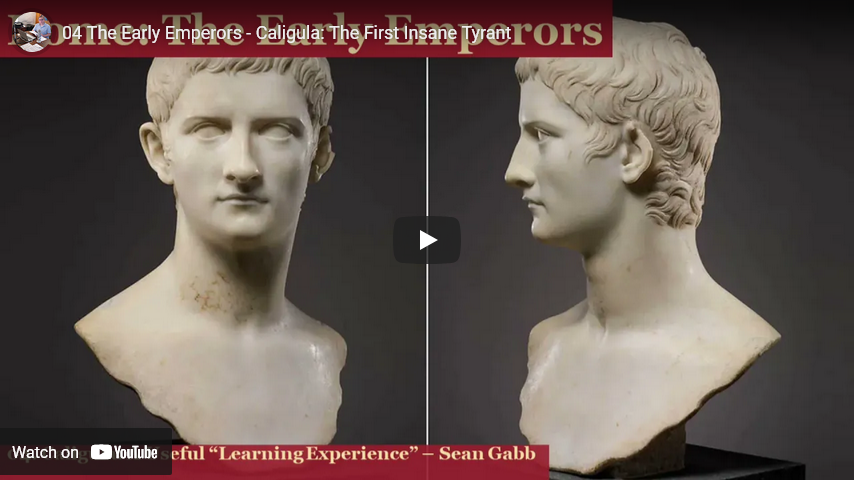
Comments Off on The Early Emperors – Part 4: Caligula, The First Insane Tyrant
July 30, 2013
Was Caligula the victim of a historical smear campaign?
I confess, my views on Emperor Caligula (formally Gaius Julius Caesar Augustus Germanicus) were almost completely informed by the character in the novels I, Claudius and Claudius the God by Robert Graves. BBC News Magazine‘s Mary Beard thinks Caligula got a fearful load of bad press:
Of course, there had been some very nasty monarchs and despots before Caligula. But, so far as we know, none of his predecessors had ever ticked all the boxes of a fully fledged tyrant, in the modern sense.
There was his (Imelda Marcos-style) passion for shoes, his megalomania, sadism and sexual perversion (including incest, it was said, with all three of his sisters), to a decidedly odd relationship with his pets. One of his bright ideas was supposed to have been to make his favourite horse a consul — the chief magistrate of Rome.
Roman writers went on and on about his appalling behaviour, and he became so much the touchstone of tyranny for them that one unpopular emperor, half a century later, was nicknamed “the bald Caligula”.
But how many of their lurid stories are true is very hard to know. Did he really force men to watch the execution of their sons, then invite them to a jolly dinner, where they were expected to laugh and joke? Did he actually go into the Temple of the gods Castor and Pollux in the Roman Forum and wait for people to turn up and worship him?
It is probably too sceptical to mistrust everything that we are told. Against all expectations, one Cambridge archaeologist thinks he may have found traces of the vast bridge that Caligula was supposed to have built between his own palace and the Temple of Jupiter — so it was easier for him to go and have a chat with the god, when he wanted.
So the idea that Caligula was a nice young man who has simply had a very bad press doesn’t sound very plausible.
All the same, the evidence for Caligula’s monstrosity isn’t quite as clear-cut as it looks at first sight. There are a few eyewitness accounts of parts of his reign, and none of them mention any of the worst stories.
No revisionist slant on Caligula is complete without a few nasty cracks directed towards kindly old Uncle Claudius:
More topical though is the question of what, or who, came next. Caligula was assassinated in the name of freedom. And for a few hours the ancient Romans do seem to have flirted with overthrowing one-man rule entirely, and reinstating democracy.
But then the palace guard found Caligula’s uncle Claudius hiding behind a curtain and hailed him emperor instead. Thanks to Robert Graves, Claudius has had a good press, as a rather sympathetic, slightly bumbling, bookish ruler.
But the ancient writers tell a different story — of an autocrat who was just as bad as the man he had replaced. The Romans thought they were getting freedom, but got more of the same.
Considering what happened then, it’s hard not to think of the excitements and disappointments of the Arab Spring.
Comments Off on Was Caligula the victim of a historical smear campaign?


