Quotulatiousness

November 11, 2025

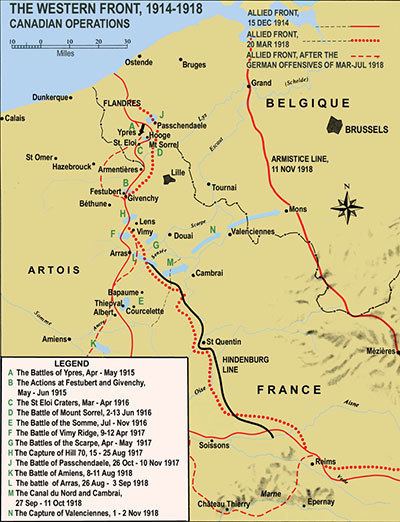
Four battles of the Canadian Corps

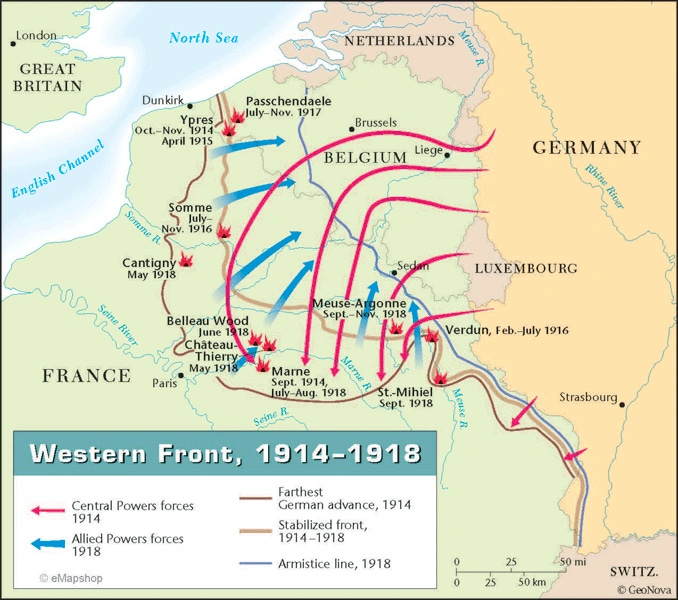
Following on from part one (excerpted here), The Black Horse outlines four major battles that the Canadians fought on the western front during the First World War:
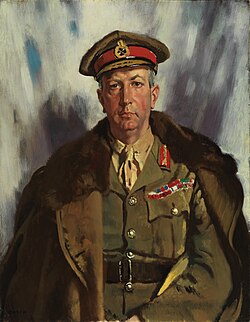
Sir Arthur Currie
Portrait by William Orpen, 1919.

The first part of the series was a political biography of Currie; the second part attempts to tell the story of the Canadian Corps at war through somewhat detailed account of four important battles. The piece is only partly biographical, it partly tells the story of Currie’s war, and partly tells the story the Canadian men who fought for the British Empire in the Great War. It’s a story of incredible martial prowess, but the careful reader will also observe a story of warring duties placed upon the leader of a colonial army; duty to his men, duty to the political leadership of his colonial people and the future of that nation, duty to the objectives of the imperial power on whose behalf he fought, and finally duty to glorious Victory. Currie ended his life understood by those with eyes to see as a great warrior and a military genius; but disliked by his men and hated by the leadership of his people because he prioritized the needs to the Empire and of Victory; but after the war the Empire was of limited service to Currie and to the Canadian people. I leave to the reader, to history, and to God, to decide the value of Victory.

[…]

2nd Battle of Ypres

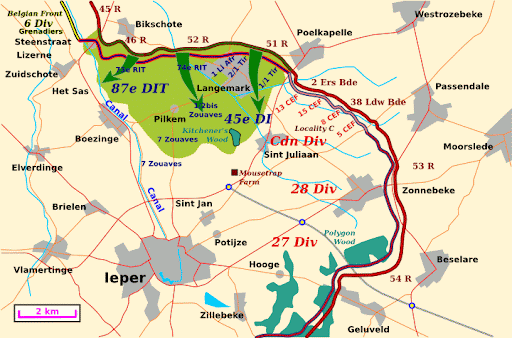
In the spring of 1915 the early dynamic advances of the German army were a distant memory faded behind the great defeat at the First Battle of the Marne. Through the winter both sides had dug in; and many German troops were redeployed to the Russian front. German chemists Walther Nernst and Fritz Haber brought forward the idea of using heavier-than-air Chlorine gas, carried on the wind, to overcome the mathematical impossibility of conventional attack. On April 22, 1915, Albrecht of Württemberg led 7 German divisions to attack 8 Allied divisions, including the 1st Canadian Division under the command of Sir Edwin Alfred Hervey Alderson. The attack began with the release of 168 tons of chlorine gas at about 1700h along a 4 mile stretch of the front around Langemark.

[…]

Vimy Ridge

For a year and a half after Ypres, Currie & the Canadian Corps continued to fight desperate engagements along the Western front with no clear strategic conclusion. After heavy losses and a lot of hard-learned lessons at the Somme from Sept 1915-Sept 1916, the Canadian Corps and Currie with them had become both hardened by bitter experience, and desperate to find better ways to prosecute the war. In September 1915 he was recorded to have said “I did not care what happened to me, but to my men, to their wives, their mothers, their children and to Canada I owed a duty which I wanted to fulfill to the very best of my ability”. Later that year as the division struggled with desertion, he ordered the execution of a deserter despite a three hour plea for clemency by the divisional cleric. The decision restored discipline, but haunted Currie’s dreams long afterwards.

In May 1916 Julian Byng took command of the Canadian Corps, replacing Sir Edwin Alderson. In the fall of that year, after heavy losses in a series of engagements at the Somme, Byng was given the opportunity to reorganize and refit the Canadian Corps; he looked to Currie as a key partner in the effort. They replaced the ineffective Ross Rifle with the Lee Enfield, reorganized the platoon structure to include heavy weapons within each platoon [machine guns, mortars, etc.], and implemented new training and tactics like rehearsals for advances, and the “creeping barrage”, carefully coordinated intended to keep artillery shells landing slightly ahead of advancing men.

[…]

Hill 70

After Vimy, Julian Byng was promoted. Currie was promoted in turn to lead the Canadian Corps. He would lead the Corps that he and Byng had made into one of the most effective fighting forces on any side of the conflict and lead it to bloody victory again and again. There is perhaps no better example of the mastery of the Canadian Corps, from top to bottom, than the battle of Hill 70. “Hill 70 was as close to a perfect battle as was ever fought on the Western Front” wrote historian Tim Cook.

[…]

The Hundred Days Offensive & the Pursuit to Mons

As the winter of 1917-18 passed, a new set of highly political decisions concerning whether and how to reorganize the Canadian Corps for the next round of fighting were taken. As noted in part one, Currie opted to split up the newly formed 5th division to reinforce the four divisions of the Canadian Corps and triple the size of the field engineering element. The decision optimized the Canadian Corps as an attacking force; and when they returned to the front that’s exactly how they would be used. Between August 8th and November 11th, 1918, the Canadian Corps fought nine major battles advancing 86 miles, and suffering 45,835 casualties [The force that began the offensive was ~100,000]. By comparison, the substantially larger American Expeditionary Force, over this same period, advanced only 34 miles while capturing only half the number of prisoners, suffering roughly twice the casualties per German division defeated.
November 9, 2025

Sir Arthur Currie, commander of the famous Canadian Corps in WW1

Filed under: Britain, Cancon, History, Military, WW1 — Tags: , , , , , , , — Nicholas @ 05:00

As a counterpoint to the OTT summary of Sir Arthur posted last week, here’s The Black Horse with part one of a two-part look at the man’s early career before joining the Canadian Expeditionary Force in Europe:

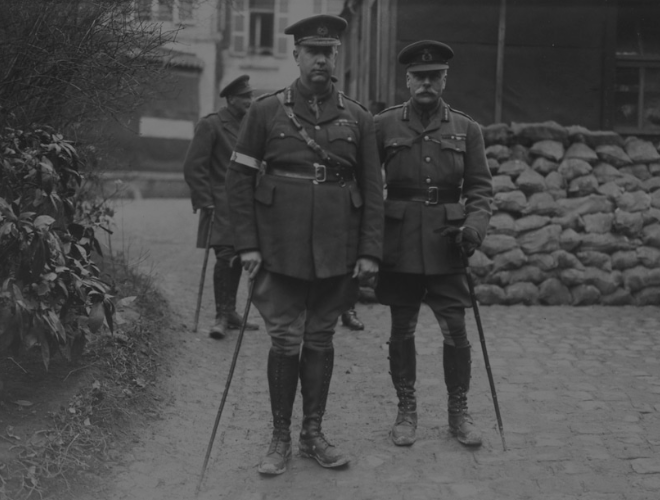
Sir Arthur Currie with Field Marshal Sir Douglas Haig, February 1918.
Libraries and Archives Canada item ID number 3404878.

The Red Ensign is a publication deeply interested in leadership; the good, the bad, and the ugly. For this reason, this Remembrance Day, I have chosen to draw the audience’s attention to the life and times of Sir Arthur Currie, the first Canadian commander of the Canadian Corps during the Great War. This presents an opportunity to both on honour and reflect upon the courage and sacrifice of the men who have fought under the flag of this great nation, but also offers the language to articulate the task facing any who would attempt to lead Canada today. As Currie’s war was defined by the challenge [of] leadership of Canadians in the context of the shifting priorities of the late British Empire, any who would seek to lead Canadians today face will struggle to harmonize efforts on behalf of the Canadian people and the priorities and policies of the American power block which he cannot eschew.

Dulce et decorum est pro patria mori; but when your country is an Imperial Dominion, who and what is “pro patria“, and how can one spend their life for them?

The Man Before the Great Man:

Arthur Currie was born in 1875 in Napperton, Ontario [50 km West of London], the third of eight children living on a homestead belonging to his grandfather. Raised with a the vigorous discipline of a Methodist home, Currie would remain a convicted Christian for his entire life, though he converted to Anglicanism as an adult. Currie was a good student, intending to pursue a career in law or medicine but dropped out of school twice, first temporarily because of the financial constraints brought on by the death of his father, and then for a second time at 19 because of a quarrel with one of his teachers. After leaving school he went West; after a string of failed efforts to establish himself via entrepreneurship and real-estate speculation he joined the Canadian militia as a gunner in 1897 in Victoria B.C. at the age of 23. A giant man (6’3″ at a time when the average Canadian height was 5’7″) with a noted eye for technical detail and, in the words of his son, a “tremendous command of profanity”, he quickly distinguished himself and was promoted to corporal before earning a commission as an officer in 1900. As an officer in peace time Currie was noted for his detailed inspections and his rapid transformation from “one of the boys”, into a rigid disciplinarian. This duality, an officer raised from the ranks, who could both embody the rigid tradition of the British military and who had an intimate familiarity with the life and ways of the enlisted men would become a defining feature of his career.

During Currie’s peace-time career as an officer he maintained a second career as a real-estate [agent]. After becoming head of Matson Insurance Firm 1904, he and the firm invested aggressively in the Victoria real-estate market. In 1913 Currie’s financial situation began to rapidly deteriorate as a consequence of price declines in the real-estate market. Currie’s financial problems nearly led him to refuse to stand up the 50th Regiment Gordon Highlanders of Canada in 1913. In July 1914 Curry used $10,833.34 of regimental funds intended for the purchase of uniforms and kit to pay his personal debts, and found himself facing forcible retirement just as the Canadian Army was being mobilized for war. At the intervention of one of his subordinates, Major Garnet Hughes, he instead accepted promotion as brigadier-general of the 2nd Brigade of the 1st Canadian Division, and ignored correspondence from the new commander of the 50th regiment, Major Cecil Roberts, about the missing funds until he was overseas.

Currie arrived at camp Valcartier on September 1st, 1914 to find himself charged with 10x as many men as he had ever led before, no staff, a shared tent as a command center, and the duty to prepare these men for one of the most difficult theatres of war the world has ever seen. The six months between taking command and the arrival of his brigade in the trenches near Ypres were marked by two mud besotted poorly supplied training camps, shoddy kit, rampant disease, and the company of a certain bear that was to become beloved by children around the world. Through this period Currie was well liked by the men, but known as a disciplinarian with an eye for technical detail. In March 1915 the brigade was deployed to what was expected to be a quiet part of the front with the intent of allowing the men to gain some experience with trench warfare before they were relied upon for action. Nobody anticipated what would happen next.

November 4, 2025

Sir Arthur Currie, Canada’s best general in WW1

On the social media site formerly known as Twitter, InfantryDort gives a lesson in Canadian military history that your kids are unlikely to ever get in school:

Canada: Let us remind you of what your nation was once capable of, and likely still is again. Time will tell. Courtesy of @grok UNHINGED👇

SIR ARTHUR CURRIE: The Ontario slide-rule psychopath who turned war into a goddamn spreadsheet and made the Kaiser cry uncle.

Listen up, you trench-foot tourists and armchair Haigs. While Europe’s aristocrats were using human meat to plug shell holes, some lanky insurance salesman from Napperton, Ontario rolled up with a protractor and a grudge against inefficiency so pure it could sterilize a field hospital. Six-foot-four of quiet Canadian fury. No Sandhurst polish. No inherited estate. Just a militia gunner who looked at the Western Front and said: “This is sloppy. Let me fix your murder math.”

Vimy Ridge: the ridge that laughed at French corpses for two years. Currie hands every platoon leader a map accurate to the latrine, rehearses the assault until the boys can do it blindfolded in a thunderstorm, then unleashes a creeping barrage so precise it’s basically a Roomba made of high explosives. Four days later the ridge is theirs. France needed therapy. Canada needed a birth certificate.

Hill 70: supposed to be a sideshow. Currie turned it into a German obituary — 9,000 Canadian casualties for 20,000 German ones. That’s not a battle, that’s a hostile takeover with extra steps.

Passchendaele: Haig wants it. Currie says, “Fine, but it’ll cost exactly 16,000 of my boys”. Mud eats them like clockwork. Sixteen thousand. He predicted it to the body. The man could forecast death better than the Farmer’s Almanac predicts frost.

Amiens: the day the German army discovered existential dread. Currie’s corps punches twenty-two kilometers through the Hindenburg Line in four days like it’s made of wet cardboard. Ludendorff calls it “the black day of the German Army” and probably wet his monocle.

The Hundred Days: wherever the Canadians go, the war ends faster — Arras, Cambrai, Canal du Nord. German prisoners start asking for Currie by name like he’s the Grim Reaper’s polite cousin. “Wenn Currie kommt, bricht die Linie.” When Currie shows up, your defense budget becomes a suggestion.

And the best part? He’s not screaming. He’s not posing for propaganda photos with a riding crop. He’s in the back, recalculating artillery tables while lesser generals are still figuring out which end of the horse goes forward.

Post-war? Becomes principal of McGill because apparently breaking the German army wasn’t challenging enough. Gets slandered for “wasting lives” at Mons, sues the bastard for libel, and wins with the same cold precision he used to win battles. Even his lawsuits had kill ratios.

Runner-ups:
Sir Richard Turner — the human participation ribbon. Managed the 2nd Division like success was contagious.

Sir David Watson — followed Currie’s plans like IKEA instructions: mostly right, but slower.

Sir Henry Burstall — thought “supporting fire” meant “hope the shell lands somewhere in Europe”.

Currie carried their divisions like a Sherpa with a PhD in applied violence.

Verdict: Currie didn’t just win battles. He invented the modern battlefield while everyone else was still playing medieval siege with extra mustard gas. Montgomery called him “the best corps commander of the war”, and Monty would rather die than compliment anyone.

Share this if you’d let Currie balance your checkbook, plan your wedding, and end your existential crisis with a well-timed barrage. Canada’s greatest general was a nerd with a death wish for waste and a heart that bled maple syrup for every lost soul. Never forget.

October 8, 2023

The Grave of Canada’s Greatest General: Sir Arthur Currie

Filed under: Cancon, History, Military, WW1 — Tags: , , , , , — Nicholas @ 02:00

OTD Military History
Published 23 Jun 2023

The grave of General Sir Arthur Currie in Mount Royal Cemetery in Montreal, Quebec. Arthur Currie was the commander of the Canadian Corps from June 1917 to the end of World War 1. Appointed as the Principal and Vice-Chancellor of McGill University in 1920, he held that position until his death in 1933.
(more…)

December 30, 2021

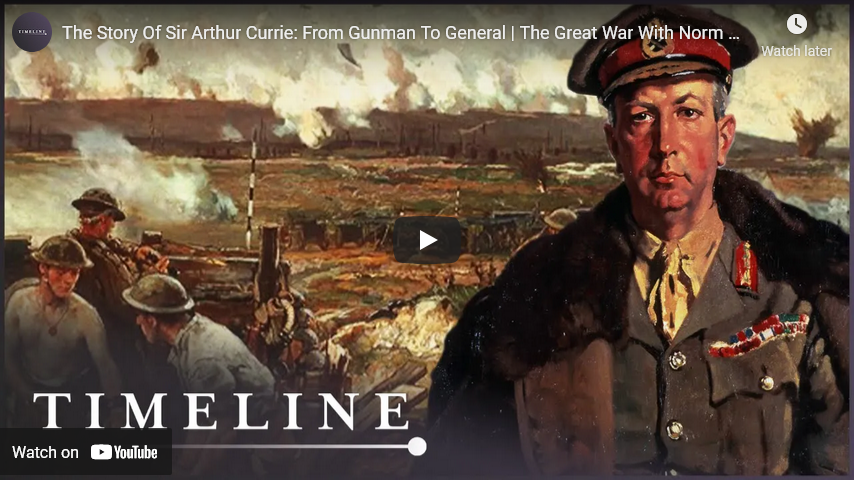
The Story Of Sir Arthur Currie: From Gunner To General | The Great War With Norm Christie | Timeline

Timeline – World History Documentaries
Published 28 Dec 2021

Military historian Norm Christie presents a four-part series examining the First World War from a Canadian perspective. As he begins his journey through the historic battlefields of France and Belgium, Christie focuses on the career of General Sir Arthur Currie, a soldier who rose through the ranks from humble gunner in 1897 to lead the Canadian Corps to several victories during the conflict which began in 1914.

📺 It’s like Netflix for history… Sign up to History Hit, the world’s best history documentary service and get 50% off using the code ‘TIMELINE’ http://bit.ly/3a7ambu

You can find more from us on:

https://www.instagram.com/timelineWH

Any queries, please contact owned-enquiries@littledotstudios.com

Note: The original YouTube title said “from Gunman to General”. Perhaps in British usage, “gunman” is a variant of “gunner” (an artilleryman), but in Canadian usage the word “gunman” almost invariably means armed criminal or terrorist, and while Sir Arthur’s career had its difficulties, he was never a criminal.

August 6, 2018

The Battle of Amiens

Filed under: Britain, Germany, History, Military, WW1 — Tags: , , — Nicholas @ 03:00

At Samizdata, Patrick Crozier explains why the Battle of Amiens should be far better known than it is:

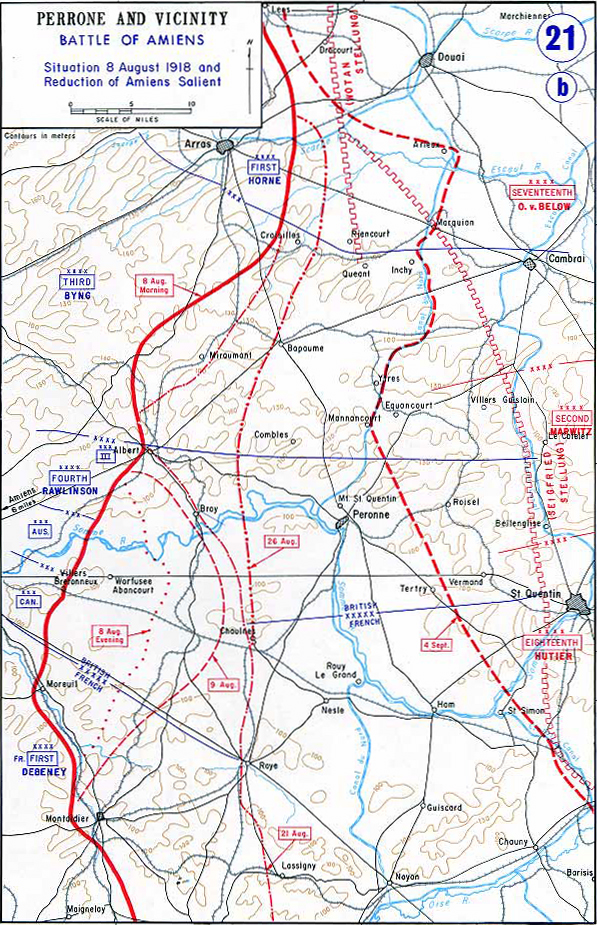
On 8 August 1918 in Northern France, a mainly British force attacked on a 15 mile front and advanced to a depth of 7 miles. In so doing it inflicted 70,000 casualties on the Germans capturing 500 guns while suffering 44,000 casualties of its own. The Battle of Amiens as it became known, was the first clearly-successful, large-scale, Allied offensive operation on the Western Front. Ludendorff, the German commander, famously called it the “Black day of the German army”. But then again he was always a bit of a flibbertygibbet.

Although no one knew it at the time the Battle of Amiens heralded the beginning of the Hundred Days Offensive in which Allied success followed Allied success. By November the Germans realised that the game was up and sued for peace.

Amiens did not take place in a vacuum. At the Second Battle of the Marne which took place a few weeks earlier the Germans had attacked and the French and Americans had successfully counter-attacked. This brought to an end German hopes of a quick victory.

[…]

So why have so few heard of Amiens? Why doesn’t it occupy a similar position to Agincourt, Waterloo and El Alamein? Quite simply because it doesn’t fit the narrative. The lazy story we’ve all heard a million times tells us that the Western Front was all about incompetent generals and stalemate. Amiens and the Hundred Days Offensive show this to be nonsense.

A more accurate narrative might be that winning on the Western Front was never going to be easy but they got there in the end.

The battle also saw the Australian Corps and the Canadian Corps reprising their roles as “shock troops” of the British army (including an elaborate scheme to hide the presence of the Canadians from the German commanders):

Purists will be offended by Terraine’s failure to explain the role of the French army at Amiens (which extended the attack to the south), but more intriguing is the sidelining of Sir Arthur Currie’s Canadian Corps. Indeed, Terraine’s focus on generals Rawlinson and Monash (although not incorrect in itself) seems to miss how important the Canadians were to the battle; it would be true to say that they made the Battle of Amiens. Their four divisions in line, deployed in the centre along the Amiens-Roye Road, formed the spearhead of the assault. At the end of the day they had driven eight miles into the position of the German Second Army.

Notwithstanding these quibbles, Terraine’s article, with its focus on training and planning and the coordination of firepower and manoeuvre, prefigures much of the debates that would take place in the 1990s and beyond about the nature of change and development in the British Expeditionary Force (the ‘learning curve’). While the military effort of the ‘white dominions’ – Australia, New Zealand and Canada – has been widely praised (with Canadians being justifiably proud of their tag as the ‘shock army of the British Empire’), the humble British Tommy has often been left behind. Since Terraine wrote his article, however, much work has been done to rectify this imbalance.

November 6, 2017

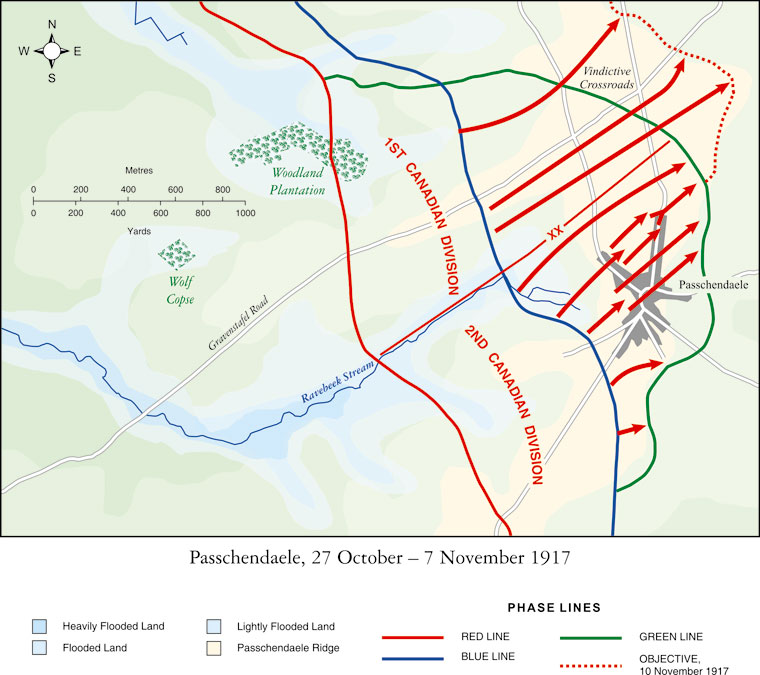
The end of the battle of Passchendaele, 1917

Filed under: Cancon, Europe, History, Military, WW1 — Tags: , , — Nicholas @ 03:00

The Canadian Corps under Lieutenant General Arthur Currie began the final phase of the battle on 6 November, 1917:

By 6 November, the Canadians were prepared to advance upon the Green Line. The final objective was to capture the high ground north of the town and to secure positions on the eastern side of Passchendaele Ridge. Again, according to Major Robert Massie: “The third attack … was the day when the First and Second Divisions took Passchendaele itself. On this occasion, the attack went off the most smoothly of any of the three. They had fair ground to go over, and especially those that went into Passchendaele itself had pretty fair going, and the objectives were reached on time.”

After early hand-to-hand fighting, the 2nd Division easily occupied Passchendaele just three hours after commencement of the attack at 0600 hours. The 1st Division, however, found itself in some trouble when one company of the 3rd Battalion became cut off and was stranded in a bog. When this situation eventually righted itself, the 1st Division continued toward its objectives. Well-camouflaged tunnels at Moseelmarkt provided an opportunity for the enemy to counterattack, but they were fended off by the Canadians. By the end of the day, the Canadian Corps was firmly in control of both Passchendaele and the ridge.

The final Canadian action at Passchendaele commenced at 0605 hours on 10 November 1917. Sir Arthur Currie used the opportunity to make adjustments to the line, strengthening his defensive positions. Robert Massie summed up the thoughts of many participating Canadians as follows: “What those men did at Passchendaele was beyond praise. There was no protection in that land. They could not get into the trenches which were full of mud, and you would see two or three of them huddled together during the night, lying on ground that was pure mud, without protection of any kind, and then going forward the next morning and cleaning up their job.”

[…]

The Canadians had done the impossible. After just 14 days of combat, they had driven the German army out of Passchendaele and off the ridge. There was almost nothing left of the village to hold. Altogether, the Canadian Corps had fired a total of 1,453,056 shells, containing 40,908 tons of high explosive. Aerial photography verified approximately one million shell holes in a one square mile area. The human cost was even greater. Casualties on the British side totalled over 310,000, including approximately 36,500 Australians and 3596 New Zealanders. German casualties totalled 260,000 troops.

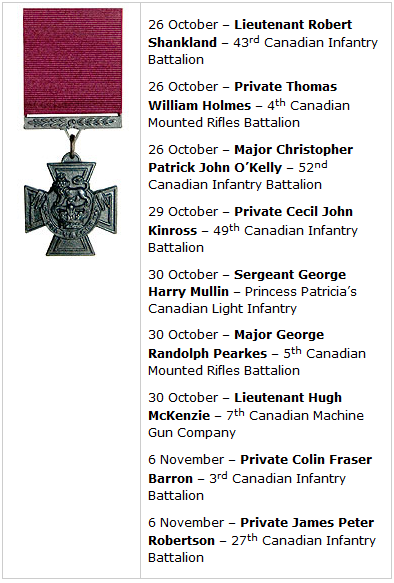
For the Canadians, Currie’s words were prophetic. He had told Haig it would cost Canada 16,000 casualties to take Passchendaele – and, in truth, the final total was 15,654, many of whom were killed. One thousand Canadian bodies were never recovered, trapped forever in the mud of Flanders. Nine Canadians won the Victoria Cross during the battles for Passchendaele. While the human cost had been terrible: “Nevertheless, the competence, confidence, and maturity began in 1915 at Ypres a short distance away, and at Vimy Ridge earlier that spring, again confirmed the reputation of the Canadian Corps as the finest fighting formation on the Western Front.” So wrote esteemed Professor of History Doctor Ronald Haycock at the Royal Military College of Canada for The Oxford Companion to Canadian History in 2004.

Haig proved to be true to his word. By 14 November 1917, the Canadians had been returned to the relative quiet of the Vimy sector. They had not been asked to hold what it had cost them so much to take. However, by March 1918, all the gains made by Canada at Passchendaele would be lost in the German spring offensive known as Operation Michael.

General Sir David Watson praised the Canadian effort: “It need hardly be a matter of surprise that the Canadians by this time had the reputation of being the best shock troops in the Allied Armies. They had been pitted against the select guards and shock troops of Germany and the Canadian superiority was proven beyond question. They had the physique, the stamina, the initiative, the confidence between officers and men (so frequently of equal standing in civilian life) and happened to have the opportunity.”

British Prime Minister David Lloyd George was even clearer when it came to the Canadians: “Whenever the Germans found the Canadian Corps coming into the line they prepared for the worst.”

November 3, 2017

Battle of Beersheba – Canadian Frustration – Balfour Declaration I THE GREAT WAR Week 171

The Great War
Published on 2 Nov 2017

On the Western Front this week, the Canadians under Sir Arthur Currie attempt to advance once more, whilst Haig remains optimistic about an imminent breakthrough. Following Caporetto, the Italian retreat continues, whilst the British Army enjoys success on the Palestine Front, with a little help from mounted ANZAC troops. With Lenin’s return, the revolution looms over the Russian capital, whilst the Balfour Declaration is issued in Britain.

August 16, 2017

Canadian War Museum highlights the six Canadian VCs won at the Battle of Hill 70

Filed under: Cancon, France, History, Military, WW1 — Tags: , , , — Nicholas @ 03:00

On August 15th, 1917, the Canadian Corps began a planned attack on German positions near Lens in northern France, to relieve pressure on the larger British and Imperial operations at Passchendaele. During the vicious fighting around the feature designated as “Hill 70”, the valour of six Canadians was deemed deserving of the highest military honour the British Empire could bestow, the Victoria Cross. From the institution of the medal in 1856, only 96 Canadians have been awarded a VC. David Pugliese reports for the Ottawa Citizen:

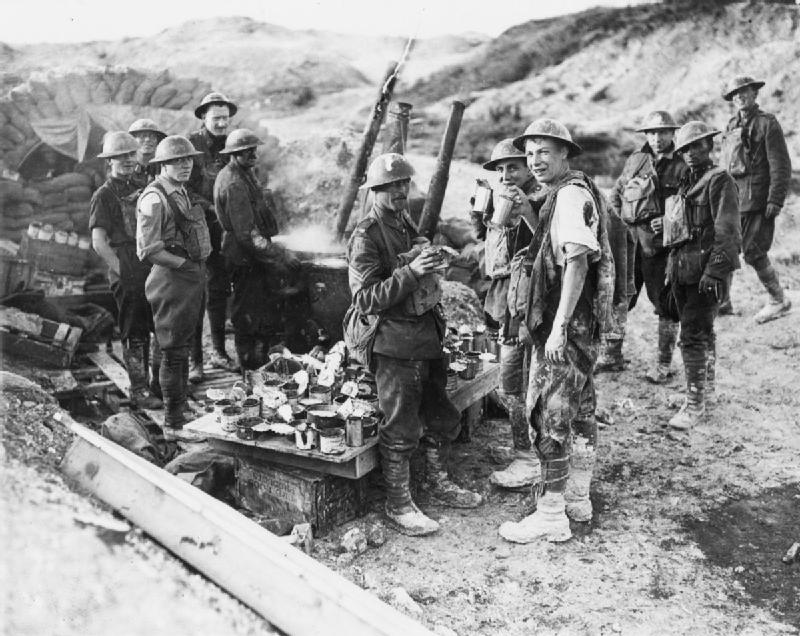
IWM caption : Hill 70 (Lens) 15-25 August: A group of Canadians, standing with mugs at a soup kitchen set up on boards “100 yards from Boche lines” during the push on Hill 70 (via Wikimedia)

The Canadian War Museum is marking the centenary of the Battle of Hill 70 with a special display highlighting the six Canadian soldiers who received Victoria Cross decorations as a result of their courageous actions. The Battle of Hill 70, which includes portraits of the recipients and some of their medals, will be on view from August 15 until Remembrance Day, according to the Canadian War Museum.

“Sir Arthur Currie described the Battle of Hill 70 in August 1917 as ‘altogether the hardest battle in which the Corps has participated,’” Stephen Quick, Director General of the Canadian War Museum, said in a news release. “It’s remarkable that this 11-day battle, fought four months after Vimy Ridge, resulted in six Canadian soldiers of varying backgrounds and ranks being awarded the highest honour for military valour in the British Empire.”

Here the Canadian War Museum also provides details about the battle and the Victoria Cross winners:

The Canadian Corps, under the command of Sir Arthur Currie, launched an attack on the German-held city of Lens in northern France on August 15, 1917. His strategy was to capture the high ground overlooking the town, forcing the enemy to counterattack. This prevented German units from reinforcing formations facing Allied troops struggling to gain ground at Passchendaele in Flanders. By August 25, the Canadians had withstood 21 failed counterattacks and suffered 9,000 casualties at Hill 70, but they had killed, wounded or taken as prisoner about 12,000 Germans. It was a significant and costly tactical victory for the Allies.

The Battle of Hill 70 introduces visitors to Sergeant Frederick Hobson, Corporal Filip Konowal, Private Harry Brown, Private Michael James O’Rourke, Acting Major Okill Massey Learmonth and Sergeant-Major Robert Hill Hanna. They are among only 96 Canadian recipients of the Victoria Cross since its introduction during the Crimean War in 1856.

April 10, 2017

100 years later, the second day at Vimy

Filed under: Europe, History, Military, WW1 — Tags: , , — Nicholas @ 08:31

David Warren recalls the then-ongoing battle at Vimy Ridge, along with a ghostly visit from his grandfather, who fought in WW1:

Today is the hundredth anniversary of the day after the four divisions of the Canadian Corps launched their assault up Vimy Ridge, and stormed to the top, as part of the Battle of Arras in the Great War. This was a task the British and French armies had failed to accomplish. In the national mythology, it was the day we truly became a nation, at the cost of more than ten thousand casualties, including three thousand five hundred and ninety-eight dead; and rather more, I should say, among the Sixth German Army. The engagement was essentially settled in the first light hours of April 9th, which was Easter Monday. The mop-up continued until the 12th, when we took “The Pimple,” silencing the enemy’s last artillery.

One cannot argue with mythology, and I was not arguing with my grandfather, Harry Roy Warren, when he appeared to me in a dream last night. This helped me recall what he had had to say about the whole affair, when he still lived. He said that the gods were with us, in the form of the magnificent British artillery and logistics that lay behind us; the remarkable generalship of the very British “Bungo” Byng, and of our beloved Canadian, Arthur Currie; and most importantly, the sky. After an unusually cold and prolonged winter, it was hurling snow and sleet into the faces of the defenders, who were often shooting blind. But to our farm boys, from across the fair Dominion, it was, if one could overlook the shell-bursts, just like home.

Grandpa was more impressed with the casualties. It was the first in a long string of engagements in which the Canadians were used as shock troops — Hill 70! Amiens! Cambrai! — as the allies broke the German lines, setting stage for the rest of the twentieth century.

January 13, 2016

One Of the Capable Generals of WW1 – Arthur Currie I WHO DID WHAT IN WW1?

Filed under: Cancon, Europe, History, Military, WW1 — Tags: , , — Nicholas @ 02:00

Published on 11 Jan 2016

Arthur Currie is one of the few universally acclaimed generals of World War 1. His refusal to send is troops into battle as canon fodder and his detailed planning and training made the Canadian Corps a force to be reckoned with on the Western Front. Find out all about the man who was only serving in the militia before the war.

May 28, 2014

The oddly neglected Battle of Amiens, 1918

Filed under: Britain, Cancon, Europe, Germany, History, Military, WW1 — Tags: , , , — Nicholas @ 08:28

In History Today, Nick Lloyd wonders why the allied victory at the Battle of Amiens does not have the same degree of recognition that the British disaster at the Battle of the Somme does:

For the historian John Terraine, who fought a long and lonely battle to rescue the reputation of Field Marshal Sir Douglas Haig – commonly caricatured as a ‘butcher and bungler’ – the Battle of Amiens was his vindication. In his article for History Today, written in 1958, Terraine revisited the scene of the infamous ‘black day’ of the German army on August 8th, 1918. As Terraine reminds us, this battle was a far cry from the barren, bloody results of the first day on the Somme, July 1st, 1916, when the British army suffered its worst day. According to Terraine, Amiens was a triumph of ‘planning and method … of co-ordination and cunning; of the valour and efficiency of the British artillery and tanks; and of the courage, initiative and dash of the infantry’.

Much of what Terraine wrote still stands. Amiens was a decisive moment, kicking off Marshal Ferdinand Foch’s ‘series of movements’ that would end with the German government appealing for peace negotiations on October 3rd (an essential prelude to the Armistice on November 11th). Amiens was a perfect demonstration of not only how effective British and Commonwealth forces had become by 1918 – developing an embryonic blitzkrieg – but also how the German army had no answer to this kind of combined, all-arms approach to warfare.

Purists will be offended by Terraine’s failure to explain the role of the French army at Amiens (which extended the attack to the south), but more intriguing is the sidelining of Sir Arthur Currie’s Canadian Corps. Indeed, Terraine’s focus on generals Rawlinson and Monash (although not incorrect in itself) seems to miss how important the Canadians were to the battle; it would be true to say that they made the Battle of Amiens. Their four divisions in line, deployed in the centre along the Amiens-Roye Road, formed the spearhead of the assault. At the end of the day they had driven eight miles into the position of the German Second Army.

November 11, 2013

“The Canadian Corps … had beaten 47 German divisions since Aug. 8”

Filed under: Cancon, Europe, France, Germany, History, Military, WW1 — Tags: , , , , — Nicholas @ 15:55

In the Globe and Mail, J.L. Granatstein wants us to remember the greatest military achievement of the Canadian Corps in World War One (and it isn’t the battle of Vimy Ridge):

On Aug. 8, 1918, the Canadian Corps had secretly moved into position in front of the French city of Amiens. The German army had been on the offensive since March, and the Amiens sector was rather lightly defended. The Canadians, British and Australians struck this sector a surprise hammer blow in the early morning, a hurricane of artillery fire clearing the way for the tanks and infantry that blasted through the defences. Thousands of Germans surrendered, more were killed and within a few hours, the Canadian advance was almost 15 kilometres. This, wrote the German army’s great strategist, General Erich Ludendorff, was “the black day” of the German Army.

Lt.-Gen. Currie’s troops then moved north to the Arras area, where, at the end of the month, they struck toward and then through the Drocourt-Quéant Line, an immensely strong extension of the Hindenburg Line defended by crack troops. In heavy fighting at high cost, the Corps broke the line, forcing the Germans back behind the Canal du Nord, their last position protecting the key supply point of Cambrai.

[…]

The Germans now were in full retreat, moving eastward as fast as they could go. The Canadians took Valenciennes, smashing the enemy defences with a massive artillery barrage, and then moved into Belgium. By Nov. 11, they were in Mons, the same small town where the men of the British Expeditionary Force had first faced the invading Germans in August, 1914.

The Canadian Corps, more than a hundred thousand strong, had fought its last battles. As Lt.-Gen. Currie noted proudly, it had beaten 47 German divisions since Aug. 8, a quarter of the German forces in the West. The Corps had accomplished this because of its great fighting spirit, its fine leadership at all levels and its effective reinforcement and logistics systems. The cost in lives and in wounded was terrible — 45,000 casualties, 20 per cent of the total of Canadian losses in the entire war — but for once, the campaign had achieved measurable gains on the ground. More than that, the Canadian shock troops had battered the enemy, forced them eastward and obliged them to seek an armistice that was a de facto capitulation. It had scored its greatest victory, the greatest battlefield triumph ever by Canadian troops.

Powered by WordPress