Quotulatiousness

April 12, 2011

Next iPhone to be delayed into 2012?

Filed under: Technology — Tags: , , — Nicholas @ 08:27

According to sources at some of the various suppliers for key iPhone components, Apple may be delaying the next iPhone:

Analyst firm Avian Securities said that production of the iPhone 5 won’t begin till September, meaning a holiday launch at the earliest, or even a New Year’s debut.

The note, reported in Business Insider, is based on chats with key component suppliers, which support a consensus view that launch will be either a late 2011 or early 2012 event.

The note adds that a low-spec, low-price iPhone is also on the Apple roadmap, though exactly where on the roadmap is unclear.

This is surely a worrying development for the iPhone elite — not only could such a nano-iPhone divert some components, further pushing back the iPhone 5, but it would mean that “ordinary people” can get their hands on a fondleslab.

My own iPhone 3G is still holding up well (I’m not a particularly abusive owner), but I’ll finally be out of contract with Rogers in August, so the delay in the next iPhone release may increase the chances of me switching to an Android phone instead.

March 23, 2011

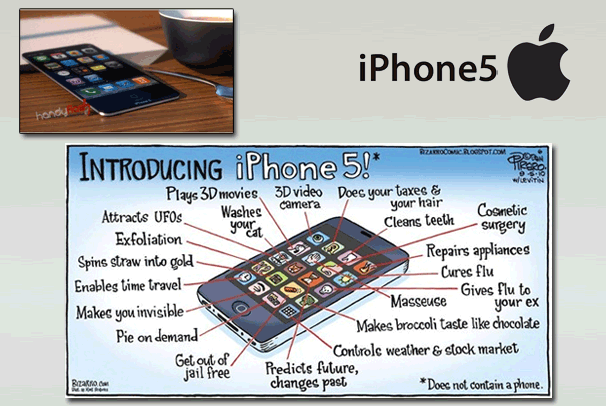
Breaking! New iPhone 5 features revealed!

Filed under: Humour, Technology — Tags: , , , — Nicholas @ 14:49

Image from PC World article which is a bit more serious than the graphic might indicate.

March 16, 2011

Guest post: Virginia Postrel and the “magic” iPad

Filed under: Technology — Tags: , , , , — Nicholas @ 11:16

This was written by Jon, my former virtual landlord, in an email to me earlier today. I’ve asked his permission to post it on the blog.

Did you see this Wall Street Journal post?

When Apple introduced the iPad last year, it added a new buzzword to technology marketing. The device, it declared, was not just “revolutionary,” a tech-hype cliché, but “magical.” Skeptics rolled their eyes, and one Apple fan even started an online petition against such superstitious language.

But the company stuck with the term. When Steve Jobs appeared on stage last week to unveil the iPad 2, which hit stores Friday, he said, “People laughed at us for using the word ‘magical,’ but, you know what, it’s turned out to be magical.”

I’m not sure what she’s on about when get gets to magic and dissing “makers” and hackers for their disdain of such. More on that later.

Sadly, I think love for the iPad is explained in much simpler terms: it is a shiny object, and people like shiny objects.

The thing is well proportioned (I’ve not looked at the specs, but I suspect that golden ratio proportions are present in its design), it has a polished surface, the display is bright and vivid — and people simply dig that sort of thing. I admit that I find the things attractive, but not attractive enough to overcome what are, for me, wallet-crushing limitations:

  • No ROI. I cannot be measurably productive on an iPad — I could not write or code or draw on the thing — so I’m never going to make back its cost. I’ve been able to pay for all of my computers by being productive on them, but that would not happen on the iPad. For that to happen, I would have to devote far more time than I have to, say, learning how to program for the thing — and that’s not likely to happen. Your mileage will, of course, vary on this: if you can measure and assign a dollar value to the time saved by having a portable internet access point around the office, plant, home, or on the road, then you’ll see more of a return here. At present, though, I don’t need that — at least not in a way that can be represented by income or cashflow.
  • Hyper-accelerated planned obsolescence. Apple is notorious for this — the next generation of device typically makes the earlier generation either less desirable or downright useless. My first — and only — Mac taught me this lesson, and I won’t fall for it again — at least not with an Apple product. The device becoming less desirable may not be an issue for most people, unless they are stylish hipsters who buy the device simply for its value as a fashion accessory. The reduced functionality, lack of updates, and lack of development support might be a real problem for people who bought the things for measurable productivity. So again, as ever and always, your mileage will vary.

Another thing that keeps me from buying one of these is that I can see that they are not going to age well. A portable device is going to get beat up, and the iPad will lose much of its Jobs-gizz-polished luster as the screen gets greasy and smudged, the case gets dinged and pitted, and then, finally — horror of horrors — the screen gets a deep corner-to-corner gouge after you read about the next generation device, drop the thing face down in shock, accidentally kick it into the next stall, and the hobo there picks it up and does who knows what with it before passing it back to you under the cubicle wall. Something as precious as the iPad just will not weather that sort of abuse. And even if it did, would you really want it back after that?

Postrel dibbles:

Even the “maker ethic” of do-it-yourself hobbyists depends on having the right ingredients and tools, from computers, lasers and video cameras to plywood, snaps and glue. Extraordinarily rare even among the most accomplished seamstresses, chefs and carpenters are those who spin their own fibers, thresh their own wheat or trim their own lumber — all once common skills. Rarer still is the Linux hacker who makes his own chips. Who among us can reproduce from scratch every component of a pencil or a pencil skirt? We don’t notice their magic — or the wonder of electricity or eyeglasses, anesthesia or aspirin — only because we’re used to them.

I’m not sure what to make of that. It sounds like she’s saying that hackers should revere the iPad simply because they could not make one themselves from scratch. By that logic, I should revere a shipping pallet because I could not make one from scratch — and I’m thinking beyond my lack of woodworking skills here. To Postrel, the shipping pallet should be seen as magic because I did not plant the acorn that grew into the oak that I cut down with the axe that I forged myself from ore that . . . oh, screw it, you know where I’m going with this and have better things to do with your time than to follow me there).

Postrel is missing the fact that clever people have commoditized magic: they’ve found methods to manufacture tedious or complicated things in ways that make them commonplace and disposable. It’s true that your average hacker could not build an iPad from scratch, starting from raw silicon and copper and gold and dead plankton transmogrified into petrochemicals. I mean, really, who has the time to farm plankton, wait for them to die, settle to the bottom of the ocean, be covered by sediment, be compressed through the build-up of rock strata over geological epochs — sorry, I’m doing it again. While your average hacker is not going to build an iPad from raw materials, your average hacker could probably build a world-changing application for a popular platform if that platform were open.

The article throws out the old groan about any sufficiently advanced technology being indistinguishable from magic. To those who don’t think too much about how that technology works, it certainly must seem like magic. What’s truly magical, though, is when such magic is commoditized and becomes commonplace. It goes from being a flashy-bangy trick to something that’s actually useful. Sadly, Apple is not building magic — they are building a captive audience.

Damnit. I’ve been letting this stew for a couple of days, and I can see that it’s just going to boil down to some lame bromide about how free markets and free access to products that one actually owns after paying for them are what is truly magical, but I’m just not going to go there. So I’m going to consider this done and send it off.

March 14, 2011

The iBoob saga

Filed under: Humour, Technology — Tags: , , , , — Nicholas @ 14:57

Jesse Brown recounts the story of the iBoob app:

Idiots worldwide rejoiced when news came that the iBoobs app, censored by Apple, had found a home in the Android Marketplace.

For those tragically unfamiliar with iBoobs — how can I describe it? It’s boobs. They jiggle. A settings screen lets you adjust things like “boob weight,” “stifness,” and “gravity factor.” If any of this turns you on, I’d like to introduce you to a killer app called porn.

iBoobs is a Freemium product. If you upgrade from the free ”iBoobs light” app to the $2.10 paid app, you can toss the boobs around with the tip of your finger. Or at least, you could last week. It seems that Google has since followed Apple’s lead (at least partially) and banned the paid version of the app.

If your imagination isn’t enough, there’s a YouTube video of the application here.

March 11, 2011

Nothing to see here, citizen iPhone 3G user, move along

Filed under: Technology — Tags: , , , — Nicholas @ 12:31

An impertinent Apple iPhone 3G user risks becoming a non-person by asking why Apple’s latest security fixes exclude customers using earlier iPhones:

A Reg reader who brought up Apple’s decision to exclude the iPhone 3G and other older devices from its latest security update on an official forum has received a firm rebuke for his effort.

Apparently the post, which was quickly deleted, failed three separate rules of the Apple Discussions soviet, as a curt notice to our source explained (extract below):

Apple removed your post on Apple Discussions, titled “Please Apple, you cannot leave a major share of your customers vulnerable,” because it contained the following:

Speculation or Rumors Discussion of Apple Policies, Procedures or Decisions Petitions

Damn straight. Frankly our man can consider himself fortunate not to have his account deleted for suggesting Apple (at minimum) ought to release patches for Safari for the iPhone 3G. An iOS 4.3 update, released on Wednesday, which includes a number of critical security fixes, is incompatible with both the iPhone 3G and older versions of the iPod Touch. You need the iPhone 3GS, or later, or iPod Touch third generation to take advantage of the update, which includes a number of critical security fixes as well as performance and functionality improvements.

You don’t question us, Apple customer. We question you.

January 28, 2011

Finns unhappy with icy iPhones

Filed under: Europe, Law, Technology — Tags: , , , — Nicholas @ 09:23

Bill Ray reports on the source of Finnish unhappiness with Apple iPhone performance:

Finnish iPhone users unhappy at the inability of the handset to operate below zero are entitled to their money back, even if the limitation appears in the small print.

The clarification comes from the Finland’s Consumer Agency, as reported by Finnish news agency YLE.fi, in response to numerous questions from concerned Finns who are unhappy that their shiny Apple toys won’t promise to work again until the spring, at best. So unless the shop specifically stated the zero-degree operational limit, then the regulator reckons iPhone-purchasing Finns are entitled to their money back.

Finland, like the UK, requires all items sold new to operate in the way they might reasonably be expected to do. Small print can’t negate those rights, and it’s reasonable for Finns to expect to be able to make phone calls outside, so refunds would seem to be in order. Meanwhile the regulator is preparing a list of questions for Apple about how it trains its staff, and how badly the iPhone breaks down when it gets cold.

August 24, 2010

Censors to poke noses into what Aussies can load on their iPhones?

Filed under: Australia, Law, Liberty, Technology — Tags: , , — Nicholas @ 12:16

Roger Henry sent this information to one of my mailing lists and I repost it here with his permission:

An interesting bombshell in Oz. Apple iPhones, and presumably other similar devices, have been put on notice that all, or nearly all, of the apps that people buy and install should, by law, have been submitted for “Classification” (i.e., censorship). Failure to do so is a criminal offence with penalties of some AU$35,000 per offence. Purchasing said ‘apps’ without a Classification label is also a criminal offence, punishable with jail time and/or fines. Seems that getting these ‘apps’ Classified attracts a charge varying from AU$470 to AU$2,600 so a lot of money is outstanding. With 50,000 apps already in use, the government accepts that there are some practical limitations to the matter but they aren’t going to let the matter just fade away.

This is Roger’s summary from information posted in The Australian‘s weekly IT Notes. And then, in response to a “Dude, WTF?” query:

It may well be that Apple will cease making apps available in Oz. Yes. It is known that they have their own censors. This merely compounds their culpability. What might have been an accidental oversight is now clearly a deliberate attempt to A) avoid censorship and B) defraud the government. This cannot go unpunished. As for the consumers, well, they are all probable pedophiles and identified thieves. No punishment can be too severe . . . it might take awhile but Justice will be served.

While it likely will all end in a round of dignified press releases and backslaps all ’round, there’s still the outside possibility of a highly entertaining politico-technical train wreck here. Let’s hope the wilder spirits prevail.

August 11, 2010

iPhone girls are easy

Filed under: Humour, Media, Technology — Tags: , , , , — Nicholas @ 07:47

Colby Cosh links to a dating website that actually provides useful photography information:

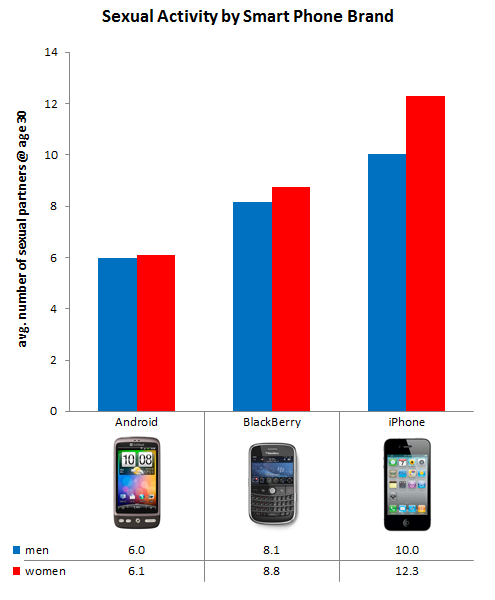
oh, also — iPhone users have more sex.

File this under “icebreakers, MacWorld ’11”. Finally, statistical proof that iPhone users aren’t just getting fucked by Apple:

The chart pretty much speaks for itself; I’ll just say that the numbers for all three brands are for 30 year-olds, so it’s not a matter of older, more experienced people preferring one phone to another. We found this data as part of our general camera-efficacy analysis: we crossed all kinds of user behaviors with the camera models and found we had data on the number of sexual partners for 9,785 people with smart phones.

Okay, I’ve posted the funny bit. The rest of the article actually does have useful photography tips, especially if you’re a user of dating websites.

August 9, 2010

Apple execs’ worst fears coming true

Filed under: Economics, Media, Technology — Tags: , , , , — Nicholas @ 12:52

Apple has seemed almost ham-handed in their attempts to control the media “storyline” since the iPhone 4 was released. If Eric Raymond is correct in his analysis, Apple will continue to struggle:

Apple’s bid to define and control the smartphone market is going down to defeat. I was going to describe the process as “slow but inexorable”, but that would be incorrect; it’s fast and inexorable. My prediction that Android’s installed base will pass the iPhone’s in the fourth quarter of this year no longer looks wild-eyed to anybody following these market-share wars; in fact, given the trends in new-unit sales a crossover point late in the third quarter is no longer out of the question.

There’s an important point that, so far, all the coverage seems to have missed. You can only see it by juxtaposing the market-share trendlines for both 1Q and 2Q 2010 and noticing what isn’t there — any recovery due to the iPhone 4. This product has not merely failed to recover Apple’s fortunes against Android, it has not even noticeably slowed Apple’s loss of market share to Android.

Forget for now the blunder the trade press has been calling “Antennagate”; I had fun with it at the time, but bruising as it was, it’s only a detail in the larger story. With the iPhone 4, Apple tried to counter the march of the multiple Androids using a single-product strategy, which was doomed to fail no matter how whizbang the single product was. As I predicted would happen months ago, the ubiquity game is clobbering the control game; Apple has wound up outflanked, outgunned, and out-thought.

As I’ve noted before, Apple had been running a very slick, very successful media image-building strategy of coolness and technological sophistication. For several years, they barely put a foot wrong in their complex dance of marketing and public-perception-influencing. When something finally did go wrong, they clearly lacked the ability to respond gracefully and recapture the wavering affections of both the reporters and the readers.

In short, the short-term effect of “antennagate” could have been limited to a one-off glitch: give the punters a free “bumper” for their phones, do it quickly and ungrudgingly, and reap the PR reward for being pro-active and showing that you care for your customers. Instead, the “smartest guys in the room” managed to squander almost all their accumulated goodwill in a few short weeks of bluster, denial, and arrogance. Nice work.

July 19, 2010

QotD: “Happy now, whiners?”

Filed under: Media, Quotations, Technology — Tags: , , , , , — Nicholas @ 10:33

On Thursday, I hoped that Apple CEO Steve Jobs would admit there’s a problem with the new iPhone’s antenna and apologize for pretending there wasn’t. I didn’t get that apology. Not even close. Instead, in a defensive press conference at Apple’s headquarters on Friday, Jobs argued that the new iPhone offers terrific, out-of-this-world reception. He blamed the media for whipping up a frenzy out of a “fact of life” that affects every phone on the market. As Jobs sees it, the only problems with the iPhone 4 are the pesky “laws of physics,” which pretty much ensure that anyone who holds a mobile phone in her hands is asking for trouble. The only reason people have been focusing on the iPhone is that blogs keep singling Apple out, perhaps because “when you’re doing well, people want to tear you down.”

Still, if you want to be a total jerk about it and keep insisting there’s a problem with your magical iPhone, Jobs has an offer for you. “OK, great, let’s give everybody a case,” he said. Happy now, whiners?

Farhad Manjoo, “Here’s Your Free Case, Jerk: Apple’s condescending iPhone 4 press conference”, Slate, 2010-07-16

July 18, 2010

Has the Reality-Distortion Field failed?

Filed under: Media, Technology — Tags: , , , , , , — Nicholas @ 12:24

Eric S. Raymond does a happy dance over the discomfiture of Steve Jobs in the (ongoing) iPhone 4 antenna debacle:

The stench of desperation must be getting pretty thick on the Infinite Loop. Can it be that the generator for Steve Jobs’s notorious Reality Distortion Field has finally broken down?

Two days ago, we learned that Jobs knew of the iPhone 4’s antenna problem before launch. They had warnings both from an in-house antenna engineer and “carrier partner”, presumably AT&T. Yes, this means all the Apple fanboys who had hissy fits at me when I said fifteen days ago that Apple was lying about the problem now get to go sit in the stupid corner.

[. . .]

A day ago, we got to watch Jobs tap-dance his way around the problem. This was a first; I cannot recall any previous instance in which the Turtlenecked One, rather than effectively controlling the agenda, has had to operate in full damage-control mode. He could have manned up and said “OK, we messed up on the antenna design, we’re recalling,” but no. Instead it’s bumper cases for all and a truly smarmy attempt to claim that everyone else in the industry is just as bad.

Way to recover your damaged reputation, Stevie boy! Time was when the wunderkind’s reality-distortion field would have somehow soothed everyone into glaze-eyed insensibility, but that’s not the way it’s going down today. Instead, there’s public pushback from both RIM and Nokia, and neither company is being shy about specifying just how far his Jobness has rammed his head up his own ass.

And there is absolutely no one else to blame for this; it’s obviously Job’s fetishism about cool industrial design, the aesthetic of the minimalistically slick-looking surface above all else, that compromised the antenna design and led him to ignore the warnings. The exact quality that Apple fanboys have been telling us would ultimately win the game for Jobs turns out to be the tragic flaw instead. And now he’s reduced to telling everyone to wrap a big ugly rubber on, it, sparky! Hubris and nemesis; this epic fail could be right out of Aeschylus.

Apple will survive this, but they need to rally the damage control teams and be pro-active, or their reputation will take years to recover . . . and it’s the reputation that allows Apple to charge more than the competition for broadly comparable goods.

July 17, 2010

Does Apple have to kill the iPhone 4?

Filed under: Technology — Tags: , , , — Nicholas @ 19:31

I discussed the PR nightmare Apple has been going through since the first problems with the iPhone 4 was introduced, but I didn’t think this extreme a solution was called for:

Image is everything. And that’s why Apple must terminate the iPhone 4 as quickly as possible.

In his Friday morning news conference, Apple CEO Steve Jobs admitted the iPhone 4 is flawed, no doubt a painful admission for a proud man known for his perfectionist ways. He even offered free cases to alleviate the signal and reception problems plaguing some iPhone 4 users.

[. . .]

But none of that matters. The iPhone 4 is now tainted in the consumer’s eyes. It’s no longer a triumph of form and function, but rather a crippled device that requires protective headgear to work properly.

We could debate the merits of the iPhone 4’s antenna design all day, but that’s beside the point. Perception is reality here, and the public now views Apple’s latest offering as The Phone That Drops Calls. And no one can blame AT&T this time either.

I don’t think it’s quite that bad for Apple, although they’ve been flying so high in public perception that any glitch will seem far more significant in comparison to their reputation. Maybe Jeff Bertolucci has it right: even if you don’t re-engineer the entire package, the PR hit will be less and the re-inforced public support will be that much greater if Apple bites the bullet sooner rather than later.

July 16, 2010

iPhone 4 – that’s the fourth one she’s had so far

Filed under: Technology — Tags: , , , — Nicholas @ 16:59

Melissa J. Perenson may just be unlucky, or she may be more attentive than a lot of current Apple iPhone customers:

Apple’s unprecedented move to hold a press conference regarding the iPhone 4’s antenna issues underscores the power of the masses, and the fact that the phone has serious problems. I know about the iPhone 4’s flaws first hand. Here’s what went wrong with mine.

As I write this I’m on my third iPhone 4 replacement so far. Yes, that means I’ve had a total of four phones in the three weeks the phone has been out. As responsive and friendly as the Apple Store has been through this, I really didn’t need to get to know the store so well. At this point, I’ve spent as much on cab fares to and from the Apple Store as I would have on a couple of bumpers in different colors.

One bad phone can be written off as a fluke; but three is extreme and indicates something more may be in play. I’ve come to expect better from a company like Apple. I reached out to Apple for a comment, but no response at this writing.

This is definitely a case where Apple’s traditional hands-off approach is backfiring on them: if there are hardware problems with the iPhone 4, aside from the acknowledged signal strength display and antenna issues, Apple needs to become proactive in addressing them.

July 15, 2010

Apple to hold news conference on iPhone 4 today

Filed under: Technology — Tags: , , , , , — Nicholas @ 08:42

BBC News reports that Apple has called a surprise news conference:

The company has refused to give details about whether the event will address reception problems that some users have reported with the phone, launched just last month.

Apple has faced mounting criticism from analysts and consumers over its handling of the issue.

Industry watchers said the firm was in danger of damaging its “rock star” reputation over how poorly it had dealt with what would normally be a minor problem.

“It seems there has been a real crisis of leadership here,” said Patrick Kereley, senior digital strategist for Levick Strategic Communications which deals in crisis managment and reputation protection.

“There are so many conflicting reports about this issue and a lot of confusion in the marketplace. They need a plan of attack. Today’s companies have to react quickly before chatter on Facebook or Twitter turns into news headlines as is the case here,”

Of course, blaming the problem on Facebook and Twitter users isn’t particularly appropriate: there is a problem with the iPhone 4 and even the most pro-Apple folks are noticing it and complaining. Apple has reacted very badly to their most enthusiastic customers, and (for a change) appears to be damaging their reputation. Now that they’re no longer seen as underdogs, the haughty and uninformative response won’t work.

July 14, 2010

iOS4 doesn’t play quite as nicely with older iPhones

Filed under: Humour, Technology — Tags: , , , — Nicholas @ 14:41

adamburtle: “The first iPhone captivated the world because the interface was so well done, so snappy, so interactive; it was like nothing before it. Of course it was, it was an Apple product. That, right there, is why I buy Apple products. And I didn’t even mind that it was missing “copy and paste,” MMS, ringtones, etc — because I knew Apple would eventually get to these through software updates. And eventually they did. Unfortunately they kept coming out with new phones. With faster processors. And they wrote all their software updates for these phones, with little attention to deprecated models. I don’t really use third party software on my phones, I honestly don’t even use ringtones. I just my phone for SMS, web, maps, and occasionally as an actual phone, so the 3G model was more than I ever needed.

“Except over time, it’s fulfilled my needs less and less. And it’s not because my needs have grown. It’s not because I’ve installed a bunch of laggy software. It’s because Apple’s firmware has become bloated, with respect to the processing power of the 3G iPhone. I just installed iOS 4 two weeks ago, and at this point, I’d be happy to roll back to the first firmware I ever had, just to have that original speed again; forget about the copy and paste, I don’t need it that badly. “

H/T to Michael O’Connor Clarke for the most graphical example of why you don’t always want to be the first one to install new software.

« Newer PostsOlder Posts »

Powered by WordPress