Quotulatiousness

November 12, 2011

Still no charges in the Gibson Guitar case

Filed under: Bureaucracy, India, Law, Media, USA, Woodworking — Tags: , , , , — Nicholas @ 11:00

An update in the Wall Street Journal just recaps the background to the case, and has an interview with Henry Juszkiewicz, the CEO.

On Aug. 24, federal agents descended on three factories and the Nashville corporate headquarters of the Gibson Guitar Corp. Accompanied by armored SWAT teams with automatic weapons, agents from the Fish and Wildlife Service swarmed the factories, threatening bewildered luthiers, or guitar craftsman, and other frightened employees. A smaller horde invaded the office of CEO Henry Juszkiewicz, pawing through it all day while an armed man stood in the door to block his way.

“I was pretty upset,” Mr. Juszkiewicz says now, sitting outside that same office. “But you can only do so much when there’s a gun in your face and it’s the federal government.” When the chaos subsided, the feds (with a warrant issued under a conservation law called the Lacey Act) had stripped Gibson of almost all of its imported Indian rosewood and some other materials crucial to guitar making.

The incident attracted national attention and outrage. Like Boeing — whose plans to locate new production in South Carolina are opposed by the National Labor Relations Board — here was an iconic American brand under seemingly senseless federal fire.

November 4, 2011

The Kangaroo Family Court

Filed under: Law, USA — Tags: , , , , — Nicholas @ 11:15

The headline says it all: “Sexual Assault Victim Must Pay Her Attacker Spousal Support”

A San Diego judge ordered Crystal Harris to pay $1,000 a month in spousal support to her ex-husband — just as soon as he finishes up his six year prison sentence for sexually assaulting her. As 10News reports, “The entire assault was caught on tape and what it captured was enough to convict Shawn Harris of a felony — forced oral copulation.”

So why is a victim being forced to pay her attacker? According to Judge Gregory Pollock, it’s because Crystal Harris brought home six figures worth of bacon while Shawn Harris was unemployed.

    “I can’t look at a 12-year marriage where one side is making $400 a month, the other side is making over $11,000 and say no spousal support,” Pollock said in court. “That would be an abuse of discretion.”

It sounds like a miscarriage of justice, but the law is written so that it only excludes attempted murderers from the right to receive spousal support. Another case of a bad law forcing a bad judgement (or a judge unwilling to exercise his discretion in a case that cries out for it).

November 1, 2011

Beaver versus Polar Bear

Filed under: Cancon, History, Humour — Tags: — Nicholas @ 12:08

Lester Haines conjures up exactly the right image to illustrate the absurdity of the “Canadian national symbol” argument:

A Canadian politician has rather deliciously insisted that vast tracts of his nation were opened by “the relentless pursuit of beaver”, an agreeable concept that for some reason conjures an image of Silvio Berlusconi furiously paddling a kayak through white water rapids in pursuit of a fleeing supermodel.

The description of Canada’s beaver-hunting past comes from New Democratic Party MP Pat Martin, who isn’t too impressed with Ontario senator Nicole Eaton’s proposal to replace the beaver with the polar bear as the country’s national emblem.

Eaton reckons the polar bear, with its “strength, courage, resourcefulness and dignity” is a more appropriate emblem for the 21st century than the “dentally defective rat” that has symbolised the nation since 1975.

While I don’t think the symbol needs to be changed, it might be best if our politicians are busy in this sort of snark hunt rather than inflicting further intrusive regulations and distortions into the economy.

October 19, 2011

Four year sentence for . . . posting an idiotic suggestion to Facebook

Filed under: Britain, Law, Liberty — Tags: , , , , , — Nicholas @ 08:54

Patrick Hayes attempts to point out that the sentence imposed on Facebook idiot Jordan Blackshaw is both disproportional and a clear and present danger to free speech rights in Britain:

Did you know that all it took for people to trash their own neighbourhoods this summer, such was the ‘collective insanity’ then gripping the UK, was for someone to suggest they do so on Facebook? A few words saying something like ‘let’s have a riot’ and, hey presto, off people went to have a riot.

This didn’t happen, of course. But it is a view of last August’s riots that seems to provide the rationale behind the sentencing of 20-year-old Jordan Blackshaw. This was the man, lest we forget, who on 9 August set up a Facebook ‘event’ entitled ‘Smash Down in Northwich town’. This hardly inspiring suggestion involved would-be rioters meeting up for said ‘smash down’ outside a local McDonald’s.

In explaining why Blackshaw was to receive a four-year jail sentence for doing nothing more than publishing words online, the judge claimed that ‘this happened at a time when collective insanity gripped the nation’. Blackshaw’s conduct, he continued, ‘was quite disgraceful and the title of the message you posted on Facebook chills the blood’. Yesterday, Blackshaw’s appeal against the harsh sentencing, alongside that of another ‘Facebook rioter’, was rejected by the Crown Court.

So, how many people responded to Blackshaw’s online suggestion during this period of ‘collective insanity’? The answer is one: Blackshaw himself. (He was immediately arrested). In fact, only nine of his 147 Facebook friends even responded online. Yet the reason for this collective no-show, at least as far as the judge was concerned, was ‘the prompt and efficient actions of police’ who eventually took Blackshaw’s Facebook page offline.

October 8, 2011

WIPO head: the Web would be better if it was patented and users had to pay license fees

Filed under: Bureaucracy, Economics, Technology — Tags: , , , , — Nicholas @ 11:42

Cory Doctorow reports on remarks by the head of the UN World Intellectual Property Organization:

Last June, the Swiss Press Club held a launch for the Global Innovation Index at which various speakers were invited to talk about innovation. After the head of CERN and the CEO of the Internet Society spoke about how important it was that the Web’s underlying technology hadn’t been patented, Francis Gurry, the Director General of the UN’s World Intellectual Property Organization (WIPO), took the mic to object.

In Gurry’s view, the Web would have been better off if it had been locked away in patents, and if every user of the Web had needed to pay a license fee to use it (and though Gurry doesn’t say so, this would also have meant that the patent holder would have been able to choose which new Web sites and technologies were allowed, and would have been able to block anything he didn’t like, or that he feared would cost him money).

This is a remarkable triumph of ideology over evidence. The argument that there wasn’t enough investment in the Web is belied by the fact that a) the Web attracted more investment than any of the network service technologies that preceded it (by orders of magnitude), and; b) that the total investment in the Web is almost incalculably large. The only possible basis for believing that the Web really would have benefited from patents is a blind adherence to the ideology that holds that patents are always good, no matter what.

Just imagine: instead of our current anarchic, idiosyncratic-but-still-amazingly-useful Web, we’d have a bureaucratically regulated superset of the old walled garden models like Compuserve, where innovation was stifled long before it got into the users’ hands.

October 4, 2011

New York wants to rework the First Amendment “not as a right, but as a privilege”

Filed under: Law, Liberty, USA — Tags: , , , — Nicholas @ 08:53

Some New York senators think you’ve got too much freedom of speech, and they think the world would be a much nicer place if you didn’t have as much:

. . . some state Senators in NY are trying a new line of attack: going directly after the First Amendment and suggesting that current interpretations are way too broad, and it’s not really meant to protect any sort of free speech right. In fact, it sounds as though they’re trying to redefine the right to free speech into a privilege that can be taken away. Seriously:

     Proponents of a more refined First Amendment argue that this freedom should be treated not as a right but as a privilege — a special entitlement granted by the state on a conditional basis that can be revoked if it is ever abused or maltreated.

Yes, that totally flips the First Amendment on its head. It is not a “more refined First Amendment.” It’s the anti-First Amendment. It suggests, by its very nature, that the government possesses the right to grant the “privilege” of free speech to citizens… and thus the right to revoke it. That’s an astonishingly dangerous path, and one that should not be taken seriously. Of course, given their right to speak freely, state senators Jeff Klein, Diane Savino, David Carlucci and David Valesky have every right to put forth that argument — but similarly, it allows others to point out their rather scary beliefs.

September 28, 2011

“‘Sensitivity to hurt feelings’ is not, in fact, a First Amendment value or a justification for censorship”

Filed under: Bureaucracy, Education, Liberty, Media — Tags: , , — Nicholas @ 14:42

Follow-up to Monday’s link to Popehat on bureaucratic censorship at the University of Wisconsin, Ken has a few words to say about the administration’s “justification”:

2. The problem with demanding a campus free of “implied threats” is illustrated by this case. Campus police first censored a poster of an imaginary space cowboy with a fan-pleasing quote. Next, just to say FUCK YOU IRONY they used threats of official retaliation against a poster condemning threats of official retaliation. No rational person could construe either poster as a threat, actual or implied, to commit violence against any person (although I suppose the second could be construed as a warning — a correct one — that thugs will act thuggishly when questioned.) If a rational person wouldn’t take it as an actual threat of violence, then it’s not a true threat that can be censored, however much the hysterical, irrational, nanny-stating, coddling, or professionally emo think about it, and however much university chancellors would like to believe otherwise.

3. Similarly, this case illustrates the problem with an approach to freedom of expression premised on “sensitivity” and making people feel “welcome, safe and secure.” “Sensitivity to hurt feelings” is not, in fact, a First Amendment value or a justification for censorship. In fact, stopping people from speaking because the speech hurts people’s feelings is the essence of censorship. A system in which what we can say is premised upon the likely reactions of the mentally ill and the undernourished pussywillows of the world is a system that encourages suppression of all unpopular, forceful, interesting, or challenging speech. The irrational and the morally and mentally weak are not entitled to have their feelings protected through the force of law, however prevalent they are on campus.

September 26, 2011

Gorram purplebelly censors

Filed under: Bureaucracy, Education, Liberty, Media — Tags: , , , , , — Nicholas @ 12:24

A Mal Reynolds poster falls victim to academic censorship:

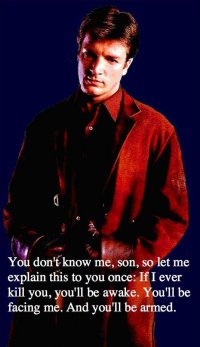
Dateline: Wisconsin. At the University of Wisconsin-Stout, theater professor James Miller put up a poster on his door with an image of Nathan Fillon in the character of Captain Malcolm Reynolds with one of Mal’s better lines: “You don’t know me, son, so let me explain this to you once: If I ever kill you, you’ll be awake. You’ll be facing me. And you’ll be armed.”

In a better world, nothing would happen — except perhaps Firefly fans would geek out and people who roll their eyes at geek culture references would roll their eyes.

But this is modern America. In modern America, the Browncoats are people who like to use vigorous figurative language to speak their mind, and they are often outnumbered and outgunned by the Alliance, made up of silly, professionally frightened moral and intellectual weaklings who see expressions of dissent (particularly dissent rendered in vivid figurative terms) as upsetting and potentially all terroristy.

So naturally the campus police at University of Wisconsin-Stout went all Mrs.-Grundy-With-A-Gun-And-A-Badge on Professor Miller. They threatened Prof. Miller with criminal charges for disorderly conduct, taking a page from the cops at Sam Houston state. They also took the poster down. The redoubtable FIRE has the story and has sent the necessary letter asking the University to grow the fuck up and pull its shit together. (That might be kind of a paraphrase by me.)

September 8, 2011

Play it again, Gibson

Filed under: Bureaucracy, India, Law, USA, Woodworking — Tags: , , , , — Nicholas @ 08:59

Allahpundit posted the video clip above, saying:

If I’m understanding the applicable law correctly, Gibson is as much a victim of Indian protectionism as they are federal meddling. Watch the quickie John Roberts segment for the gist of it. The wood they use to make guitar keyboards is sufficiently rare/endangered that it can’t be exported legally from India unless it’s already been finished by Indian workers, and under U.S. law, if the export is illegal under Indian law, then it’s illegal here too. The governing statute, the Lacey Act, was passed in 1900, but only in 2008 was it expanded to include plants as well as animals, which is why Gibson’s now being hassled about the wood. All of which is jim dandy — except for the question of why Gibson seems to be getting so much federal attention vis-a-vis other firms. Roberts touches on that.

H/T to Jon, my former virtual landlord, who commented “I like the way he pulls the finished guitar fret out of his ass.”

Update: Speaking of Jon, he’s all over this issue with another link and extra commentary:

CHRIS DANIEL: Mr. Juszkiewicz, did an agent of the US government suggest to you that your problems would go away if you used Madagascar labor instead of American labor?

HENRY JUSZKIEWICZ: They actually wrote that in a pleading.

[. . .]

He’s even warned clients to be wary of traveling abroad with old guitars, because the law says owners can be asked to account for every wooden part of their guitars when re-entering the U.S. The law also covers the trade in vintage instruments.

As Jon points out, this is more than just an issue for the musical instrument makers and musicians:

It’s only a matter of time until this is applied to tools and furniture.

I wonder where [hand tool maker] Lie Nielsen’s politics lie — but he should be safe, using domestic cherry for his totes and knobs.

Lee Valley might have a problem exporting to the US, what with bubinga and rosewood components and being based in Ottawa, which is now a hotbed of hard-right conservative political thought. (A co-worker is wondering why I’m giggling to myself here).

September 7, 2011

A bit more on the Lacey Act

Filed under: Bureaucracy, Environment, India, Law, USA, Woodworking — Tags: , , — Nicholas @ 08:53

The Economist has a brief mention of the Gibson raid:

Agents barged in and shut down production. They were hunting for ebony and rosewood which the Fish and Wildlife Service (FWS) alleges was imported from India in violation of the Lacey Act, a 1900 law originally designed to protect fauna from poachers. This law has metastasised: it now requires Americans, in essence, to abide by every plant and wildlife regulation set by any country on Earth. Not having heard of an obscure foreign rule is no defence. Violators face fines or even jail. FWS claims the ebony sent from India was mislabelled, and that Indian law forbids the export of unfinished ebony and rosewood.

[. . .]

Guitarists now worry that every time they cross a state border with their instrument, they will have to carry sheaves of documents proving that every part of it was legally sourced. Edward Grace, the deputy chief of the FWS’s office of law enforcement, says this fear is misplaced: “As a matter of longstanding practice,” he says, “investigators focus not on unknowing end consumers but on knowing actors transacting in larger volumes of product.” But Americans have been jailed for such things as importing lobsters in plastic bags rather than cardboard boxes, in violation of a Honduran rule that Honduras no longer enforces. Small wonder pluckers are nervous.

Original report on the Gibson guitar raid here. Rules like the Lacey Act are tailor-made for petty bureaucrats to exercise immense amounts of judicially unsupervised power. It’s hard to believe that this kind of rule is being enforced evenhandedly, and rather easier to believe that it is being used selectively as a way of paying off scores, providing a “service” to certain firms at the expense of others, and creating lots of opportunities for bribes, “protection money”, and the like.

September 4, 2011

California is apparently not in deep enough trouble

Filed under: Bureaucracy, Economics, Government, USA — Tags: , , — Nicholas @ 10:44

Otherwise, there’s no explanation for yet another extension of the state’s regulatory reach into the lives of everyday citizens. The most recent example is a bill that (at least on first look) appears to mandate workers’ compensation coverage, detailed pay slips (with all deductions clearly indicated), and paid vacation time for babysitters. Coyote Blog would like to see even more of this kind of thing:

I know this is exactly the kind of thing you would expect me to oppose, but I have decided this is exactly the kind of thing California needs. I am tired of average citizens passing crazy requirements on business without any concept of the costs and injustices they are proposing, and then scratch their head later wonder why job creation is stagnant.
I want to propose that California do MORE in this same vein. Here are some suggestions:

  • Every household will have to register for a license to conduct any type of commerce, a license to occupy their house, and a license to hire any employees. Homeowner will as a minimum have to register to withhold income taxes, pay social security taxes, pay unemployment insurance, pay disability insurance, and pay workers comp insurance.
  • Households should have to file a 1099 for every payment they make to contractors
  • All requirements of Obamacare must be followed for any household labor, including payment of penalties for even part-time labor for which the homeowner does not provide medical insurance
  • No alcohol may be purchased by any individual without first applying for and receiving a state liquor license
  • No cigarettes may be purchased by any individual without first applying for and receiving a state cigarette license
  • No over the counter drugs may be purchased by any individual without first applying for and receiving a state over the counter drug license

And the list goes on. But they’re not just being randomly generated: they’re all things that ordinary businesses in California already have to do.

August 31, 2011

Why aren’t atheists registered like sex offenders?

Filed under: Religion, USA — Tags: , , , — Nicholas @ 12:05

Apparently because “they’re just too busy eating babies and having blood-soaked sex orgies“:

Meet Michael Stahl, otherwise known as “Pastor Mike.” Stahl lives in Miramar, Florida, and leads an online church called Living Water Church, which we think is a fancy way of saying he hangs out a lot in a Christian-themed chat room. Stahl has proposed the creation of a national registry for atheists, much like the ones in existence for sex offenders. It’s almost self-evident why this is a good idea, but let’s have Stahl explain it himself:

     Now, many (especially the atheists), may ask “Why do this, what’s the purpose?” Duhhh, Mr. Atheist for the same purpose many States put the names and photos of convicted sex offenders and other ex-felons on the I-Net — to INFORM the public! I mean, in the City of Miramar, Florida, where I live, the population is approx. 109,000. My family and I would sure like to know how many of those 109,000 are ADMITTED atheists! Perhaps we may actually know some. In which case we could begin to witness to them and warn them of the dangers of atheism. Or perhaps they are radical atheists, whose hearts are as hard as Pharaoh’s, in that case, if they are business owners, we would encourage all our Christian friends, as well as the various churches and their congregations NOT to patronize them as we would only be “feeding” Satan.

August 28, 2011

Britain’s next military target?

Filed under: Britain, Humour, Military — Tags: , , , — Nicholas @ 09:29

James Delingpole tries to draw up a list of the next most likely place for David Cameron’s military adventure:

China

Pros: on the verge of taking over the world and enslaving us all; mines evil rare earth minerals in environmentally unfriendly fashion which Sam Cam, like, totally, like hates, even though it’s OK really because they go towards the wind farms which make Daddy nearly £1000 a day on his estates; a big, juicy target that would impress David Cameron’s Notting Hill friends way more than poxy Libya.

Cons: We’d lose

[. . .]

France

Pros: Would be hugely popular with the home crowd and guarantee re-election in 2015

Cons: Victory would depend, crucially, on whose turn it is to use the aircraft carrier.

[. . .]

The USA

Pros: Would send a clear signal to Guardianistas that Britain is not going to be “America’s poodle”; might well result in a sexy-sexy congratulatory tete a tete with Christine Lagarde; would make the Lib Dem element of the Coalition feel more at home than ever.

Cons: Our record of beating America in wars is not good. Then again, with a President as lame-duck as Obama in charge this could yet be our best hope.

August 27, 2011

US government moves swiftly to crush guitar industry

Filed under: Bureaucracy, Government, Law, USA — Tags: , , , — Nicholas @ 09:46

The US federal government, not satisfied with the state of the economy, is now targeting smaller industries for regulatory SWAT raids and asset confiscation:

The Justice Department raided the Memphis and Nashville offices of a guitar manufacturing company this week, seizing several pallets of wood, electronic files and guitars as part of a crackdown on illegally harvested hardwoods from protected forests, The Wall Street Journal reported.

But Henry Juszkiewicz, the chairman and chief executive of Gibson Guitar, defended his company’s manufacturing policies and accused the Justice Department of overreaching.

“The wood the government seized Wednesday is from a Forest Stewardship Council certified supplier,” he said in a statement to the newspaper, suggesting the Feds are using the aggressive enforcement of overly broad laws to snare the company.

The Justice Department refused to speak to the newspaper.

The raid prompted Iowahawk to connect the dots between this raid and the “Fast and Furious” operation:

Today’s uncovering of secret multi-agency program for shipping illegal Gibson guitars to Mexican drug cartels left red-faced officials of the U.S. Department of Justice scrambling for an explanation amid angry calls for a Congressional investigation.

“I have ordered all agency personnel to fully cooperate in any Congressional inquiries, including all reasonable document request, as soon as we can redact them with Sharpie pens and lighter fluid,” said U.S. Attorney General Eric Holder.

The secret program came to light early this morning in the border town of Nogales, Arizona, after what was described as a wild battle of the bands between members of the Sinaloa cartel and Los Zetas, two of Mexico’s most notorious violent drug gangs.

“Usually these guys are armed with Mexican Strats and Squires, Epiphones, small caliber stuff like that,” said Pedro Ochoa, 36, an eye witness to the sonic melee. “This time they were packing the heavy firepower.”

The steady barrage of power chords and piercing solo attacks attracted the attention of nearby U.S. Border Patrol agents, who arrived at the scene just as Los Zetas broke into Led Zeppelin’s ‘Immigrant Song.’ By the time the dust had cleared, U.S. Border Patrol Agent Oscar Jimenez was found in a catatonic state of headbanging. He was later flown to University of Arizona Hospitals, where his condition is listed as seriously rawked.

Jon, my former virtual landlord, sent me a link to the press release from Gibson and a link to this Wall Street Journal article with more information.

John Thomas, a law professor at Quinnipiac University and a blues and ragtime guitarist, says “there’s a lot of anxiety, and it’s well justified.” Once upon a time, he would have taken one of his vintage guitars on his travels. Now, “I don’t go out of the country with a wooden guitar.”

The tangled intersection of international laws is enforced through a thicket of paperwork. Recent revisions to 1900’s Lacey Act require that anyone crossing the U.S. border declare every bit of flora or fauna being brought into the country. One is under “strict liability” to fill out the paperwork — and without any mistakes.

It’s not enough to know that the body of your old guitar is made of spruce and maple: What’s the bridge made of? If it’s ebony, do you have the paperwork to show when and where that wood was harvested and when and where it was made into a bridge? Is the nut holding the strings at the guitar’s headstock bone, or could it be ivory? “Even if you have no knowledge — despite Herculean efforts to obtain it — that some piece of your guitar, no matter how small, was obtained illegally, you lose your guitar forever,” Prof. Thomas has written. “Oh, and you’ll be fined $250 for that false (or missing) information in your Lacey Act Import Declaration.”


August 10, 2011

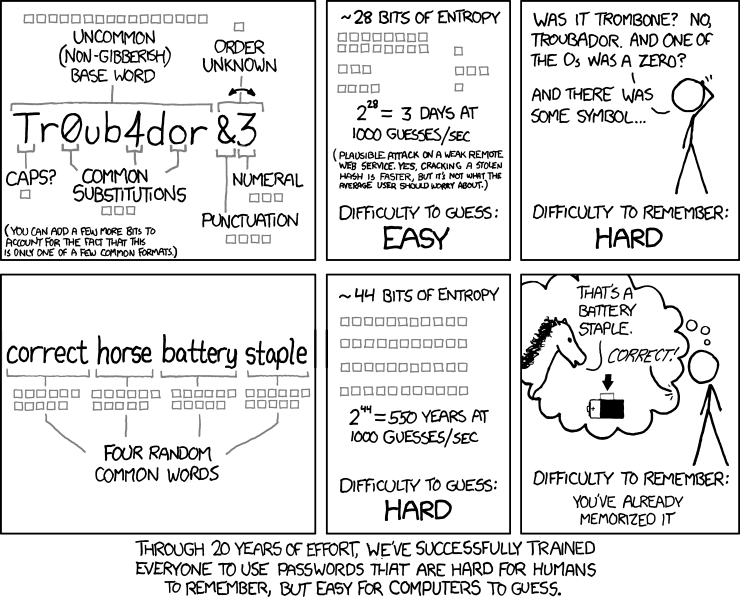
xkcd on the paradox of passwords

Filed under: Humour, Technology — Tags: , , , , — Nicholas @ 10:10

He’s absolutely right, you know . . .

« Newer PostsOlder Posts »

Powered by WordPress