
Reading Goddess of the Market much later in life, I finally met the woman behind the philosophy. Rand doesn’t start out so bad, at least in Burns’ telling. Who can blame the Russian-born Rand, watching helplessly as Communists seize her father’s pharmacy, for growing up to be a furious foe of collectivism (and realpolitik compromise), whose übermensch heroes fight back against the “parasites, moochers and looters“, and win?
Yet the sprinklings of patriotic, almost Capra-esque populism that softened The Fountainhead’s unavoidable elitism are absent entirely in her follow-up, Atlas Shrugged, replaced by an almost hallucinatory misanthropy. What happened, Burns wonders, in the intervening thirteen years?
The answer seems obvious to me now, rereading her book in my 50s:
Menopause.
Ayn Rand, the avatar of adolescence, was going through The Change.
“Now in her forties,” writes Burns of the author between novels, “Rand struggled with her weight, her moodiness, her habitual fatigue.” Already dependent on the crazy-making Benzedrine she’d been popping to help her meet her Fountainhead deadline, Rand was hurtling toward what we’d now recognize as a midlife crisis.
Enter Nathaniel Blumenthal. He’d begun corresponding with Rand while still a high school student, but unlike her thousands of other teenage fans, he’d even memorized The Fountainhead. At UCLA, he’d coauthored a letter to the campus paper, declaring that a professor with suspected Communist ties who’d killed himself deserved “to be condemned to hell.” Then he changed his surname to “Branden” because it had “Rand” in it.
So, basically a nut.
Kathy Shaidle, “The Danger of Ayn Rand”, Taki’s Magazine, 2017-04-18.
May 3, 2019
QotD: The key difference between The Fountainhead and Atlas Shrugged
May 2, 2019
Natural Edged Bowl with Bronze Powder | Turning Tuesday #14
Matt Estlea
Published on 30 Apr 2019In this video, I begin by making a natural edged bowl but then kind of lose my mind and start adding metal, and fire, and more metal….. and more fire.
_________________________________________________________________Support what I do by becoming a Patron! This will help fund new tools, equipment and cover my overheads. Meaning I can continue to bring you regular, high quality, free content. Thank you so much for your support! https://www.patreon.com/mattestlea
_________________________________________________________________See what tools I use here: https://kit.com/MattEstlea
My Website: http://www.mattestlea.com
_________________________________________________________________My name is Matt Estlea, I’m a 23 year old Woodworker from Basingstoke in England and my aim is to make your woodworking less s***.
I come from 5 years tuition at Rycotewood Furniture Centre with a further 1 year working as an Artist in Residence at the Sylva Foundation. I now teach City and Guilds Furniture Making at Rycotewood as of September 2018.
I also had 5 years of experience working at Axminster Tools and Machinery where I helped customers with purchasing tools, demonstrated in stores and events, and gained extensive knowledge about a variety of tools and brands.
During the week, I film woodworking projects, tutorials, reviews and a viewer favourite ‘Tool Duel’ where I compare two competitive manufacturers tools against one another to find out which is best.
I like to have a laugh and my videos are quite fast paced BUT you will learn a lot, I assure you.
Lets go make a mess.
NASA to export bullying off the Earth to small, harmless objects in the solar system
Colby Cosh on NASA’s latest plan for “nudging” an asteroid out of its orbit:
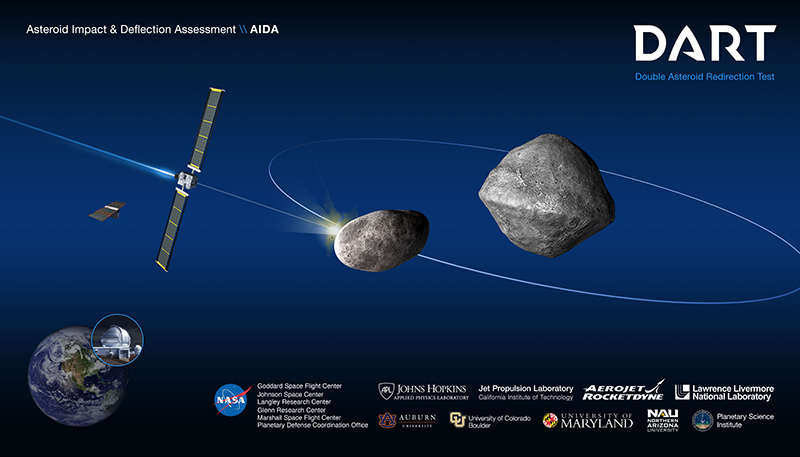
NASA has a plan — a serious plan, which it intends to carry out pretty soon — to smash a spacecraft into an object in the solar system and intentionally change its orbit. I confess I don’t quite know why this act of awesome American techno-hubris hasn’t been bigger news. I think partly it is because the mission comes under the heading of “planetary defence” against small natural objects straying into the path of the Earth. Science reporters on that beat are easily distracted by apocalyptic fantasies, and by smirking anthropology about the actually-quite-numerous band of researchers trying to deal with this arguably-quite-important subject.
Part of the problem may be that NASA’s mission to mess with the asteroid Didymos B is hidden under a mountain of technical jargon about “kinetic impactors” and “xenon thrusters.” And part of it is surely the hard-earned professional knowledge that NASA ends up implementing about one plan for every 10 it makes. Accountants have a way of showing up with an axe at the last minute.
Still, the idea is pretty neat, and not just because it appeals to everyone’s natural appetite for destruction. The basic premise of the DART (Double Asteroid Redirection Test) is that our planet may one day face the asteroid/meteor/comet collision scenario outlined in a vast corpus of books and movies (Lucifer’s Hammer, Armageddon, Deep Impact). If that day comes, we as a species don’t want to just be winging it — so let’s go out now, find some innocent chunk of rock that isn’t bothering anybody, and see if we already have the technological capability to change its course.
This turns out not to necessarily involve Bruce Willis or Robert Duvall; mostly we just need Isaac Newton. The scheme of planetary defence now emerging from decades of speculation and effort emphasizes systematic tracking of near-Earth objects and early detection of potentially dangerous ones. If we can spot an approaching impactor soon enough, we don’t need to deliver a bundle of explosives: we can just nudge it out of the way.
Humanity has been pretty lucky that the asteroid impacts have been relatively rare since we started keeping track of important things like the planting calendar, the seasonal flooding of the rivers, and the ever-important (to the rulers) tax records. It wouldn’t take a particularly large object hurtling into the atmosphere at interplanetary speeds to ruin our collective day (year, decade, century, etc.). We think we know how to divert incoming dangerous objects … but we need to actually do it successfully before it becomes the last headline of all recorded history.
The French Char B Tank – WORLD WAR TWO Special
World War Two
Published on 30 Apr 2019After the Great War was over, the French reconsidered their army’s function and the role that tanks would play in future warfare. On the brink of World War Two, the Char B tank is deeply embedded in the structure of the French armoured defences. David Willey from the Tank Museum in Bovington (UK) tells how French politics influenced how the Char B will be used if the Germans attack. To learn more about the technical details of the Char B, check out the Tank Chat that David Fletcher from the Tank Museum has done about the Char B-1 Bis: https://www.youtube.com/watch?v=tz8L1…
Check out the Tank Museum YouTube Channel right here: https://www.youtube.com/user/TheTankM…
Join us on Patreon: https://www.patreon.com/TimeGhostHistory
Or join The TimeGhost Army directly at: https://timeghost.tvFollow WW2 day by day on Instagram @World_war_two_realtime https://www.instagram.com/world_war_t…
Source list: http://bit.ly/WW2sourcesWritten and Hosted by: David Willey and Indy Neidell
Produced and Directed by: Astrid Deinhard
Executive Producers: Bodo Rittenauer, Astrid Deinhard, Indy Neidell, Spartacus Olsson
Creative Producer: Joram Appel
Post Production Director: Wieke Kapteijns
Research by: David Willey
Edited by: Wieke KapteijnsArchive by Screenocean/Reuters https://www.screenocean.com.
A TimeGhost chronological documentary produced by OnLion Entertainment GmbH.
From the comments:
World War Two
44 minutes ago (edited)
David Willey from the Tank Museum in Bovington (UK) explains brilliantly what impact French politics in the 1920s and 1930s had on the development and use of French tanks leading up to World War Two. On their own channel, the Tank Museums own David Flecher dives into the technical ins and outs of the Char B-1 tank. You can find that right here: https://www.youtube.com/watch?v=tz8L1FU74Rs Make sure to subscribe to their YouTube channel too, as it perfectly compliments the content that we show here. Cheers!
“Wuv, twue wuv”
Debra Soh talks about the neurobiology of “wuv”:

We all remember the first time we fell in love. No matter how strong or independent or free you thought you were, all at once, you became powerless in the face of feelings that, to others, seemed obsessive and irrational.
When you’re in that state, everything reminds you of the one you love. They become the center of your world. Friends say your face lights up when you talk about them. You can’t sleep, you can’t eat. The thought of being without them feels like losing a part of yourself.
There are biological reasons that explain why the experience of being in love feels so overwhelming. These emotions serve an evolutionary purpose. Specifically, they allow two people to bond in a way that increases the likelihood they’ll procreate and maintain an environment in which the resulting offspring survive.
Neurobiologists know that love usually occurs in three phases: lust, attraction and attachment. In the first phase, lust, sex hormones create physiological arousal; in the second phase, attraction, dopamine creates intense feelings associated with the object of one’s desire (often tipping into something that resembles real addiction); and in the third phase, attachment, occurring in established couples, oxytocin and vasopressin (the “cuddle hormones”) facilitate the long-term bonding required to raise children over a time span of years or decades.
Romantic love is an intangible state of mind. But we are coming to understand it more clearly through techniques such as functional magnetic resonance imaging. FMRI, as it’s known, measures brain activity by examining changes in blood flow and oxygenation. These studies typically have involved researchers showing study participants pictures of their lovers, and then contrasting the observed brain activity with the activity observed when the study subjects are shown pictures of friends of the same sex and a similar age.
One of the first fMRI studies in the field found a distinct network of brain regions associated with being, as described by the researchers, “truly, deeply, and madly in love.” These regions included the insula and anterior cingulate cortex, which are associated, respectively, with feelings of desire and happiness. Other regions included those linked to sexual arousal, such as the hypothalamus and amygdala.
Chicken Tikka Masala | Basics with Babish
Binging with Babish
Published on 28 Mar 2019Enter offer code “Babish” at Squarespace.com for 10% off your first purchase, or visit: http://smarturl.it/BWBsquarespace
One of my favorite curries is the beloved chicken tikka masala. You can make this dish at home by making your own curry powder and tikka masala sauce.
Shopping List:
+ For the curry powder:
1 stick cinnamon
1 whole nutmeg
2 dried bay leaves
1 Tbsp whole cloves
2 Tbsp cumin seeds
3 Tbsp coriander seeds
1 Tbsp cardamom
1 tsp red pepper flakes+ For the chicken tikka masala marinade:
1 cup full fat yogurt
2 inches ginger, grated
2 garlic cloves, grated
1 Tbsp of the homemade curry powder (above)
Kosher salt
Freshly ground pepper
Drizzle of olive oil
3 boneless, skinless, chicken breasts (cut into 1-inch cubes)+ For the tikka masala sauce
2 inches ginger, grated
1/2 small yellow onion, finely minced
2 cloves garlic, grated
1 small bird’s eye chili, finely minced
2 Tbsp vegetable oil
1 Tbsp tomato paste
1 heaping Tbsp homemade curry powder (above)
1 28-ounce can of crushed tomatoes
Pinch of white sugar
3/4 cup heavy creamOptional: serve with long grain basmati rice and cilantro garnish
Special Equipment:
Spice grinder or coffee grinder
H/T to Victor for the link.
May 1, 2019
Bavarian Soviet Republic – 1919 Economy and Reconstruction I BEYOND THE GREAT WAR
The Great War
Published on 30 Apr 2019» SUPPORT THE CHANNEL
Patreon: https://www.patreon.com/thegreatwar
Merchandise: https://shop.spreadshirt.de/thegreatwar/Jesse Alexander takes a look at the short lived but historically important Bavarian Soviet Republic that existed for 3 weeks in April 1919. He also takes a look at the post armistice economy and reconstruction in the west.
» SOURCES
Deperchin, Annie. “Des destructions aux reconstructions,” in Stéphane Audoin-Rouzeau and Jean-Jacques Becker, eds. Encyclopédie de la Grande guerre 1914-1918 (Paris : Bayard, 2013): 1063-1074.Gerwarth, Robert. The Vanquished. Why the First World War Failed to End, 1917-1923 (Penguin, 2017).
Jones, Mark. Am Anfang war Gewalt. Die Deutsche Revolution 1918/19 und der Beginn der Weimarer Republik (Berlin: Propyläen, 2017). English edition: Founding Weimar. Violence and the German Revolution of 1918-19 (Cambridge University Press, 2016).
» SOCIAL MEDIA
Twitter: https://twitter.com/WW1_Series
Reddit: https://reddit.com/r/TheGreatWarChannel»CREDITS
Presented by: Jesse Alexander
Written by: Jesse Alexander
Director: Toni Steller & Florian Wittig
Director of Photography: Toni Steller
Sound: Toni Steller
Editing: Toni Steller
Mixing, Mastering & Sound Design: http://above-zero.com
Motion Design: Christian Graef – GRAEFX
Maps: Daniel Kogosov (https://www.patreon.com/Zalezsky)
Research by: Jesse Alexander
Fact checking: Florian Wittig
Channel Design: Alexander Clark
Original Logo: David van StepholdA Mediakraft Networks Original Channel Contains licensed material by getty images
All rights reserved – Real Time History GmbH 2019
From the comments:
The Great War
28 minutes ago
As a small production announcement: This was the last episode in the classical format where we answer questions directly. From May onward, every video we publish every other week will have one main topic: an important event from exactly 100 years ago. This will make it much easier to follow the channel and it will be more in line with our mission statement to cover the war in real time 100 years later. Of course, you can still ask questions. We will answer some of the directly in our Patreon podcast and we will use them as inspiration for our episodes. As an example: A lot of fans asked if we will cover the American “Polar Bear Expedition” and so that will be exactly what we will cover in our episode in late May. On top of that, we will do a small “time jump” and starting with our episode in June we will have a synchronized timeline again meaning: The episodes coming out in June 2019 will cover June 1919 and so forth.
Feds impose media ban on companies taking part in “the largest single outlay of tax dollars in Canadian history”
Ted Campbell understands that governments need to keep some information secret (like the capability of weapon systems or details of naval radar implementations), but that our current federal government is going far beyond any reasonable definition of secrecy:

Type 26 Global Combat Ship — selected as the Canadian Surface Combatant program’s design winner.
(BAE Systems, via Flickr)
But, that sort of really SECRET stuff aside, we, citizens, do have a right to know how the government is spending our money and that, in my opinion, includes understanding “details about the industrial benefits and jobs supposedly to be created by the surface combatant project.” After all, it was our government, the Harper Conservative government to be clear, that selected, in that case, Irving Shipbuilding (Halifax) to be the supplier of new destroyer-frigate type warships, and they did so after what was described in a 2010 press release by then Public Works and Government Services Minister Rona Ambrose as developing a
Strategy [that] promotes the regional distribution of work and opportunities to shipyards across the country. Shipyards that are selected to build the combat and non-combat packages will have to subcontract vast amounts of work to the broader marine industry and suppliers of this industry. Subcontracting in any of the three streams encompassed by the Strategy will be of notable benefit small and medium enterprises … [and] … The Government of Canada is committed to getting the best value for Canadian taxpayers. Under the Strategy, shipbuilding projects that are similar in nature will be grouped together to reduce production costs. This type of strategic sourcing will create the conditions for the effective and efficient delivery and support of the federal fleet over the long term.
That’s all pretty good stuff and I’m pretty sure that most Liberal ministers are still toeing that same line today. They promised industrial benefits and jobs; we, taxpayers, have a right to know if they are delivering.
But, in an article in the National Post, defence correspondent David Pugliese tells us that
The Liberal government has brought in yet another media ban, this time affecting companies seeking work on a warship project that involves the largest single outlay of tax dollars in Canadian history … [in this case] … In a new directive, firms interested in maintenance work on the $60 billion Canadian Surface Combatant program have been told they can’t talk to journalists and instead must refer all inquiries to Public Services and Procurement Canada … [and] … At the same time, a public interest researcher who is seeking details about the industrial benefits and jobs supposedly to be created by the surface combatant project has been informed by government it will take at least three and a half years to get any such documents under the Access to Information law.
Mr Pugliese says, and these are two very worrying points, that:
- The media ban imposed by Procurement Canada on firms interested in maintenance work on that fleet is the fifth such order in the last year involving the purchase of military equipment or ships, according to documents compiled by Postmedia; and
- Industry representatives have sent the news organization the documents, warning about the growing secrecy at Procurement Canada. The records include a ban on firms talking to journalists about the Canadian Surface Combatants, the purchase of next generation fighter jets, a light icebreaker, a Defence department satellite, as well as a military pilot training contract. Industry executives point out the secrecy is not based on security concerns but on worries the news media will be able to use the information to keep close tabs on the problem-plagued military procurement system.
The Trudeau regime seems obsessed with secrecy and wants to bend all factual information to suit its narrative that it is spending our money as we might wish … which is, of course exactly what the Trudeau campaign said about Prime Minister Stephen Harper
Mythology Matters #4 – Persian Myths – Extra Mythology
Extra Credits
Published on 29 Apr 2019Join the Patreon community! http://bit.ly/EMPatreon
In this episode, Extra Credits goes to King’s Landing — er, so we can talk about the things we couldn’t fit in to our Persian myths episodes, *obviously.*
Myths offer us a fascinating look into the things that a culture historically valued, even though as modern viewers we may have a hard time relating to them.
To the surprise of nobody, Ontario’s cannabis stores are still struggling
The Ontario government created a tightly restricted retail market regime for newly legal cannabis sellers, with a tiny number of licenses issued and highly bureaucratic “safeguards” for the retailers’ guidance and control. The city of Toronto, for example, with a population in the 2.7 million range, was allocated a whopping five stores. Only one of those stores was allowed to open on the first day of legal retail sales, and today there are three in operation, despite penalties and potential loss of licenses at stake for those who haven’t opened yet. The chorus of complaints from would-be customers has not diminished much, if at all since day one:

With legalization day long come and gone (and the euphoria of being able to spark a joint in public gone with it), the turtle-paced roll-out of Toronto’s weed retail scene goes to show the government and the OCS have some work to do before purchasing legal weed can be completely glitch-free (and lineup free, too).
Here are a few of the lows of getting high, courtesy of Toronto weed stores since buying pot became legal.
Weed prices are up
According to Statistics Canada, prices for weed have steadily been on the up and up since legalization last year.While Nova Cannabis is trying to tackle its biggest competitor (illicit weed stores) with Black Market Buster deals, people who are buying their cannabis from the OCS are now paying an average of about $9.99 per gram—that’s roughly $3 more than those buying their bud from illegal stores.
Black market weed is still thriving
There’s still around 20 illegal dispensaries operating in the city, and at least 100 illegal marijuana delivery services. Why? See above: unlicensed weed stores are significantly cheaper than the legal ones, and loopholes in the city’s laws allow them to operate pretty much undisturbed, save for the occasional raids.[…]
OCS packaging
Aside from the fact every product coming out of the OCS comes triple-wrapped in excessive, sometimes non-recyclable polypropylene packaging, the containers are just plain confusing.Lack of packaging standards means your order comes in all shapes and sizes, regardless of whether you’re getting bud or pre-rolled joints, which is as confusing for buyers as it is for those behind the counter.
And that doesn’t even include the even louder chorus of complaints about the quality of the legal product…
The Wine Lover Meltdown that Changed the Wine World Forever
Today I Found Out
Published on 26 Mar 2019Check out my other channel TopTenz! https://www.youtube.com/user/toptenznet
Follow Simon on social media:
https://twitter.com/SimonWhistler
https://www.instagram.com/simonwhistler/Never run out of things to say at the water cooler with TodayIFoundOut! Brand new videos 7 days a week!
More from TodayIFoundOut:
Why Does the Yolk of an Overcooked Hard Boiled Egg Turn Green
https://youtu.be/ytqpeHcFT3YWhat’s the Difference Between Brown Eggs and White Eggs?
https://youtu.be/je44qy-_MHYIn this video:
Outside of wine snobs, I think we can all agree that wine snobs are just the worst. This is not because virtually every study ever conducted into the field of wine tasting as a whole has concluded that it’s ridiculously easy to convince even the top sommeliers that $5 boxed white wine is the finest red wine ever bottled. Nor is it because wines they would happily sacrifice their first born to have a glass of and would have otherwise raved about, when told the glass contains a variety of some cheap wine they are to identify, are more than likely to claim it tastes akin to horse piss.
Want the text version? http://www.todayifoundout.com/index.p…
QotD: Standardized measurements, feudalism, and revolution
The pint in eighteenth-century Paris was equivalent to 0.93 liters, whereas in Seine-en-Montane it was 1.99 liters and in Precy-sous-Thil, an astounding 3.33 liters. The aune, a measure of length used for cloth, varied depending on the material (the unit for silk, for instance, was smaller than that for linen) and across France there were at least seventeen different aunes. […]
Virtually everywhere in early modern Europe were endless micropolitics about how baskets might be adjusted through wear, bulging, tricks of weaving, moisture, the thickness of the rim, and so on. In some areas the local standards for the bushel and other units of measurement were kept in metallic form and placed in the care of a trusted official or else literally carved into the stone of a church or the town hall. Nor did it end there. How the grain was to be poured (from shoulder height, which packed it somewhat, or from waist height?), how damp it could be, whether the container could be shaken down, and finally, if and how it was to be leveled off when full were subjects of long and bitter controversy. […]
Thus far, this account of local measurement practices risks giving the impression that, although local conceptions of distance, area, volume, and so on were different from and more varied than the unitary abstract standards a state might favor, they were nevertheless aiming at objective accuracy. This impression would be false. […]
A good part of the politics of measurement sprang from what a contemporary economist might call the “stickiness” of feudal rents. Noble and clerical claimants often found it difficult to increase feudal dues directly; the levels set for various charges were the result of long struggle, and even a small increase above the customary level was viewed as a threatening breach of tradition. Adjusting the measure, however, represented a roundabout way of achieving the same end.
The local lord might, for example, lend grain to peasants in smaller baskets and insist on repayment in larger baskets. He might surreptitiously or even boldly enlarge the size of the grain sacks accepted for milling (a monopoly of the domain lord) and reduce the size of the sacks used for measuring out flour; he might also collect feudal dues in larger baskets and pay wages in kind in smaller baskets. While the formal custom governing feudal dues and wages would thus remain intact (requiring, for example, the same number of sacks of wheat from the harvest of a given holding), the actual transaction might increasingly favor the lord. The results of such fiddling were far from trivial. Kula estimates that the size of the bushel (boisseau) used to collect the main feudal rent (taille) increased by one-third between 1674 and 1716 as part of what was called the reaction feodale. […]
This sense of victimization [over changing units of measure] was evident in the cahiers of grievances prepared for the meeting of the Estates General just before the Revolution. […] In an unprecedented revolutionary context where an entirely new political system was being created from first principles, it was surely no great matter to legislate uniform weights and measures. As the revolutionary decree read “The centuries old dream of the masses of only one just measure has come true! The Revolution has given the people the meter!”
James C. Scott, Seeing Like A State: How Certain Schemes to Improve the Human Condition Have Failed, 1998.
April 30, 2019
You Will Never Do Anything Remarkable
exurb1a
Published on 28 Apr 2019Illegitimi non carborundum, yo.
So.
The original line was, “If they give you ruled paper, write the other way.” As far as I can tell it’s Juan Ramón Jiménez’s.I am also now painfully aware I’ve written a half as ‘2/1’. Sorry maths.
Please note that this wasn’t intended to be a diatribe against critics or experts. They obviously play an important role. It was more directed at the recreational cynicism one comes across in daily life from time to time, generally pointed at young artists. I have had the privilege to meet plenty of people 1000x more talented than me, who are simultaneously doubting their abilities because of some stupid comment made by an unpleasant teacher or jaded family member.
If you are that artist, I really just wanted to say: You’re in good company; the Greats doubted themselves too. Don’t let the bastards get you down and I hope you make all manner of interesting and fantastic things.
The music is the 3rd movement of Big Baus Brahms’ Violin Concerto in D Major: https://youtu.be/Ev45Knhdlp8
I like that piece lots. I hope you do too.
Again, all the very best of luck in your projects.
Japan’s monarchy
Colby Cosh looks at the astonishingly successful Japanese monarchy over the last few centuries of change:

Emperor Akihito and Empress Michiko at the Tokyo Imperial Palace in Chiyoda Ward, Tōkyō Metropolis on April 24, 2014.
US State Department photo by William Ng, via Wikimedia Commons.
Most everybody knows how the office of the Japanese Emperor became “ceremonial” for the better part of 700 years, and how the archipelago was governed in isolation by what we call the shogunate. The first Westerners who established diplomatic relations with Japan in the 19th century did not think of the Emperor as analogous to Queen Victoria at all. For years they thought of the Mikado as primarily a religious functionary, a sort of pope performing funny, tedious rites in seclusion. (As anyone who has been watching Japanese news in the run-up to Golden Week knows, there is some truth to this.)
Even as reality dawned on those foreign barbarians, their presence in Japan led to social breakdown, civil war, and a sharp, sudden revival of the power of their monarchy — the Meiji Restoration. This is still an awe-inspiring event. Japan was confronted by a little-known and hated outer realm, and was able to adapt with inexplicable confidence. It did not descend into psychic and economic malaise, but almost immediately began to compete with obtrusive Western “powers.” After centuries in abeyance, their constitution somehow allowed them to conjure a enlightened despot of enormous ability, the Meiji Emperor, at the precise moment one was required.
This led in time to the war in the Pacific — and to a second miracle of the same kind. If matters had been left up to American public opinion in 1945, or to the allies of the United States, or even to the American executive branch, the Japanese monarchy would have been abolished and the Emperor given a humiliating trial and death. Such a procedure could have easily been justified then, and can be justified in retrospect now. U.S. foreign policy almost always, in practice, seems to follow the country’s republican instincts.
But while Japan was defeated, it had not been invaded. So Gen. Douglas MacArthur and a few foreign-policy brainiacs reached a magnificent, cynical modus vivendi: they would exploit and reshape the Japanese monarchy rather than smashing it. As a soldier, MacArthur, made Supreme Commander of occupied Japan, would have shot the Emperor with his own sidearm and never lost a minute’s sleep. But he and others somehow managed to overcome racial and political prejudices, and perform an act of American “nation-building” that was not a cruel joke.


