
If you know Randall, you know that there’s some NSFW commentary in this recap. If you don’t, you do now.
July 30, 2011
Randall (the Honey Badger guy) recaps the first four seasons of The Guild
Comments Off on Randall (the Honey Badger guy) recaps the first four seasons of The Guild
Penn Jillette on his new book, and other experiences
Comments Off on Penn Jillette on his new book, and other experiences
July 28, 2011
Marking the 4th anniversary of The Guild
Greg Aronowitz has posted a retrospective of the first four years of The Guild:
I was fortunate enough to come aboard right at what could be argued as the tipping point for the show, with the “bonus feature” music video “Do You Want To Date My Avatar?” The video broke records, and went No.1 on several charts, including iTunes. People who had never played a video game or watched a web series were suddenly aware of The Guild, and the cross-over audience catapulted the show to numbers that previously were reserved for network television.
I had a great time working on the music video, but I had no idea at the time of the opportunities and adventures my association with The Guild would lead to. After reading Felicia’s article, I thought it might be fun to chronicle my involvement with the show on this special day. I went to my iPhoto, opened The Guild folder, and realized that I have over 4,000 photos! So I cancelled my lunch meeting, and put this quick run down memory lane together for you…

Update: The first episode of Season five just got posted:
Comments Off on Marking the 4th anniversary of The Guild
July 15, 2011
The Guild season 5 begins July 26th
A press release provides the details:
Season five of The Guild will return to Xbox LIVE on the Zune video Marketplace and MSN Video on Tuesday, July 26, sponsored by Microsoft and Sprint. Picking up where season four left off, season five takes the Guild members out from behind their computers and throws them into the real world like the show has never seen before, with new locations, guest stars, celebrity cameos and more!
The Guild stars writer/creator Felicia Day (Eureka, Dollhouse, Dr. Horrible’s Sing-A-Long Blog) as Codex, a lovable geek gamer addicted to an online role-playing game. Season five follows the characters of The Guild as they travel to a gaming convention called MEGAGAME-O-RAMACON. “Conventions like San Diego Comic-Con and Penny Arcade Expo have been a part of our experience promoting The Guild and connecting with fans,” says Felicia Day. “I wanted to bring that unique experience of a going to a con to the screen.” In addition to regular cast members Vincent Caso, Jeff Lewis, Amy Okuda, Sandeep Parikh and Robin Thorsen, season five will feature recognizable guest stars from the science fiction and genre community as well as over 200 extras.
Comments Off on The Guild season 5 begins July 26th
July 14, 2011
Confused by all this “debt ceiling” talk? Here’s an analogy you’ll understand
Don’t we all understand the debt ceiling situation so much better now?
Comments Off on Confused by all this “debt ceiling” talk? Here’s an analogy you’ll understand
July 13, 2011
A potential down side to ubiquitous 3D printing
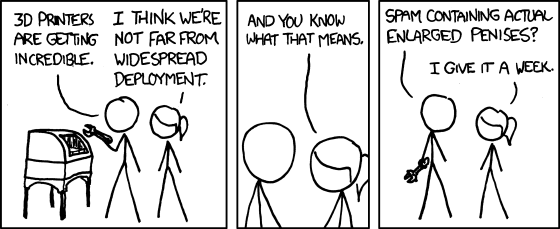
Original at http://xkcd.com/924/
Comments Off on A potential down side to ubiquitous 3D printing
July 8, 2011
Culinary cage match: Middlesbrough’s “Parmo” versus Canadian Poutine
I was born in Middlesbrough, but it was news to me that they have their own “signature dish”: the parmo:
As promised, our highly-trained operatives took time off from audacious spaceplane projects to tackle the parmo — a Middlesbrough delicacy whose fame has already spread as far as Sunderland, but is now set to burst onto the international stage.
However, in the interests of science, we decided to pitch the parmo against another dish whose name is uttered in hushed tones: Canadian poutine.
Yes, we hear you ask, qu’est-ce que c’est this poutine of which you parlez? Since you ask, it’s an unholy alliance of chips, gravy and cheese curds, which will now do battle with the parmo’s deep-fried pork fillet for the ultimate post-pub nosh deathmatch crown.
I should probably warn you that poutine is really a Quebec dish, and has only recently become well known outside the province of its birth. It’s also been described as “the culinary equivalent of having unprotected sex with a stripper in the parking lot of a truck stop in eastern Quebec.”
So, what’s the verdict? Well, I’d like to be able to report that the Spanish locals were willing to give these two tempting dishes a go and report back, but no sooner did we emerge from the kitchen bearing platters of goodness, than the bar immediately emptied.
Among the excuses offered for not being able to stick around to try our hearty fare was one bloke who’d forgotten it was his mother’s funeral in 10 minutes, and another chap who after 40 years as a committed atheist, decided it was an opportune moment to go to Mass and be reclasped to the bosom of the Church.
Comments Off on Culinary cage match: Middlesbrough’s “Parmo” versus Canadian Poutine
July 7, 2011
The Innocent Bystander’s Survival Guide
You know that it’s bound to happen, especially if you’re a comic nerd or rabid anime fan. Be prepared to survive:
9. If an acquaintance of yours seems to disappear everytime the Hero puts in an appearance, rub some of those brain cells together and see what comes up.
[. . .]
11. If you are a news reporter, find a happy medium between the people’s right to know and your right to not get kidnapped/held hostage/etc.
12. Likewise, if you are a policeman, bank guard, or night watchman, and your first shot bounces off of the intruder’s chest, try shooting other areas of the intruder’s body, like their face, groin, etc. If this also fails, do not waste the rest of your ammo on him/her/it, or risk your neck in hand-to-hand combat; instead, fall back and observe.
[. . .]
21. If a Superhero takes up residence in your city, a nice spacious estate in the country will help you to actualize your potential lifespan.
22. If you are a security guard for a vast, powerful corporation, try to get assigned to the Marketing or Personnel departments, rather than R&D.
[. . .]
49. No matter how hooked you are on phonics, don’t try to pronounce things you find inscribed in ancient artifacts.
H/T to Nicholas Rosen for the link.
Comments Off on The Innocent Bystander’s Survival Guide
July 6, 2011
That lack of historical perspective, again
Mark Steyn pokes some fun at Tim Naumetz who managed to confuse the Vichy regime with Vimy Ridge, in an attempt to portray Stephen Harper as a history-distorting warmonger:
As Lilley points out, it was the Liberal Defence Minister John McCallum who made Vichy “a household name” in Canadian history when he confused France’s Second World War collaborationists with Canada’s greatest First World War battle: Vimy, Vichy, what’s the diff? (The Defence Minister made his error in seeking to explain an earlier confession that he’d never heard of the Dieppe Raid.) After blog-mockery from Lilley and others, Mr Naumetz and/or his somnolent editors have belatedly corrected his piece, although without acknowledging the error, never mind addressing the broader question of the cultural void in which he’s operating. I mean, it’s not even a particularly Canadian question: If you don’t know what Vichy is, it’s hard to figure out Casablanca.
[. . .]
I have no idea who “Tim Naumetz” is. (Any relation to Admiral Naumetz, whom the Bush-Cheney warmongers singlehandedly made a household name in the Pacific?) But truly he is a child of Trudeaupia. He belongs in the same category as Miles Hopper and Jason Cherniak, apparently grown men who write stuff like:
Canadians have a right to Freedom of Expression. We have that right because the Trudeau Government negotiated and passed the Charter of Rights and Freedoms.
Gotcha. So before 1982 Canadians had no right to Freedom of Expression? Thank you, Boy Genius. As I said of young Mr Cherniak:
One can only marvel at the near Maoist elimination of societal memory required to effect such a belief.
For these guys, Charter Day 1982 is Year Zero in Trudeaupia, and that’s that. You get a lot of that on the review pages, of course. When a critic says “This is the best sitcom since ‘Seinfeld””, all that means is “This is as far back as I remember.” But it’s the collectivization of “this is as far back as I remember” that’s so creepy about this crowd, as if they all went through the same historical vacuuming in school.
Which is presumably why it never even seems to occur to them that “this is as far back as I remember” is an inadequate argument when you’re attempting to argue that the current regime is attempting a wholesale makeover of national identity. I have no particular views on that one way or the other, but I notice that, consciously or otherwise, Mr Harper seems to have a tonal preference for pre-Trudeaupian language. For example, he welcomed Their Royal Highnesses to “our fair Dominion”. How often did that word pass Martin’s or Chrétien’s or Trudeau’s lips? I suppose Mr Naumetz would find that a bit déclassé, too, even though, in its political sense, it’s one of the few genuine Canadian contributions to the English language.
July 3, 2011
Scott Adams on Men, Women, and Society
This one’s for the misanthopes! See, guys, at least one person understands your plight:
If you have a round peg that doesn’t fit in a square hole, do you blame the peg or the hole? You probably blame neither. We don’t assign blame to inanimate objects. But you might have some questions about the person who provided you with these mismatched items and set you up to fail.
[. . .]
Now consider human males. No doubt you have noticed an alarming trend in the news. Powerful men have been behaving badly, e.g. tweeting, raping, cheating, and being offensive to just about everyone in the entire world. The current view of such things is that the men are to blame for their own bad behavior. That seems right. Obviously we shouldn’t blame the victims. I think we all agree on that point. Blame and shame are society’s tools for keeping things under control.
The part that interests me is that society is organized in such a way that the natural instincts of men are shameful and criminal while the natural instincts of women are mostly legal and acceptable. In other words, men are born as round pegs in a society full of square holes. Whose fault is that? Do you blame the baby who didn’t ask to be born male? Or do you blame the society that brought him into the world, all round-pegged and turgid, and said, “Here’s your square hole”?
The way society is organized at the moment, we have no choice but to blame men for bad behavior. If we allowed men to act like unrestrained horny animals, all hell would break loose. All I’m saying is that society has evolved to keep males in a state of continuous unfulfilled urges, more commonly known as unhappiness. No one planned it that way. Things just drifted in that direction.
H/T Gerard Vanderleun for the link.
Comments Off on Scott Adams on Men, Women, and Society
June 30, 2011
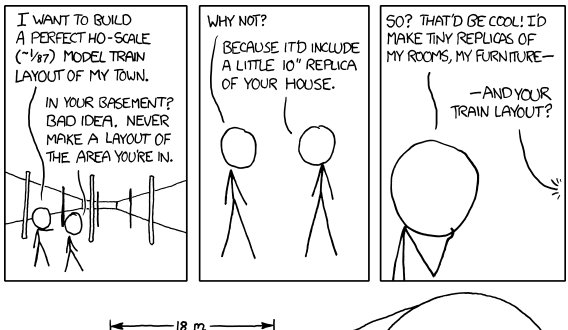
xkcd: The first rule of model train layouts
Jon sent me a link to this xkcd strip, which still amuses me:
Comments Off on xkcd: The first rule of model train layouts
June 26, 2011
Product warnings
Many weird and whacky warnings get attached to products as a result of product liability concerns, but some of them must be generated without legal prompting:
Warning #2: Booze Blues
Seen on a Terrestrial Digital outdoor antenna: “Do not attempt to install if drunk, pregnant, or both.”
Of course, if you’re drunk and pregnant, you probably have bigger problems.
Warning #3: Three-Dimensional Danger
Seen on a Samsung 3D TV disclaimer: “Pregnant women, the elderly, sufferers of serious medical conditions, those who are sleep deprived or under the influence of alcohol should avoid utilizing the unit’s 3D functionality.”
Man, those drunk moms-to-be just can’t catch a break!
Warning #4: Options, Options
Seen on a computer software package: “Optional modem required.”
The writer’s mandatory English language class, incidentally, was not completed.
Comments Off on Product warnings
June 25, 2011
“How very lucky we humans are in that all other animals are so goddamn stupid”
I think my niece mentioned this show over dinner the other night. Ilkka explains:
I recently watched two episodes of “Swamp People“, another low-budget realimentary that sets the camera to follow people with exciting and physical jobs and edits the result down to a highlights reel of action and drama with some narrative added on top. The show not only reminded me of the essay “Rednecks” by Fred Reed, but also of Tommi’s old observation of how very lucky we humans are in that all other animals are so goddamn stupid, really just simple and predictable automata. Armed with but a boat, a baited hook and a shotgun, these fellows hunt, kill and pile up 500-pound prehistoric monsters that will then be given a more useful and productive existence as delicious meat, suitcases and boots. Come on, you can’t tell me that this show doesn’t beat the initially amusing but then later just repetitive and a little bit too obviously scripted “Pawn Stars” any day…
Comments Off on “How very lucky we humans are in that all other animals are so goddamn stupid”
Tim Harford analyzes the ECB’s real problem
Tim Harford puts the head of the ECB (Essex Community Business association) on the couch:
“With all due respect, doctor, I don’t think it’s me who needs to see a shrink.”
“Don’t worry. A lot of people feel a bit awkward when they first lie on this couch. This is a safe, non-judgmental space.”
“I wish the Essex Community Business association was as relaxed.”
“But you’re the chairman of the ECB association. Tell me why you feel that way.”
“Look, I always felt that the ECB association was supposed to be an informal talking shop, a way for people with shared interests to make new friends and perhaps even launch joint projects. Everyone was really happy when Georgios, the new owner of the Plaka Taverna, wanted to join — the more the merrier.”
[. . .]
“So if I understand the situation, you’re lending money to Georgios that you know he can never pay back, and demanding that his staff make sacrifices they are transparently unwilling to make, in order to protect Mr Saville’s bank, in order to protect José, who in some unspecified way is connected to Georgios’s fate.”
“It does sound a bit strange when you put it like that. I think the theory is that if we don’t throw money and yell impractical and unwelcome management advice at a transparently bankrupt business, then maybe a perfectly viable business will be damaged. Especially since there won’t be any money left, because we’ll have given it all to Georgios, who will have given it all to his waiters. Does that make sense?”
Comments Off on Tim Harford analyzes the ECB’s real problem


