
It is possible — in fact, essential — to discover and disseminate the facts about Indian Residential Schools. Repeating the unproven (and to many, deeply discredited) narrative and denouncing those seeking the facts as “denialists” has nothing to do with scholarship but it’s very much in line with gatekeeping:
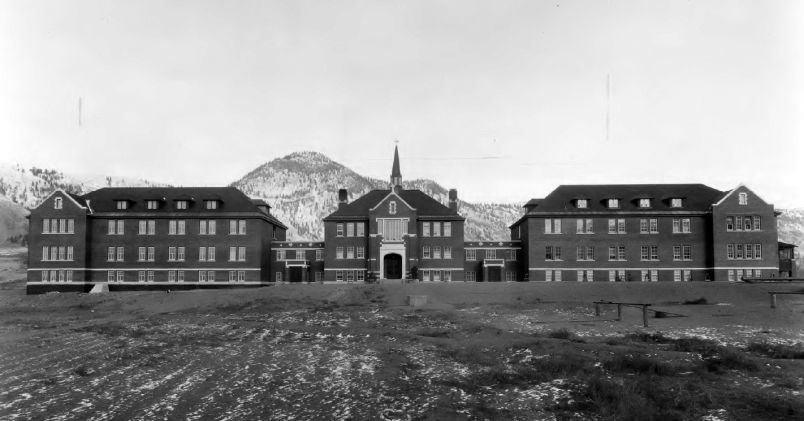
Kamloops Indian Residential School, 1930.
Photo from Archives Deschâtelets-NDC, Richelieu via Wikimedia Commons.
Let’s be honest about what is happening in this video.
This is not academic debate. It is a character attack dressed up as scholarship.
Dr. Travis Hay’s presentation at Mount Royal University, uploaded by Frances Widdowson under the title “Bad Faith: Residential School Denialism and the Academy”, is deeply disappointing. I expected a serious lecture. I expected evidence, argument, and a careful dismantling of claims he believes are wrong.
Instead, what we get is a bad faith lecture.
So yes, Bad Faith is a good title. Just not for the reason Hay thinks.
The real bad faith is pretending to defend scholarship while avoiding the hard work of open debate.
Hay spends much of the lecture drawing a line between “good faith” and “bad faith” criticism. But his standard for good faith appears to be simple: you may disagree only inside the boundaries of the approved framework. You can quibble over details. You can adjust the margins. You can offer polite corrections.
But if you challenge the premise itself, suddenly you are no longer mistaken. You are morally defective. You are a “denialist”, a “grievance merchant”, or some broken person who must be pushed outside respectable academic life.
That is not scholarship. That is gatekeeping.
None of this requires minimizing the real harm done by residential schools. It simply means historical claims should be open to examination. Evidence should be tested. Terms should be defined. Numbers should be scrutinized. Arguments should be answered.
Instead, Hay leans heavily on moral outrage, personal denunciation, and guilt by association. Rather than carefully taking apart Widdowson’s arguments, he drags in old controversies involving other people, uses emotional anecdotes, and builds a mood where the audience is being told what to feel before they are allowed to think.
The most revealing part is the conclusion. Hay says people like Widdowson do not belong in the academy. In other words, the answer to uncomfortable academic work is not better evidence, better reasoning, or open debate. It is expulsion.
That should bother everyone.
A university that cannot tolerate dissent is not protecting knowledge. It is protecting doctrine.
If Widdowson is wrong, prove it. Debate her. Bring the evidence. Take her claims apart in public. That is what serious scholars are supposed to do.
But when the response is censorship, exclusion, and personal insult, it starts to look less like confidence and more like fear.
I came away from viewing this lecture disappointed. Not because Hay disagrees with Widdowson. Disagreement is the whole point of academic life. I was disappointed because the lecture showed so little faith in the public’s ability to hear competing arguments and judge the evidence for themselves.
This lecture does not prove that Widdowson’s arguments are wrong. It proves that parts of the academy no longer know how to handle a serious challenge without reaching for moral panic and professional exile.


