On Patreon, Project ’44 has posted an extensive article on the setup and preparation for Operation Veritable in February 1945, with the First Canadian Army under General Crerar preparing to attack into the Reichswald as part of Field Marshal Montgomery’s 21st Army Group:
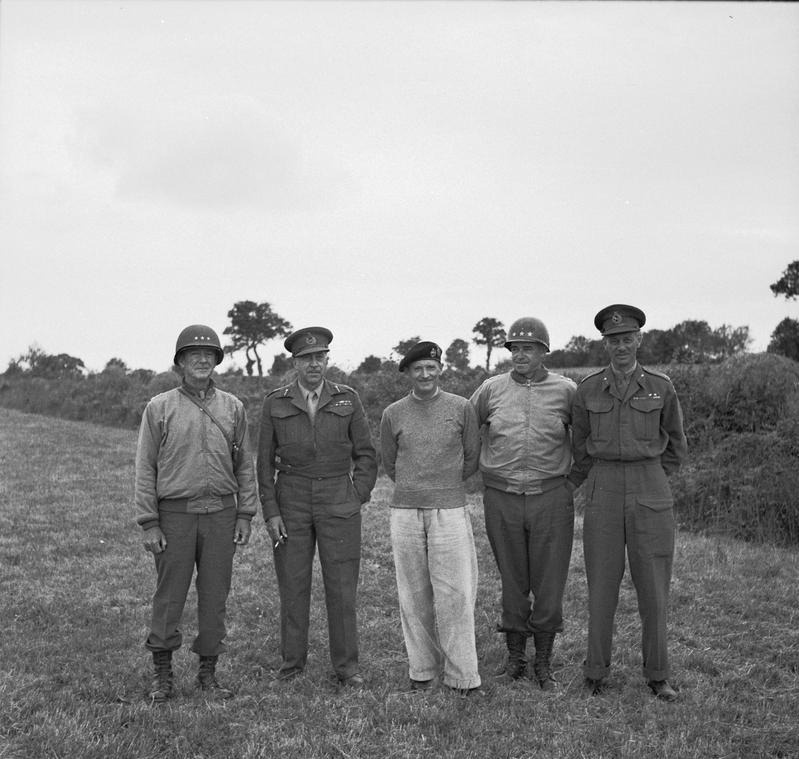
Lieutenant General Courtney Hodges (US First Army); General Harry Crerar (First Canadian Army); Field Marshal Bernard Montgomery (21st Army Group); Lieutenant General Omar Bradley (12th Army Group); and Lieutenant General Miles Dempsey (British 2nd Army), 21/08/1944 (Taken by Sgt. John Morris, No. 5 AFPS-AFPU, B9473).
In the early hours of the 8th of February 1945, the combined weight of the First Canadian Army and 21st Army Group’s massed artillery unleashed an immense orchestration of firepower, shattering any semblance of a peaceful morning and pounded German positions across the Reichswald. Massed in unprecedented density, with dump piles exceeding half a million shells, some 1,034 field, medium, heavy, super-heavy, and multi-barrelled rocket launcher platforms opened in concert. In accordance with their detailed fireplans this combined artillery effort was tasked with destroying enemy headquarters; severing lines of communication; disrupting road networks and infrastructure; rendering enemy defensive positions inhospitable; and, plainly, reducing the enemy’s force as much as possible, leaving survivors in a state of “shell happiness”. As the guns opened fire at 0500hrs, they quickly formed part of the largest artillery bombardment undertaken by Commonwealth forces since the battle of El Alamein in 1942.
This impressive symphony of artillery, along with the days of preliminary bombardments by both artillery and heavy bombers that preceded it, marked the very beginning of the month-long “Operation Veritable”. This operation was the 21st Army Group’s northern pincer movement, aimed at permitting a crossing of the river Rhine and, subsequently, a drive into Western Germany by dislodging and rupturing the German position between the rivers Mass and Rhine in the lower Rhineland.
Conceived by Canadian General Harry Crerar (commanding the First Canadian Army), part of Field Marshal Bernard Montgomery’s 21st Army Group, Veritable was set to be General Crerar’s largest and most complex undertaking of the war – and for that matter, Canada’s too. At its height, the First Canadian Army commanded almost half a million personnel, with the majority of its formations British in origin, and its personnel strewn from Canada, Britain, Poland, and the Netherlands. Though 450,000 personnel would not be involved in Operation Veritable, it would still come to command the entirety of the British XXX Corps and Canadian II Corps.
Veritable would not be the rapid breakthrough many had envisaged it to be, especially not in the style of operations the year prior. Instead, it would evolve into a month-long, multi-operation offensive fought over some of the most arduous terrain in northwestern Europe. Advancing across deep mud, inundated lowlands, and through dense forests and urban centres, against an often-fanatical enemy manning prepared defensive structures, Veritable was quickly turned into a troublesome slog.
As Sergeant Alex Troy of the 5th Field Regiment, Royal Canadian Artillery would write:
they [the Germans] fought really tough because the enemy had always before been fighting in some other poor devil’s country; now he was defending his own land.
The Allied Situation:
By early December 1944, the German force opposing Field Marshal Montgomery’s 21st Army Group had been dealt a series of important blows, none more recent than its forceful uprooting from the west bank of the river Maas as far south as Maeseyck. In that, the German position was believed to be, notably by Montgomery, strong – but undermined by a lack of equipment, trained troops, and suffering from rampant logistical shortages.
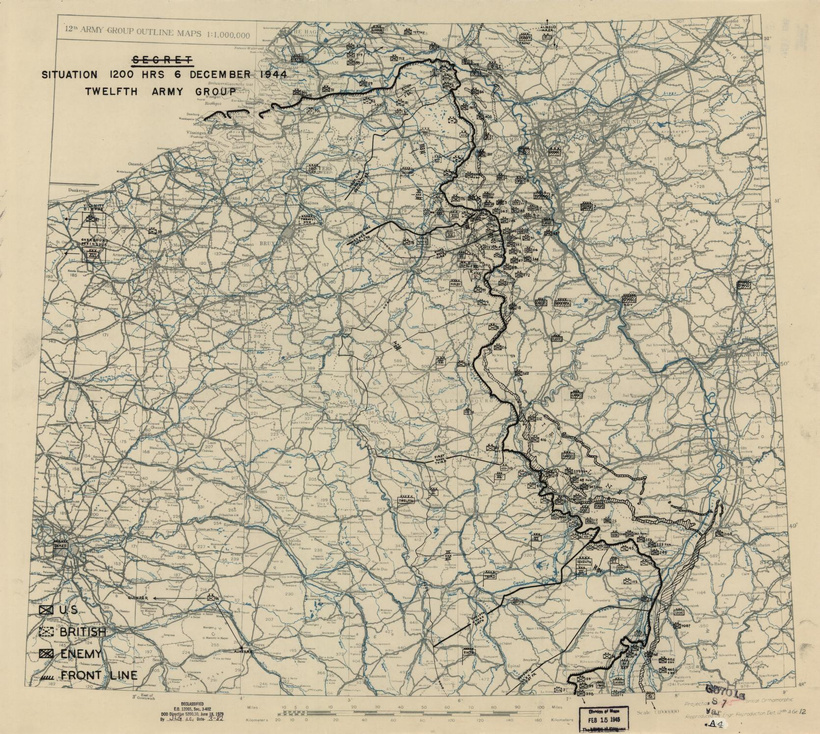
HQ Twelfth Army Group situation map, 6th December 1944. Produced by the Army Group Headquarters, 12 Engineer Section.
During a meeting on the 6th of December, Field Marshal Montgomery directed General Crerar to plan an offensive to the southeast of Nijmegen, and to support this transferred XXX (30) Corps to his command. Over the days that followed, two major operations were conceived. In the south, the British 2nd Army was to clear the triangle between Sittard, Geilenkirchen, and the river Roer as part of Operation Shears; whilst in the north, the First Canadian Army, as part of Operation Veritable, was to advance into the Reichswald, securing the settlements of Xanten, Geldern, and Sonsbeck, before taking charge of the river Rhine’s western bank.