
On the social media site formerly known as Twitter, L. Wayne Mathison describes what happens when virtue signalling becomes someone’s entire persona:
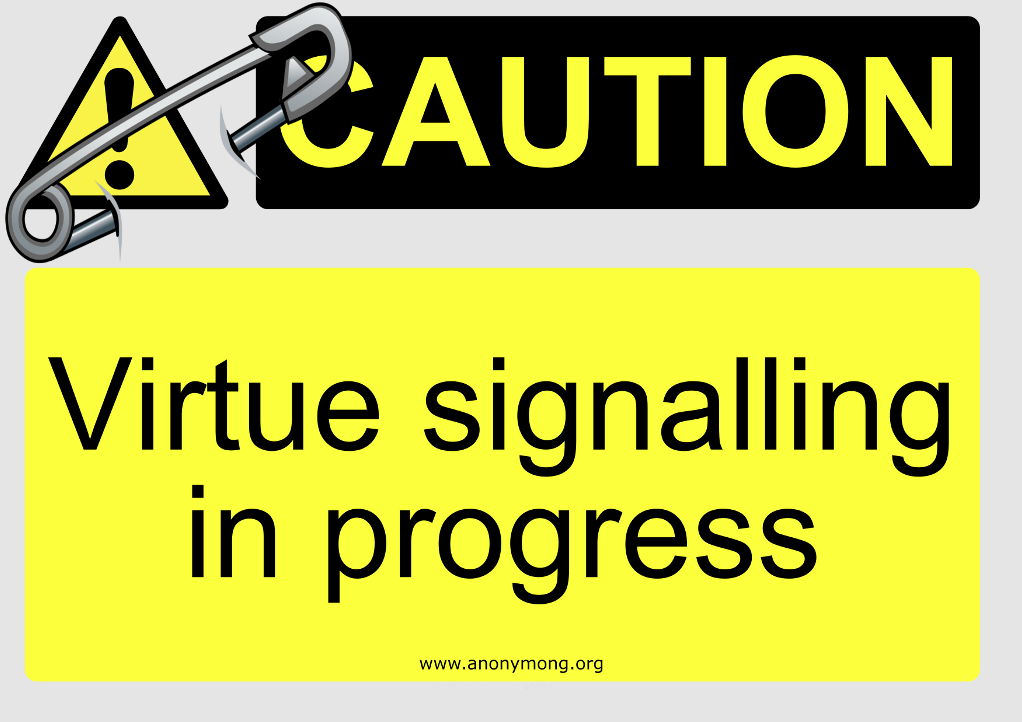
When Virtue Becomes a Costume
Here’s an old village joke: if a man walks around telling everyone how humble he is, check his pockets. He’s usually carrying a mirror.
That’s roughly how the modern “woke” phenomenon works. It presents itself as moral enlightenment, but most of the time it behaves like a status game, who can signal the most compassion, the loudest outrage, and the strongest allegiance to the fashionable cause of the week.
My definition is blunt: woke politics is moral signalling replacing moral responsibility.
It’s not about solving problems. It’s about performing concern.
And once you start looking at it that way, the pattern shows up everywhere.
The Performance Economy of Virtue
Rob Henderson calls these “luxury beliefs”.
Luxury beliefs are ideas held mostly by wealthy or highly educated people that signal status but impose real costs on everyone else. The people promoting them rarely suffer the consequences.
Think about it.
Defund the police.
Abolish prisons.
Decriminalize hard drugs.
Romanticize homelessness as a “lifestyle choice”.Who pushes these ideas hardest?
Not the working-class neighbourhood dealing with break-ins. Not the single mother living beside a drug market. It’s usually professors, activists, and celebrities living in safe neighbourhoods with security cameras and gated buildings.
The belief becomes a badge of moral sophistication.
The consequences fall somewhere else.
This is the luxury belief machine.
The Five Laws of Stupidity at Work
Carlo Cipolla’s Five Laws of Human Stupidity explains the rest.
His argument was beautifully cynical: stupidity is not about intelligence. It’s about behaviour.
A stupid person, he wrote, is someone who causes harm to others while gaining nothing themselves.
Sound familiar?
Look around at some modern activism and you’ll see Cipolla’s laws running like background software.
Law #1: Always underestimate the number of stupid people.
Every generation believes it has escaped mass foolishness. Every generation is wrong.
Law #2: Stupidity is independent of education.
A PhD does not vaccinate someone against bad thinking. Sometimes it just gives them fancier vocabulary.
Law #3: A stupid person harms others without benefit.
Policies driven by emotional slogans often damage the very communities they claim to protect.
Law #4: Non-stupid people underestimate stupidity’s power.
This is why sensible people are constantly surprised when destructive ideas gain traction.
Law #5: A stupid person is the most dangerous type of person.
Unlike criminals, they don’t know what they’re doing. And unlike the selfish, they aren’t pursuing rational gain.
They simply push the lever harder.
The Hollywood Example
Even entertainment hasn’t escaped the pattern.
Hollywood increasingly behaves less like a storytelling industry and more like a political signalling club. The pressure to conform is real: careers depend on being publicly aligned with the dominant ideology, and dissent can carry professional consequences.
The incentives are obvious.
Actors gain admiration by championing fashionable causes. They receive praise, awards, and moral approval, often without sacrificing anything material in their own lives.
It’s “virtue” at almost zero cost.
The Moral Time Machine
Then there’s what Bill Maher once joked about: the moral time machine.
Modern activists judge people from centuries ago as if those individuals possessed today’s cultural knowledge and moral vocabulary. It’s a kind of historical self-congratulation, imagining how virtuous we would have been in 1066 if only we had been there.
But that trick isn’t really about history.
It’s about status.
If you can condemn the past loudly enough, you look enlightened in the present.
The Incentive Problem
Here’s the uncomfortable truth.
Most systems don’t run on morality. They run on incentives.
Corporations chase profit.
Media chase attention.
Algorithms chase engagement.
Political activists chase moral prestige.If the reward structure encourages outrage and virtue signalling, that’s exactly what people will produce.
Not because they’re evil.
Because incentives work.
The Reframe
The real divide in modern politics isn’t left versus right.
It’s performance versus results.
One side asks:
“Does this policy sound compassionate?”
The other asks:
“Did it actually improve people’s lives?”
That’s the question that cuts through the noise.
Because compassion measured by intentions is theatre.
Compassion measured by outcomes is responsibility.
Here’s the test I use now.
When someone proposes a moral crusade, ask three questions:
Who pays the cost?
Who receives the applause?
What happens if the policy fails?
Luxury beliefs collapse under those questions almost instantly.
And the moment the performance stops, something interesting happens.
We can finally start solving the problem.
[NR – emphasis added]


