
Quotulatiousness

March 7, 2026

The massive blind spot in gender studies programs

Filed under: Education, Media, Middle East, Politics, Religion, USA — Tags: , , , , , — Nicholas @ 05:00

On the social media site formerly known as Twitter, stepfanie tyler recounts her own experience in university with gender studies:

Some feminists romanticize mandatory hair coverings, social exclusion and lack of rights for women in Islamic countries. Because reasons.

When I was in “Women’s and Gender Studies” in college, we spent a lot of time talking about “systems”, “the patriarchy” and all these hidden structures supposedly shaping women’s lives in the West

I entertained a lot of those ideas back then and I was trying my best to understand the frameworks they were teaching

But the one place I never gave them an inch on was women in the Middle East

Every time someone would say “that’s just their culture” something in me short-circuited. No matter how hard I tried, I just couldn’t reconcile it

We were told American women were oppressed because of wage gaps or subtle social expectations, but when the conversation turned to women who could be punished by the state for showing their hair, suddenly we were supposed to become culturally sensitive (some of these lunatics even romanticized it!)

My professors used to get irritated with me when that topic came up bc they knew I wasn’t going to play along and my pushback would cause a rift in their narrative

They didn’t like it when I pointed out the hypocrisy of calling Western women oppressed while treating literal legal restrictions on women’s bodies as a cultural difference

One of my professors even had a running joke she’d use to preface discussions on Islam—she’d do this smug smirk and say something to the effect of “we all know Stepfanie’s take on Islam” as if I was the ridiculous one

Looking back, I wish I had the language and wit to verbally obliterate her but I was 22 and simply did not have the intellectual capacity yet. I didn’t know the first thing about geopolitics, I just knew in my bones how fucking stupid it sounded to be bitching about making 20 cents less than men when women in the Middle East were being stoned to death for showing their hair

Even back then, before my politics changed, that contradiction never sat right with me. And it’s one of the many reasons I despise so-called feminists so much today
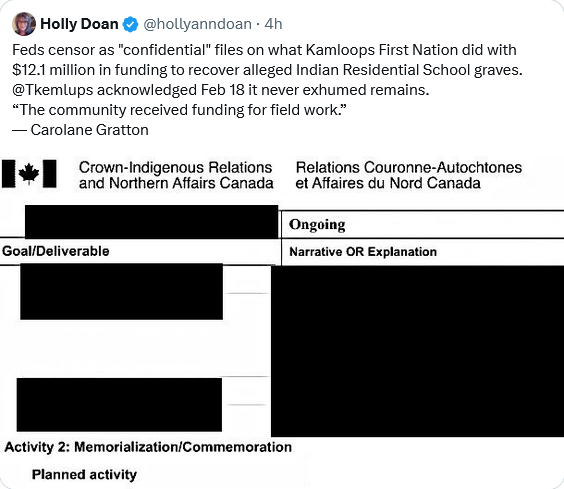
“Canadians were told there were 215 graves”

Filed under: Cancon, Government, History, Media, Politics — Tags: , — Nicholas @ 04:00

On the social media site formerly known as Twitter, John Rustad expresses his anger at the federal government’s apparent connivance in concealing information from Canadians in the not-really-an-investigation into the alleged mass graves at a former Residential School in British Columbia:

Canadians were told there were 215 graves.

The country lowered the national flag for months. Churches were burned. International headlines declared the discovery of mass graves at a former residential school. The federal government responded by allocating $12.1 million in taxpayer funding specifically to support investigation and exhumation work to verify those claims.

Now we learn that no remains have been exhumed.

At the same time, the Department of Crown-Indigenous Relations has released the activity reports tied to that funding, but every meaningful detail has been redacted. The reports describing what work was carried out, what investigations were conducted, and how public money was spent have been blacked out and labelled confidential.

That is unacceptable.

When the federal government spends millions of your taxpayer dollars to investigate a claim that shook the entire country, Canadians have a right to transparency. They have a right to know what work was performed, what evidence was found, and how their money was used.

This is not about denying history. It is not about attacking Indigenous communities. It is about basic public accountability.

If the government funded an investigation, the public deserves to see the results of that investigation.

Let me be clear: The records should be released in full. The spending should be explained clearly.

Canadians deserve the truth about what was done with their money. And if that money was not spent for the purpose it was granted for, then the public deserves accountability, including repayment of those funds.

Reported preference versus revealed preference – know the difference

Filed under: Business, Economics, Gaming — Tags: , , — Nicholas @ 03:00

On the social media site formerly known as Twitter, Devon Eriksen encapsulates the experiences of so many companies who found a male-oriented market and then they try to make their offerings more appealing to women:

Most business suicides are induced by not understand[ing] the difference between reported preference and revealed preference.

If you run Testosterone Studios, maker of Angry Muscular Axe Guy Kills Demons in Hell, you might notice after a while that not very many women buy your games.

Since your stockholders have a profound moral objection to other people having money and not giving it to them, they want you to correct this problem, stat.

They want you to make Angry Muscular Axe Guy Kills Demons in Hell 2 sell to men AND women. So you sigh, shrug your shoulders, hire a bunch of female consultants, and ask them “What do women like?”

“Feminism!”

“Girlbosses!”

“Strong Female Characters effortlessly outdoing men at everything!”

“Gay stuff!”

So Testosterone Games dutifully makes Petite Feminist Girlboss Replaces Angry Muscular Axe Guy, hoping that men will buy it because they bought the first one, and girls will buy it because it panders to what they were told girls want.

Of course, nobody buys it. The men don’t buy it because it’s not what they liked in the first one, and women don’t buy it because women couldn’t care less about games where you fight demons in hell.

If, instead of asking a bunch of consultants what women like (reported preference), they had looked at games women actually buy (revealed preference), they would have seen something very different.

“Fruit Matcher 3000 for iPhone.”

“Point and Click Alice in Wonderland Studio Ghibli Adventure”

“Something Something Hogwarts.”

And they would have realized, had they two brain cells to rub together, that you can’t please everyone, because some people hate exactly what other people like.

If you want more money, look at who is already buying your product, and see if you can make them like the next one better. Because I guarantee you aren’t already selling to every single male on the planet.

And don’t hire video game consultants.

They don’t know how to sell games, and they don’t care, because they don’t want to sell games. They just hate men, and want to ruin things men like. If you hire them, they’re going to have their fun, cash your check, and ride off into the sunset, while you lose your business.

And indie studios, who know whether they are making Aliens Must Die or Barbie Horse Adventures, will replace you, which is the free market operating as intended.

ASh-78: Albania Makes the Worst AK

Filed under: China, History, Military, Weapons — Tags: , , , , — Nicholas @ 02:00

Forgotten Weapons
Published 11 Oct 2025

Albanian AKs are both pretty scarce to find outside Albania, and also a bit unusual in the AK field. Where most countries followed Russian AK development, Albania instead patterned theirs on the Chinese Type 56. China had Russian assistance in producing the original milled-receiver AK, but the milled AKM came after the Sino-Soviet split and so China had to create their own stamped receiver design independently. We see those features in the Albanian ASh-78, in elements like the offset front trunnion rivet, gas vent holes, stock and grip style, single trigger guard rivets, and lack of a rate reducing mechanism in the FCG.

In 1960 China began providing military aid to Albania. The first rifle production there was a version of the SKS, which are made into the early 1970s. In 1974 the Albanian state arsenal began setting up AK production with Chinese help as well. Relations between the two countries broke down shortly thereafter, and by the time production began in 1978 the Albanians were working entirely independently. They added an underfolding model (the ASh-82) in 1982, and production continued past the end of the Cold War. Total production numbers are not known, as military information was pretty tightly controlled.
(more…)

QotD: Grind culture and performative working

Filed under: Britain, Business, Quotations — Tags: , — Nicholas @ 01:00

As if compelled by unseen forces — one imagines that scene in The Exorcist — my fellow traveller adjusts his AirPods, straightens his spine, and “locks in”. Before him lies the cluttered still life of Productivity™: a crumpled FT, a bottle of protein-infused kefir, and two boiled eggs sweating inside their polypropylene coffin. For several moments, he sits with priestly solemnity. Then, as the train inches forward, so does he.

And so, begins his morning recital. I would call it theatre, but theatre requires even the slightest concession to its audience. There is no risk of such grace here.

“Jenny? You still there? Jenny? Excellent.”

He repeats her name as though invoking the supernatural. Dale Carnegie once advised this rigmarole; it’s meant to build something called rapport. Unfortunately, Dale Carnegie never sat captive before a disciple who had taken his gospels quite so literally.

“Jenny (build rapport), could you run those numbers by me again? (assert authority). I’m hoping to parallel-path with you moving forward (signal tribal membership). Great! (convey enthusiasm). Jenny, let’s circle back at 1400 GMT; I want to put a pin into an area of emerging awareness.”

By this point in the sermon, I’d developed several areas of emerging resentment and the unignorable desire to drive pins into eardrums — mostly mine. His monologue, which suggested he charged by the word, stretched unabated from Reading to London Paddington, where he skulked off the platform and into the neon vomit of the city like a Roman senator descending into the Suburra.

In the false refuge of a nearby pub, the missionaries gather and gab incessantly. Chirruping clots of earnest twenty-somethings discuss REM-centric sleep regimes, dopamine stacking, and some Santeria called “sunlight dosing”. They sip protein-riddled IPAs. They recite “Huberman says …” as the devout once invoked St Augustine.

These rituals — the 21st-century Lascaux cave paintings — serve one purpose: to peacock one’s devotion to a deity known as The Grind. Like all deities, The Grind demands a daily sacrifice for a distant, mostly hypothetical reward.

We have struggled to name this social pathology. Grind culture. Hustle culture. 996. No days off. Whatever it is, it is not working. In truth, it is the inbred relation of Performative Reading — Performative Working. This theatre drips with all the fripperies of work and none of the results. Much like a Hinge premium account, or indeed the British state.

Christopher Gage, “Mourning Routine: The Cult of Performative Work”, Oxford Sour, 2025-12-03.

Powered by WordPress



