Quotulatiousness

February 19, 2026

An American anarchist

Filed under: Books, Economics, Liberty, Politics, USA — Tags: , , , — Nicholas @ 05:00

I’ve never met Christopher Schwarz, but I’ve read a lot of his writing in books, magazine articles, and blog posts. He’s forgotten more about hand tool woodworking than I’ll ever know, and he’s amazingly generous in sharing his knowledge with others. He calls himself an anarchist, which often puzzles people who only know of anarchism from media-presented bomb-throwing nihilists and conspiratorial Russian stories. Here he explains what he means when he uses the term:
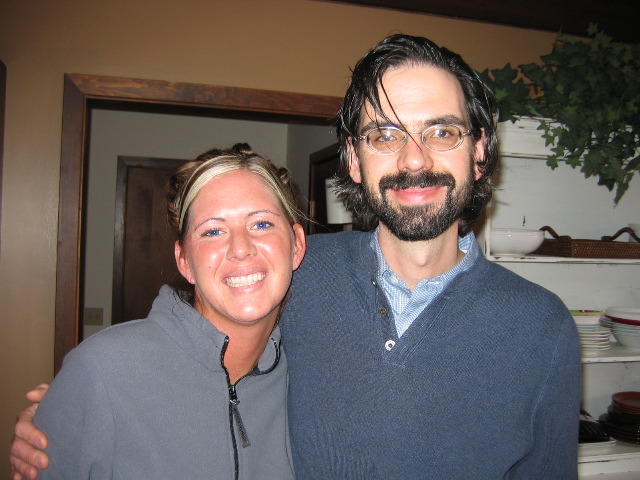
“Chris Schwarz and Meredith Schwarz” by jessamyn west is marked with CC0 1.0 .

I get asked a lot about what I mean by the word “anarchism”, and if I could please explain what I mean when I use that word.

My answer is always unsatisfying. Here’s why.

For the love of creamed corn, why would I publicly discuss ideas that are – for now – a crime in our country? Why would I say – for example – that I think that copyrights and patents on things that use public money are bullshit? That wars are founded on lies? And that the state – in general – seems to be a menace to peaceable living?

That would be stupid. Dumb nuts.

Also, I am a practitioner of anarchism, not a philosopher.

If you want to know more about American anarchism (and aesthetic anarchism, specifically), you need to ask a philosopher, not a front-of-house worker. Read Native American Anarchism (Hachette Books, 1983) by Eunice Minette Schuster for an easy on ramp. Or Josiah Warren’s Equitable Commerce (1852) for the full banana.

The Anarchist’s Tool Chest: Revised Edition by Christopher Schwarz – Link.

Or follow the trail of breadcrumbs left in The Anarchist’s Tool Chest to figure it out yourself. The book describes how to disrupt the furniture industry by building things that never need to be replaced. It’s also about how to jailbreak yourself from a tool industry that offers up aluminum jigs as a substitute for skill.

That book is not the only path. There are other ways to throw a bunch of ball bearings into the guts of the IKEA robots.

Buy antiques or used furniture. The other week I was in Savannah, Georgia, and visited one of my favorite antique stores. The price of handmade antiques has hit bottom. So-called “brown furniture” can be bought for less that the cost of the materials used to make it.

Even though I make furniture for a living, I sometimes save time and money by purchasing vintage industrial furniture for our warehouse, fulfillment center and workshop. Megan’s giant oak desk from the 1960s cost us zero dollars (we just had to move it from an insurance office). Our printer and scanning station? An old workbench from Pennsylvania. Our associate editors’ shared desk? A giant vintage drafting table from Sweden.

And if you think for a moment, there are other industries and organizations that can be farted upon by your actions. The clothing industry is even worse than the furniture industry when it comes to making flimsy crap and abusing workers.

Yes, you can buy ethically made jeans, shirts and socks. Yes, you will pay a premium for these items. And if you can afford that path, great. If you can’t, then buy secondhand clothing.

I’ve always wanted a pair of R.M. Williams boots but could never afford them on a writer’s salary. Last year I found a used pair for about $100 where the owner had ragged out the elastic part of the slip-on boots. It was a stupid easy fix. And now I have boots I shall wear at my funeral.

The other side of the equation is that I’m denying the new-boot-goofin’ industry my dollars. Forever. I don’t have to buy a pair of shoddily made boots that can’t be re-soled and will have to be replaced in a couple years. All my future “boot money” will go to our local cobbler so she can re-sole them every few years.


You can build a chair (Seriously)

Filed under: Tools, Woodworking — Tags: , , — Nicholas @ 04:00

Rex Krueger and Lost Art Press
Published 18 Feb 2026

Patrons saw this video early: / rexkrueger
James’ Video: • Making a Chair With Friends – Christopher …
Join the Mailing List: http://eepurl.com/g3rkmv
Take a course: https://www.rexkrueger.com/courses
Compass Rose Toolworks: https://www.compassrosetools.com/
Get my woodturning book: http://www.rexkrueger.com/book
Follow me on Instagram: @rexkrueger

Too many “conservatives” today are just slower-speed liberals

Filed under: Britain, Cancon, Media, Politics — Tags: , , , , , — Nicholas @ 03:00

Most self-described conservatives in politics are not particularly inclined to “conserve” anything, as Spaceman Spiff points out, they’re pretty much onboard with the liberal vision they just want it to be fractionally slower or infinitesimally not-quite-as-liberal as the liberals. They are the ineffectual, neutered, tame opposition:

Modern conservatism is not conserving our world. Mainstream conservatives seem to have no interest in the real issues affecting us.

At best they merely wish to slow down our decline. At worst, they are fully on board with the destruction.

When they do act or speak they often pick a safe version of a sensitive issue.

In Britain there is lots of talk of illegal immigration and how the state mishandles it. None about ruinous volumes of legal immigration, almost one million per year, and what it is doing to the country.

Pushback against climate policy falters on the speed of changes, not the underlying fraud of climate science itself.

No conservative will honestly discuss the plummeting happiness of women recorded across the West and yet there it is, writ large in antidepressant prescriptions and social media videos. It may have multiple causes, but feminism cannot be challenged so they say nothing lest they are reprimanded by the sisterhood.

Everything real is forbidden. It is all an act.

Like the left, those on the right are increasingly unable to face reality which means they can never course correct. They are trapped within a self-referencing culdesac designed to maintain their position in someone else’s hierarchy. That is why they have become so ineffective and appear to do very little except moan about the pace of change while they say nothing about the changes themselves.

We sense the conservatives do wish to conserve things but they are inexplicably mesmerized by the opinion of their enemies. They seek reassurance and applause from people who view them as evil.

This makes no sense to ordinary people.

Thinking like the enemy

The problem with modern conservatives is they are animated by underlying drives that cannot create a conservative or traditional society. They have adopted the thinking patterns associated with the progressive left while still using the language of conservatism.

The left is traditionally defined by a series of interrelated traits that manifest in much of what they agitate for.

  1. A desire for centralization;
  2. A notable external locus of control;
  3. Seeking approval from the group.

Central control systems feature prominently in all left-wing schemes. From local councils to national governments, those who gravitate to the left often want to create centralized decision-making bodies to manage society. Institutions, government departments, NGOs and even charities all feature, but only when they act as the controlling authority in some field of interest.

Related to this is a clear external locus of control visible in individuals and their decisions. There is a relief others make the key decisions, so people actively seek out direction from an established authority. This ensures minimal resistance to the many centralized schemes we see emerge.

Acting solo creates discomfort. An older formulation understood this as the rejection of responsibility. Today it often manifests as an obsession with experts making key decisions for us all, partly to mask individual cowardice. People making their own decisions in life are derided as naive or dangerous.

During Covid decision makers became hysterical at the very idea we would reject the advice of experts and perform our own research despite the issue being medical and therefore dangerous.

A related phenomenon characteristic of many leftists is the need for approval, often from a group. Not just others making decisions but a dependency on confirmation and endorsement to ensure thinking and behaviour follows an established norm. This is the antithesis of original thinking or bold action; it is how adolescents often behave.

In today’s world this deep urge is reflected most in the social media landscape of harvesting attention and likes. Every fledgling narcissistic applause-seeking trait is given full expression in the endless search for approval from strangers. Whole sections of society seem lost to impulses we once understood as immature and dysfunctional.

Update: Not long after I queued this item for publication, a Canadian example popped up in the news, as yet another rock-ribbed “conservative” suddenly realized that electing a Liberal was what his constituents actually wanted when they inexplicably voted for him as a Conservative candidate in the last federal election.

Edmonton Conservative MP Matt Jeneroux has crossed the floor to the governing Liberals.

“I am honoured to welcome Matt Jeneroux to our caucus as the newest member of Canada’s new government,” said Prime Minister Mark Carney, in a post on X.

“I am grateful to Matt and his family that he will continue his service as a strong voice for Edmonton Riverbend in Parliament.”

Carney said Jeneroux, who has represented the riding of Edmonton Riverbend since 2015, will take on a new role as special advisor on economic and security partnership for the Liberals.

Jeneroux is the third Conservative to join the Liberals, after colleagues Michael Ma and Chris d’Entremont crossed the floor late last year.

A Liberal source says Jeneroux first met Carney back in November, which was the first of at least two conversations, with talks between Carney’s office and Jeneroux continuing since. That source added that it has been a “long journey” to Wednesday’s announcement.

d’Entremont crossed the floor to join the Liberals in November, which unleashed a wave of speculation as to who might be next, with Jeneroux’s name heavily floated. Jeneroux then announced his plans to resign from the Conservative caucus, citing family reasons. Since then, he has not voted with the Conservatives and did not attend the party’s recent convention in Calgary in late January.

After Carney’s announcement, the prime minister updated his daily itinerary, adding a stop in Edmonton to meet with Jeneroux before attending events in British Columbia.

“Matt brings a wealth of experience in Parliament, despite his young demeanor,” said Carney, while sitting next to Jeneroux.

The MP from Edmonton welcomed the prime minister and laid out the reasons for why he had reversed his decision to resign.

“I had announced my resignation back in November, largely due to family reasons, but quite simply, couldn’t sit on the sidelines after seeing what the prime minister’s ambitious agenda he was undertaking across the country and across the world,” he said.

“Quite honestly, it was the speech in Davos where you took everything head on,” he added.

Jeneroux said it felt disingenuous and “quite simply wrong” to sit on the sidelines.

Hotchkiss Model 1886 3-pounder Quick Firing Gun

Filed under: Britain, History, Military, WW1, WW2 — Tags: , , , — Nicholas @ 02:00

Forgotten Weapons
Published 26 Sept 2025

Small fast boats with torpedos (or other explosives) have always been a threat to large warships. One of the weapons the British Royal Navy adopted to counter that threat was the Hotchkiss Model 1886 “Quick Fire” gun. This meant that it was a breech-loaded gun that used self-contained cartridge ammunition, instead of separate powder bags and projectiles. Mounted on a recoil-adsorbing soft mount with a wide range of movement and steep depression angle, guns like this could fire at small mobile torpedo boats that a capital ship’s main armament couldn’t handle.

This particular model is a 47mm bore, or 3-pounder as described in British service. It uses a vertically-traveling breech block, and more than 3,000 or them were acquired by the British. Two of them were employed as part of the Falkland Islands coastal defenses at one time. This example is one of two brought down from Gibraltar fairly recently and refurbished for ceremonial use on the Islands. Thanks to the FIDF for setting it up on its mount so I could film it for you!
(more…)

QotD: The Donation of Constantine

Filed under: Europe, History, Italy, Quotations, Religion — Tags: , , , , , — Nicholas @ 01:00

Y’all know I love the 15th century. Not “the Renaissance”, although “the Renaissance” — insofar as that’s a useful concept of historical analysis, which is not very — was in full swing in Italy by 1400, and soon enough north of the Alps, too. The professional periodization and terminology can be confusing here — the “Northern Renaissance” can refer to different things, sometimes a hundred or more years apart, depending on whether you’re talking about visual arts or poetry or what have you. So I prefer to confine the term “Renaissance” to Italy. Unless I’m talking specifically and exclusively about Italy, I’ll refer to the period as “the 15th century”.

I love it because it’s clearly a watershed moment in human thought. I don’t mean the rediscovery of the classical past; I mean the shift between a more cyclical orientation towards life, versus an orientation around linear time. Time as the regular procession of the seasons, vs. time as a stream or river.

Some examples will help. The 15th century saw not just the creation of archives-based history, but the techniques in various fields that make archival work possible. For instance, the Donation of Constantine was definitively proved to be a forgery in the 15th century, on the basis of philological evidence. Before that point, the people using the Donation – both ways — wouldn’t have cared too much if they knew it was a fake. Not because they were opportunists (although they were), but because “factual accuracy”, to use one of my favorite of the Media’s many Freudian slips, just didn’t matter much back then.

When they said “the Donation of Constantine” they meant “hallowed by tradition”, and if you’d proved to them that the Donation was fake, they’d just keep on keepin’ on — ok, then, “hallowed by tradition” it is, everyone update your style books accordingly.

Severian, “The Ghosts (II)”, Founding Questions, 2022-05-18.

Powered by WordPress