Quotulatiousness

January 30, 2026

Corruption – there … and also here

Filed under: Bureaucracy, Business, Education, Government — Tags: , , , , — Nicholas @ 04:00

Copernican draws some examples of life in a corrupt authoritarian society (the old Soviet Union) and compares them with similar situations in the western world today. Depressingly, we have been converging on how Soviets used to have to work the system just to get access to the people they had to get permission slips and permits from:

Corruption is one of the largest issues of our time. Particularly in places like Minnesota, but also nationally. For that reason, it’s necessary to understand corruption, what it is, and how to utilize its benefits. The United States exists in a political hybridization of Soviet Managerialism and Libertarian Corporatism. In both cases, corruption is a common feature of our society, but we don’t see it on the ground the same way that Mexican business owners do or Russian gangs.

Thus, I pose the following question: Are our societies so different that we cannot also benefit from corruption while our culture is ground to dust beneath it?

I recently saw a video from this YouTube channel that discusses Russia and the psychology of living in an oppressive state. A nation not of law, but of management, public policies, and mercurial Karens at every level. I’m not sure how it feels to be Western European (I get the impression the progenitor of the videos is now living in Western Europe), but I can say that, being an American, life seems similar to what’s described therein: Hope seems dangerous. Liberty seems like a time bomb until you step on the wrong bureaucrat’s toes, and your entire future and that of your family is held hostage by the proclivities of unaccountable bureaucrats that you’ve never spoken to1.

Meanwhile, at the top of government, billions of dollars are being laundered by corrupt politicians like Tim Walz, who will lie to your face. Import demographics that hate you. And if you dare defend yourselves, a lynch mob may well try to kill you. How do I get my hands on that money spigot that seems to be free-access for people who want to kill me?

Corruption, or lack thereof, is another one of those American Myths that needs to be deconstructed in the psyche of the population. To do that, we need to understand what corruption really is. Not at the national level of billions of laundered dollars for foreign pirates, but at the personal level. What is corruption for us stuck in the limbo of a faltering civilization?


    When I was young, I witnessed corruption for the first time. I was a child, and I was just entering the primary school system in my home country of Russia. Like all things, there was government paperwork to fill out and submit. When we arrived at the office, an old woman sat behind a glass barrier to help people with their paperwork. My mother knocked on the glass to get her attention. The clerk ignored my mother. My mother knocked again and then took a chocolate bar out of her bag. She passed it through a window into the barrier to the clerk. The clerk looked up and took the chocolate bar, hiding it in a stack of forms. Then she asked, “How can I help?” and filed the papers so that I could attend school.


Corruption doesn’t have to solely give an advantage to those politicians and billionaires sitting atop the society. Corruption can act at every level, from top to bottom. The West exists in a system that is corrupt from the top down, while the Russians exist in a system that is corrupt from the bottom up. Corruption doesn’t need to take the form of extortion payments or threats of ending careers. Corruption can be small, personal, and in many ways more honest than managerial formalization.

Maybe a manager will find some problem with your paperwork, any paperwork you hand in. So to smooth over the process, you bring her a coffee or a chocolate bar. Maybe your academic advisor will help you make the right connections if you gift him a bottle of whiskey or schnapps for Christmas. Maybe you want a teacher to treat your child better at school, so you give her a cupcake or school supplies as a gift.

You don’t need police officers on the take to be advantaged by corruption.

Most people here on substack are underemployed. I am one of them for the time being. I can state with certainty that I have never gotten a job by applying for a job. Never once have I sent out a resume and heard back anything besides an automated “dear applicant, kindly go fuck yourself” from the HR manager. Maybe it’s a byproduct of being a White guy. Lord knows I have enough degrees to find work.

Rather, the only way I’ve ever found employment is through direct connection: I have a friend who has a friend who knows someone who needs an employee. I’m close to fitting the bill, so they’ll hire me. Sometimes they have to dip and duck around hiring-managers and HR to do it:

    Here’s where we’re going to post the job. We’re legally required to leave the posting up for two weeks, but apply with these five keywords in your Resume. When I review the resumes submitted, I’ll be able to pick out yours.

It seems quite conspiratorial when you say it out loud, though that’s the way it has to be in more than a few companies. If they want to hire a White guy, there are hoops to jump through. The addition of “hiring policies” and “diversity” quotas has just added a few hoops, but did not limited one’s acrobatic ability.

Corruption is an individual or a small group of individuals acting in their own interests by ignoring or subverting legal or social rules of conduct.

If you have a friend you’d rather hire than some Indian with a slightly nicer resume? That’s corruption. When the boss hires his nephew, that’s corruption. When you give the DMV associate a chocolate bar, and she helps you with your paperwork instead of telling you to go fuck yourself, that’s corruption. When you hand the inspector of your 40-year-old truck a fifty so that he marks “passed” on your emissions inspection, that’s corruption.


  1. “I am Russian. Here’s how corruption really works.” I highly recommend a look. – https://youtu.be/v21toLzcCgg

“… now that the legend is fully established, good luck trying to convince people of the facts”

Filed under: History, Media, Politics, USA — Tags: , , , , — Nicholas @ 03:00

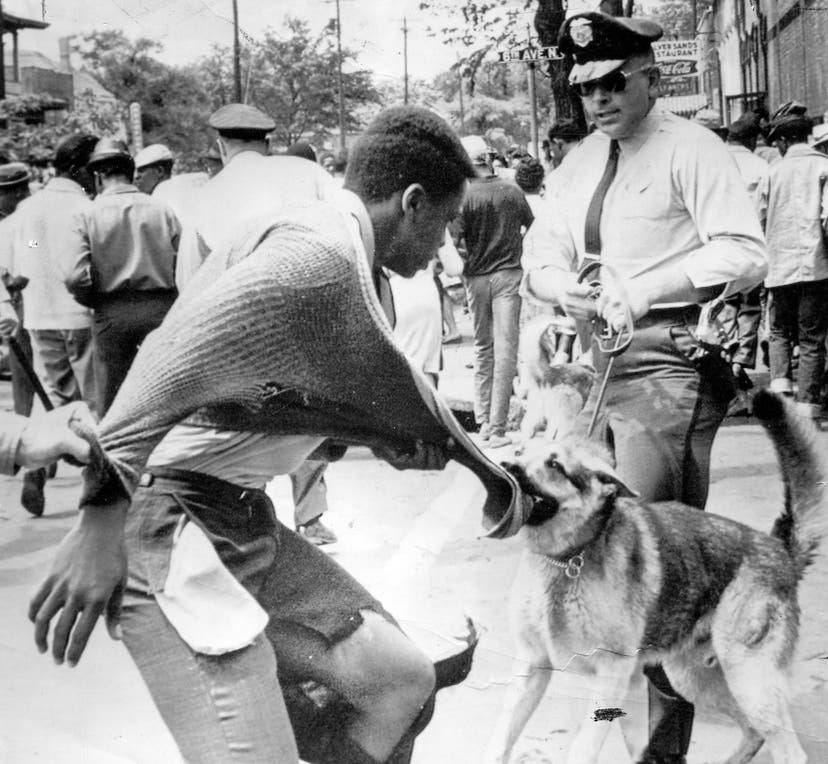
On Substack, The Scuttlebutt looks at an iconic photo, a sculpture based on the photo, and shows that the line from The Man Who Shot Liberty Valance is still quite true: “When Legend becomes Fact, print the Legend”

In an old black and white John Wayne, Jimmy Stewart movie called The Man Who Shot Liberty Valance, a newspaper man tells the hero of the piece “When Legend becomes Fact, print the Legend”. Meaning; tell the people what you want them to know, even if it’s not true. We’re going to talk about that today; but first, Get in out of the cold damn it! Seven degrees is cold even by my standards. Grab a cup of coffee, or cocoa, tea if you must, pollute it as you will, and have a seat, Dinner is Chili, please remember the tip jar where we collect for the mess. Let’s begin!

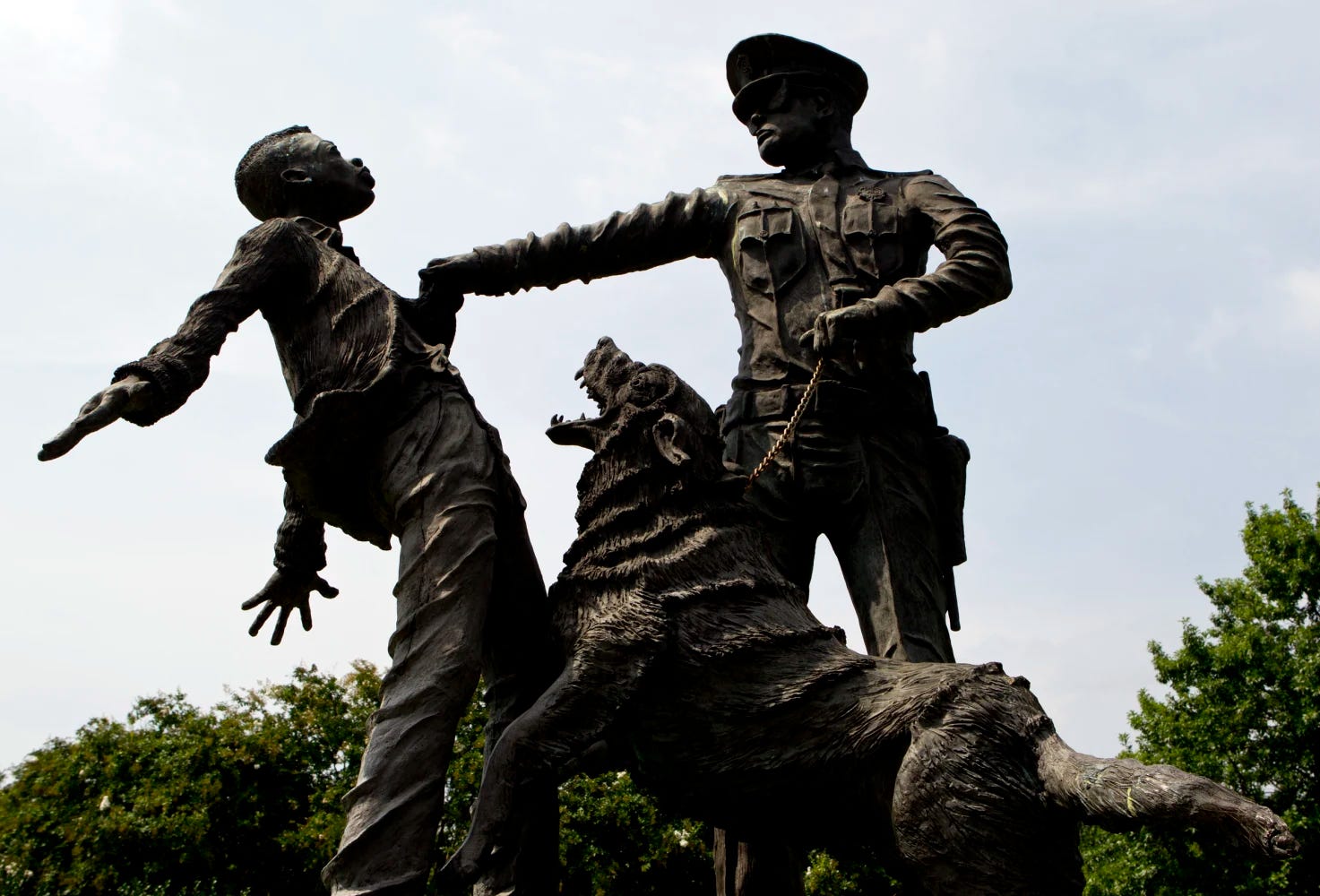
I referred to the picture above last week, though I didn’t include it. I’m going to include it now, because of something that a reader and good friend of some four decades sent me, in regard to it. See, she lives in Birmingham, where there is a statue commemorating this event, titled Foot Soldier. This is it:

Notice any differences from the photo of the event? Yeah, the cop is the one grabbing the kid, and the dog is threatening, the kid is defiant, and the cop looks like they pulled him out of a Soviet or Nazi recruiting poster. (The article I will reference also calls out the fact that the kid in the sculpture has emphasized black racial features. The kid it happened to, is so Anglo in feature he could be a white guy in “blackface”. Oh and the kid in real life is every bit as big as the cop.) Those are just the initial things, there’s more, but I’ve made my point.

Yeah, you in the back, with the purple hair and the septum ring? What’s that? “But that’s art” you say? “Putting artistic license on the sculpture is reasonable” you say?

Well, Ma’am? I think you’re a Ma’am? Yes, it is. It’s propaganda, but “Art” is allowed to be propaganda, and in fact most art is just that. From the formal paintings of Kings and Heads of State, to Andy Warhol’s stuff, images are altered to make a point. Maybe to emphasize a chin that’s pretty weak in the real guy, making him look “tougher” or putting more jewelry on the woman than the family owns to make them look richer … Most art that isn’t just “an exercise for the student” has some sort of statement. (Note, I consider “still life with fruit”, and such things to be an exercise, teaching proportion and play with light.) Political caricatures are the ultimate expression of this point, and that cop is a political caricature.

Ah, but here’s the thing. While the “art” is reasonably a political statement, the news story, and the photograph are supposed to be news, and we have been told that “News is facts, not Op-ed”.

Well, we all know that lately, that’s just not so, but here’s the thing: It never was!

It’s not that the Media is lying to you today, it’s that the media has NEVER told the truth. It’s just that by the time the truth comes out, usually, it’s decades later, and no one cares.

But you SHOULD care. Take this event enshrined in legend (Remember that quote “print the legend”?) There’s a gentleman named Malcom Gladwell. He does a podcast called Revisionist History. The transcript of the relevant show is HERE as done by Emily Maina. The whole piece is really well done, and worth your time, but it’s about twenty minutes worth of reading, so I’m pulling out a couple of points to help make my point.

Mr. Gladwell was invited by the widow of the cop, to learn, as the late Great Paul Harvey used to put it, “The Rest of the Story”. This drove him to track down the artist that did the sculpture, the actual kid that was involved, friends of the cop in question, caused him to listen to the interviews done when the statue was commemorated, and so on. It seems the legend is far different from the truth. The kid in the picture wasn’t even part of the damn protest. He was a lookie-loo who had skipped school to come see “the great man” Martin Luther King.

The protests had at this point been going on for months. Constantly getting bigger, constantly drawing more spectators. The cops, specifically “the Birmingham Chief of Police, a troglodyte named Bull Connor”, in the words of Gladwell, have been tasked with keeping the spectators separated from the protesters. There was, after all, a legitimate fear that someone in the spectators might just be a Klansman, and might be aiming to take out some of MLK’s folks.

Well, that gets harder and harder to do, and the protester numbers keep growing, the spectators keep growing, until finally, Conner decides to use the K9 units to keep the peace. This is all a part of “the plan”. The protestors are trying to get the cops to do something that can be blown up and make international headlines. Finally, they succeeded.

The third of May, 1963. A photographer, Bill Hudson, gets a picture of a kid with a cop dog on him. White officer, black victim, mean dog. That’s what the narrative is. The New York Times runs it, three columns above the fold, and makes up a story to go along with it. The trouble is, no one talked to the cop, or to the kid.

The cop was Richard Middleton, his last gig had been escorting black kids to school, to keep them from being killed by whites. He’s been assigned now, to keep the separation line between the protesters and the populace. The kid’s name is Walter Gadsden, according to the person that interviewed him at the dedication of the statue, he’s now “a grumpy old man still wedded to some of the oldest and most awkward of Black prejudices”. She sees him as Stockholmed basically.

Walter, he sees himself as a dumb kid who skipped school, went where he wasn’t supposed to, and damn near got bit by a K9 because of it. Middleton was trying to pull the dog off, you can see it in the photo, if you actually look. But that’s not the legend, and the media prints “the legend”. The artist admits:

    Well, I saw that the boy was being about 6’4, the officer was maybe 5’10, 5’9. And I said, “This is a movement about power”. So I made the little boy younger and smaller, and the officer taller and stronger. The arm of the law is so strong, that’s why his arm is almost, like, straight. And the dog is more like a wolf than a real dog. Because if I’m a little boy, that’s what I would see. I would see like this superman hovering over me, putting this big old giant monster of a dog in my groin area, in my private area. And so, that’s what I envisioned when I first saw the photograph.

Of course, the artist is a black man. He continues: “So he’s almost like a blind officer. He doesn’t even see the kid, because he’s so far beyond that. ‘Killed this nigger. Attack this nigger.’ He saw past the reality of this is a hu-, innocent chi-, human child, a human being, that’s why he was wearing blind people glasses like that.”

Well, it’s art, the artist wasn’t there, never talked to anyone involved, and he told the story he wanted to tell. OK, that’s what art does. The trouble is, that’s also what the news media did.

And they got away with it, until July 6 2017, which is when the article in question came out. Actually, they are still getting away with it, because now that the legend is fully established, good luck trying to convince people of the facts.

Japanese Last-Ditch Pole Spear Bayonet

Filed under: History, Japan, Military, Weapons, WW2 — Tags: , — Nicholas @ 02:00

Forgotten Weapons
Published 8 Sept 2025

Japanese bayonets followed the same trend of simplification as Arisaka rifles towards the end of World War Two, culminating in what is today called the “pole bayonet”. Abandoning even the fittings to mount to a rifle, these bayonets were intended to be lashed to a pole to create a spear. The Japanese government did not have the military forces to repulse an American invasion of the home islands, and was actively planning to sacrifice millions of Japanese civilians in a hopeless defense, literally having them charge American machine guns with spears. Some of this was done on outer island battles, like Saipan and Okinawa but the scale in Japan itself would have been unimaginable. It was the nuclear bombs on Hiroshima and Nagasaki that led to a Japanese surrender and prevented this from becoming a reality.
(more…)

QotD: Slavery in the Islamic world

Filed under: Africa, Books, History, Middle East, Quotations, Religion — Tags: , , , , — Nicholas @ 01:00

As one recent study of the 19th century slave Fezzeh Khanom puts it, “The history of slavery in Iran has yet to be written”. A general history of slavery in the wider Islamic world had yet to be written, too — until Justin Marozzi took up the task.

The widespread neglect of the history of slavery in North Africa and the Middle East, which Captives and Companions seeks to redress, partly reflects a culture of American exceptionalism; slavery in other parts of the Americas (it was abolished in Brazil only in 1888) also receives little attention.

Partly, too, it reflects a tradition of denial in the Islamic world itself. Marozzi recalls a professor at Bilkent University in Turkey admonishing a younger historian not to dig too deep: “Our ancestors treated their slaves very well; don’t waste your time”.

In the West, meanwhile, Islamic slavery is an unfashionable — and often suspect — subject: one is reminded of West Germany in the 1980s, when any overemphasis on Soviet crimes against humanity could appear as an attempt to whitewash or relativise the Holocaust. Marozzi is careful not to dwell too much on comparisons between Islamic and Atlantic slavery, except as regards the scholarly attention which they have received. Still, many readers will pick up his book hungry for such comparisons. So here they are.

In both Islamic and Atlantic slavery there was a marked racial — anti-black — component. Slavery was sustained by similar religious and philosophical justifications: the biblical “curse of Ham”, for example, and the idea that geography and climate made sub-Saharan Africans naturally suited for servitude. “Chattel slavery”, Marozzi emphasises, existed in the Islamic world too. Both involved horrific violence and displacement. Both were complex and sophisticated enterprises, often with serious money at stake.

People have always been hesitant to draw any comparisons between Islamic and Atlantic slavery, albeit often for entirely opposite reasons to historians today. Whereas the Jewish-American writer Mordecai Manuel Noah was a vocal supporter of the enslavement of Africans in America, he was also bitterly opposed to the enslavement of Americans in North Africa — and therefore a strong supporter of America’s involvement in the Barbary wars.

Gladstone, meanwhile, thought that Turks killing and enslaving Europeans was far worse than “negro slavery”, which had at least involved “a race of higher capacities ruling over a race of lower capacities”. However dubious his family connections, Gladstone was born after Britain had abolished the slave trade.

The lack of attention given to Islamic slavery is all the more dismaying when one considers just how much longer it survived.

Most of slavery’s 20th century holdouts were in the Islamic world. Iran abolished slavery in 1928; Yemen and Saudi Arabia in 1962; Turkey — which we like to consider more “Western” than the others — in 1964. Mauritania half-heartedly abolished slavery in 1981. Slavery was still a feature of elite life in Zanzibar as late as 1970. When 64-year-old President Karume took an underage Asian concubine, he justified it by declaring that “in colonial times the Arabs took African concubines … now the shoe is on the other foot”.

The Royal Harem in Morocco, meanwhile, was only dissolved on the death of Hassan II in 1999. In the Islamic world, human beings were bought and sold, and forced to do demeaning and painstaking labour, within living memory; some people languish there still.

The key difference between Atlantic and Islamic slavery concerned status. Slaves in the Islamic world could rise to high places: 35 of the 37 Abbasid caliphs were born to enslaved concubine mothers; the slave eunuch Abu al Misk Kafur was regent over Egypt from 946 to 968. Slave dynasties, most notably the Mamluks, were amongst the most powerful in the Islamic world.

The polyglot governor of Hong Kong, Sir John Bowring, when he inveighed against “slavery in the Mohamedan states”, had no choice but to acknowledge that a slave in the East could attain the “highest social elevation” — a far cry from the black slaves of the West Indies. Some slaves, too, were amongst the worthies of Islam, such as the first Muslim martyr, Sumayya bint Khabat.

Slavery occupied a complex place in Islamic law. The Quran, on the one hand, permits men to have sex with female slaves. But on the other, the emancipation of slaves is smiled upon as one of the noblest things a Muslim can do. The Abyssinian slave Bilal ibn Rabah was freed by Abu Bakr and became the first caller to prayer; another freed slave, Zayd ibn Haritha, was briefly the Prophet’s adopted son.

The Quran also expressly forbids Muslims from enslaving fellow Muslims. Nonetheless, as Marozzi shows, this prohibition has not always been strictly observed. The Mahdi (of General Gordon fame) claimed to represent pure, Islamic orthodoxy, but he had no qualms about enslaving Muslim Turks.

Likewise, it mattered little that the Prophet Muhammad had explicitly forbidden castration of male slaves. For over a millennium his tomb in Medina was guarded by a corps of eunuchs. This, too, was an institution which survived into living memory: in 2022 a Saudi newspaper reported that there remained one living eunuch guardian.

Samuel Rubinstein, “The dirty secret of the Muslim world”, The Critic, 2025-10-17.

Powered by WordPress