Quotulatiousness

January 21, 2026

“It is a deal so bad that only Keir Starmer could have negotiated it”

In Spiked, Fraser Myers says that British Prime Minister Keir Starmer fully deserves to be humiliated over his give-it-all-away negotiations for the Chagos Islands, which includes the strategic naval base at Diego Garcia:
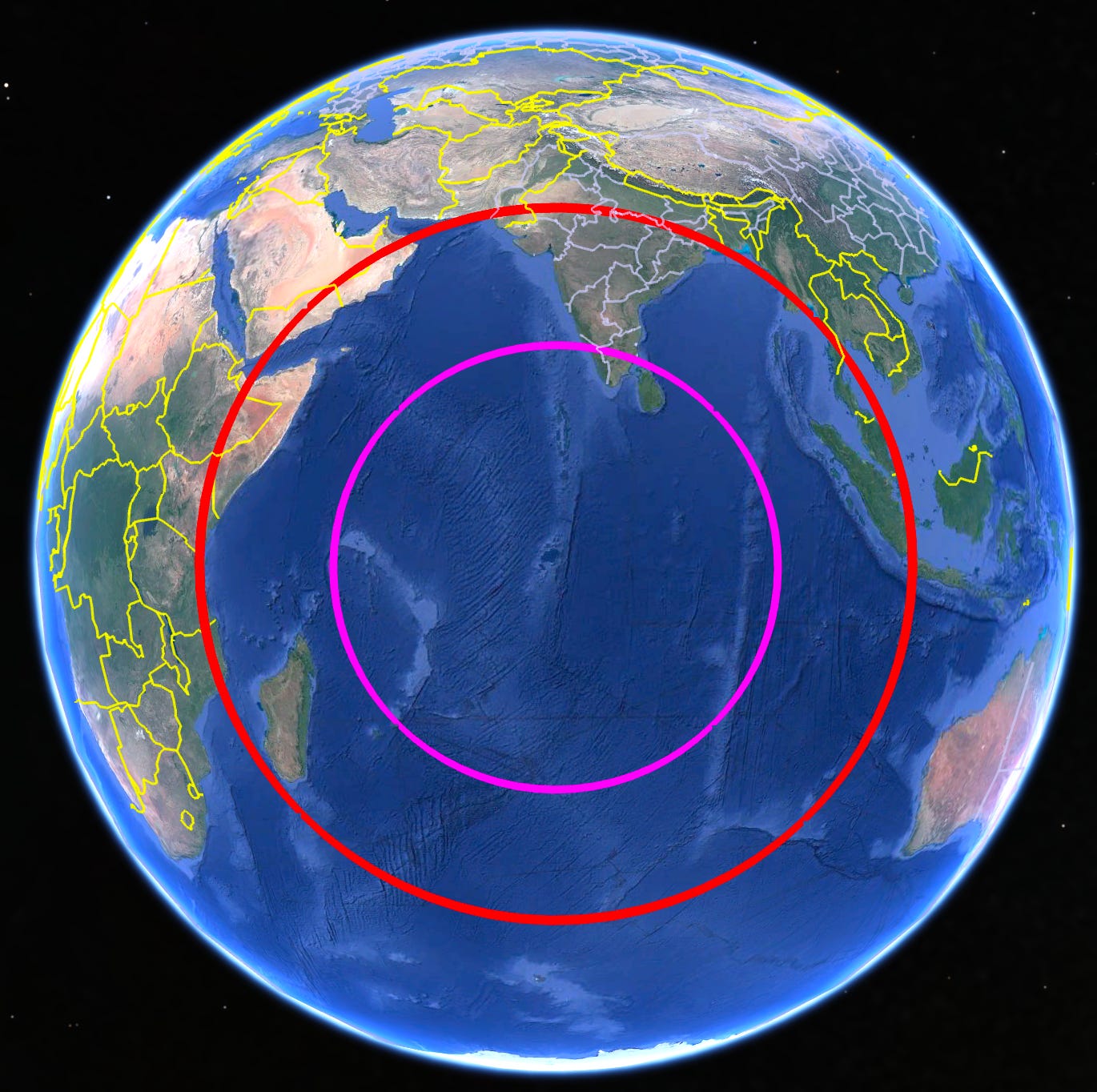
In the middle of that map is Diego Garcia, British Indian Ocean Territory and home to one of the most strategic airfields and anchorages on the planet. […] The red circle is 2,000 nautical miles from the island. The purple circle is 1,150 nautical miles, roughly the distance from London to Malta, that represents the distance from Diego Garcia. That circle is also the distance from Diego Garcia to the island of Mauritius.
Caption and image from CDR Salamander.

With the assistance of the brightest and best of the UK Foreign Office, the Labour government agreed to an arrangement that would hand over territory containing an Anglo-American military base to an unfriendly country, condemn its former inhabitants to permanent exile, and pay tens of billions of pounds for the pleasure.

I’m talking, of course, about Chagos (officially, the British Indian Ocean Territory), which has briefly caught the attention of the world’s most powerful man. This morning, amid a flurry of Truth Social posts about his designs on Greenland, US president Donald Trump’s gaze briefly alighted on this small, tropical archipelago on the other side of the planet. And he did not hold back in his criticism of Britain’s plans: “Shockingly, our ‘brilliant’ NATO Ally, the United Kingdom, is currently planning to give away the Island of Diego Garcia [the largest of the Chagos Islands], the site of a vital US Military Base, to Mauritius, and to do so FOR NO REASON WHATSOEVER”, he wrote. “The UK giving away extremely important land is an act of GREAT STUPIDITY”.

Trump’s reaction has widely been described as a major about-turn. But, in truth, his team has veered all over the place on the Chagos question. In October 2024, when Starmer initially agreed to hand over the islands, Marco Rubio, then still a US senator for Florida, reportedly warned that this would allow “Communist China” to spy on the US Navy, given Mauritius’s alliance with China. Yet in February 2025, when Starmer visited the Oval Office, the US president said he was “inclined to go along with” the UK’s proposals. And by May, when the deal was signed between the British and Mauritian governments, Rubio, by now US secretary of state, welcomed it. He claimed that Trump himself had “expressed his support for this monumental achievement”, hailing the deal that would cede sovereignty to Mauritius, while Diego Garcia would be leased to Britain for the next 99 years.

Of course, Trump’s motivation for bashing Starmer’s deal now has little to do with the Chagos Islands themselves. The real prize for the US president is in a different hemisphere entirely, as he freely admits. In a bizarre non-sequitur, the US president’s Truth Social post goes on to say that the Chagos deal is “another in a very long line of reasons why Greenland has to be acquired” by the US. This smackdown over Chagos, this attempt to humiliate Starmer and Britain on the global stage, is clearly part of Trump’s broader pressure campaign against the European powers, in his bid to seize Greenland for the US.

Nevertheless, it really should not have taken Trump’s intervention to put the brakes on the dreadful Chagos deal. Whichever way you spin it, this arrangement has never been in Britain’s national interest, nor the interests of the Chagossians who call the islands their home. It poses a risk to Western security interests, handing sovereignty over a territory, where almost 400 UK and US troops and 2,000 contractors are based, to a country that’s allied to China. The cost of leasing back Diego Garcia from Mauritius is also eye-watering. Although the Labour government tried to present the cost as just £3.4 billion, the true figure is believed to be 10 times as much, at around £34.7 billion.

So what on Earth possessed Starmer to sign up to such a risible deal? What leverage was a tiny island like Mauritius able to gain over Britain?
The Korean War Week 83: The Medics’ War! – January 20, 1952

Filed under: China, Health, History, Military, USA — Tags: , , , , , , — Nicholas @ 04:00

The Korean War by Indy Neidell
Published 20 Jan 2026

There’s discussion — and disagreement — in UN Command and Washington about whether or not to poll all the POWs the UN side holds to see where they would like to go should they be released. There are arguments for and against this, and it brings up a couple different interpretations of the Geneva Convention. This week we also talk a lot about recent medical advances in field medicine in Korea, and the development of the “Medics’ War”.

00:00 Intro
00:44 Recap
01:14 Poll the POWS
04:52 UN Decleration
08:19 52nd Medical Battalion
10:56 Cho-Do Island
11:45 Summary
12:06 Conclusion
12:49 Memorial
(more…)

We’ll resist the Yankee hordes with our … um, strongly worded tweets?

Filed under: Bureaucracy, Cancon, Government, Military, USA, Weapons — Tags: , , , — Nicholas @ 03:00

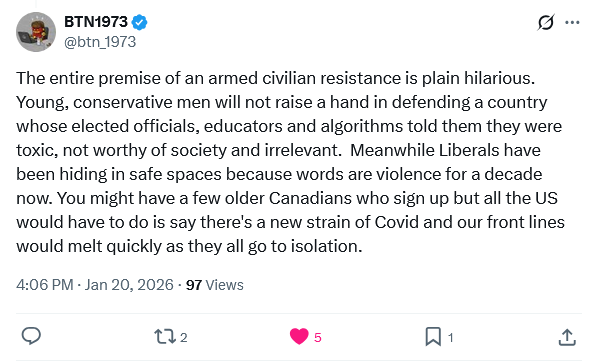
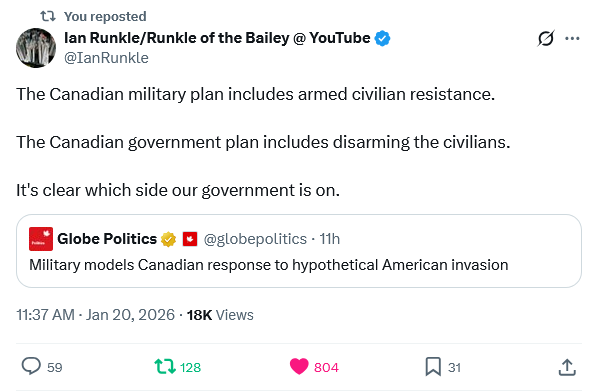
A brilliant example of the general case of progressives never taking into account the impact of their own pet schemes is the Canadian Armed Forces including “armed civil resistance” as part of their contingency planning for an American invasion … at the same time that the Canadian government is moving heaven and earth to disarm as many Canadians as possible:

Jason James writes:

Canadian military planners have modeled a potential US invasion from the south.

Their plan?

An armed civilian resistance.

I’m not sure if they’ve checked in with the Liberal government yet, but they’ve outlawed most “assault style” weapons (meaning anything that could actually be used to mount such a resistance).

And depending on where the US invades, they might have a difficult time finding civilians who actually own anything beyond kitchen knives.

Furthermore, anyone who does own hunting rifles or the few legal “assault style” weapons would be more inclined to fight on the side of the Americans than defend a socialist wasteland that sold their future to China.

So what’s the plan then? Mobilize the Mexican cartels and Chinese organized crime gangs who actually have some fire power? Form a militia of IRGC operatives and Indian drug gangs to fight American special forces?

I highly doubt any of them would be interested in walking into certain death for a country they have no allegiance to.

So I guess we’re down to a handful of lesbians and communists armed with broom handles defending Vancouver and Toronto from the greatest military power the world has ever known.

Good luck with that, comrades.

No disrespect to James, but the weapons the federal government are trying to confiscate are not “weapons of war” or “assault weapons” — they are mostly semi-automatic guns that look vaguely like military weapons. The feds offered to send all confiscated weapons to Ukraine as they fight a desperate war of defence against the Russian invaders and need anything they can get. And Ukraine refused the offer because these weapons would not be useful in combat. But the basis for confiscating them in the first place is that they’re all dangerous military weapons.

This is likely what would happen if such an invasion materialized:

Of course, you can always depend on Not the Bee to provide a tasteful selection of topical memes.

Soviet World War Two 50mm Light Mortars (RM-39 & RM-40)

Forgotten Weapons
Published 25 Aug 2025

The Soviet Union decided to adopt a 50mm light mortar in 1937 as a company-level armament. The first such weapon they used was the RM-38, introduced in 1938. It was a complex design, with a gas venting system to adjust range (200m – 800m), a bipod specifically set to either 45 or 75 degrees, and a recoil buffering system. This was clearly too complex, and it was replaced by the RM-39 the next year. This remained a well-made mortar, but now had a freely adjustable bipod. However it quickly proved too complex and expensive and it was in turn replaced by the RM-40.

The RM-40 is a much more efficient (aka, cheap) design. It used simple stamped bipod legs and a heavy stamped baseplate. It still uses adjustable gas venting to set range and retains a simplified recoil buffer, but it is a much more quickly produced weapon. A 1941 model of completely different design did replace it though, and by 1943 the Soviet Union moved to 82mm mortars for better effectiveness.

The Soviet mortars were generally well liked by German troops who captured them, as they were significantly longer ranged than the German 50mm mortar. They were also captured in large numbers by the Finns, who used them as well but found them underpowered. In 1960 some 1,268 Soviet 50mm mortars of all models were sold by the Finnish Defense Forces to Interarms to be imported into the US. Some were registered and sold as Destructive Devices and some were deactivated and sold as dummies.
(more…)

QotD: White elephant airports

Filed under: Australia, Cancon, Germany, Government, History, Humour, Quotations — Tags: , , , , , — Nicholas @ 01:00

Few things capture modern planning like a multibillion-dollar airport no one’s entirely sure will have any planes. Enter Western Sydney International Airport (WSI), Australia’s shiny $5 billion gamble at Badgerys Creek. It’s a development so hyped it already has merch, an anticipated metro line, and a better skincare routine than most of us, despite rumors it may spend its first year servicing only freight and the occasional confused ibis.

If history teaches us anything, it’s that airports, like wrinkle creams which cost the GDP of a small country but couldn’t iron out a bedsheet, can be wildly overpromised and underdelivered. Western Sydney’s runway might yet join the vainglorious global herd of White Elephant Airports: majestic, expensive, and standing alone in a field wondering where everyone went.

Let’s take a safari.

Mirabel: Montreal’s Monument to Inconvenience

Built in 1975, Mirabel International was meant to replace Montreal’s Dorval Airport and usher in a new aviation era. Instead, it became the architectural embodiment of “We should’ve checked the map”. Located more than 50 kilometers from the city, it was so unpopular that passengers would rather fling themselves onto dogsleds than make the commute.

Eventually, Mirabel stopped pretending to be an airport and transitioned into its second act: a car-racing track and film set. Somewhere in Quebec there’s probably still a baggage carousel being used as a wedding dance floor.

Ciudad Real: A Billion-Euro Garage Sale

Spain saw Mirabel and said, “Hold my sangria”. Ciudad Real International Airport opened in 2009 with a €1.1 billion price tag, dreams of high-speed rail links, and the confidence of a Bachelor contestant in week one. Within three years, it had no flights, no buyers, and no shame.

It was eventually auctioned for €10,000, less than a parking space in Bondi or a bottle of champagne at a Sydney rooftop bar. One imagines the bidding process was just two blokes shrugging in a room and someone whispering, “Ten grand and a paella voucher?”

Berlin Brandenburg: German Efficiency, But Make It Chaos

If you’ve ever wanted to see what happens when a nation famous for precision tries on farce, just pay a visit to Berlin Brandenburg Airport. Construction began in 2006, with an opening scheduled for 2011. By 2015, it was such a national embarrassment that Berliners stopped making jokes about British plumbing to recover emotionally.

In 2020, it finally launched amid the global COVID pandemic, after delays caused by faulty fire systems, suspicious cables, and the ghost of every German engineer pacing in dismay.

Nicole James, “Australia’s New Albino Elephant Sanctuary (Now with Parking)”, The Freeman, 2025-10-16.

Powered by WordPress