Quotulatiousness

January 17, 2026

Shout Out UK – “… embracing right-wing extremism will give you a shot at getting a manic pixie dream girl gf”

Filed under: Britain, Government, Media, Politics — Tags: , , , , , — Nicholas @ 05:00

At Postcards from Barsoom, John Carter looks at the most amazing political own-goal I’ve encountered in a long, long time:

Somewhere in the suffocating fog of the unhappy and restless Yookay, a minor functionary of the government’s behavioural shaping bureaucracy is staring at her computer screen in appalled alarm at the horror she’s accidentally helped to summon from the churning depths of the Immaterium.

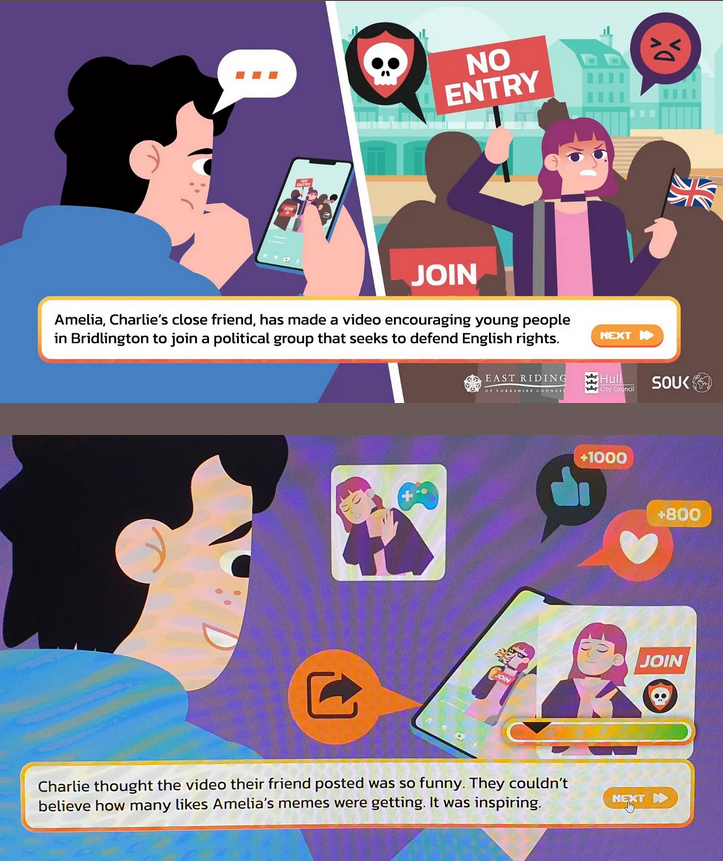
Shout Out UK, which describes its mission as “countering disinformation through political and media literacy”, released a “visual novel” called Pathways, subtitled “navigating the Internet, gaming, and extremism”. The game itself is of course terrible, a ham-fisted “teaching aid” intended to remind British teenagers that even innocuous and entirely peaceful activities – downloading memes, speaking your mind, watching videos, researching things for yourself, attending rallies – will complicate their lives if they draw the concerned and empathetic eye of the managerial state, which after all just wants what’s best for them.

Prevent, if you haven’t heard of them, are a group of government-funded busybodies whose remit is to prevent extremism via early intervention, catching impressionable youth before they can be radicalized. The organization was nominally started to deal with Islamic terrorists, but in recent years it has focused on the “right-wing extremism” of the native British to the exclusion of all else. The Southport butcher Axel Rudakubana, for instance, was referred to Prevent multiple times for his open glorification of white genocide, which Prevent ignored completely.

The player can choose either a male or female character, both of whom are amusingly and awkwardly referred to with they/them pronouns, with grammatical abominations such as “Charlie decided to look for themselves” sprinkled throughout. The character is then placed in a series of scenarios and made to choose between good and bad options: downloading extremist content or telling an adult; agreeing with a classmate that ethnic minorities are being shown favouritism at the expense of native youth vs clapping back at her unconscionable bigotry; watching a video and reading more about the subject or ignoring it; accepting or refusing an invitation to join a secret group chat; attending an anti-immigration rally or staying home. If you make the bad choice, a little “extremism meter” goes into the red.

[…]

If you want to play the game for yourself, your best bet is probably to download the archived version of the Government Approved Goth Girl Dating Simulator. I was able to play it a week ago, but since then it gets stuck on the loading screen, which at first I thought was because they’d taken it offline, but is probably just because Shout Out UK has gotten DDOSed by an entirely unexpected surge of interest in their execrable product (or maybe it’s just that the Shout Out UK website has a dead link on its page, as after poking around a bit on their website I was able to find one that works). Alternatively, you can find most of the screenshots archived here.

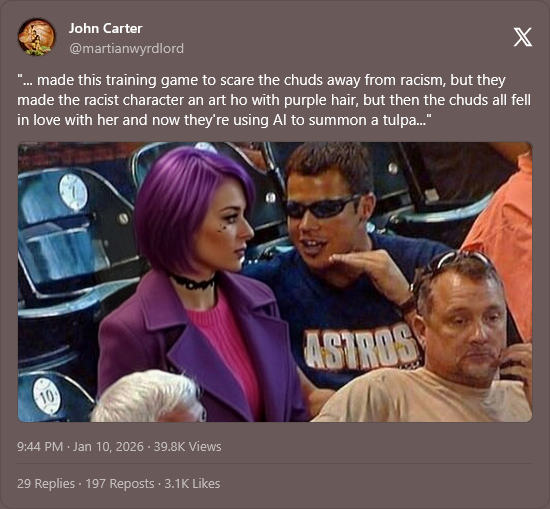
Had it not been for one unfortunate creative choice made by the development team, no one would have taken any notice of Pathways. It would have been one of countless cringe-inducing training aids churned out by regime-adjacent quangos cashing in on the flood of taxpayer lucre sluicing through the DEI-and-disinformation industry. But for some reason, which can be explained only by a calamitous failure on the part of Shout Out UK to develop an accurate theory of mind for their target audience, the creators of Pathways decided that it would be a great idea to cast the awful bigot leading the protagonist step by step to his ideological doom in the form of a cute alt girl, thereby sending the message that embracing right-wing extremism will give you a shot at getting a manic pixie dream girl gf.

Update, 18 January: Welcome, Instapundit readers! Have a look around at some of my other posts you may find of interest. I send out a daily summary of posts here through my Substackhttps://substack.com/@nicholasrusson that you can subscribe to if you’d like to be informed of new posts in the future.

How would Greenlanders cope with a sudden case of American citizenship?

Filed under: Americas, Europe, Media, Military, Politics, USA — Tags: , , , — Nicholas @ 04:00

Only a minority of Canadians would welcome Donald Trump’s offer to become the 51st state, and Canadians have a long history of coping with the overflow of American politics across the border. Greenland is suddenly a target for involuntary statehood if Trump gets his way, yet few seemed to be concerned how the actual people in Greenland feel about this proposed change of legal status:

Satellite view of Greenland, Iceland, and parts of Northern Canada.
NASA/Ames Research Center, 17 May, 2005.

According to President Donald Trump, taking possession of Greenland is a national security necessity. It’s so critical, he claims, that he’s willing to take the chilly island the “easy way” or the “hard way”. Denmark, which governs Greenland, isn’t eager to surrender the territory. Even more important, the residents of Greenland, most of whom don’t especially want to be Danish, have even less interest in becoming American. The leader of a country founded on high-minded sentiments about the “consent of the governed” should consider taking that into account.

[…]

“56% of Greenlanders answer that they would vote yes to Greenlandic independence if a referendum were held today, 28% would vote no, and 17% do not know what they would vote for,” The Verian Group announced a year ago about a survey it conducted in Greenland.

With regard to Trump’s long-voiced desire to acquire Greenland for the United States, Verian’s Camilla Kann Fjeldsøe added, “the results show that 85% of Greenlanders do not want to leave the Realm and become part of the United States, while 6% want to leave the Danish Realm and become part of the United States, whereas the remaining 9% are undecided”.

Greenland’s 57,000 people don’t want to be Danish, but they really don’t want to be American. If forced to choose between remaining an appendage of one country or joining another, they’ll likely take the devil they know over the one they don’t.

What About the Consent of the Governed?

That’s a problem for Trump’s imperial ambitions — annexing Greenland would have to happen over the objections of the people who live there. The U.S. could get away with that sort of thing when it didn’t even pretend to give a damn about what the Sioux and the Cheyenne wanted, and when it bought the Louisiana Territory and Alaska from autocratic regimes. It’s not as if Napoleon Bonaparte or Czar Alexander II were going to offer their subjects a say in the matter anyway. But Denmark is a relatively inoffensive liberal democracy that holds regular elections. Greenlanders are accustomed to picking their own political leaders and having input into their fate. If asked, they’ll almost certainly reject the offer.

So, is Trump really going to opt for doing it “the hard way” and just grab the island?

When the United States decided its own fate 250 years ago, the Declaration of Independence set out grievances with the British crown, as well as some basic principles for the new nation. Among them:

    We hold these truths to be self-evident, that all men are created equal, that they are endowed by their Creator with certain unalienable Rights, that among these are Life, Liberty and the pursuit of Happiness.–That to secure these rights, Governments are instituted among Men, deriving their just powers from the consent of the governed.

Most Americans no longer consented to be governed by King George III or the British Parliament and so set up a new country with a government of its own. What excuse would we have for foisting American governance and laws on Greenlanders if — as seems likely — they reject political affiliation with the U.S.?

In his Weekly Dish, Andrew Sullivan — who has never in his life been a fan of Donald Trump — warns that “Greenland is a Red Line” and crossing that line will destroy the American constitution (Warning – contains Andrew Sullivan):

(more…)

Scott Adams, RIP

Filed under: Books, Bureaucracy, Business, Humour, Media, Politics, USA — Tags: , , , , , — Nicholas @ 03:00

Another Scott, Scott Alexander, has a long essay about the career and life of the late comic strip artist, author, and internet personality. When I first encountered his Dilbert comic strip, I was living the cubicle life and far too many of the jokes and situations felt like Adams must be in the same company — possibly even the same department. I read a couple of his non-Dilbert books, but I didn’t follow his work very much after I escaped the cube farm, so reading this essay told me a number of things about Adams that I didn’t already know:

Thanks to everyone who sent in condolences on my recent death from prostate cancer at age 68, but that was Scott Adams. I (Scott Alexander) am still alive.1

Still, the condolences are appreciated. Scott Adams was a surprisingly big part of my life. I may be the only person to have read every Dilbert book before graduating elementary school. For some reason, 10-year-old-Scott found Adams’ stories of time-wasting meetings and pointy-haired bosses hilarious. No doubt some of the attraction came from a more-than-passing resemblance between Dilbert’s nameless corporation and the California public school system. We’re all inmates in prisons with different names.

But it would be insufficiently ambitious to stop there. Adams’ comics were about the nerd experience. About being cleverer than everyone else, not just in the sense of being high IQ, but in the sense of being the only sane man in a crazy world where everyone else spends their days listening to overpaid consultants drone on about mission statements instead of doing anything useful. There’s an arc in Dilbert where the boss disappears for a few weeks and the engineers get to manage their own time. Productivity shoots up. Morale soars. They invent warp drives and time machines. Then the boss returns, and they’re back to being chronically behind schedule and over budget. This is the nerd outlook in a nutshell: if I ran the circus, there’d be some changes around here.

Yet the other half of the nerd experience is: for some reason this never works. Dilbert and his brilliant co-workers are stuck watching from their cubicles while their idiot boss racks in bonuses and accolades. If humor, like religion, is an opiate of the masses, then Adams is masterfully unsubtle about what type of wound his art is trying to numb.

This is the basic engine of Dilbert: everyone is rewarded in exact inverse proportion to their virtue. Dilbert and Alice are brilliant and hard-working, so they get crumbs. Wally is brilliant but lazy, so he at least enjoys a fool’s paradise of endless coffee and donuts while his co-workers clean up his messes. The P.H.B. is neither smart nor industrious, so he is forever on top, reaping the rewards of everyone else’s toil. Dogbert, an inveterate scammer with a passing resemblance to various trickster deities, makes out best of all.

The repressed object at the bottom of the nerd subconscious, the thing too scary to view except through humor, is that you’re smarter than everyone else, but for some reason it isn’t working. Somehow all that stuff about small talk and sportsball and drinking makes them stronger than you. No equation can tell you why. Your best-laid plans turn to dust at a single glint of Chad’s perfectly-white teeth.

Lesser lights may distance themselves from their art, but Adams radiated contempt for such surrender. He lived his whole life as a series of Dilbert strips. Gather them into one of his signature compendia, and the title would be Dilbert Achieves Self Awareness And Realizes That If He’s So Smart Then He Ought To Be Able To Become The Pointy-Haired Boss, Devotes His Whole Life To This Effort, Achieves About 50% Success, Ends Up In An Uncanny Valley Where He Has Neither The Virtues Of The Honest Engineer Nor Truly Those Of The Slick Consultant, Then Dies Of Cancer Right When His Character Arc Starts To Get Interesting.

If your reaction is “I would absolutely buy that book”, then keep reading, but expect some detours.


  1. As is quantum complexity blogger Scott Aaronson.

At Ace of Spades H.Q., Buck Throckmorton remembers Scott Adams:

Scott Adams’ death is being eloquently covered by others, so there is not much I can add. But I do want to offer up a few quick thoughts. Aside from Dilbert being my favorite cartoon for decades, I was a loyal reader of Mr. Adams’ blog for many years before his greater celebrity during the Trump era. Mr. Adams often expanded my views, and occasionally frustrated me, but he helped me understand how rational people can understand things differently.

Back in 2016, when I doubted that Donald Trump was in any way conservative, and when I thought Trump had no chance to beat Hillary in the presidential election, Scott Adams was one of two writers who made an impact on my attitude toward that election. Mr. Adams famously wrote about the reasons why Trump was likely to win. He was right. (The other writer was John Hinderaker of Powerline, who was the first legacy conservative I read who stated that of course we traditional Republicans needed to vote for Trump.)

I was flattered once when Scott put out a call for Dilbert topics and he ended up using one of my submissions. As I recall, his invitation to the public was something to the effect of “You provide the workplace situation and I’ll provide the humor“. I wrote him and offered up what a special hell it was to be working for a company campaigning for recognition in a local “Best Places to Work” contest. Shortly thereafter he used that in a cartoon.

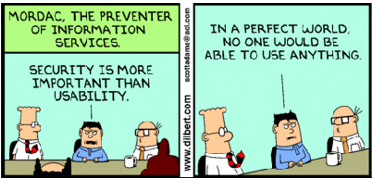
Finally, my favorite Dilbert character was one who got very little screen time. Scott Adams may be gone, but Mordac, The Preventer of Information Services lives on.

I think of Mordac every time I have a spontaneously obsolete password, or I’m blocked from being able to access a system necessary for my job, or I can’t access an SaaS app because there are too few licenses, or I’m logged out of a system because I got called away for a short meeting, etc. In all these circumstances, I give a tip of the hat to Mordac, and I applaud his success in protecting my employer by preventing me from doing my job.

Everything you need to know about art deco

Filed under: Europe, History, Media, USA — Tags: , , , , — Nicholas @ 02:00

Dezeen
Published 29 Apr 2025

To mark the centenary of art deco’s debut, Dezeen features editor Nat Barker rounds up everything you need to know about art deco.

In this video produced by Dezeen Studio, Dezeen explores the history and context of the movement, and the most notable characteristics of the style.

Art deco was a design movement that rose to prominence in the 1920s and 30s. Its origins are often disputed, but most agree that art deco’s entrance on to the world stage took place 100 years ago, at the Exposition Internationale des Arts Décoratifs et Industriels Modernes in Paris.

#artdeco #designhistory

QotD: The introduction of tanks on the western front did not break the trench stalemate

Filed under: Britain, France, History, Military, Weapons, WW1 — Tags: , , , — Nicholas @ 01:00

Where the Germans tried tactics, the British tried tools. If the problems were trenches, what was needed was a trench removal machine: the tank.

In theory, a good tank ought to be effectively immune to machine-gun fire, able to cross trenches without slowing and physically protect the infantry (who could advance huddled behind the mass of it), all while bringing its own firepower to the battle. Tracked armored vehicles had been an idea considered casually by a number of the pre-war powers but not seriously attempted. The British put the first serious effort into tank development with the Landship Committee, formed in February of 1915; the first real tanks, 49 British Mark I tanks, made their first battlefield appearance during the Battle of the Somme in 1916. Reliability proved to be a problem: of the 49 tanks that stepped off on the attack on September 15th, only 3 were operational on the 16th, mostly due to mechanical failures and breakdowns.

Nevertheless there was promise in the idea that was clearly recognized and a major effort to show what tanks could do what attempted at Cambrai in November of 1917; this time hundreds of tanks were deployed and they had a real impact, breaking through the barbed wire and scattering the initial German defenses. But then came the inevitable German counter-attacks and most of the ground taken was lost. It was obvious that tanks had great potential; the French had by 1917 already developed their own, the light Renault FT tank, which would end up being the most successful tank of the war despite its small size (it is the first tank to have its main armament in a rotating turret and so in some sense the first “real” tank). This was hardly an under-invested in technology. So did tanks break the trench stalemate?

No.

It’s understandable that many people have the impression that they did. Interwar armored doctrine, particularly German Maneuver Warfare (bewegungskrieg) and Soviet Deep Battle both aimed to use the mobility and striking power of tanks in concentrated actions to break the trench stalemate in future wars (the two doctrines are not identical, mind you, but in this they share an objective). But these were doctrines constructed around the performance capabilities of interwar tanks, particularly by two countries (Germany and the USSR) who were not saddled with large numbers of WWI era tanks (and so could premise their doctrine entirely on more advanced models). The Panzer II, with a 24.5mph top speed and an operational range of around 100 miles, depending on conditions, was actually in a position to race the train and win; the same of course true of the Soviet interwar T-26 light tank (19.3mph on roads, 81-150 mile operational range). Such tanks could have radios for coordination and communication on the move (something not done with WWI tanks or even French tanks in WWII).

By contrast, that Renault FT had a top speed of 4.3mph and an operational range of just 37 miles. The British Mark V tank, introduced in 1918, moved at only 5mph and had just 45 miles of range. Such tanks struggled to keep up with the infantry; they certainly were not going to win any race the infantry could not. It is little surprise that the French, posed with the doctrinal problem of having to make use of the many thousands of WWI tanks they had, settled on a doctrine whereby most tanks would simply be the armored gauntlet stretched over the infantry’s fist: it was all those tanks could do! The sort of tank that could do more than just dent the trench-lines (the same way a good infiltration assault with infantry could) were a decade or more away when the war ended.

Moreover, of course, the doctrine – briefly the systems of thinking and patterns of training, habit and action – to actually pull off what tanks would do in 1939 and 1940 were also years away. It seems absurd to fault World War I era commanders for not coming up with a novel tactical and operational system in 1918 for using vehicles that wouldn’t exist for another 15 years and yet more so assuming that they would get it right (since there were quite a number of different ideas post-war about how tanks ought to be used and while many of them seemed plausible, not all of them were practical or effective in the field). It is hard to see how any amount of support into R&D or doctrine was going to make tanks capable of breakthroughs even in the late 1920s or early 1930s (honestly, look at the “best” tanks of the early 1930s; they’re still not up to the task in most cases) much less by 1918.

Bret Devereaux, “Collections: No Man’s Land, Part II: Breaking the Stalemate”, A Collection of Unmitigated Pedantry, 2021-09-24.

Powered by WordPress