
Forgotten Weapons
Published 8 Aug 2025With the expansion of SWAT teams throughout law enforcement in the 1980s, Colt realized that it was leaving a lot of sales on the table by not having a submachine gun it could offer alongside M16/CAR-15 rifles and carbines. They addressed this in the early 1980s by adapting a CAR-15 to 9x19mm. It used an adapter in the magazine well to fit modified Uzi pattern magazines (they were given hold-open tabs on the followers), and retained the same handling and controls as the full size AR. The SMG was made as a closed bolt, hammer fired, simple blowback action. By adding weight to the bolt carrier and buffer, the rate of fire was kept down to around 800 rpm.
The Colt SMG never really captured wide appeal. It was reasonably successful for Colt in large part because of their ability to market it alongside rifles, but it was dogged by reliability problems. A bunch of different models were made with different fire control options, including a couple civilian semiautomatic models and the distinctive DoE “briefcase gun” and the integrally suppressed DEA model, although neither of those saw very substantial sales. Still, it remains available to this day.
Colt 633 DoE Reproduction: • PSA/H&R Clones the Department of Energy Co…
(more…)
December 28, 2025
Colt SMG: First of the 9mm ARs
“The Singularity is upon us”
ESR is clearly not worried about the clankers taking over, at least based on his own experience with coding assistance from AI:
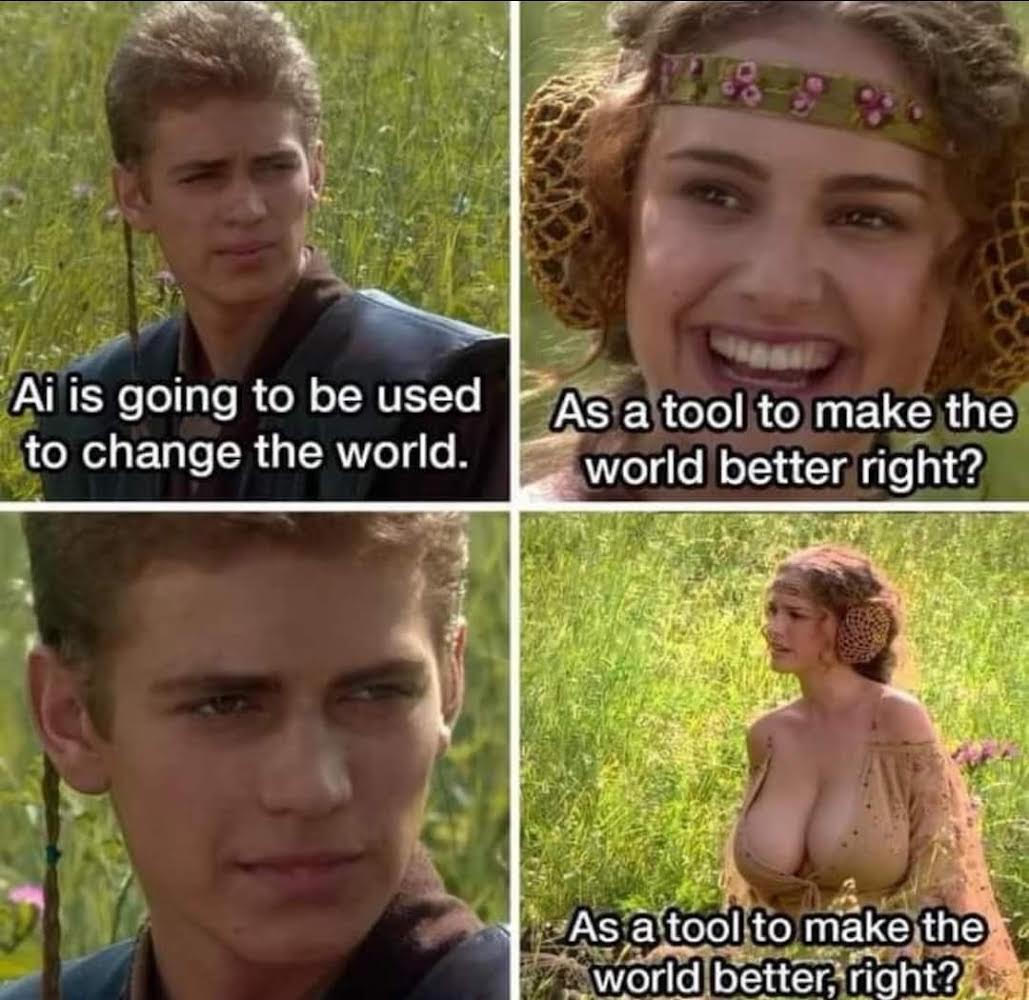
Yes, I’m still 12
I was writing some code the new-school way yesterday, prompting gpt-4.1 through aider, and for whatever reason my mind flashed back 50 years and the utter freaking enormity of it all crashed in on me like a tidal wave.
And now I want to make you feel that, too.
In 1975 I ran programs by feeding punched cards into a programmable calculator. Actual computers were still giant creatures that lived in glass-walled rooms, though there were rumors from afar of a thing called an Altair.
Unix and C had not yet broken containment from Bell Lab; DOS and the first IBM PC were six years away. The aggregated digital computing capacity of the entire planet was roughly equivalent to a single modern smartphone.
We still used Teletypes as production gear because even video character terminals barely existed yet; pixel-addressable color displays on computers were a science-fiction dream.
We didn’t have version control. Public forge sites wouldn’t be a thing for 25 years yet. The number of computer games that existed in the world could probably be counted on the fingers of two hands.
Because of all this, I learned to program over the next ten years with tools so primitive that when I talk about them today it sounds like uphill-both-ways sketch comedy.
You may not even be able to imagine what a slow and laborious process programming was then, and how tiny the volume of code we could produce per month was; I have to work to remember it, myself.
Today I call spirits from the vasty deep, conversing with unhuman intelligences and belting out finished programs I would once have considered prohibitively complex to attempt within a single working day.
Fifty years, many generations of hardware technology, from punched cards to AIs that can pass the Turing test … and I’m still here, still coding, still on top of what a software engineer needs to know to get useful work done in the current day. Gotta admit I feel some pride in that!
This meditation isn’t supposed to be about me, though. It’s about the dizzying, almost unbelievable progress I’ve lived through and been a part of. If you had told me to predict when I would have a device in my pocket that would give me instant real-time access to most of the world’s knowledge, with my own pet homunculi to sift through it for me, I would have been one of the few that wouldn’t have said “never” (because I was already a science-fiction fan), but I wouldn’t have predicted a date fewer than multiple centuries in the future either.
We’ve come a hell of a long way, baby. And the fastest part of the ride is only beginning. The Singularity is upon us. Everything I’ve lived through and learned was just prologue.
It may seem petty to deny entry to EUrocrats, but it’s all they will understand
At first, I thought it was just another bout of Trump being deliberately petty over trivial stuff, but on reflection, it’s actually a neat way to bring home the message to the EU bureaucrats personally that they will be held responsible for their actions:
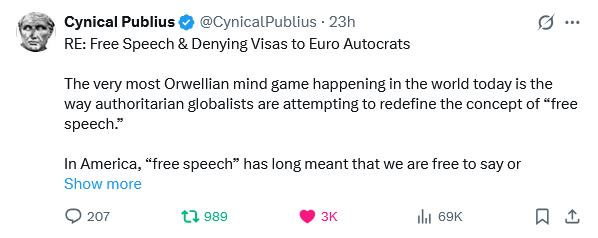
RE: Free Speech & Denying Visas to Euro Autocrats
The very most Orwellian mind game happening in the world today is the way authoritarian globalists are attempting to redefine the concept of “free speech”.
In America, “free speech” has long meant that we are free to say or write virtually anything without fear of government intervention or suppression. It is this ability to express whatever we want that makes it “free”.
The authoritarian globalists, however, have stood this on its head. They have decided that in order for their citizens to be “free”, they must be free of ever hearing or reading any speech that might offend someone or sow doubt as to government policies. To these fascists, “free speech” means GOVERNMENT MODERATED speech which somehow — through its moderation — sets people “free” from ever hearing conflicting views. As I said — straight out of Orwell.
Europe is, of course, the hotbed of this fascist redefinition of what free speech means, but we in America have only narrowly escaped this plague by electing Trump. Remember, Biden and his team were reliant on institutionally stamping out so-called “disinformation” as a means of control over the populace. We must be ever vigilant here in the USA that such thuggish government criminality never again be allowed to prosper.
I think it is very important that every citizen of the USA and the world understand the depths of depravity these people will sink to in order to control ordinary people. This is about mind control, and nothing else.
Ultimately, the value of true free speech is that it embraces the idea that we all have agency over ourselves; that we are free individuals who can and should hear conflicting views, and decide for ourselves what is true and just, and what is untrue and unjust. This is sovereignty over the self, and unfortunately Europe has never let go of the concept of serfdom, so self-sovereignty is a threat that must be stamped out.
The Trump Administration has been prescient, bold and effective in denying visas to the Eurotrash autocrats who would see free speech reduced to whatever speech unelected bureaucrats deem acceptable. I cannot commend Trump enough for the thoughtfulness and importance of that action.
In a world where almost all humans are linked by essentially the same communications platform, only one world leader is truly standing for free speech: Donald Trump. And I thank him for it. We all should — even the TDS sufferers.
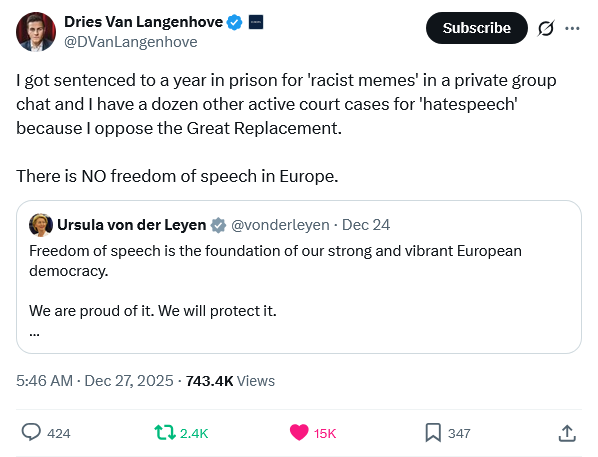
For a relevant example, Dries Van Langenhove:
Update, 29 December: Welcome, Instapundit readers! Please do have a look around at some of my other posts you may find of interest. I send out a daily summary of posts here through my Substack – https://substack.com/@nicholasrusson that you can subscribe to if you’d like to be informed of new posts in the future.
QotD: The Middle Ages saw rebellions but no revolutions
At some point in this space, we discussed the difference between a rebellion and a revolution. Drawing on Michael Walzer’s key work The Revolution of the Saints, I argued that a true revolution requires ideology, as it’s an attempt to fundamentally change society’s structure.
Therefore there were no revolutions in the Middle Ages or the Ancient World, only rebellions — even a nasty series of civil wars like The Wars of the Roses were merely bloody attempts to replace one set of rulers with another, without comment on the underlying structure. A medieval usurpation couldn’t help but raise questions about “political theory” in the broadest sense — how can God’s anointed monarch be overthrown? — but medieval usurpers understood this: They always presented the new boss as the true, legitimate king by blood. I forget how e.g. Henry IV did it — Wiki’s not clear — but he did, shoehorning himself into the royal succession somehow.
Combine that with Henry’s obvious competence, Richard II’s manifest in-competence, and Henry’s brilliant manipulation of the rituals of kingship, and that was good enough; his strong pimp hand took care of the rest. Henry IV was a legitimate king because he acted like a legitimate king.
A revolution, by contrast, aims to change fundamental social relations. That’s why medieval peasant rebellions always failed. Wat Tyler had as many, and as legitimate, gripes against Richard II as Henry Bolingbroke did, but unlike Henry’s, Tyler’s gripes couldn’t really be addressed by a change of leadership — they were structural. 200 years later, and the rebels were now revolutionaries, willing to give structural change a go.
Severian, “¡Viva la Revolución!”, Founding Questions, 2025-02-27.


