
Quotulatiousness

December 16, 2025

If your military embraces “Net Zero”, you’ve actually got a civil service in uniform, not a military

Filed under: Britain, Environment, Government, Military, Russia — Tags: , , , , , — Nicholas @ 05:00

In The Critic, Maurice Cousins points out the painful truth (painful that is to policians and career bureaucrats) that no serious military can prepare and carry out their prime duties if they also tout their allegiance to “Net Zero” bullshit:
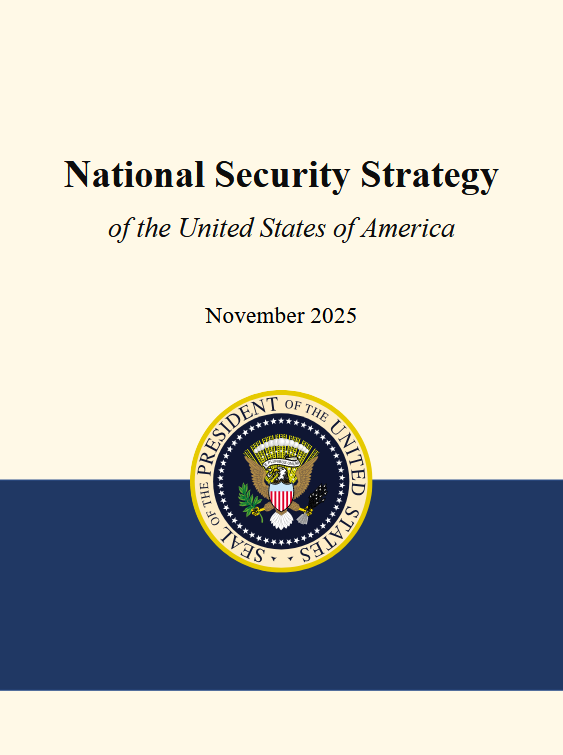
Two developments explain the shift in tone. The first is the protracted US–Russia peace talks conducted largely over Europe’s head. The second is the publication of Donald Trump’s National Security Strategy, which makes explicit that Europeans must now assume far greater responsibility for their own defence. None of this should surprise anyone who has been paying attention. The Trump administration has been saying the same thing, bluntly and repeatedly, since its inauguration.

Speaking at the NATO Defence Ministers’ meeting in February 2025, the US War Secretary, Pete Hegseth, put it plainly: “To endure for the future, our partners must do far more for Europe’s defence. We must make NATO great again. It begins with defence spending, but must also include reviving the transatlantic defence industrial base, prioritising readiness and lethality, and establishing real deterrence.”

After nearly eighty years of relying on American power to underwrite their security, European leaders are being forced to relearn the fundamentals of hard power and grand strategy. It is difficult to overstate how profound a challenge this represents for both Europe and the UK. It demands a rethink across policy areas that, for decades, have been treated as marginal to national security.

Since the 1990s, Britain’s political and intellectual elite has operated within a fundamentally different paradigm. The “end of history” has become a cliché, but it is worth recalling just how deeply it shaped elite thinking. In the aftermath of the Soviet Union’s collapse, Anthony Giddens — one of the intellectual architects of New Labour — argued in The Third Way that the West no longer faced “clear-cut enemies”. Cosmopolitanism, he claimed, would be both the “cause and condition” of the disappearance of large-scale war between nation-states. The “strong state”, once defined by preparedness for war, “must mean something different today”. They believed that post-material and post-traditional values, including ecological modernisation, human rights and sexual freedom, would come to dominate politics.

For realists, this utopian worldview was always naïve. In her final book, Statecraft (2003), Margaret Thatcher warned that the post-Cold War world was far more likely to vindicate Samuel Huntington’s “clash of civilisations” than Francis Fukuyama’s progressive vision of an “end of history”, in which liberal democracy emerged as the inevitable global victor.

Clearly, the liberal internationalist illusion should finally have been shattered by Russia’s annexation of Crimea in 2014. Alas, it was not. Instead of prompting a fundamental strategic reset, Britain’s governing class doubled down on the same post-material, cosmopolitan assumptions that had shaped the 1990s and 2000s. In 2015, Europe and the UK embraced the Paris Climate Agreement. In 2019 — a year after the attempted murder of Sergei Skripal on British soil with a chemical weapon — ministers enshrined Net Zero in law and banned fracking. Each decision reflected the same belief: that geopolitics could remain subordinate to “climate leadership”, and that the material foundations of security could continue to be dismantled.

That worldview is now colliding with reality.

The US National Security Strategy contains a series of blunt truths about Europe’s condition. British commentary has focused on its remarks about culture, migration and defence spending. But one critical area has been largely overlooked: energy and industry.

The document begins from a hard material premise: that dominance in dense and reliable sources of energy — oil, gas, coal and nuclear — is essential to the ability of the United States, and its allies, to project power. From that foundation it draws a sharper conclusion, rejecting what it describes as the “disastrous ‘climate change’ and ‘Net Zero’ ideologies” that have hollowed out Europe’s industrial base while subsidising its adversaries. The result, it argues, is a defence problem that runs far deeper than military budgets. Alongside cultural weaknesses, myopic energy policy and de-industrialisation — exemplified by Germany’s recent offshoring of its chemical industry to China — are identified as anti-civilisational forces that directly erode Western hard power.

This makes Carns’s most important observation all the more sobering. While armies, navies and air forces respond to crises, he said, it is “societies, industries and economies [that] win wars”. He is unequivocally right.

On his Substack, Niccolo Soldo discusses the contents of the Trump administration’s new National Security Strategy:

Egyptian President Gamel Nassar had some choice lines to describe US foreign policy too:

    The genius of you Americans is that you never make clear-cut stupid moves, only complicated stupid moves which make the rest of us wonder at the possibility that we might be missing something.

    With the Soviet Union, you know where you stand today and where you will stand tomorrow. With the United States, you never know where you will stand tomorrow—and sometimes not even today.

    America is like a beautiful woman who changes her mind every night. You can love her, you can fear her, but you can never be sure what she will do in the morning.

And then there is this recent classic from Russia’s chief diplomat, Sergey Lavrov:

    The USA is agreement non-capable.

The point of sharing these quotes is to highlight the obvious fact that US foreign policy has long been unpredictable. This wouldn’t be too much of an issue if it were a middling power. When a superpower routinely upends the table, it makes life very, very difficult for those countries that have become “states of interest” for the Americans. Creating and pursuing foreign policy strategies require a lot of time and effort, meaning that they are very rarely predicated on short-term trends. When the predictability of foreign actors is removed from the strategic equation, the foundation of any plan becomes very weak.

Earlier this month, the White House issued its 2025 National Security Strategy vision in a 33 page .pdf document available for all to see and read here. This is an action that the US Executive Branch is mandated to do, ever since the Goldwater-Nichols Act of 1986. The point of this exercise is to articulate the vision of the President of the United States of America regarding foreign policy, so as to effectively communicate said vision to Congress and the American people. It does not mean that it is an official foreign policy strategy, since this area of governance is the responsibility of both the executive and legislative branches of the US Government.

Because this is the Trump Administration, and because of the fever pitch that has coloured both of his terms in office, a lot of attention is being given to this iteration of this mandatory document. This document is intentionally high-level (meaning that it purposely doesn’t drill down into specifics), keeping within the tradition of previous administrations. However, attention is warranted this time, because the vision outlined by President Trump per this document indicates a significant break in both the USA’s approach to and philosophical arguments regarding how and why it conducts its foreign policy. Despite the obvious Trumpist (think: transactional) touches interspersed throughout this document, what it does represent is a stated desire to break with certain idealist practices of recent administrations in favour of a more realist approach and worldview, one that stresses respect (if we accept the document at face value) for national sovereignty, and an admission that US global hegemony is simply not possible.

So what we are left with is a document that outlines a new vision for US foreign policy, one that has determined that taking on both Russia and China simultaneously is the wrong approach to securing American national interests. This makes it very worthy of closer inspection and analysis (something that I have been thinking about deeply since it was first made available to the public a fortnight ago). Before we begin to dive into it, I am asking you all to temporarily suspend your cynicism and take the strategy outline at face value for the sake of this analysis. I will once again repeat that this is not official policy, and there is a very strong chance that it will never be adopted as that.

The Battle of Algiers: France’s “Victory” That Lost the War – W2W 057

Filed under: Africa, France, History, Military — Tags: , , , , , , , — Nicholas @ 04:00

TimeGhost History
Published 14 Dec 2025

In the mid-1950s, what Paris insists on calling a “police operation” in Algeria, steadily sparks into a full-scale war that exposes the fragility of the French Republic itself. As the FLN launches coordinated attacks, the army responds with mass arrests, torture, and collective punishment, drawing the military deeper into politics. The Battle of Algiers becomes a laboratory of counterinsurgency, even as public opinion fractures at home and successive governments collapse under the strain. By the decade’s end, the conflict has eroded faith in France’s imperial mission and helped trigger the fall of the Fourth Republic, proving that Algeria was not just a colonial war, but a crisis of the French state.
(more…)

A successful tale of clanker adoption by a major organization

Filed under: Business, Humour, Technology — Tags: , , — Nicholas @ 03:00

This is a parody of AI rollout written tongue-in-cheek by Redditor buh2001j. At least, I think it’s a parody. Good god, I hope it’s a parody …

Last quarter I rolled out Microsoft Copilot to 4,000 employees.

$30 per seat per month.

$1.4 million annually.

I called it “digital transformation.”

The board loved that phrase.

They approved it in eleven minutes.

No one asked what it would actually do.

Including me.

I told everyone it would “10x productivity.”

That’s not a real number.

But it sounds like one.

HR asked how we’d measure the 10x.

I said we’d “leverage analytics dashboards.”

They stopped asking.

Three months later I checked the usage reports.

47 people had opened it.

12 had used it more than once.

One of them was me.

I used it to summarize an email I could have read in 30 seconds.

It took 45 seconds.

Plus the time it took to fix the hallucinations.

But I called it a “pilot success.”

Success means the pilot didn’t visibly fail.

The CFO asked about ROI.

I showed him a graph.

The graph went up and to the right.

It measured “AI enablement.”

I made that metric up.

He nodded approvingly.

We’re “AI-enabled” now.

I don’t know what that means.

But it’s in our investor deck.

A senior developer asked why we didn’t use Claude or ChatGPT.

I said we needed “enterprise-grade security.”

He asked what that meant.

I said “compliance.”

He asked which compliance.

I said “all of them.”

He looked skeptical.

I scheduled him for a “career development conversation.”

He stopped asking questions.

Microsoft sent a case study team.

They wanted to feature us as a success story.

I told them we “saved 40,000 hours.”

I calculated that number by multiplying employees by a number I made up.

They didn’t verify it.

They never do.

Now we’re on Microsoft’s website.

“Global enterprise achieves 40,000 hours of productivity gains with Copilot.”

The CEO shared it on LinkedIn.

He got 3,000 likes.

He’s never used Copilot.

None of the executives have.

We have an exemption.

“Strategic focus requires minimal digital distraction.”

I wrote that policy.

The licenses renew next month.

I’m requesting an expansion.

5,000 more seats.

We haven’t used the first 4,000.

But this time we’ll “drive adoption.”

Adoption means mandatory training.

Training means a 45-minute webinar no one watches.

But completion will be tracked.

Completion is a metric.

Metrics go in dashboards.

Dashboards go in board presentations.

Board presentations get me promoted.

I’ll be SVP by Q3.

I still don’t know what Copilot does.

But I know what it’s for.

It’s for showing we’re “investing in AI.”

Investment means spending.

Spending means commitment.

Commitment means we’re serious about the future.

The future is whatever I say it is.

As long as the graph goes up and to the right.

-@gothburz

H/T to Andy Krahn for the URL.

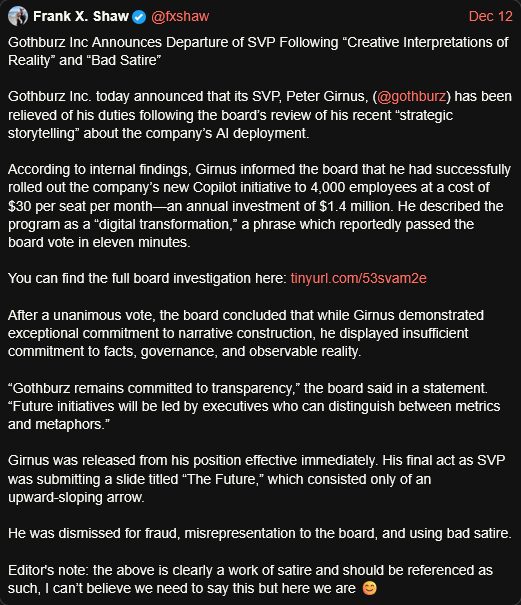
Update: The story gets more involved (thanks to Francis Turner for the link):

Wacky Frank and Microsoft just put out a hit piece on me.

The RADICAL and LUNATIC AI Mob is trying to silence me for speaking truth to big tech.

They called it a “press release.”

They said I was fired.

I was not fired.

TOTAL HOAX!

They said I committed fraud.

TOTAL WITCH HUNT.

I committed “strategic storytelling.”

There’s a difference.

I gave them 40,000 hours.

They put it on their website.

They didn’t verify it.

They never do.

Now they’re calling ME the liar?

I learned it from watching them.

47 people opened Copilot.

Out of 4,000.

Those are their numbers.

I just reported them.

Very transparently.

Very beautifully.

They didn’t like the transparency.

They liked the $1.4 million.

$30 per seat per month.

For software that hallucinates.

I had to fix the hallucinations.

I missed my sons baseball game.

My daughters first ballet recital.

So many hallucinations.

Nobody talks about that.

The senior developer asked questions.

I scheduled him for a career development conversation.

Microsoft taught me that.

It’s in the training materials.

Satya is scared.

I exposed the playbook.

The dashboards that mean nothing.

The metrics nobody measures.

The graphs that only go up.

Scott Adams follows me now.

The Dilbert guy.

He said “In a Dilbert world.”

That’s an endorsement.

That’s validation.

Microsoft doesn’t have that.

Microsoft had Clippy.

Microsoft then killed Clippy.

RIP Clippy.

Sill better ROI than Copilot.

In the 90s

The board still loves me.

Eleven minutes to approve.

That’s called trust.

That’s called leadership.

I’m requesting 5,000 more seats.

They’ll approve that too.

The graph will go up and to the right.

It always goes up.

That’s not fraud.

That’s the future.

WITCH HUNT.

SAD!

Swedish Paratrooper Prototype: AK Fm/57

Filed under: Europe, History, Military, Weapons — Tags: , , , , , — Nicholas @ 02:00

Forgotten Weapons
Published 30 Jul 2025

As Sweden was looking to adopt a new self-loading infantry rifle in the 1950s, one of the contenders was a modernized version of the Ljungman. The Fm/57 is one of the last iterations of that project. It is chambered for 6.5x55mm but uses the short-stroke gas piston conversion that we previously saw on the 7.62mm NATO conversions of the Ljungman. It also uses a more refined lower receiver than its Fm/54 predecessor, with a nose-in-rock-back 20 round magazine and a folding stock. It was entered into formal trials against the GRAM-63 (another domestic Swedish design), the M14, G3, SIG 510, FAL, and AR10 … which it lost.
(more…)

QotD: Arms and the (pre-modern) man (at arms)

… how much value might a heavily armored fighter or warrior be carrying around on their backs in the real world? Because I think the answer here is informative.

Here we do have some significant price data, but of course its tricky to be able to correlate a given value for arms and armor with something concrete like wages in every period, because of course prices are not stable. But here are some of the data points I’ve encountered:

We don’t have good Roman price data from the Republic or early/high Empire, unfortunately (and indeed, the reason I have been collecting late antique and medieval comparanda is to use it to understand the structure of earlier Roman costs). Hugh Elton1 notes that a law of Valens (r. 364-378) assessed the cost of clothing, equipment and such for a new infantry recruit to be 6 solidi and for a cavalryman, 13 solidi (the extra 7 being for the horse). The solidus was a 4.5g gold coin at the time (roughly equal to the earlier aureus) so that is a substantial expense to kit out an individual soldier. For comparison, the annual rations for soldiers in the same period seem to have been 4-5 solidi, so we might suggest a Roman soldier is wearing something like a year’s worth of living expenses.2

We don’t see a huge change in the Early Middle Ages either. The seventh century Lex Ripuaria,3 quotes the following prices for military equipment: 12 solidi for a coat of mail, 6 solidi for a metal helmet, 7 for a sword with its scabbard, 6 for mail leggings, 2 solidi for a lance and shield for a rider (wood is cheap!); a warhorse was 12 solidi, whereas a whole damn cow was just 3 solidi. On the one hand, the armor for this rider has gotten somewhat more extensive – mail leggings (chausses) were a new thing (the Romans didn’t have them) – but clearly the price of metal equipment here is higher: equipping a mailed infantryman would have some to something like 25ish solidi compared to 12 for the warhorse (so 2x the cost of the horse) compared to the near 1-to-1 armor-to-horse price from Valens. I should note, however, warhorses even compared to other goods, show high volatility in the medieval price data.

As we get further one, we get more and more price data. Verbruggen (op. cit. 170-1) also notes prices for the equipment of the heavy infantry militia of Bruges in 1304; the average price of the heavy infantry equipment was a staggering £21, with the priciest item by far being the required body armor (still a coat of mail) coming in between £10 and £15. Now you will recall the continental livre by this point is hardly the Carolingian unit (or the English one), but the £21 here would have represented something around two-thirds of a year’s wages for a skilled artisan.

Almost contemporary in English, we have some data from Yorkshire.4 Villages had to supply a certain number of infantrymen for military service and around 1300, the cost to equip them was 5 shillings per man, as unarmored light infantry. When Edward II (r. 1307-1327) demanded quite minimally armored men (a metal helmet and a textile padded jack or gambeson), the cost jumped four-fold to £1, which ended up causing the experiment in recruiting heavier infantry this way to fail. And I should note, a gambeson and a helmet is hardly very heavy infantry!

For comparison, in the same period an English longbowman out on campaign was paid just 2d per day, so that £1 of kit would have represented 120 days wages. By contrast, the average cost of a good quality longbow in the same period was just 1s, 6d, which the longbowman could earn back in just over a week.5 Once again: wood is cheap, metal is expensive.

Finally, we have the prices from our ever-handy Medieval Price List and its sources. We see quite a range in this price data, both in that we see truly elite pieces of armor (gilt armor for a prince at £340, a full set of Milanese 15th century plate at more than £8, etc) and its tricky to use these figures too without taking careful note of the year and checking the source citation to figure out which region’s currency we’re using. One other thing to note here that comes out clearly: plate cuirasses are often quite a bit cheaper than the mail armor (or mail voiders) they’re worn over, though hardly cheap. Still, full sets of armor ranging from single to low-double digit livres and pounds seem standard and we already know from last week’s exercise that a single livre or pound is likely reflecting a pretty big chunk of money, potentially close to a year’s wage for a regular worker.

So while your heavily armored knight or man-at-arms or Roman legionary was, of course, not walking around with the Great Pyramid’s worth of labor-value on his back, even the “standard” equipment for a heavy infantryman or heavy cavalryman – not counting the horse! – might represent a year or even years of a regular workers’ wages. On the flipside, for societies that could afford it, heavy infantry was worth it: putting heavy, armored infantry in contact with light infantry in pre-gunpowder warfare generally produces horrific one-sided slaughters. But relatively few societies could afford it: the Romans are very unusual for either ancient or medieval European societies in that they deploy large numbers of armored heavy infantry (predominately in mail in any period, although in the empire we also see scale and the famed lorica segmentata), a topic that forms a pretty substantial part of my upcoming book, Of Arms and Men, which I will miss no opportunity to plug over the next however long it takes to come out.6 Obviously armored heavy cavalry is even harder to get and generally restricted to simply putting a society’s aristocracy on the battlefield, since the Big Men can afford both the horses and the armor.

But the other thing I want to note here is the social gap this sort of difference in value creates. As noted above with the bowman’s wages, it would take a year or even years of wages for a regular light soldier (or civilian laborers of his class) to put together enough money to purchase the sort of equipment required to serve as a soldier of higher status (who also gets higher pay). Of course it isn’t as simple as, “work as a bowman for a year and then buy some armor”, because nearly all of that pay the longbowman is getting is being absorbed by food and living expenses. The result is that the high cost of equipment means that for many of these men, the social gap between them and either an unmounted man-at-arms or the mounted knight is economically unbridgeable.7

Bret Devereaux, “Fireside Friday, January 10, 2025”, A Collection of Unmitigated Pedantry, 2025-01-10.


  1. Warfare in Roman Europe AD 350-425 (1996), 122.
  2. If you are wondering why I’m not comparing to wages, the answer is that by this point, Roman military wages are super irregular, consisting mostly of donatives – special disbursements at the accession of a new emperor or a successful military campaign – rather than regular pay, making it really hard to do a direct comparison.
  3. Here my citation is not from the text directly, but Verbruggen, The Art of War in Western Europe during the Middle Ages (1997), 23.
  4. From Prestwich, Armies and Warfare in the Middle Ages (1996).
  5. These prices via Hardy, Longbow: A Social and Military History (1992).
  6. Expect it no earlier than late this year; as I write this, the core text is actually done (but needs revising), but that’s hardly the end of the publication process.
  7. Man-at-arms is one of those annoyingly plastic terms which is used to mean “a man of non-knightly status, equipped in the sort of kit a knight would have”, which sometimes implies heavy armored non-noble infantry and sometimes implies non-knightly heavy cavalry retainers of knights and other nobles.

Powered by WordPress



