
Jill Bearup
Published 28 Jul 2025Miles Naismith Vorkosigan, what have you done this time?
December 10, 2025
Fantasy or Sci-Fi? I Pick …
Comments Off on Fantasy or Sci-Fi? I Pick …
Let us stop lying to children about the world they’ll have to face
Recommendations for good books intended for young readers is pretty far from my usual bailiwick, so I’ll let John Carter step in with his suggestion that Fables for Young Wolves is worth your attention:
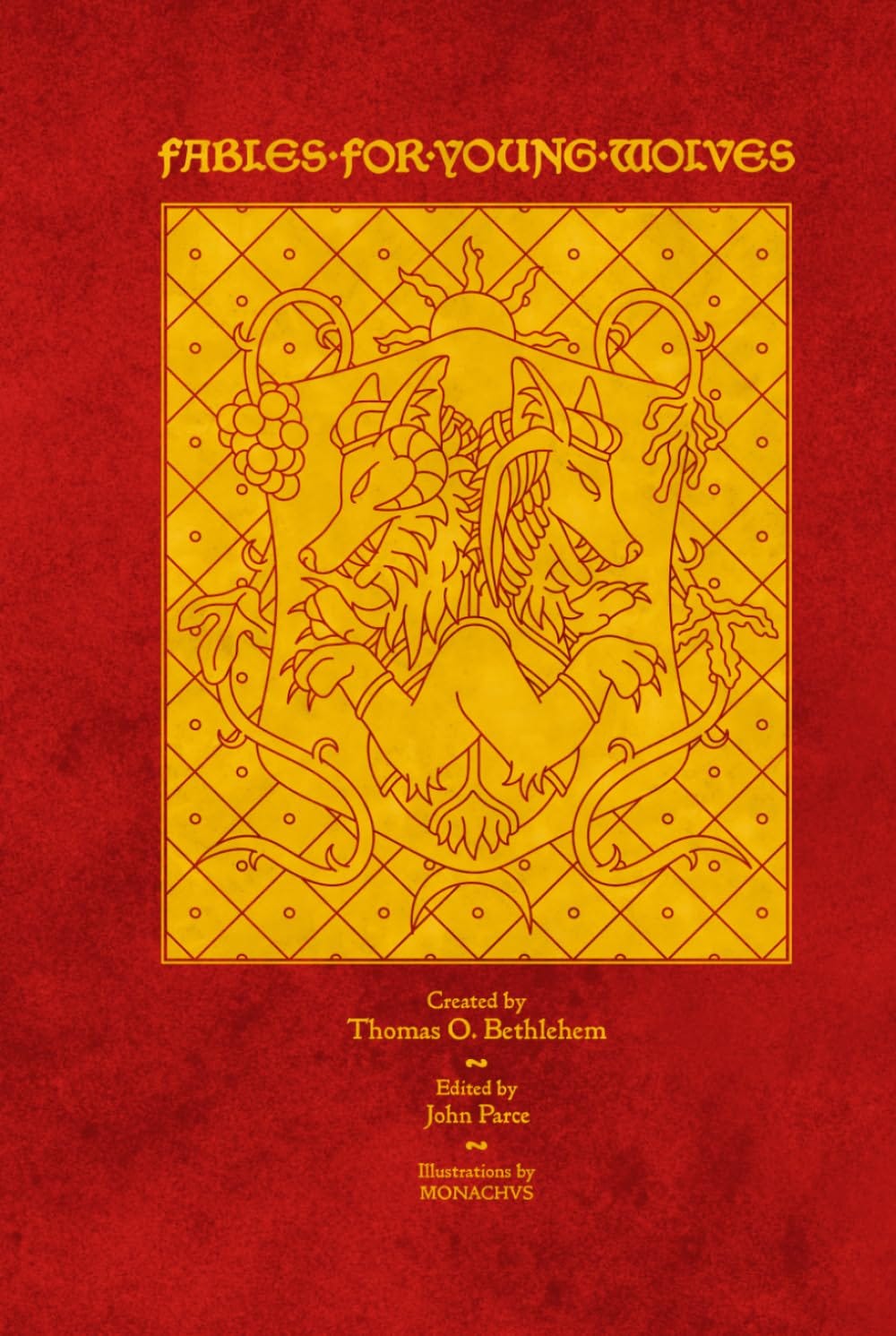
“You should move to a small town, somewhere the rule of law still exists. You will not survive here. You are not a wolf, and this is a land of wolves now.” – Sicario (2015)
Children’s literature has gotten soft. Disney turned every woodland creature into a cute little forest friend, and tacked a happy ending onto every dark fairy tale. The bloodstains were scrubbed out, death was swept under the rug, and the moral lessons became saccharine platitudes about being kind and sharing … a helpful aid to management of kindergarten classrooms, perhaps, but worse than useless for the moral instruction of the young, who will one day need to navigate a world where the shadows of the human soul conceal sharpened knives, and the truth is not always what well-meaning young women with associates degrees in early childhood education might wish. Children go along with it, but deep down they know that they’re being lied to, that the adult are keeping something from them when they pretend that every story has a happy ending, that everyone can be friends and get along if they’re just sufficiently nice to one another.
Contemporary children’s literature has gotten even worse under the pressure of politics, with bookshelves filling with stories about antiracist babies who grow up to become boys who become girls, and girls who save themselves from dragons and therefore don’t need help from the boys who foolishly refused to become girls. This is less moral instruction than moral inversion, literature meant to turn children against their own natures, stories that deliberately deceive developing minds in order to neuter them, soften them, make them malleable and unthreatening for a managerial culture in which the socially acceptable lie is always preferable to the uncomfortable truth.
Fables For Young Wolves is not that sort of book.
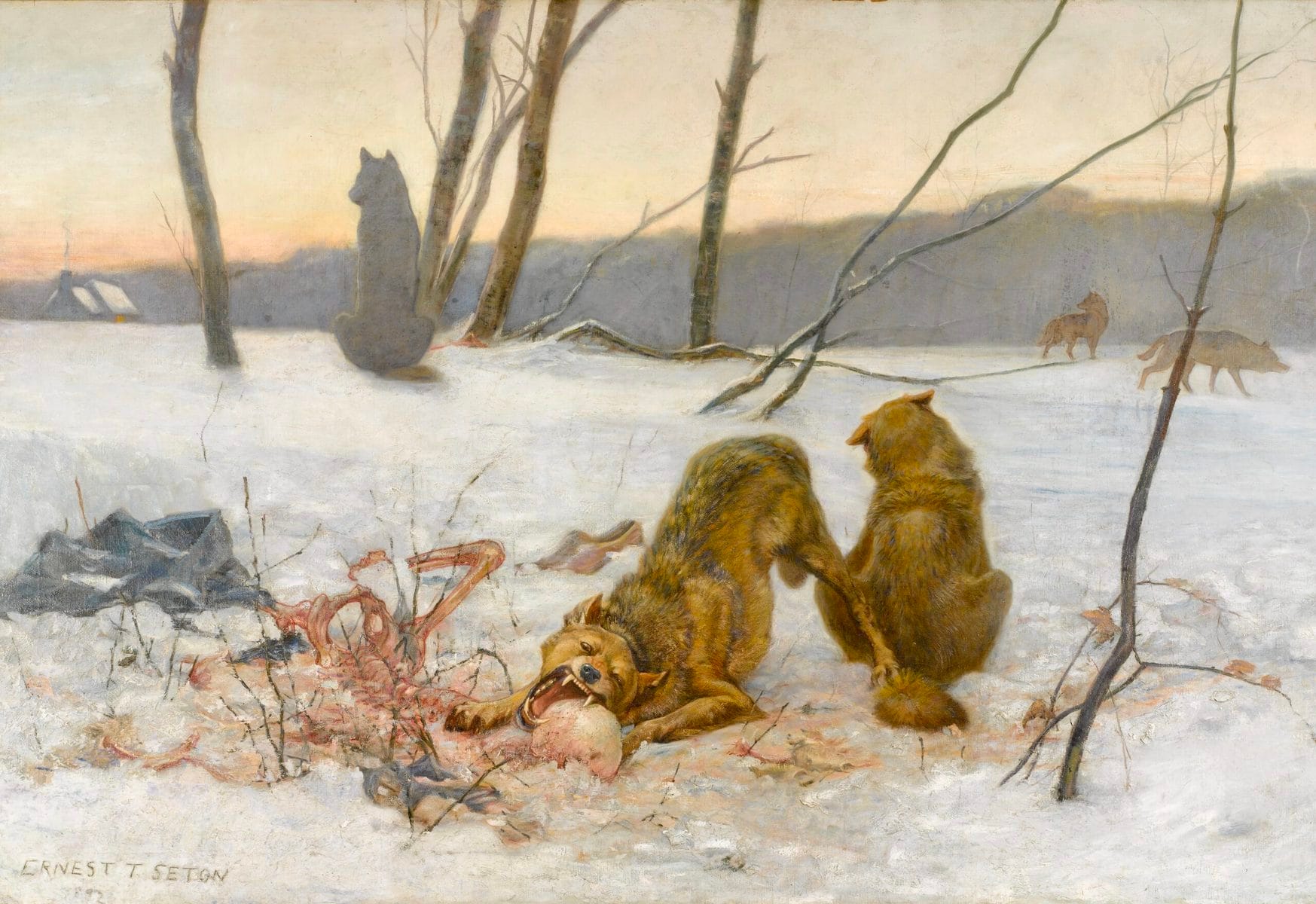
Triumph of the Wolves by Ernest Thompson Seton (1892)
The stories in Fables For Young Wolves are true fables in the Aesopian tradition: tales in which animals are used as symbols for particular facets of human character, or for particular kinds of humans. Foxes are wily, crows are wise but conniving, pigs are greedy and vulgar, asses are stupid, sheep are conformist and dull, dogs are loyal but credulous.
For after being brought up from childhood with these stories, and after being as it were nursed by them from babyhood, we acquire certain opinions of the several animals and think of some of them as royal animals, of others as silly, of others as witty, and others as innocent. – Apollonius, on Aesop (quoted in the foreword).
The titular wolves around whom the fables revolve are true wolves: noble, cruel, cunning, vicious enemies to their foes but faithful to a fault to their friends, playing roles of villain, victim, and hero as each tale requires. As the most psychologically complex of the animals, they stand for everything that is highest in the human soul, and so are also suited to plumb the depths. These are not Disneyfied vegan wolves that make friends with rabbits: these wolves are hunters and killers, and unashamed of it.
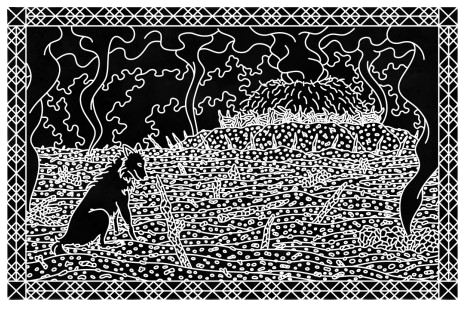
Illustration by Monachvs.
Thomas O. Bethlehem‘s fables are intended, as all fables should be, to impart lessons about human nature and about the world, not as we might wish it to be but as it is, with the intent that the young reader will be guided away from bad decisions and towards the good. Many of the stories are anecdotes of a couple of pages, which communicate simple ideas about controlling your base impulses, having your friend’s back, knowing who your real friends are, the consequences of helping those who cannot be helped, and so on. Interspersed between these are longer and more psychologically complex tales which build upon well-known folk-tales such as “The Boy Who Cried Wolf”, “The Three Little Pigs”, “The Wolf in Sheep’s Clothing”, and “Little Red Riding Hood”.
Comments Off on Let us stop lying to children about the world they’ll have to face
The Korean War Week 77: The Korean Winter Bites Hard – December 9, 1951
The Korean War by Indy Neidell
Published 9 Dec 2025Now that they’ve agreed on a Demarcation Line, the talk this week at the Panmunjom peace talks has turned to whether there will be restrictions or not after the signing of an armistice. Also, how would inspections work to make sure the other side is complying with the armistice terms? Perhaps a group of representatives from neutral nations? Meanwhile the troops are digging in to their winter defenses, as the frozen Korean winter descends upon them.
Chapters
00:00 Intro
00:48 Recap
01:16 Two New Points
08:42 Korean Winter
11:47 Communist Defenses
13:20 Summary
13:33 Conclusion
14:28 Call to Action
(more…)
Murmurs of dissent from within Canada’s supply management cartel
At Juno News, Sylvain Charlebois shares a sign of internal dissent inside the supply management system that prioritizes protecting producers at the cost of significantly higher prices and reduced choice for Canadian consumers — not to mention getting Trump’s attention (and anger) for shutting out American competitors:

Every once in a while, someone inside a tightly protected system decides to say the quiet part out loud. That is what Joel Fox, a dairy farmer from the Trenton, Ontario area, did recently in the Ontario Farmer newspaper. In a candid open letter, Fox questioned why established dairy farmers like himself continue to receive increasingly large government payouts — even though the sector is not shrinking, but expanding. His piece, titled “We continue to privatize gains, socialize losses“, did not come from an economist or a critic of supply management. It came from someone who benefits from it. And yet his message was unmistakable: the numbers no longer add up.
Fox’s letter marks something we have not seen in years — a rare moment of internal dissent from a system that usually speaks with one voice. It is the first meaningful crack since the viral milk-dumping video by Ontario dairy farmer Jerry Huigen, who filmed himself being forced to dump thousands of litres of perfectly good milk because of quota rules. Huigen’s video exposed contradictions inside supply management, but the system quickly closed ranks. Until now. Fox has reopened a conversation that has been dormant for far too long.
In his letter, Fox admitted he would cash his latest $14,000 Dairy Direct Payment Program (DDPP) cheque, despite believing the program wastes taxpayer money. The DDPP was created to offset supposed losses from trade agreements like CETA, CPTPP, and CUSMA. These deals were expected to reduce Canada’s dairy market. But those “losses” are theoretical — based on models and assumptions about future erosion in market share. Meanwhile, domestic dairy demand has strengthened.
Which raises the obvious question: why are we compensating dairy farmers for producing less when they are, in fact, producing more?
This month, dairy farmers received another 1% quota increase, on top of several increases totalling 4% to 5% in recent years. Quota — the right to produce milk — only increases when more supply is needed. If trade deals had truly devastated the sector, quota would be falling, not rising. Instead, Canada’s population has grown by nearly six million since 2015, processors have expanded, and consumption remains stable. The market is expanding.
Understanding what quota is makes the contradiction clearer. Quota is a government-created financial asset worth $24,000 to $27,000 per kilogram of butterfat. A mid-sized dairy farm may hold $2.5 million in quota. Over the past few years, cumulative quota increases of 5% or more have automatically added $120,000 to $135,000 to the value of a typical farm’s quota — entirely free. Larger farms see even greater windfalls. Across the entire dairy system, these increases represent hundreds of millions of dollars in newly created quota value, likely exceeding $500 million in added wealth — generated not through innovation or productivity, but by regulatory decision.
Comments Off on Murmurs of dissent from within Canada’s supply management cartel
QotD: The “rules” of Gonzo journalism
Thompson now had the recipe for his journalism career, and it involved three conceptual breakthroughs.
- The story behind the story is the real story.
- The writer is now the hero of each episode.
- All this gets written in the style of a personal communication to the reader of the real, dirty inside stuff — straight, with no holds barred.
Why couldn’t you write journalism like this? In fact, a whole generation learned to do just that, mostly by imitating Hunter S. Thompson.
But it grows tired and predictable in the hands of today’s imitators — and the Gonzo King never invited either of those modifiers. Yes, blogs and Substacks are part of his legacy, formats that blur the line between diary, confession, and journalism. But he did it before all the rest, not as a desktop publisher — instead putting his life at risk on the road with total fear and loathing.
So if Substack is the grandchild of Hunter Thompson and New Journalism, it is a tame, well-behaved descendant — and nothing like its brave forebear, who kept going full speed without a helmet until the end.
Even the reader has to run to keep up.
Ted Gioia, “The Rise and Fall of Hunter Thompson (Part 2 of 3)”, The Honest Broker, 2025-09-08.
Comments Off on QotD: The “rules” of Gonzo journalism


