
 Canada has only had two brushes with military conscription — after voluntary enlistments couldn’t keep up with casualties in both the First and Second World Wars — and both caused severe resentment in Quebec. Canadian politicians have generally avoided any hint of anything that could be framed as “conscription” for fear of triggering yet another existential crisis between Quebec and the rest of the country. Prime Minister Mark Carney isn’t a typical Canadian politician, and does not seem to have any of the built-up scar tissue that most others do. This might make him prone to saying and doing things that seem quite ordinary to him, but trigger civil unrest … like forcing civil servants to become soldiers against their will.
I floated the notion that this might be Carney’s five-dimensional chess strategy to reduce the civil service without having to fire everyone, but it’s far more likely that he genuinely doesn’t understand Canadians and our shared history.
John Carter is … skeptical about the Laurentian Elite being capable of rebuilding the depleted Canadian Armed Forces, as it’s hard to conceal sixty years of open contempt long enough to fake some sincerity:
The Canadian Armed Forces – which refer to themselves as the CAF, pronounced exactly as it’s spelled – recently leaked its intention expand its reserves from the current, anemic 22,000 to 400,000 soldiers. At first I wondered if an extra 0 was added to that number as a typo, but the plan is to grow the Army reserve to 100,000 and the supplementary reserve (which I hadn’t even known existed, and is currently composed of retirees) from a few thousand to 300,000. Further leaked details are that the 300,000-strong supplementary reserve will be created by essentially drafting civilian Federal employees, training them in driving trucks, marksmanship, and drone flying, which really just sounds like the makings of an absolute clown show.
At the same time, Canada’s prime minister Mark Carney has committed to a considerable increase in the CAF’s budget – over $80 billion spread over the next five years, with 2025-26 spending rising to around $62B from the previous average of around $35B – with the goal of reaching the 2% of GDP level that NATO members are expected to (but in practice usually don’t) maintain. As part of this build-up, the CAF is hoping to reach its authorized strength of 71,500 uniformed personnel.
[…]
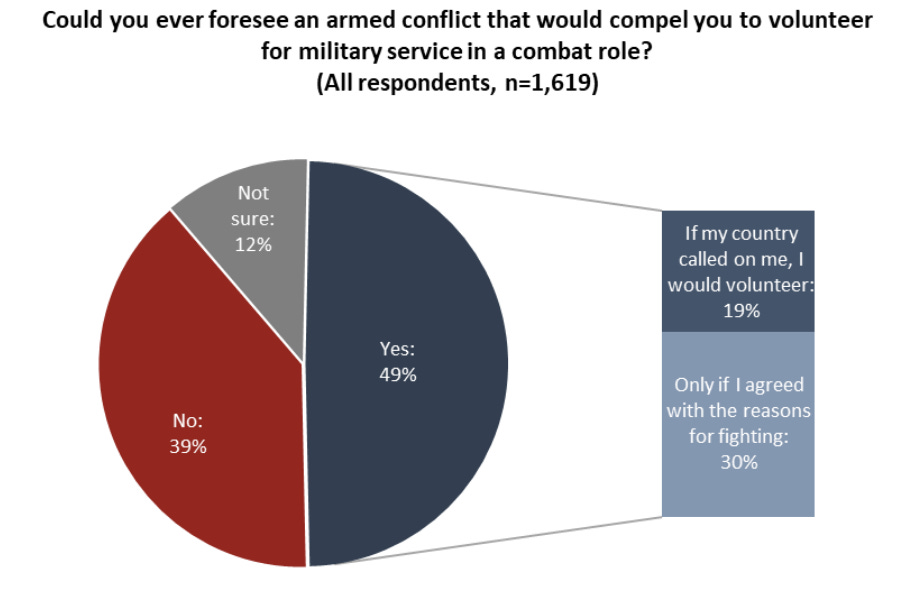
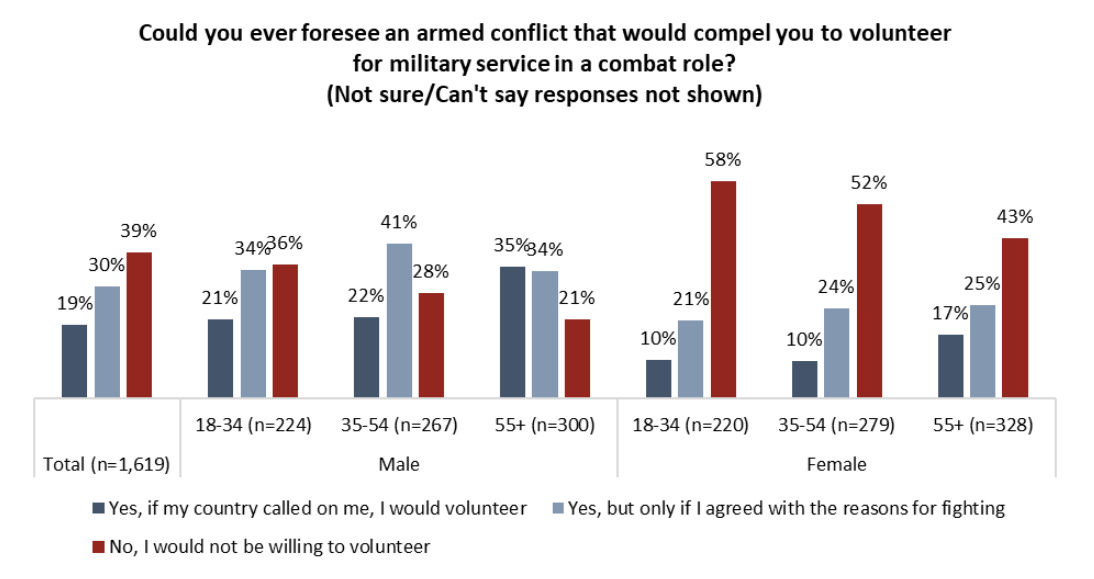
A recent Angus Reid poll indicates that there is very little enthusiasm for military service amongst Canada’s population. Only one in five Canadians would volunteer no matter the reason if their country called them, while 40% would refuse service under any circumstances.
Young men are even less likely to be potentially willing to unconditionally volunteer than old men, while being far more likely to refuse to volunteer under any circumstances (of course, women are almost universally aghast at the idea of serving). Contrast this to World War 2, when about 1/3 of fighting-aged men volunteered.
Governments that find it impossible to motivate their young men to volunteer for military service, but need their warm bodies in uniform anyhow, have historically resorted to conscription. Since they are manifestly not interested at the moment, the political class has begun floating trial balloons about mandatory military service in its media.
[…]
Just because conscription would be unpopular doesn’t mean that the government won’t reach for it, of course. More or less by definition, conscription has never been popular. It is, however, very far from ideal. Conscripts don’t tend to make the most enthusiastic troops. Their morale tends to be low, their enthusiasm non-existent, and their propensities to shirk their duties, avoid danger, surrender, and mutiny are all much higher than those of the committed volunteer.
[…]
The Canadian government has worked hard to systemically alienated the native population. Official state ideology is that Canada is a post-national multicultural state with no core identity built on stolen native land by genocidal settler-colonialists. As such, there’s nothing to defend. There’s no there, there: no identity to identify with, no boundaries of culture to justify the borders of political geography, no in-group to defend against an outgroup. No nationalism without a nation; no patriotism without patria.
Reinvigorating Canadians’ willingness to serve their country and rebuilding Canada’s military into a force that can win wars would both require the Canadian political class to repudiate the ideological territory of globalism, feminism, multiculturalism, mass immigration, and gender-bothering that they have made themselves synonymous with. However, they can’t reverse course without discrediting themselves, and so, they won’t. Fixing the recruitment crisis is therefore a coup-complete problem: it cannot be accomplished absent wholesale replacement of Ottawa’s political class. We only need to look south of the border for demonstration of this. Until 2025, the American military was suffering from precisely the same recruiting woes as afflict Canada and Great Britain, due entirely to a collapse in interest amongst America’s traditional warrior class: white rural Southern men.
The ascendant Trump replaced the shapeless blob Lloyd Austin as the Secretary of Defense with the young, energetic, crusader-tattooed Pete Hegseth as the Secretary of War (and that difference in terminology matters). Recruitment rebounded immediately, with the US Army alone exceeding its 2025 goals by 61,000, four months ahead of schedule. Including reserves, the US military as whole recruited about 325,000 new personnel in 2025, with each branch either hitting or exceeding its recruitment targets (which were also 10-20% higher than in 2024). Adjusting for population ratios, this would be the equivalent of the CAF recruiting 32,500 personnel in one year.
Of course, as we’ve noted here before, the CAF doesn’t have the same kind of recruiting problem that the American services faced (please pardon the self-quote here):
We’ve had surprising numbers of media folks paying attention to the crippling recruiting crisis, as even on current funding, the CAF is short thousand and thousands of soldiers, sailors, and aircrew. Sadly, but predictably, most of that media attention looks at the shortfall of new recruits being trained for those jobs, which is true but incomplete. The biggest problem on the intake side of the CAF is the bureaucratic inability to bring in new recruits in anything remotely like a timely fashion. The last time I saw annual numbers, the CAF had huge numbers of volunteers coming in the door at recruiting centres, but getting the paperwork done and getting those volunteers into uniform and on to job training was an ongoing disaster area. More than seventy thousand would-be recruits applied to join the CAF and the system managed to process less than five thousand of those applicants and get them started on their military careers.
At a time that we’re losing highly trained technicians in all branches to overwork, underpay, and vocational burn-out, we somehow lack the competence to take in more than one in twenty applicants? That is insane.


