
As a counterpoint to the OTT summary of Sir Arthur posted last week, here’s The Black Horse with part one of a two-part look at the man’s early career before joining the Canadian Expeditionary Force in Europe:
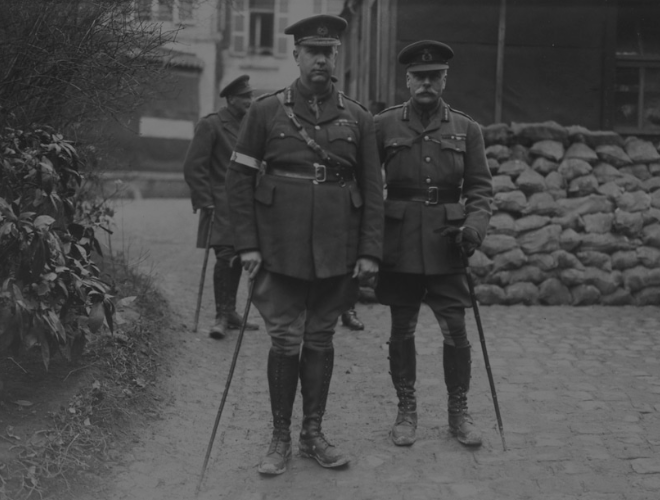
Sir Arthur Currie with Field Marshal Sir Douglas Haig, February 1918.
Libraries and Archives Canada item ID number 3404878.
The Red Ensign is a publication deeply interested in leadership; the good, the bad, and the ugly. For this reason, this Remembrance Day, I have chosen to draw the audience’s attention to the life and times of Sir Arthur Currie, the first Canadian commander of the Canadian Corps during the Great War. This presents an opportunity to both on honour and reflect upon the courage and sacrifice of the men who have fought under the flag of this great nation, but also offers the language to articulate the task facing any who would attempt to lead Canada today. As Currie’s war was defined by the challenge [of] leadership of Canadians in the context of the shifting priorities of the late British Empire, any who would seek to lead Canadians today face will struggle to harmonize efforts on behalf of the Canadian people and the priorities and policies of the American power block which he cannot eschew.
Dulce et decorum est pro patria mori; but when your country is an Imperial Dominion, who and what is “pro patria“, and how can one spend their life for them?
The Man Before the Great Man:
Arthur Currie was born in 1875 in Napperton, Ontario [50 km West of London], the third of eight children living on a homestead belonging to his grandfather. Raised with a the vigorous discipline of a Methodist home, Currie would remain a convicted Christian for his entire life, though he converted to Anglicanism as an adult. Currie was a good student, intending to pursue a career in law or medicine but dropped out of school twice, first temporarily because of the financial constraints brought on by the death of his father, and then for a second time at 19 because of a quarrel with one of his teachers. After leaving school he went West; after a string of failed efforts to establish himself via entrepreneurship and real-estate speculation he joined the Canadian militia as a gunner in 1897 in Victoria B.C. at the age of 23. A giant man (6’3″ at a time when the average Canadian height was 5’7″) with a noted eye for technical detail and, in the words of his son, a “tremendous command of profanity”, he quickly distinguished himself and was promoted to corporal before earning a commission as an officer in 1900. As an officer in peace time Currie was noted for his detailed inspections and his rapid transformation from “one of the boys”, into a rigid disciplinarian. This duality, an officer raised from the ranks, who could both embody the rigid tradition of the British military and who had an intimate familiarity with the life and ways of the enlisted men would become a defining feature of his career.
During Currie’s peace-time career as an officer he maintained a second career as a real-estate [agent]. After becoming head of Matson Insurance Firm 1904, he and the firm invested aggressively in the Victoria real-estate market. In 1913 Currie’s financial situation began to rapidly deteriorate as a consequence of price declines in the real-estate market. Currie’s financial problems nearly led him to refuse to stand up the 50th Regiment Gordon Highlanders of Canada in 1913. In July 1914 Curry used $10,833.34 of regimental funds intended for the purchase of uniforms and kit to pay his personal debts, and found himself facing forcible retirement just as the Canadian Army was being mobilized for war. At the intervention of one of his subordinates, Major Garnet Hughes, he instead accepted promotion as brigadier-general of the 2nd Brigade of the 1st Canadian Division, and ignored correspondence from the new commander of the 50th regiment, Major Cecil Roberts, about the missing funds until he was overseas.
Currie arrived at camp Valcartier on September 1st, 1914 to find himself charged with 10x as many men as he had ever led before, no staff, a shared tent as a command center, and the duty to prepare these men for one of the most difficult theatres of war the world has ever seen. The six months between taking command and the arrival of his brigade in the trenches near Ypres were marked by two mud besotted poorly supplied training camps, shoddy kit, rampant disease, and the company of a certain bear that was to become beloved by children around the world. Through this period Currie was well liked by the men, but known as a disciplinarian with an eye for technical detail. In March 1915 the brigade was deployed to what was expected to be a quiet part of the front with the intent of allowing the men to gain some experience with trench warfare before they were relied upon for action. Nobody anticipated what would happen next.


