City Journal, whose articles I’ve been linking to for over 20 years, recently started a Substack to highlight articles including this recent post by Robert VerBruggen arguing against letting schoolchildren use smartphones in class:
Today’s kids are getting cell phones — with constant access to viral videos, gaming, social-media bullying, and potentially contact with strangers — as early as elementary school. My ten-year-old reliably informs me that everyone else has one.
Along with parents like me, schools have been struggling to navigate this issue. Phones have become a major source of classroom distraction. There’s a lot of interest in policy action: Earlier this year, my Manhattan Institute colleagues John Ketcham and Jesse Arm proposed strong restrictions on phones in schools. Some places, including Florida, have led the way in pursuing such policies.
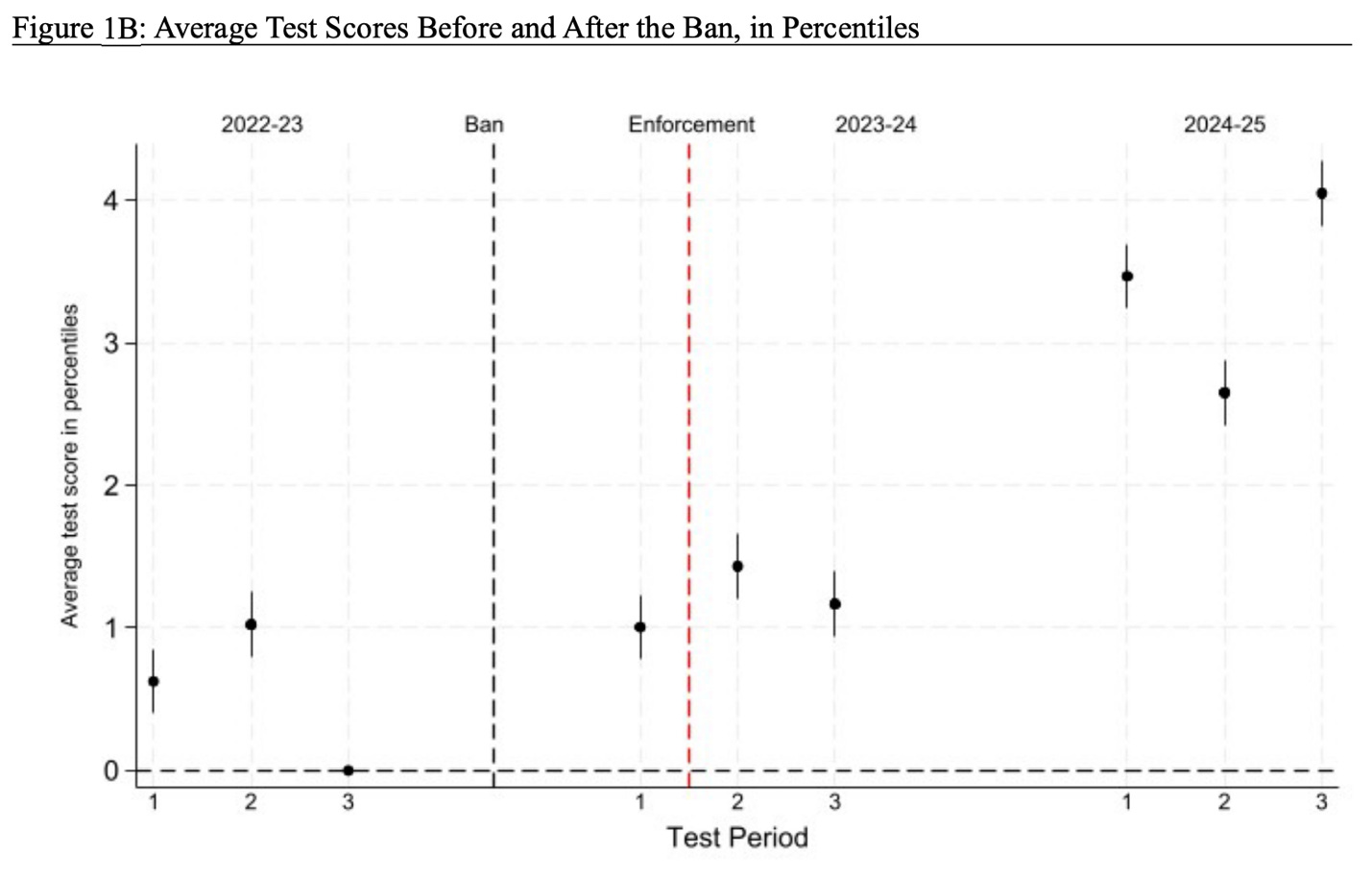
A new study, released as a working paper through the National Bureau of Economic Research, evaluates Florida’s experiment. In the authors’ analysis, the rule drastically reduced student phone use, led to a temporary increase in disciplinary incidents, and improved test scores.
Let’s dig in a little.
The study focuses on an unnamed “large urban county-level school district” in Florida. While the state law restricted phone use only during instructional time, this district went further, requiring phones to be silenced and put away for the entire school day. The policy went into effect in May of 2023 and was enforced with disciplinary measures starting in September of that year.
The change reduced student phone use, measured via phone location data captured from 9 a.m. to 1 p.m. on school days, by about two-thirds. This is a striking victory if you find it self-evident that kids shouldn’t have cell phones on in school.
The transition was a little rough, with disciplinary incidents increasing over the first year—by around 20 monthly incidents per 10,000 students—especially in schools with higher levels of pre-ban phone use. Male and black students were disproportionately affected, though it’s unclear to what extent that stems from behavior vs. enforcement disparities. At any rate, discipline mostly returned to normal in the second year.
That’s also when the test-score benefits manifested. Scores rose a couple of percentiles, on average: a student at the 48th percentile nationally, for example, would tend to end up around the median. The change was largest in schools with higher pre-ban phone use. Student absences also declined and fewer kids switched schools, which may help explain the improvement.
All in all, this looks like a successful policy: Less distracting phone use in schools, better attendance, higher test scores. More effort is warranted, though, to confirm these results elsewhere — and to figure out the best way of implementing and enforcing cell-phone bans.