
Quotulatiousness

October 3, 2025

Women and credit card access … another “just so” story

Filed under: Business, Government, History, Media, Politics, USA — Tags: , , , , , — Nicholas @ 04:00

Janice Fiamengo debunks a common “just so” story about women only gaining the right to hold a credit card in the 1970s:
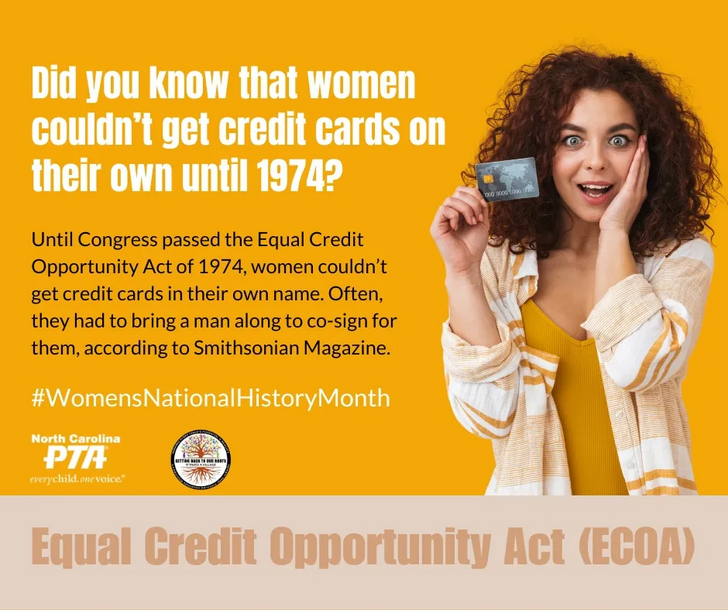
A few years ago, I started hearing that women, before feminism, couldn’t have their own credit cards. Or they couldn’t get one without a man’s signature. Or married women couldn’t have one in their own name. Divorced women, apparently, couldn’t get credit at all. Men conspired to keep women powerless and dependent.

THANK THE GODDESS FOR FEMINISM!

Just last June, on the podcast Diary of a CEO (in an episode viewed by nearly two million people), three feminists debating feminism agreed that, in the words of one of the panelists, “None of us could get a credit card a few decades ago … We couldn’t have anything …” (see 1:50:37).

Before correcting herself, in fact, the panelist had started to say, “None of us could get a credit card a couple of decades ago …”

The statement struck me with the full force of the ludicrous. I started school in 1970. My teachers were nearly all women, at least half of them unmarried. They certainly seemed to live full, normal lives in obeisance to no man. They were paid a salary; they had bank accounts; they owned cars; they bought things and went on vacations.

My mother had worked in an insurance office for years both before and after she married my father in 1956. She had purchased appliances and paid her own rent, helped my father buy his first commercial fishing boat, and handled all the household expenses when my dad was away fishing for months every summer.

My friends’ mothers were similarly active and self-determining. Were all these women actually hobbled by the patriarchy, cut off from the economy?

Received knowledge would have us believe so. Last year, The Globe and Mail published a paid advertisement for Women’s History Month titled “50 Years Ago: Women Got the Right to Have Credit Cards”. Written by a financial services company seeking to drum up business, the article repeated the popular story that women in North America could not get their own credit cards until 1974.

Credit cards were one of the growth areas for banks and other financial service companies in the 1960s and 70s … from something only relatively wealthy travellers and business executives used, they expanded to become widely used by ordinary consumers for all kinds of purchases. Consumers benefitted from access to useful financial tools, while banks enjoyed the profits from the widespread use of credit cards. So where did the idea that they were male-only come from?

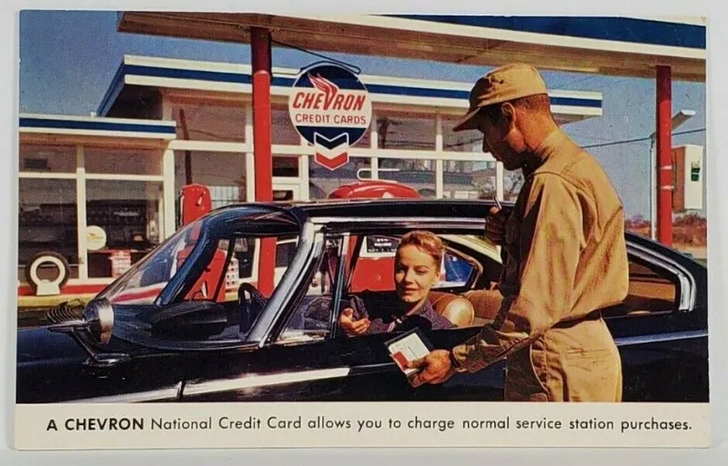
The reality is that from the 1950s on, credit cards were a new invention being aggressively marketed to both men and women. Advertising from the era shows how keen credit card companies were to target female customers, how eager to tap into women’s spending power.

Originally introduced as a convenience for travelers on business, credit cards began to expand their purview in the late 1950s. Bank Americard (later Visa) became the first consumer credit card in 1958. A network of banks formed the Interbank Card Association, originally named Master Charge (later Mastercard), in 1966.

Yet we are somehow to believe that half the population was deliberately excluded from this new consumer venture for no other reason than that they were female?

“It wasn’t until 1974 that women were allowed to open a credit card under their own name,” the Globe article states emphatically. “Before 1974, if women wanted to open a credit card, they would be asked a bunch of intrusive questions, like if they were married or whether they planned to have children. If a woman was married, she could (hopefully) get a credit card with her husband. But single, divorced, or widowed women weren’t allowed to get a credit card of their own — they had to have a man cosign for the credit application.”

The explanation is dramatic and incoherent, undoing its own logic from the beginning. It backtracks to allege that women were in fact “allowed” to have a credit card so long as they answered “a bunch of intrusive questions” or found a co-signer. Even this lesser claim is false, but it is rather different from the prior assertion about women “not having the right” to a card.

At a time when many married women either did not work outside the home or worked only part-time and on a temporary basis, there would have been nothing unreasonable about a woman’s husband co-signing her credit card application. Many married women were happy to purchase what they wanted on the assurance that their husbands would pay the bill when it came in, and credit card issuers saw joint accounts as a way of ensuring payment.
Update, 4 October: Welcome, Instapundit readers! Please have a look around at some of my other posts you may find of interest. I send out a daily summary of posts here through my Substackhttps://substack.com/@nicholasrusson that you can subscribe to if you’d like to be informed of new posts in the future.
Adding digital ID to the pocket moloch … what could possibly go wrong?

Filed under: Britain, Bureaucracy, Government, Liberty, Technology — Tags: , , , , — Nicholas @ 03:00

On Substack, Andrew Doyle explains why it’s a terrible idea to trust the government — any government — in forcing digital ID on everyone:

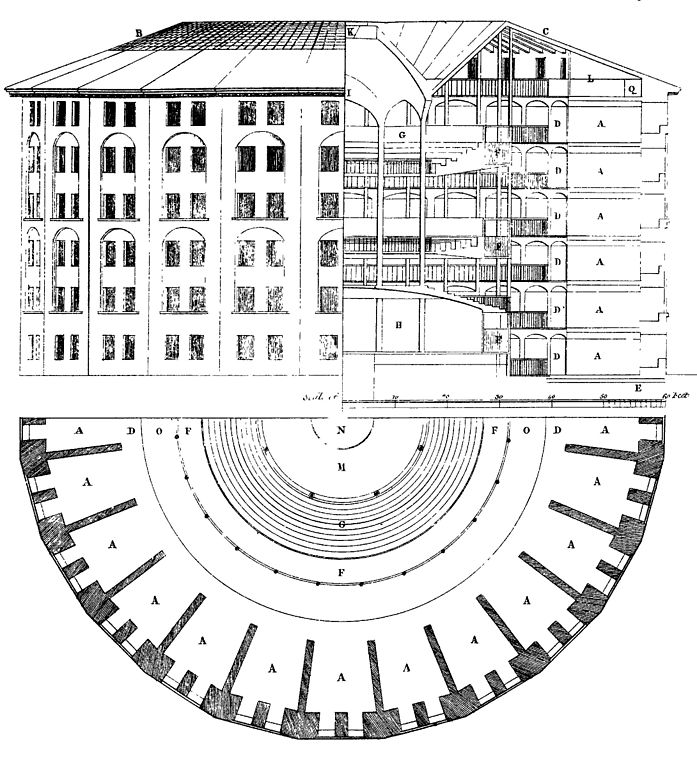
An illustration of Jeremy Bentham’s Panopticon prison.
Drawing by Willey Reveley, 1791.

During a trip to Russia in 1785, the philosopher Jeremy Bentham sketched an outline for a new prison design. The cells were arranged around the circular perimeter and, at the centre, he placed his “panopticon”: a watchtower which afforded a view of any of the cells at all times. The prisoners might not always be being observed, but they could never be sure that they weren’t.

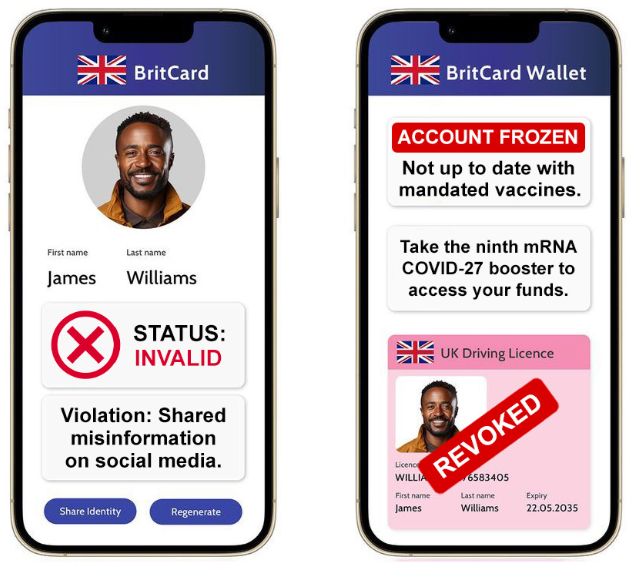
Bentham’s design was never directly used, but the idea took hold as a symbol of state overreach and control, most famously in Michel Foucault’s Discipline and Punish (1975). Foucault was alert to the political ramifications of such a concept, and how surveillance might become an internalised experience. With Keir Starmer now pledging to introduce a digital ID system as a mandatory condition for the right to work, are we seeing the first step towards the realisation of Bentham’s vision?

I suppose we are already there. I have seen friends switch off their phones before discussing politically sensitive issues, genuinely convinced that digital eavesdropping is the norm. Many people are mistrustful of the “Alexa” voice assistant, which they are persuaded is recording their every word. While this all seems terribly conspiratorial, I’m sure most of us remember those reports a few years ago about the Pegasus spyware which had been covertly installed on the phones of journalists and government figures, turning the devices into pocket spies.

[…]

Few will be surprised to hear that public trust in political institutions has plummeted. The increasingly authoritarian tendencies of successive governments, our two-tier policing system, public manipulation as embodied in the “nudge unit”, and the corrupt prioritisation of the interests of the political class over the people they serve – perhaps best demonstrated by parliament’s flagrant efforts to overturn the Brexit vote – have all contributed to this climate of mistrust. The bizarre overreach of police during the lockdowns – in which dog walkers were publicly shamed with drone footage, and shopping trolleys were probed for “non-essential items” – has hardly helped matters.

To many of us, it is baffling that anyone at all would support the prospect of the government keeping track of our movements and holding our private details in a database. Starmer claims that the scheme will curb illegal immigration, but we are talking about criminals who already work outside the system and will doubtless continue to do so. Besides, identity cards have been a reality on the continent for years, and have done precisely nothing to resolve the problem. Employers in the UK are already legally obliged to insist on proof of immigration status from workers.

Labour’s digital ID scheme seems more about control than anything else. The possibility of fraud is also a major concern. It’s not as though the government has an unblemished track record of preventing data breaches. We all recall the massive leak of official MOD data regarding Afghans who had worked with the British government during the UK’s military campaigns. And who could forget the senior civil servant who, in 2008, left top-secret documents concerning al-Qaeda and Iraq’s security forces on a train from London Waterloo? Are we really to suppose that the creation of an all-encompassing centralised database will not leave the public open to risk from hackers and hostile foreign powers?

Tim Worstall adds that “they c’n fuck off ‘n’ all”:

So we’ve that wet dream of Tony Blair raising its ugly head again. There should be a national ID system. Actually, it’s not just Blair, T — the bureaucracy has been right pissed at the erasure of the wartime system since the 50s when it was abolished.

For there are two ways of looking at, thinking about, the whole governance thing. One is — the Blair, bureaucrats’, version — that the population are cattle, kine, to be managed. For the benefit of the bureaucracy of course — or at very least to be forced into doing what the bureaucracy thinks they — we — should be doing.

Then there’s that stout Englishman, the Anglo Saxon, version, which is that government are just the slaves we communally hire to make sure the bins get emptied. Well, OK, maybe raise a bit of tax for a Royal Navy to sink the Frenchies. But even then, not too much of that — the Civil War was, after all, triggered by Ship Money. Did the people who would not be slaughtered by the first wave of invading Frenchies — because they had the silly excuse of living 25 miles inland — have to pay the tax to run the Royal Navy to keep the Frenchies at bay or not? The King said yes — the King was right — and not for the first nor last time in British political history the guy who was right had his head cut off for being so.

Digital ID, so which version should we have? That one beloved of Froggie-type bureaucrats who view La Profonde as kine to be corralled? Or the Anglo Saxon version where we just devolve the scut work to a few slaves?

[…]

The reason this never will be proposed is that it doesn’t fit the reasons why our rulers wish to have an ID system. They’re insistent that we be their kine rather than they our. So, the Hell w’ ’em.

But it could be done. Government simply publishes an interface — an API — which says that proof of identity needs to be presented in this format. We’re done as far as whose kine is whose.

Update 4 October: From Samizdata, another illustration of just how toxic Two Tier Keir has become to British voters:

The Guardian reports:

    “Reverse Midas touch”: Starmer plan prompts collapse in support for digital IDs

    Public support for digital IDs has collapsed after Keir Starmer announced plans for their introduction, in what has been described as a symptom of the prime minister’s “reverse Midas touch”.

    Net support for digital ID cards fell from 35% in the early summer to -14% at the weekend after Starmer’s announcement, according to polling by More in Common.

    The findings suggest that the proposal has suffered considerably from its association with an unpopular government. In June, 53% of voters surveyed said they were in favour of digital ID cards for all Britons, while 19% were opposed.

Mulligan “Hobo” Stew from the Great Depression

Filed under: Food, History, Railways, USA — Tags: , , , , , — Nicholas @ 02:00

Tasting History with Max Miller
Published 29 Apr 2025

Soup with canned peas, canned corned beef, onion, and ketchup

City/Region: United States of America
Time Period: 1940

Today the word “hobo” is usually used in a derogatory manner, but back in the time between the end of the Civil War and the end of the Great Depression, it referred to a specific group of migrant workers and their culture.

Part of that culture was mulligan stew, which was basically a stew of any meat and vegetables that were thrown together. The ingredients would be made up of things that keep well, mostly food that was canned or bottled.

The flavor of this soup is surprisingly good, but it’s maybe a little too sweet, even for me. The prodigious amount of ketchup is the dominant flavor, and maybe 1940 ketchup was less sweet than modern versions.

    Mulligan Stew (Serves 6)
    1 medium size can corned beef — minced
    1 onion — minced fine
    1 No. 2 can peas with liquid
    1 medium size bottle tomato catsup
    1 cup water
    Salt and pepper to taste

    Put all ingredients in saucepan and simmer gently over low flame for about one hour. The flavor improves with the length of cooking time.

    The Brookshire Times, August 2, 1940

(more…)

QotD: The role of the True Believer

Filed under: History, Politics, Quotations — Tags: , — Nicholas @ 01:00

    Anon @Greynxgga69

    Abolish The Family.
    Abolish Religion.
    Abolish Wage Labour.
    Abolish Money.
    Abolish Work.
    Abolish Commodity Production.
    Abolish the State.
    Abolish Class.
    Abolish Private Property.
    Abolish the Nation.
    Abolish Patriarchy.
    Abolish Gender.
    Abolish Town and Country.

The True Believers imagine they will live in Utopia after the Revolution.

They will instead be sent to the gulag, or lined up against the wall and shot.

Why?

Because the function of the True Believer is to make the Revolution. And the purpose of the Revolution is to replace The Regime.

Once the Revolution is made, and The Regime has been replaced, no further Revolutions are wanted. Therefore the True Believer serves no purpose.

He is a liability, because he has been promised Utopia, and Utopia is hard, even perhaps impossible, to deliver. If he does not receive the promised Utopia, he is apt to make Revolution again.

The Regime does not want this. It does not wish to be replaced in the same fashion that it replaced The Regime. So the True Believer must be disposed of. He must be replaced with the Opportunist.

The Opportunist can be relied upon, because he does not want Utopia. He wants to have more than his comrades. So long as he receives more than his comrades, he will serve The Regime.

As above, so below.

As before, so after.

Meet the New Boss. Same as the Old Boss.

Devon Eriksen, The social media site formerly known as Twitter , 2025-07-01.

Powered by WordPress



