On his substack, Lorenzo Warby considers the origins of what we now call “woke” politics and how they became the predominant set of beliefs of the people who can’t be held accountable:
Western civilisation, over the last two centuries, has gone through the Emancipation Sequence whereby — taking the Anglosphere pattern — free people voted to liberate slaves, Christians to get rid of exclusions on Jews, Protestants to get rid of exclusions on Catholics, whites to get rid of exclusions on blacks, men to get rid of exclusions on women, straights to get rid of exclusions on gays and lesbians. We live in free societies of mass prosperity, yet we have highly motivated political networks that think nothing of casting our societies as marked by layers of oppression.
Yes, this is based on a monstrous (and self-serving) inflation of the concept of oppression. It also functions to channel the rage of downwardly mobile children of Western elites.
More important still, it is the signature politics of the unaccountable classes, of those paid to turn up — as distinct from the accountable classes whose income depends directly on their performance. The dominant politics of the unaccountable classes has acquired a name: it is woke politics, the politics of wokery or of being woke.
The technical name for wokery is Critical Constructivism. It is the popularisation of Critical Theory. I have labelled it Post-Enlightenment Progressivism, as it rests on critiques of The Enlightenment, and rejection of Enlightenment values, while orienting itself towards an imagined future — one where it is no longer true, as Marx and Engels wrote in The Communist Manifesto (1848), that society is based:
on the antagonism of oppressing and oppressed classes.
That is, of oppression as they define it.
Wokery is the currently dominant form of left-progressivism. Political scientist Eric Kaufmann defines “wokery” as:
making sacred of historically marginalised race, gender and sexual minorities.
That is how the Oppressor/Oppressed template that Critical Theory takes from Marxism is popularised in a post civil rights world, using any differences in outcomes between groups as markers of oppression. The Oppressor/Oppressed template requires oppression to be pervasive in contemporary societies, hence psychologist Steven Pinker’s observation about progressives hating progress.1
What wokery also is, is lazy self-righteousness. The self-righteousness is obvious and pervasive. These folk really do act as if they own morality; as if they can withhold the moral grace of their presence from the wicked, from wrongthinkers; as if wrongthinkers are purveyors of moral pollution. This has much to do with the dwindling of the culture of public debate.
But it is also lazy, in that it massively economises on the use of information and intellectual effort. Much of the appeal of “wokery” comes from how remarkably little accurate knowledge it demands. All one has to do is to master the lingo, the linguistic signalling, involved; the pre-set talking points; which terms of moral abuse apply and when; and be willing to engage in any required level of rationalisation and mental gymnastics. Once you do so, the moralised status game of lazy self-righteousness is open for you, with approved positions lined up for one to adopt, all based on semblances of knowing.
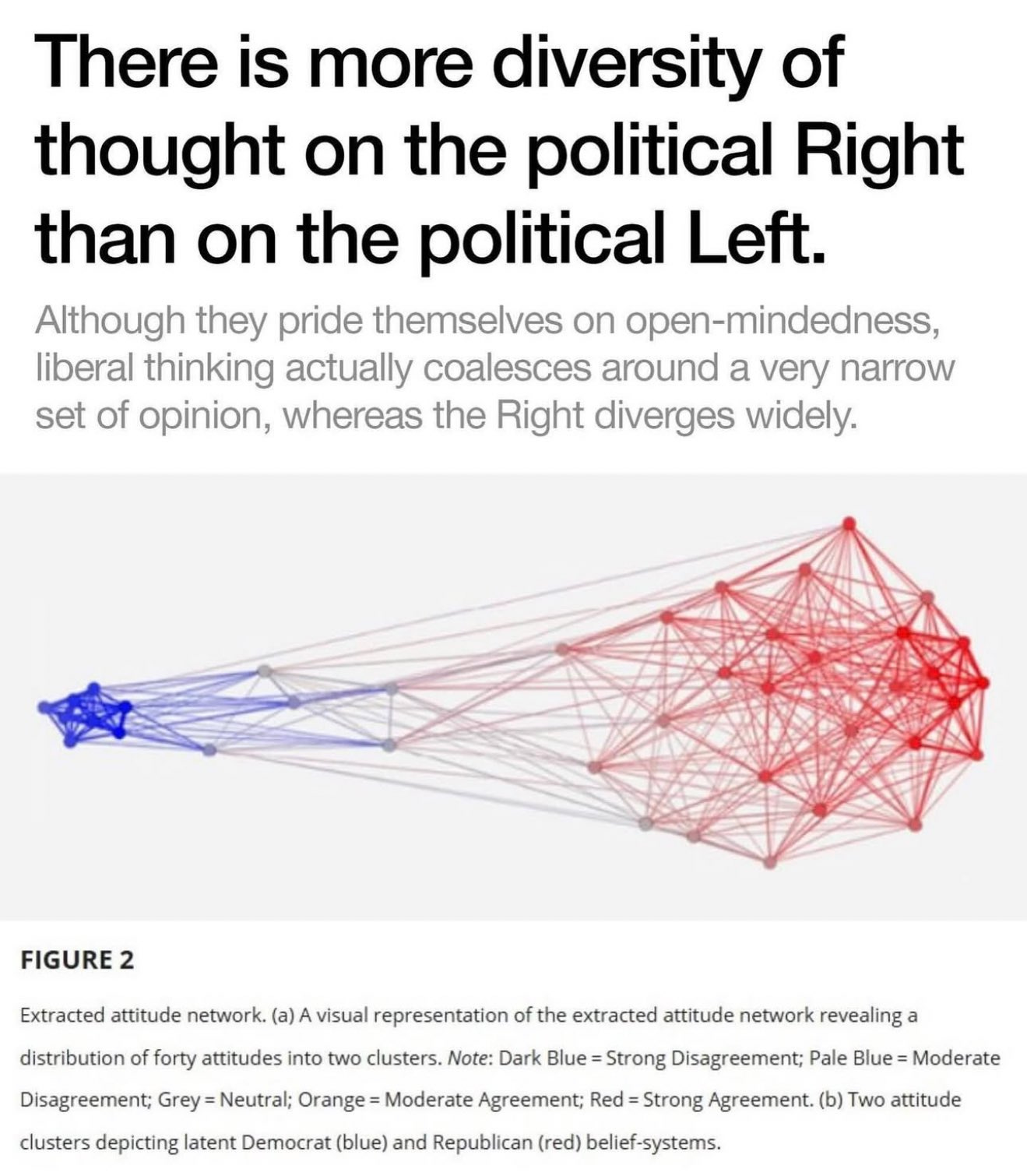
This dynamic has much to do with why one side of US politics is far more conformist in its political opinions than the other.
The underlying blank slate views about humans means you don’t have to accept any constraints from evolutionary biology. If we are all blank slates, if there are no inherent differences between groups, then all inequalities between groups can be classed as malicious — as signs of oppression — so you do not have to bother exploring differences in traits, cultures, life-strategies, etc.
Lazy self-righteousness does not require any thinking about successful and unsuccessful life strategies, about what makes things work, or not work. It does not require much in the way of statistical or mathematical understanding. The most mathematical it gets is whether social outcomes are proportional to a group’s population share or not.
If a group is doing better than average, they are oppressors. If they are doing worse, they are oppressed. Viewing society through the oppressed/oppressor mindset always ends up looking for (and finding) kulaks.
It is a simple metric to adopt, with the self-righteous status game built-in of opposing oppression and supporting the marginalised. No further intellectual effort is required.
- Pinker’s observation that populism is a phenomenon of older voters has not worn well. Also, it is a sign how reflexive future-orientated judgements have become, that the voters with the most experience of the EU were most likely to vote against it in the 2016 Brexit referendum passes people by.