
Drachinifel
Published 5 Sept 2025Today we take a look at a heretofore unpublished account from a sailor who saw the destruction of HMS Hood, and take a look at what this might tell us about the incident.
(more…)
September 6, 2025
New Evidence on the loss of HMS Hood!
Comments Off on New Evidence on the loss of HMS Hood!
The federal government’s foreign worker program is set up for abuse
Dan Knight discusses Canada’s deliberately two-track job system, which severely disadvantages unemployed Canadians and favours temporary foreign workers instead:

Canada now has a two-track employment system. On one track, you’ve got over 1.6 million Canadians unemployed the official rate just jumped to 7.1%, the worst since 2016 outside the COVID crash. Youth joblessness? 14.5%. Alberta, supposedly an economic engine, bleeding at 8.4% unemployment. And those folks are drawing EI, funded by your tax dollars.
On the other track? The Temporary Foreign Worker pipeline. In 2024 alone, Ottawa issued over 162,000 TFW permits by October. And they’ve already budgeted another 82,000 entries in 2025. Think about that: while Canadians are struggling to find work, Ottawa is busy handing out golden tickets to foreign workers.
And let’s be honest about how this program actually works. It’s sold as a way to “fill labor shortages”. In practice, it often looks like a backdoor family reunification scheme. Business owner Abdul suddenly needs a “specialized” worker conveniently, his cousin in India just happens to fit the bill. So instead of waiting in line under the normal visa system, he comes in the side door through the TFW program. Legal? Sure. Exploitative? Absolutely. It undercuts the immigration rules that everyone else has to follow, and it keeps wages low for Canadians who should be first in line.
Here’s the part that makes you wonder if Ottawa is even trying: we’ve got two federal departments, Employment and Social Development Canada (who runs EI) and Immigration, Refugees and Citizenship Canada (who runs TFW permits). Wouldn’t a functioning government have these two agencies talk to each other? One department says, “Hey, we’ve got 1.6 million people sitting on EI“. The other says, “We’ve got 162,000 employers asking for TFWs“. The obvious solution? Connect the dots. Fill Canadian jobs with Canadian workers first.
But that would require coordination and “coordination” is a foreign concept in Ottawa. These are the same geniuses who can’t keep escalators running in Parliament Hill without a three-year feasibility study. You expect them to line up two departments, EI and Immigration … and have a five-minute conversation? Forget it. Imagine the radical idea: one arm of government saying, “Hey, we’ve got 1.6 million Canadians unemployed and drawing EI …” and the other saying, “Oh great, we’ve got 162,000 employers begging for workers. Maybe, just maybe, we could match those two groups up“. That’s not rocket science. That’s not even science. That’s called basic competence. And Ottawa can’t even spell it.
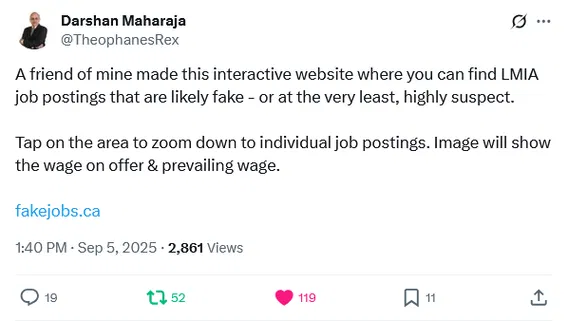
Using the fakejobs.ca website, I found three LMIA postings in my small town on the edge of the GTA … all paying well over median for pretty ordinary retail management jobs.
Comments Off on The federal government’s foreign worker program is set up for abuse
Unique British Crankfire .58 Morse Manual Machine Gun
Forgotten Weapons
Published 30 Apr 2025This is a really interesting piece with a mostly unknown origin. It was manufactured in the UK (the barrel was deemed Enfield-made by former Royal Armouries curator Herb Woodend) and is chambered for the .58 Morse centerfire cartridge. The date of production is unknown. It uses a gravity-feed magazine and fires via hand crank. Turning the crank cycles the bolt forward and back, not completely unlike a Maxim gun but without the automatic operation. It came out of a small Canadian museum in the 1950s, but its provenance before that is unknown.
(more…)
Comments Off on Unique British Crankfire .58 Morse Manual Machine Gun
QotD: Leadership training for Persian nobles
Anyway, young Cyrus […] and his classmates spend practically every waking moment being little Tai-Pans. They study in classrooms, receive military training,1 and shadow the magistrates in their official duties; but all of these official lessons are just the backdrop against which the real lessons are taking place. The boys have missions to accomplish, missions which they cannot possibly accomplish individually. So they have to learn to put together a team, to apportion responsibilities, and to judge merit in the aftermath. Anytime one of the boys commits an infraction,2 the adults ensure that he is judged by the others. All of this is carefully monitored, and boys who show partiality or favoritism, or who simply judge poorly, are savagely punished.3
The most common sort of mission is a hunt, the boys are constantly going on hunts, because: “it seems to them that hunting is the truest of the exercises that pertain to war”. This is obvious at the level of basic physical skills: while hunting they run, they ride, they follow tracks, they shoot, and they stab. But the military lessons imparted by hunting are not just physical, they’re also mental. They learn to “deceive wild boars with nets and trenches, and … deer with traps and snares”. To battle a lion, a bear, or a leopard on an equal footing would be suicide, and so by necessity the boys learn to surprise them, or exhaust them, or to terrify them with psychological warfare, doing everything in their power to find an unfair advantage or to create one from circumstances.4 As Cyrus’s father tells him years later: “We educated you to deceive and take advantage not among human beings but with wild animals, so that you not harm your friends in these matters either; yet, if ever a war should arise, so that you might not be unpracticed in them.”
There’s another reason that the boys constantly hunt wild animals, which is that it habituates them to hunger, sleep-deprivation, and extremes of heat and cold. When they depart on a hunt the boys are deliberately given too little food, and what they have is simple and bland (though that’s hardly an issue for those who “regularly use hunger as others use sauce”). Some of this is ascesis in the original Ancient Greek meaning of the word (ἄσκησις – “training”); by getting used to being tired and hungry and cold under controlled circumstances, they will be better at shrugging off these disadvantages when the stakes are higher.
But the real core of it lies in the phrase: “He did not think it was fitting for anyone to rule who was not better than his subjects.” Later, when they’ve reached manhood, the boys will oftentimes be called upon to share physical hardship with those they have been set over, and in that moment it is vital to this social order that they not be soft. “We must of necessity share with our slaves heat and cold, food and drink, and labor and sleep. In this sharing, however, we need first to try to appear better than they in regard to such.” Better in the sense of physically tougher, but also better in the sense of having achieved the absolute mastery of the will over any and all desires.5
Constant exposure to deprivation and hardship isn’t just supposed to improve their endurance, it’s also supposed to make them better at sneering at comforts.6 This is a society which believes that men are more easily destroyed by luxury than by hardship, and that it’s especially important that the leaders be seen to scorn luxury, for “whenever people see that he is moderate for whom it is especially possible to be insolent, then the weaker are more unwilling to do anything insolent in the open.”7 What I love about Xenophon is that unlike many Greek authors, who would deliver that line completely straight, he instead subverts (or at least balances) it with the observation that any kind of suffering is easier to bear when you’re in charge, and even easier when you’re bearing it in order to be seen to be bearing it.
John Psmith, “REVIEW: The Education of Cyrus, by Xenophon”, Mr. and Mrs. Psmith’s Bookshelf, 2024-01-08.
1. If you’ve ever been a little boy, or the parent of a little boy, you know how true this is:
“Now the mode of battle that has been shown to us is one that I see all human beings understand by nature, just as also the various other animals each know a certain mode of battle that they learn not from another but from nature. For example, the ox strikes with his horn, the horse with his hoof, the dog with his mouth, the boar with his tusk … Even when I was a boy, I used to seize a sword wherever I saw one, even though I did not learn how one must take hold of it from anywhere else, as I say, than from nature. I used to do this not because I was taught but even though I was opposed, just as there were also other things I was compelled to do by nature, though I was opposed by both my mother and father. And, yes, by Zeus, I used to strike with the sword everything I was able to without getting caught, for it was not only natural, like walking and running, but it also seemed to me to be pleasant in addition to being natural.”
2. Not just explicit violations of the rules though: “they also judge cases of ingratitude, an accusation for which human beings hate each other very much but very rarely adjudicate; and they punish severely whomever they judge not to have repaid a favor he was able to repay”.
3. “In one case, I was beaten because I did not judge correctly. The case was like this: A big boy with a little tunic took off the big tunic of a little boy, and he dressed him in his own tunic, while he himself put on that of the other. Now I, in judging it for them, recognized that it was better for both that each have the fitting tunic. Upon this the teacher beat me, saying that whenever I should be appointed judge of the fitting, I must do as I did; but when one must judge to whom the tunic belongs, then one must examine, he said, what is just possession.”
4. Players of old-school tabletop role-playing games might be reminded of the distinction between “combat as sport” and “combat as war” or the parable of Tucker’s Kobolds.
5. Years later one of Cyrus’s classmates gives a long speech about how falling in love is optional — a real man can make himself love any woman he chooses, and conversely can restrain himself from loving any woman, no matter how desirable. All poetic references to being made a prisoner by love, or forced by love to do certain things, are excuses made by weaklings who wish to give into their desires. This is a message right in line with the most inhuman aspects of Greek philosophy, and to his credit Xenophon immediately subverts it by having the guy who delivers it immediately fall madly in love with his beautiful female captive.
6. One of the highest compliments ever paid to Cyrus is when an older mentor remarks of his posse that:
“I saw them bearing labors and risks with enthusiasm, but now I see them bearing good things moderately. It seems to me, Cyrus, to be more difficult to find a man who bears good things nobly than one who bears evil things nobly, for the former infuse insolence in the many, but the latter infuse moderation in all.”
7. Compare this to the American ruling class, which is also weirdly Spartan in its own way. The wealthiest Americans on average work a crazy number of hours, lead highly regimented lives, and avoid drugs. The difference is that whereas the Persian aristocracy does this as an example for the lower classes, the American aristocracy actively encourages the lower classes to consume themselves in cheap luxury and sensual dissipation.
Comments Off on QotD: Leadership training for Persian nobles


