
Quotulatiousness

August 6, 2025

Actual data demolishes the “climate catastrophe” narrative

Filed under: Environment, Government, Media, Politics, USA — Tags: , , , — Nicholas @ 05:00

At The Conservative Woman, Paul Homewood summarizes the findings of a new report for the US Department of Energy:
A report by five independent, eminent scientists has blown apart the myth of catastrophic climate change, destroying the case for Net Zero in the process.

Judith Curry, Roy Spencer, Ross McKitrick, John Christy and Steve Koonin are all highly respected leaders in their respective fields. Their report was commissioned by the US Department of Energy (DOE) but written with no editorial oversight by the DOE and with no political influence whatsoever. Although it specifically covers the US, its findings have worldwide ramifications.

The 151-page report, A Critical Review of Impacts of Greenhouse Gas Emissions on the US Climate, reviews scientific certainties and uncertainties in how anthropogenic carbon dioxide (CO2) and other greenhouse gas emissions have affected, or will affect, the nation’s climate, extreme weather events, and selected metrics of societal well-being.

Maybe the most relevant part concerns extreme weather. According to the report: ‘Most extreme weather events in the US do not show long-term trends. Claims of increased frequency or intensity of hurricanes, tornadoes, floods, and droughts are not supported by US historical data. Additionally, forest management practices are often overlooked in assessing changes in wildfire activity. Global sea level has risen approximately 8 inches since 1900, but there are significant regional variations driven primarily by local land subsidence; US tide gauge measurements in aggregate show no obvious acceleration in sea level rise beyond the historical average rate.

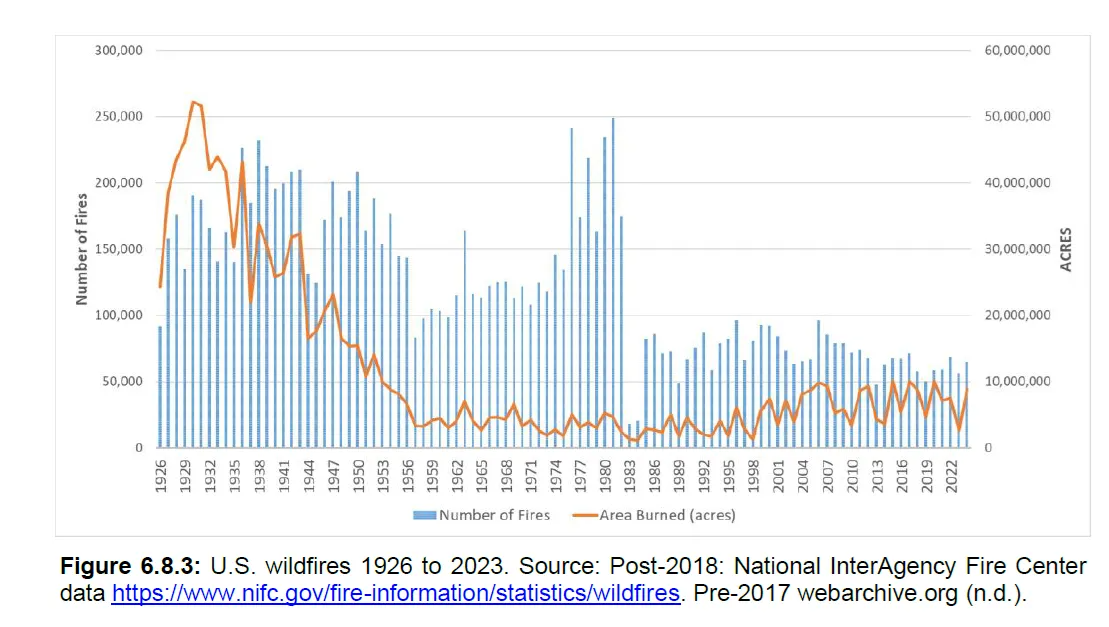
A few graphs from the report tell the story, and you can see them at the end of this article.

  1. US landfalling hurricanes show no long-term trends, either in frequency or intensity;
  2. Heatwaves were much worse than now before the 1960s;
  3. Temperature extremes are reducing, as a greater number of extremely hot days is more than offset by fewer extremely cold ones;
  4. There has been a marked decline in the number of the strongest tornadoes, EF3 to EF5, since the 1970s. The increased numbers of weaker tornadoes is the result of better observation methods, including Doppler radar, not an actual increase;
  5. US droughts were much more severe for most of the historical record going back to 1895;
  6. While wildfire activity has marginally increased since the 1980s, it was considerably worse up to the Second World War. Most of these long-term changes are caused by fire management practices, not climate changes;
  7. Tide gauges all around the US show the same story – a slow and steady sea level rise beginning in the mid 19thC. The rate of rise can vary considerably from station to station because of local factors. New York and the rest of the Atlantic Coast, for example, has been subsiding since the Ice Age; Galveston is sinking as a direct result of groundwater withdrawals.

The scientists pour scorn on weather attribution computer models, which have become the media’s go-to source for climate apocalypse stories. These attribution models routinely claim that extreme weather events have been made more likely because of global warming. They are dismissed in the report, which highlights the lack of high-quality data and reliance on deficient climate models. Other scientists have not been so kind!


The Korean War Week 59 – Who’s Really Running the Korean War? – August 5, 1951

Filed under: China, History, Military, USA — Tags: , , , , — Nicholas @ 04:00

The Korean War by Indy Neidell
Published 5 Aug 2025

The Kaesong peace talks keep dragging on, and where any demarcation line should be drawn continues to the biggest obstacle to progress. The war continues, though, and plans for new offensives and blockades are being hashed out. But who exactly are the forces fighting this war? This week we take a closer look at the Communist forces and the American chain of command.

Chapters
00:00 Hook
00:37 Intro
00:50 Recap
01:11 The 38th Parallel Issue
02:51 War Without Victory
04:58 US Chain of Command
09:21 Plans and Alternatives
10:58 UN Air Power
13:19 The Communist Forces
18:28 Summary
18:49 Conclusion
19:45 CTA
(more…)

Do journalists’ “unnamed sources” have to actually exist? Asking for an imaginary friend …

Filed under: Cancon, Media, Politics — Tags: , , , , — Nicholas @ 03:00

At The Rewrite, Peter Menzies discusses the growing trend of Canadian journalists depending on “unnamed sources” to fill in details in their political stories:

No name news image created by Grok, via The Rewrite

If I spun you a tale about my life as a mercenary in the 2012 Guinea-Bissau coup d’etat, I’d probably get your attention.

It would be a ripping good yarn, filled with evil masterminds, hints of Bond villains, precious relics, and blood diamonds. I might even sprinkle it with how I’d heard that the Ark of the Covenant is guarded quietly and stored in Nokolo-Koba National Park, not far from the Gambia River.

You might enjoy it. But I’m thinking you might ask for proof. Trust me, I would say, it’s not something I’m at liberty to discuss freely. Loose lips sink ships, these boys don’t like publicity, I’m not authorized, I wish to speak freely, etc. You’re going to have to put your faith in me.

Which, while I used hyperbole to make the point, is what the nation’s reporters are increasingly asking the public to do.

The once rare use of unnamed sources in the new “just trust me” world of Canadian journalism is getting out of control.

Exhibit A is a National Post story posted on May 23 in which readers learn of changes in the Prime Minister’s Office where staff are now expected to dress professionally and show up on time. In other words, a return to what most people would view as normal office decorum. Yes, you might wonder — as I did — why this constitutes news while the previous nine years’ shabbily-attired tardiness went unreported, but that would involve a significant digression. Another day, perhaps.

The sources were “half a dozen current and former PMO officials, senior bureaucrats and caucus members”, granted anonymity “to discuss internal workings of government openly”.

Two are “former” Liberal staffers, which makes one wonder if they might bear a grudge and what their motivations are. There is not a single named source in the story, nor is there any reference to the Post having asked the current management of the PMO for comment.

Exhibit B is the May 14 analysis on the pages of the Globe and Mail, which explains the thinking involved in selecting a finance minister. The thesis was based on “seven sources who have worked for Liberal and Conservative governments over the last two decades”, whose identities are being hidden “because they were not authorized by their parties to speak publicly about the federal finance minister”.

In Exhibit C, CBC/Radio Canada uses no fewer than 12 — count ’em — anonymous sources discussing whether party leader Pierre Poilievre should dismiss his chief of staff and recent campaign manager, Jenni Byrne. All were granted “confidentiality to discuss internal party matters”.

To his credit, the reporter selected sources offering a variety of perspectives on the issue. But still, other than reference to public statements by Poilievre, no one is on the record even for passive phrases such as “No one seems ready to make this their hill to die on”. Are there no political scientists left to comment on such topics?

Schmeisser MK-36,II – The Mechanics of the MP40

Filed under: Germany, History, Military, Weapons, WW2 — Tags: , , , — Nicholas @ 02:00

Forgotten Weapons
Published 24 Mar 2025

The German military began looking for a new submachine gun design in secret in the mid 1930s. There is basically no surviving documentation, but the main contenders appear to have featured: Hugo Schmeisser’s MK-36,II and Erma’s EMP-36. Today we are taking a look at the two known examples of the Schmeisser design at the British Royal Armouries. It is a simple blowback design with a full wooden stock, and chambered for 9x19mm (although the second example, made for Hungarian trials, is in 9x25mm). It does have a quite strange magazine safety, which prevents the bolt from opening if a magazine is not present — the purpose of this is a mystery to me.

The Schmeisser gun was simple and effective mechanically (expect for that weird safety), and it ultimately contributed its magazine, bolt, and fire control system to the MP38 and MP40 design. In exchange, the Haenel company that Schmeisser works for was one of the two initial MP38 manufacturers.

Many thanks to the Royal Armouries for allowing me to film and disassemble this unique prototype! The NFC collection there — perhaps the best military small arms collection in Western Europe — is available by appointment to researchers: https://royalarmouries.org/research/n…

You can browse the various Armouries collections online here:
https://royalarmouries.org/collection/
(more…)

QotD: Modern English night life

Filed under: Britain, Quotations — Tags: , , , , , — Nicholas @ 01:00

There are few sounds more frightening than that of the English young enjoying themselves. The English, it was once said, take their pleasures sadly; but now they take them loudly, which is far, far worse. Their pleasures are brutish, and the sounds the men emit while experiencing them are indistinguishable from those of a mob indignantly beating someone to death. As for the women, they never speak but they scream, as if being chronically raped. Of course, they all have to raise the level of their vocalizations because there is the perpetual background throb and thump of background music, or para-music, turned up to maximum volume, so that the ground vibrates beneath you like a ripple bed in an intensive care unit.

Recently I stayed overnight in a charming small cathedral city in England, genteel by day and Gomorrah by night. It is a little like H.G. Wells’ story The Time Machine, set 3,000 years hence, when humanity has divided into two: the effete, gentle, vegetarian diurnal Eloi, and the ugly, vicious, carnivorous nocturnal Morlocks, who emerge from underground once the sun goes down and prey on the Eloi.

I had booked no place to stay until the last minute, and found only a room above a cavernous, darkened bar, for me an antechamber of Hell, where the Morlock youth of the cathedral city gathered to enjoy themselves — or at least to pretend to do so, for I have long thought that those who cannot enjoy themselves without shouting and screaming are really hysterics, trying to convince themselves that they are enjoying themselves when actually they do not really know how to do so.

Theodore Dalrymple, “Evening Above the Hell-Bar”, Taki’s Magazine, 2019-12-16.

Powered by WordPress


