Quotulatiousness

July 29, 2025

EU Commission President Ursula von der Leyen triumphantly announces EU capitulation to Trump’s demands

Filed under: Bureaucracy, Economics, Government, Media, Politics, USA — Tags: , , , , — Nicholas @ 05:00

The EU and the United States are finalizing negotiations on bilateral trade issues that basically give Trump everything he wanted with very little in return for the EU’s concessions. It’s almost as if Trump has some kind of experience in negotiating lopsided agreements, isn’t it? I guess von der Leyen didn’t get Mark Carney’s memo on the importance of keeping your eLbOwS uP:
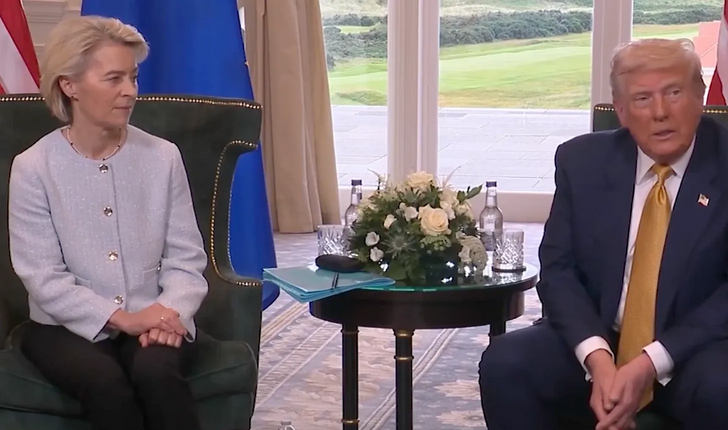
EU Commission President Ursula von der Leyen “[learning] in real time that weakness and submission do not in fact invite conciliation”

Donald Trump has shown up the European Union. He’s revealed that the world’s largest single market is a paper tiger to be kicked around, with basically no leverage or strength to resist American demands.

All of these supposedly fierce backroom tariff negotiations have yielded an incredibly one-sided deal – really an unparalleled embarrassment. As announced yesterday, the EU promises to invest $600 billion in the U.S. economy and to make $750 billion worth of “strategic purchases” of oil, gas and the like over the next three years. We also promise to buy a bunch of American military equipment. In return for giving the Americans $1.35 trillion, we earn the privilege of a 15% baseline tariff on all of our exports to America and we drop our own tariffs to zero. At least we don’t have to pay the 30% tariffs Trump threatened!

[…]

While von der Leyen was trying weakly to put a happy face on her total failure, Trump gave her what we might call a softer Zelensky treatment. He twisted the knife in the wound, calling out the idiocy of EU wind energy in an extended soliloquy that will surely keep the fact-checkers and the regime deboonkers up late for weeks to come. I transcribe his remarks in full, because the whole moment was wonderful:

    And the other thing I say to Europe, we will not allow a windmill to be built in the United States. They’re killing us. They’re killing the beauty of our scenery, our valleys, our beautiful plains. And I’m not talking about airplanes. I’m talking about beautiful plains, the beautiful areas in the United States. And you look up and you see windmills all over the place. It’s a horrible thing. It’s the most expensive form of energy. It’s no good.

    They’re made in China, almost all of them. When they start to rust and rot in eight years, you can’t really turn them off. You can’t bury them. They won’t let you bury the propellers, you know, the props, because they’re a certain type of fiber that doesn’t go well with the land. That’s what they say. The environmentalists say you can’t bury them because the fiber doesn’t go well with the land. In other words, if you bury it, it will harm our soil.

    The whole thing is a con job. It’s very expensive. And in all fairness, Germany tried it and, wind doesn’t work. You need subsidy for wind and energy should not need subsidy. With energy, you make money. You don’t lose money.

    But more important than that is it ruins the landscape. It kills the birds. They’re noisy. You know, you have a certain place in the Massachusetts area that over the last 20 years had one or two whales wash ashore and over the last short period of time they had 18, okay, because it’s driving them loco, it’s driving them crazy. Now, windmills will not come, it’s not going to happen in the United States, and it’s a very expensive …

    I would love to see, I mean, today I’m playing the best course I think in the world, Turnberry, even though I own it, it’s probably the best course in the world, right? And I look over the horizon and I see nine windmills. It’s like right at the end of the 18. I said, “Isn’t that a shame? What a shame.” You have the same thing all over, all over Europe in particular. You have windmills all over the place.

    Some of the countries prohibit it. But, people ought to know that these windmills are very destructive. They’re environmentally unsound. Just the exact opposite. Because the environmentalists, they’re not really environmentalists, they’re political hacks. These are people that, they almost want to harm the country. But you look at these beautiful landscapes all over all, over the the world. Many countries have gotten smart. They will not allow it. They will not. It’s the worst form of energy, the most expensive form of energy. But, windmills should not be allowed. Okay?

All the while von der Leyen had to sit there, absolutely frozen except for a curiously accelerated rate of blinking, as she learned in real time that weakness and submission do not in fact invite conciliation.

In Spiked, Jacob Reynolds agrees that the deal is a humiliation for the European Union:

So this is the famous “trade superpower”. After months of tough talk, European Commission president Ursula von der Leyen announced a trade deal with Donald Trump this week which is nothing short of total capitulation. The Commission has accepted a 15 per cent baseline US tariff on most EU goods, agreed to purchase $750 billion worth of American gas and procure billions more of US military kit. What did Queen Ursula get in return? Nothing.

“VDL”, as she is known in the Brussels Bubble, tried desperately to spin this as a win. Sitting anxiously next to Trump in Scotland last weekend, she recited impressive-sounding numbers – such as the EU and US’s combined 800million consumers and the EU’s $1.7 trillion trade volume – like a nervous student. Trump cut through the spin by greeting the deal as fantastic for US cars and agriculture. He didn’t need to say much else – indeed, it was clear for all to see that there was only one winner in this deal.

For decades, even critics of the EU had to concede that whatever its many economic and democratic shortcomings, it still possessed enormous leverage when it came to trade. At the very least, it was more than capable of defending EU interests in trade deals. Evidently, this is no longer the case. When even the hapless government of Keir Starmer can negotiate a better trade deal with Trump, the problems with the EU should be clear to see. (Tariffs on most UK goods are just 10 per cent.)

Even the most ardent Europhiles have found it hard to put a positive spin on the deal. Manfred Weber, leader of the European People’s Party (a coalition of Europe’s legacy centre-right parties) described it as “damage control” and better than not reaching a deal at all. Guy Verhofstadt, former prime minister of Belgium and usually the most maniacal of EU fanboys, slammed the deal as not only “badly negotiated”, but also “scandalous” and a “disaster”, with “not one concession from the American side”. Member states, from Ireland to France, have been similarly unenthusiastic. Yet the brutal truth is that the deal reflects how America views the EU – as strategically weak and politically empty.

Trump has taught the EU a harsh lesson in statecraft. The EU has long relied on its neighbours for energy production. It has long underinvested in defence. And now it throttles its biggest industries with green dogma. This left it with little leverage for the negotiations with the US.

Of course, after Mark Carney being elected on a highly dubious platform of being “the right person to deal with Trump”, this is almost inevitable at this stage:
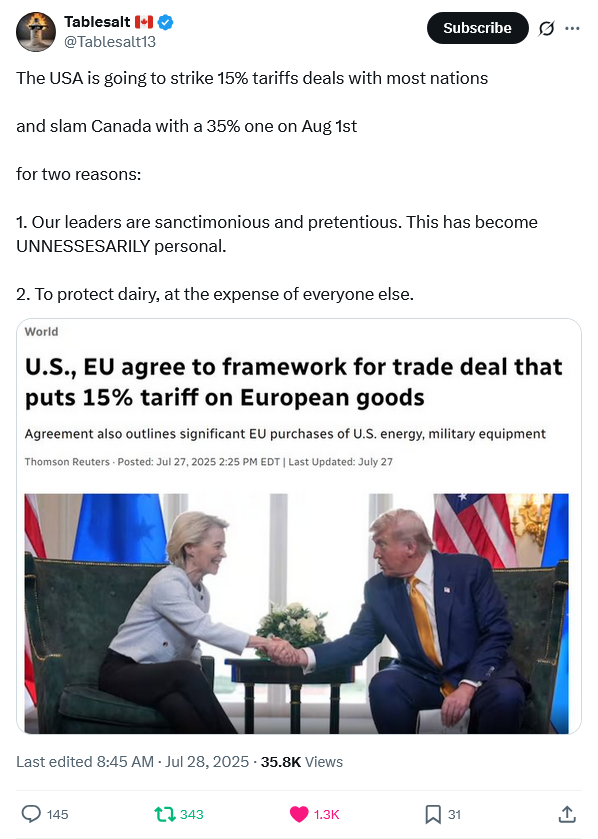

“The free and open internet has now ceased to exist in the UK”

Britain, like Canada, has been moving toward a less free internet experience for ordinary users, the key bit of legislation in the UK being the Online Safety Act, which like Canada’s proposed Online Harms Act, provides tools to the government to clamp down on online activities they deem “unsafe”:

The free and open internet has now ceased to exist in the UK. Since Friday, anyone in Britain logging on to social media will have been presented with a censored, restricted version – a “safe” internet, to borrow the UK government’s language. Vast swathes of even anodyne posts are now blocked for the overwhelming majority of users.

The Online Safety Act was passed by the last Conservative government and backed enthusiastically by Labour. Both parties insisted it is necessary to protect children. Supposedly, its aim is to shield them from pornography, violence, terrorist material and content promoting self-harm. Age-verification checks, we were assured, would ensure that children would not be exposed to inappropriate content, but adults could continue using the internet as they please. Yet as we have seen over the past few days, on many major tech platforms, UK-based adults are being treated as children by default, with supposedly “sensitive” content filtered from everyone’s view.

Predictably, what is deemed “sensitive” and therefore censored goes well beyond pornography and obviously illegal or adult material. Already UK users of X have been blocked from viewing footage of an anti-asylum protest, a tweet calling for single-sex spaces and a video of a speech in parliament on the grooming-gangs scandal. Historical trivia, such as a thread on Richard the Lionheart, and classic artworks like Goya’s Saturn Devouring His Son have been shielded by the tech censors. A thread on X of examples of what has been censored under the Online Safety Act, collated by Benjamin Jones of the Free Speech Union, has itself been partially censored due to the Online Safety Act. Open, political debate online is now a thing of the past.

When the Online Safety Act was first put before parliament, supporters from all parties insisted that fears about its impact on free speech were overblown. “The worst misrepresentation I’ve heard is that the [Online Safety Act] will force tech companies to censor legal social-media posts”, insisted Chris Philp, the then minister for tech and digital economy, now the shadow home secretary, back in 2022. Anyone who warned that this vast new architecture of online speech regulation was obviously going to curtail free speech was presented as a friend of paedophiles, terrorists or the far right. This gaslighting was kept up right until the point the age filters were implemented. “The UK’s online safety regime is here. Will anybody notice?”, asked Politico the day before much of the internet disappeared. The Guardian, on the same day, pondered whether the new rules would be censorious enough.

Despite my financial plight, I’d been considering getting a VPN subscription in advance of the Canadian government getting some version of the Online Harms Act onto the books. Clearly many Brits had already gone that route, and the British government reacts with the care and subtlety one would expect:

Crimes less serious than “Mischief” according to Canadian courts

Filed under: Cancon, Government, Law, Media, Politics — Tags: , , , — Nicholas @ 03:00

In the National Post, Tristin Hopper notes that the sentences being sought for Freedom Convoy 2022 organizers Tamara Lich and Chris Barber are more severe than prosecutors have asked for what appear to be far more serious crimes:

Chris Barber and Tamara Lich

Last week, Crown prosecutors announced they were seeking jail sentences of up to eight years for Tamara Lich and Chris Barber, two organizers of the Freedom Convoy protest.

Both were convicted of mischief, but the Crown is seeking a minimum sentence of seven years in jail for Lich, and eight for Barber, who was also found guilty of counselling others to disobey a court order.

The Crown has argued that the disruptiveness of the Freedom Convoy blockades warrants the harsh sentence, but in a statement this week, Conservative Leader Pierre Poilievre said courts are throwing the book at Barber and Lich while simultaneously giving free reign to “rampant violent offenders” and “antisemitic rioters”.

It’s certainly the case that you can do an awful lot of heinous things in Canada before a prosecutor would ever think of asking for seven years. Below, a not-at-all comprehensive list of things you can do in Canada, and have the Crown seek a lighter sentence than the one they’re seeking for the organizers of the Freedom Convoy.

  • Sexually assaulting a baby [5 to 6 years]
  • Using a car filled with guns to ram into Justin Trudeau’s house [6 years]
  • Killing multiple innocent people via drunk driving [5 years]
  • Stabbing a man to death because he told you to stop abusing your girlfriend [5 years]
  • Being a police officer who stalks and sexually harasses crime victims [6 months]
  • Amassing enough child pornography to fill a video store [3 and a half years]
  • Torturing a toddler to death [7 to 8 years]
  • Intentionally ramming a car loaded with children and pregnant women [8 years]
  • Beating a fellow homeless shelter resident to death [5 and a half years]
  • Raping a minor and bragging about it online [4 to 5 years]

The Original Girl Scout Cookie Recipe from 1922

Filed under: Food, History, USA — Tags: , , , — Nicholas @ 02:00

Tasting History with Max Miller
Published 25 Feb 2025

The original Girl Scout sugar cookies, some round, some cut with my 1950s Girl Scout cookie cutter (post-baking)

City/Region: United States of America
Time Period: 1922

During the early years of Girl Scout cookies, the girls would bake the cookies themselves. This recipe, from The American Girl, the magazine published by the Girl Scouts, is from the first year of the official cookie sales in 1922. The scouts would continue to bake the cookies they sold for 12 more years until the task was turned over to commercial bakeries in 1934.

These are fairly standard sugar cookies, but they are delicious. They bake up nice and crispy, and the sugar sprinkled on top is a lovely touch. I could easily see myself eating dozens of them without even noticing.

    ATTENTION SCOUTS! FORWARD MARCH! BAKE! SELL!
    This is your chance to show how much Scouting means to you.
    GIRL SCOUT COOKIES
    1 cup of Butter, or substitute
    1 cup of sugar
    2 tablespoons of milk
    2 eggs
    1 teaspoon of vanilla
    2 cups of flour
    2 teaspoons of baking powder

    Cream butter and sugar, add well beaten eggs, then milk, flavoring, flour and baking powder. Roll thin and bake in quick oven. (Sprinkle sugar on top.) This amount makes six to seven dozen.
    The American Girl magazine, 1922.

(more…)

QotD: Thucydides wasn’t articulating a deterministic law of geopolitics – he was writing a tragedy

If you’re 45 and above, you will remember how much fear Japan stoked in the hearts of Wall Street in the 1980s when their economy was booming and their exports sector exploding. There were major concerns that the Japanese economy would leap ahead of the USA’s, and that it would result in Japan discarding its constitutional pacifism in order to spread its wings once more throughout the Pacific.

These concerns were not limited to the fringes, they were real. So real were they that respected geopolitical analysts like George Friedman (later of Stratfor) wrote books like [The Coming War With Japan] The argument was that an upstart like Japan would crash head first into US economic and security interests, sparking another war between the two. This conflict was inevitable because challengers will always seek the crown, and the king will always fight to maintain possession of it.

Suffice it to say that this war did not come to pass. The Japanese threat was vastly overstated, and its economy has been in stagnation-mode for decades now (even though living standards remain very high in relative terms). What may seem inevitable need not be.

The next several years will see marked increase in tension between the USA and China, as the former completes its long awaited “Pivot to East Asia”. So anxious are the Americans to pivot that they have been threatening to “walk away” from Ukraine if they cannot hammer down a peace deal in the very near future. This indicates just how serious a threat they view China’s ascent to be to its economic and security interests. If they are willing to sacrifice more in Ukraine than originally intended, the implication is that China’s rise is a grave concern, and that a clash between the two looks very likely … some would argue that it is inevitable, appealing to a relatively new IR concept called the “Thucydides Trap“.

Andrew Latham explains the concept to us, arguing that Thucydides is misunderstood, making conflict between rising powers and hegemons not necessarily inevitable:

    The so-called Thucydides Trap has become a staple of foreign policy commentary over the past decade or so, regularly invoked to frame the escalating rivalry between the United States and China.

    Coined by political scientist Graham Allison — first in a 2012 Financial Times article and later developed in his 2017 book Destined for Warthe phrase refers to a line from the ancient Greek historian Thucydides, who wrote in his History of the Peloponnesian War, “It was the rise of Athens and the fear that this instilled in Sparta that made war inevitable.”

Distortion:

    At first glance, this provides a compelling and conveniently packaged analogy: Rising powers provoke anxiety in established ones, leading to conflict. In today’s context, the implication seems clear – China’s rise is bound to provoke a collision with the United States, just as Athens once did with Sparta.

    But this framing risks flattening the complexity of Thucydides’ work and distorting its deeper philosophical message. Thucydides wasn’t articulating a deterministic law of geopolitics. He was writing a tragedy.

This essay might be an exercise in historical sperging, but I think it has value:

    Thucydides fought in the Peloponnesian War on the Athenian side. His world was steeped in the sensibilities of Greek tragedy, and his historical narrative carries that imprint throughout. His work is not a treatise on structural inevitability but an exploration of how human frailty, political misjudgment and moral decay can combine to unleash catastrophe.

    That tragic sensibility matters. Where modern analysts often search for predictive patterns and system-level explanations, Thucydides drew attention to the role of choice, perception and emotion.

    His history is filled with the corrosive effects of fear, the seductions of ambition, the failures of leadership and the tragic unraveling of judgment. This is a study in hubris and nemesis, not structural determinism.

    Much of this is lost when the phrase “Thucydides Trap” is elevated into a kind of quasi-law of international politics. It becomes shorthand for inevitability: power rises, fear responds, war follows.

Therefore, more of a psychological study of characters rather than structural determinism.

Giving credit to Allison:

    Even Allison, to his credit, never claimed the “trap” was inescapable. His core argument was that war is likely but not inevitable when a rising power challenges a dominant one. In fact, much of Allison’s writing serves as a warning to break from the pattern, not to resign oneself to it.

Misuse:

    In that sense, the “Thucydides Trap” has been misused by commentators and policymakers alike. Some treat it as confirmation that war is baked into the structure of power transitions — an excuse to raise defense budgets or to talk tough with Beijing — when in fact, it ought to provoke reflection and restraint.

    To read Thucydides carefully is to see that the Peloponnesian War was not solely about a shifting balance of power. It was also about pride, misjudgment and the failure to lead wisely.

    Consider his famous observation, “Ignorance is bold and knowledge reserved”. This isn’t a structural insight — it’s a human one. It’s aimed squarely at those who mistake impulse for strategy and swagger for strength.

    Or take his chilling formulation, “The strong do what they will and the weak suffer what they must”. That’s not an endorsement of realpolitik. It’s a tragic lament on what happens when power becomes unaccountable and justice is cast aside.

and

    In today’s context, invoking the Thucydides Trap as a justification for confrontation with China may do more harm than good. It reinforces the notion that conflict is already on the rails and cannot be stopped.

    But if there is a lesson in The History of the Peloponnesian War, it is not that war is inevitable but that it becomes likely when the space for prudence and reflection collapses under the weight of fear and pride.

    Thucydides offers not a theory of international politics but a warning — an admonition to leaders who, gripped by their own narratives, drive their nations over a cliff.

Latham does have a point, but events have a momentum all their own, and they are often hard to stop. Inevitabilities do exist, such as Israel and Hezbollah entering into conflict with one another in 2022 after their 2006 war saw the latter come out with a tactical victory. Barring a black swan event, the USA and China are headed for a collision. The question is: in what form?

Niccolo Soldo, “Saturday Commentary and Review #188 (Easter Monday Edition)”, Fisted by Foucault, 2025-04-21.

Powered by WordPress