Quotulatiousness

June 25, 2025

It’s fine to refer to their bead-and-feather superstitious beliefs as a mythology, but not our holy revealed faith!

Filed under: Europe, History, Religion — Tags: , , , , , — Nicholas @ 05:00

kulak responds to the “do you really believe this?” question:
One of the reoccurring critiques and challenges I get from Christians and others regarding Paganism is the accusation that I don’t “Really” believe in the Pagan Gods … that I believe or “believe” only as some calculated political/philosophical expedient or aesthetic choice and that really my professed “belief” is some sort of white or darker shade of lie or “LARP”, and that I must plainly KNOW that the Greek, Roman, Nordic, Celtic and other pantheons and only legends, mere mythologies, and cute stories …

I wish I could find it … but there was actually a twitter thread about a group of Christians and Jews responding with OUTRAGE when a group of academics, quite detachedly and seemingly meaning nothing by it, referred to Behemoth, Leviathan, the Flood, the Destruction of Sodom and Gomorrah, David’s defeat of Goliath, Adam and Eve, the Nephilim, the Plagues of Egypt, and Abraham and Issac as stories and figures of “Hebrew Mythology”.

“Mythology” to their mind was not a neutral term referring merely to cultural stories of a supernatural or historically unverifiable nature whose historicity, origin, and attachment to actual events cannot be verified to the standard of primary history — Stories of cultural import which may or may not be true or fictionalized to some extent we can’t differentiate (Imagine if Gone with the Wind was the last American book to survive and then arguing the Battle of Atlanta was fictional and never happened), the way Homer’s account of the sloped walls of Troy turned out to be shockingly accurate when Troy was found, whereas his accounts of Chariot warfare seemed to be confused by the subsequent 300 years without Greeks employing chariot archers. Rather “Mythology” to their minds denotes FALSE STORIES. SUPERSTITIONS with no attachment to reality, and thus to refer to even the most fantastical and supernatural of biblical stories as events or aspects of “Hebrew Mythology” was to state the Bible was false.

Troy, Gilgamesh, the Arthurian Legends, the Buddha, the conquests of Mohammed, the war of the Three Kingdoms, the Battle of Goths and Huns, the Hiawatha, the Wendigo, Quetzalcoatl (the God and the hypothesized historical ruler), the various unconfirmed Pharaoh stories, the Mormon Corpus … THESE ARE MYTHOLOGY. Even the stuff that’s been archeologically confirmed. Our collection of of texts and books though … you can’t call that mythology. It’s the truth!

Ironically many of these same people within nearly the same breath that they accuse me of being a “LARPER” will also accuse me of making pacts with “Demons” and claim that the beings I believe in are in fact vastly more real than I can possibly comprehend and that I am playing with the most dangerous of hellfire … so pressingly REAL and dangerous are the Ancient “Gods” who are actually Satanic Demons in barely concealed disguise.

Somehow I am simultaneously a cringe 90s mall goth playing at witchcraft and also a Later-Day Faustus dealing in a damnable deadly game with the Devil himself.

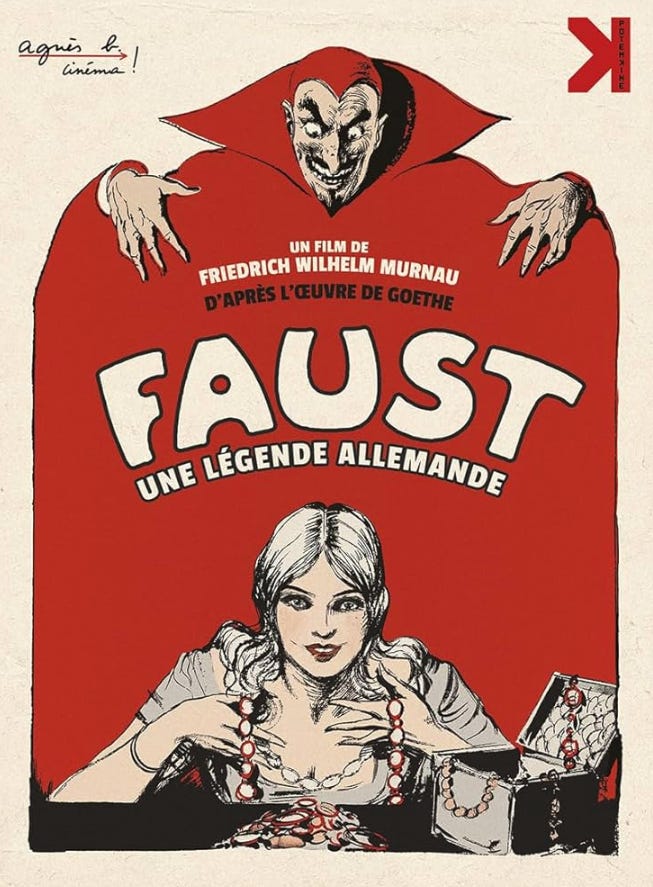
Amazing film BTW (Faust 1926)

“But do you actually believe in the Pagan Gods?”

Yes. Vastly more deeply and in more ways than the vast majority of Christian believe in their religion.
The Korean War Week 53 – Moscow Says ‘End the War!’ – June 24, 1951

The Korean War by Indy Neidell
Published 24 Jun 2025

Soviet Ambassador Jacob Malik speaks to the world on UN radio, saying that the Soviet position on Korea is that ceasefire talks should begin among the belligerents. The Americans are thinking of how they can bring in more non-American UN units, even as South Korean President Syngman Rhee denounces the British and Commonwealth forces and says they should go home.

00:00 Intro
00:41 Recap
01:07 Jacob Malik Speaks
02:02 Chinese Change Plans
03:19 10th Corps Advances
05:37 More Non-American UN Units
07:52 Rhee Denounces his Allies
12:17 Summary
12:40 Conclusion
14:15 Call to action
(more…)

Experts – “The shorter, the better”. Audiences – “Gimme more long-form, stat!”

Filed under: Books, Media — Tags: , , — Nicholas @ 03:00

At The Honest Broker, Ted Gioia notes that the experts are all-in on shorter videos, but actual audiences are clearly now more interested in much longer-form treatments:

When I saw the numbers, I couldn’t believe them.

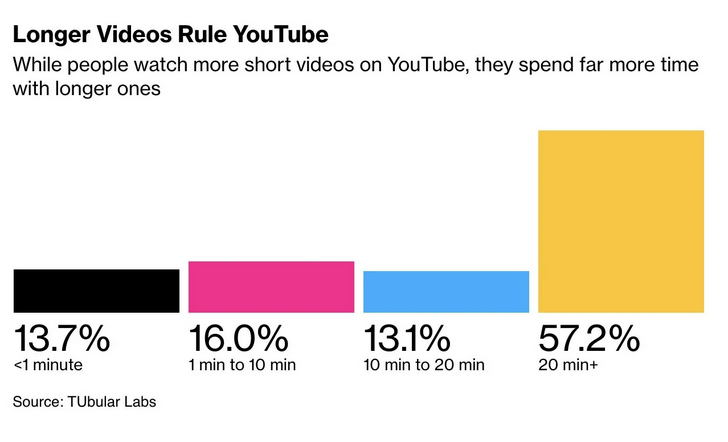
Every digital platform is flooding the market with short videos, but the audience is now spending more time with longform video — and by a huge margin.

Source: Tubular Labs

Some video creators have already figured this out. That’s why the number of videos longer than 20 minutes uploaded on YouTube grew from 1.3 million to 8.5 million in just two years.

That’s a staggering six-fold increase. But even short videos are now getting longer. Social media consultants call this the “long short” format. Sometimes they are used as teasers to draw viewers to still longer media (often on another platform).

Movies are also getting longer. At first glance, that makes no sense — more people are watching films at home on small digital devices, where Hollywood fare has to compete with bite-sized junk from TikTok and Instagram.

You might think that filmmakers would feel forced to compress their storytelling, but the opposite is true. They are learning that audiences crave something longer and more immersive than a TikTok.

At first, Hollywood insiders tried to imitate the ultra-short aesthetic, but they failed — sometimes in colossal fashion. (Does anyone remember the Quibi fiasco?)

Now they not only embrace long films, but happily release sprawling mega-movies longer than the Boston Marathon. Dune Two ran for 166 minutes — not even Eliud Kipchoge does that. Oppenheimer clocked in at 180 minutes. Scorsese’s Killers of the Flower Moon lasted a mind-boggling 206 minutes.

The studios would have vetoed these excesses just a few years ago. Not anymore.

Songs are also getting longer. The top ten hits on Billboard actually increased twenty seconds in duration last year. Five top ten hits ran for more than five minutes.

Two of those long hit songs came from Taylor Swift — who has been a champion of longer immersive musical experiences, most notably in her insanely successful Eras tour. She set the record for the biggest money-generating roadshow in music history, and did it with a performance twice as long as a Mahler symphony.

These Swift concerts run for three-and-a-half hours (just like Scorsese at his most maniacal), and include more than 40 songs. They’re grouped in ten separate acts, each built around a different era in her career.

Ten acts? Really?

Even Wagner stopped short of that. But the Eras tour generated more than $2 billion in revenues. And all this happened while experts were touting 15-second songs on TikTok as the future of music.

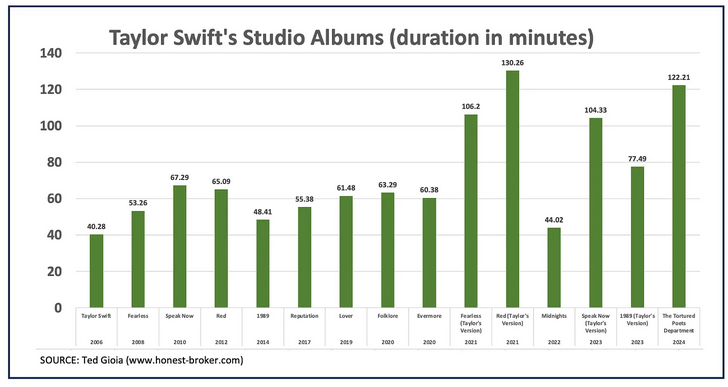
I’ve charted the duration of Swift’s studio albums over the last two decades, and it tells the same story. She has gradually learned that her audience prefers longer musical experiences.

The New York Times complained about the length of her most recent album — calling it “sprawling and often self-indulgent.” It mocked her for believing that “more is more.”

It summed up her whole worldview with a dismissive claim that she has fallen in love with “abundance”. In fact, the Times opened its article with that accusation.

But I note that a year after the Times laughed at Swiftian abundance, the hottest topic in the culture is a book with that same word as its title. (Full disclosure: I’ll be doing a live Substack conversation with its co-author Derek Thompson in a few days.)

Abundance has dominated the New York Times non-fiction bestseller list for the last several months. Even more to the point, the word seems to tap into the public’s hunger for something bigger, deeper, and more expansive than it’s been getting.

H.G. Wells’ Things To Come: Through The Eyes of its Time

Feral Historian
Published 10 Jan 2025

H.G. Wells’ Things To Come played much differently in 1936 than it does today. So much so that it offers us an insight into the politics of the period if we can step back from our post-WWII understanding and look at it on its own terms.

Link to the Coupland essay.
http://digamoo.free.fr/coupland2000.pdf

00:00 Intro
02:08 Revolution Envy
05:15 The Gulf of Time
06:32 Wells and the BUF
08:02 Empire and Establishment
12:11 The World State
15:18 To Understand the Past …

QotD: Marie Antoinette and the “Diamond Necklace” scandal

Filed under: France, History, Quotations — Tags: , , , — Nicholas @ 01:00

Today, the Diamond Necklace affair has been relegated to the status of sensational footnote in history books about the French Revolution. Throughout the 19th century, however, the scandal was widely believed to have been a major factor in the overthrow of the Bourbon monarchy. Decades after the French Revolution, Napoleon observed from the vantage point of his post-Waterloo exile: “The Queen’s death must be dated from the Diamond Necklace trial”. […] And here’s the irony: While the Diamond Necklace affair was the scandal that most tarnished Marie Antoinette’s reputation, it was one in which she was almost certainly guiltless.

The origins of the affair stretched back to Louis XV, who wished to lavish on his mistress, Madame du Barry, a splendid diamond necklace containing 647 stones and weighing 2,800 carats (worth roughly $15 million today). But Louis XV died before the sale of the necklace was concluded. And when young Louis XVI took the throne, the Paris jewelers Boehmer and Bassenge hoped the new king would purchase the same necklace for his own queen, Marie Antoinette. However, she refused to accept a piece of jewelry that had been created for the previous king’s mistress.

Meanwhile, a socially ambitious minor aristocrat named Jeanne de la Motte was plotting to get her hands on the necklace. Married to the Comte de la Motte, she was also the mistress of Cardinal de Rohan, former French ambassador to Marie Antoinette’s native Austria. Madame de la Motte managed to convince Cardinal de Rohan not only that Marie Antoinette wished to possess the necklace, but that she was acting on the Queen’s behalf. He could ingratiate himself at court, she insisted, by obtaining it. Cardinal Rohan foolishly purchased the necklace on credit, under the naive belief that he’d be repaid by Marie Antoinette. The scam concluded with Madame de la Motte stealing the necklace from the cardinal and, using her husband’s louche connections, selling it in pieces through fences in England.

This tawdry business was closer to comic opera than an affair of state. But when the fraud was discovered, the scandal gripped Parisian society. Louis XVI was so infuriated that he had Cardinal de Rohan arrested and imprisoned in the Bastille, which only heightened public interest. Marie Antoinette was already being caricatured in pamphlets as a depraved nymphomaniac. It was now open season.

In some caricatures, she appeared as a wild beast, a tiger feeding on the French nation. In others, she was depicted as an ostrich, a French wordplay with her home country Autriche, for Austria, which reads like autruche for ostrich. Even worse, she was depicted in pornographic postures, legs open and genitals gaping, cuckolding her obese husband with a succession of lovers, including lesbian trysts. Allusions to her sexual appetites suggested a carnal relationship with Satan. Robespierre’s publication Le Journal des hommes libres described her as “more bloodthirsty than Jezebel, more conniving than Agrippina”. The pamphlets blamed Marie Antoinette for all the nation’s misfortunes, including economic recession. She was so hated by the French public that there were serious concerns for her physical safety.

[…]

Cardinal de Rohan, meanwhile, was tried for his role in the Diamond Necklace affair. Astonishingly, he was acquitted. The scheming Madame de la Motte met a different fate. She was found guilty of theft and sentenced to be whipped and branded on the shoulder with the letter V for voleuse (thief). She was also incarcerated in the Salpêtrière prison in Paris, but escaped to London. In 1789, she published a book, Mémoires justificatifs, a scathing tell-all memoir about Marie Antoinette. It was a good year to attack the French monarchy, for the revolution was just getting going. Madame de la Motte was never returned to France to face justice. Exiled in London, she died in 1791 after falling from a window, apparently fleeing debt collectors. She was buried in St. Mary’s Churchyard in south London.

Matthew Fraser, “Marie Antoinette: Figure of Myth, Magnet for Lies”, Quillette, 2020-06-24.

Powered by WordPress