
In the New York Times (don’t worry … link is to an archived version), Nathan Levine explains to NYT readers why there is such a push back against the over-mighty technocratic organizations that have been running more and more of our fading civilization:
It is the culmination of a once marginalized, now transformative strand of political thought about who really holds power in the modern American system. Namely, that our democracy has been usurped by a permanent ruling class of wholly unaccountable managers and bureaucrats.
Anti-managerialism is back. Well positioned to answer decades of frustration with mainstream conservatives’ failure to deliver results, this old idea has become the central principle of the new right.
In fact, much of what is commonly called “populist” politics can be more accurately described as part of an anti-managerial revolution attempting to roll back the expansion of overbearing bureaucratic control into more and more areas of life.
Though it has so far met with limited success amid stiff resistance, grasping the nature of this anti-managerialism is essential to understanding the Trump administration’s effort to transform America’s institutional landscape, from government to universities and major corporations.
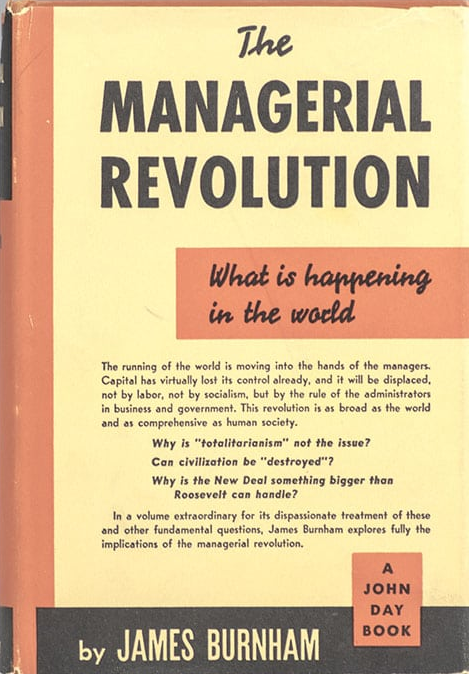
The idea’s intellectual history begins with the political philosopher James Burnham, who argued in his seminal 1941 book, The Managerial Revolution, that the aristocratic capitalist class was in the process of being overthrown by a revolution — just not, as the Marxists predicted, by the working class.
Instead, the exponential growth of mass and scale produced by the Industrial Revolution meant that in both corporation and state it was now those people cleverest at applying techniques of mass organization, procedure and propaganda — what he called the managerial class — who effectively controlled the means of production and would increasingly come to dominate society as a new technocratic oligarchy.
The book made an especially significant impression on George Orwell, who remarked that a managerial class consisting of “scientists, technicians, teachers, journalists, broadcasters, bureaucrats, professional politicians: in general, middling people”, hungry for “more power and more prestige”, would seek to entrench “a system which eliminates the upper class, keeps the working class in its place, and hands unlimited power to people very similar to themselves”.
Orwell was particularly struck by Burnham’s observation that the major political systems of the day — fascism, Communism and New Deal-era social democracy — were fundamentally similar in their turn toward the bureaucratic management of society. He observed that everywhere “laissez-faire capitalism gives way to planning and state interference” and “the mere owner loses power as against the technician and the bureaucrat”. Believing that accelerating managerial control risked dragging every society inexorably into totalitarianism, Orwell made Burnham’s ideas the basis of his novel 1984.
While the Cold War persisted, the view that America’s government might share some traits with the Soviet Union unsurprisingly proved unpopular, especially among Washington’s conservative establishment.
Nonetheless, the managerial class continued to grow, regardless of which political party controlled the government. Cold War defense budgets drove a relentless expansion of security state bureaucracy and the military-industrial complex. The advent of Great Society welfare programs and the Civil Rights Act demanded a re-engineering of social relations, prompting a dramatic proliferation of lawyers, regulatory bureaucrats and corporate compliance officers throughout much of public and private life. An ever-greater proportion of Americans began funneling through the credentialing machinery of higher education, inflating demand for yet more upper-middle-class managerial jobs.


