
In The Free Press Rupa Subramanya discusses King Charles’s land acknowledgement at the start of the Throne Speech earlier this week:
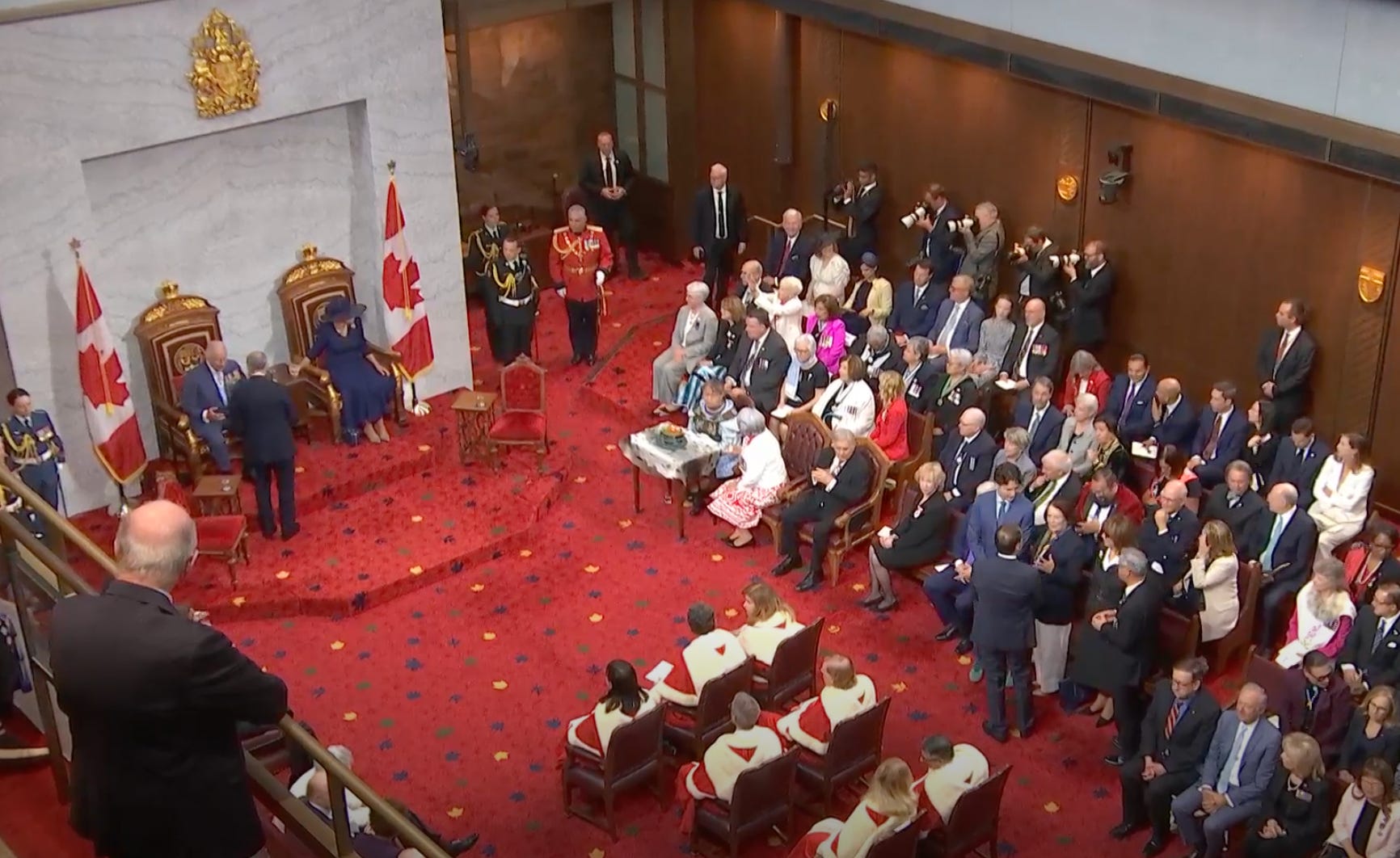
Mark Carney joins our visiting King in the traditional Making of the Small Talk.
Photo by Paul Wells from his Substack
Canadians have a fondness for land acknowledgments, [NR: while some of us think they’re merely virtue signalling on steriods which will end up causing more mischief in the long run] which have now become common at police press conferences, on Air Canada flights, at hockey games, and even at a Taylor Swift concert.
But nothing has caused more commotion than the spectacle of King Charles III opening the 45th legislative session of Parliament on May 27 with a land acknowledgment, when he declared from his throne: “I would like to acknowledge that we are gathered on the unceded territory of the Algonquin Anishinabe people. This land acknowledgment is a recognition of shared history as a nation.”
People will point out that King Charles’s speech was written by Canadian prime minister Mark Carney’s government (true) and that as the monarch he was being respectful to Canadian traditions (fine). But there is something deeply funny about the literal King of England talking about the lands his predecessors brutally conquered centuries ago like they’re still up grabs.
Kicking off Parliament with a speech is a time-honored tradition, but it’s rare for the monarch to deliver it in person, and is normally delivered by the governor general, Canada’s official stand-in for the king. The reason the king was there was to push back against the idea that Canada is for sale.
“There is no better way to assert Canada’s sovereignty than by inviting the sovereign,” said Philippe Lagassé, a constitutional expert at Carleton University in Ottawa, Ontario. “Carney invited the king as part of his renewed emphasis on Canadian nationalism rooted in our institutions and history.” (Unlike the U.S., which broke from Britain in 1776, Canada remained a colony until 1867, when it became a constitutional monarchy with a British-style parliamentary system and the UK monarch as head of state.)
Lagassé added that Carney’s invite to Charles was also likely done to “leverage President Trump’s affection for the king in Canada’s favor.”
Trump may love the monarchy, but Canadians have traditionally been indifferent towards it. But that’s changing, thanks to Trump’s “51st state” rhetoric.
According to a recent poll, 66 percent of Canadians now believe the monarchy helps set the country apart from the United States, up from 54 percent in April 2023. In 2023, 67 percent thought the royal family should have no formal role in Canadian society; today, that number has dropped to 56 percent.
In his speech, King Charles didn’t mention Trump by name, but the subtext was hard to miss: “Canada faces another critical moment. Democracy, pluralism, the rule of law, self-determination, and freedom are values which Canadians hold dear, and ones which the government is determined to protect.”


