
James Pew reviews Douglas Murray’s latest book, On Democracies and Death Cults: Israel and the Future of Civilization (I was first made aware of the book by the sudden uptick in antisemitic posts on social media that directly attacked Murray and his work).
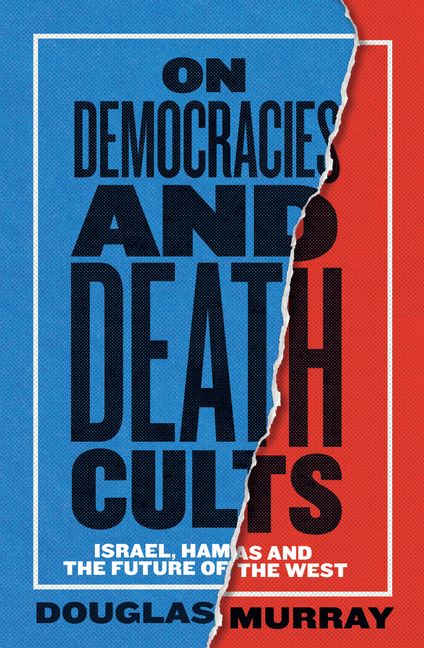
The opening words of On Democracies and Death Cults by Douglas Murray contains a disturbing fact about the situation Israel, and the entire Western world, were thrust into immediately following the barbaric terrorist attacks of October 7, 2023:
Sometimes a flare goes up and you get to see exactly where everyone is standing.
Indeed. Out of all the conflicts occurring all over the world, many of which are more devastating by orders of magnitude and in terms of the scale of humanitarian catastrophe than the IDF’s Gaza campaign, why would Westerners care so much about it? Why do Canadians and Americans take to the streets and occupy college campuses over it? These and many other vital questions are asked by Douglas Murray in On Democracies and Death Cults.
So why should this particular October 7th event, and the IDF’s subsequent military response, which is taking place halfway around the world, be the one that reveals “exactly where everyone is standing”? Murray knows the answer, as do his readers and most clear thinking people who do not harbour secret loathing’s for the Jewish people. The reason is clear and plain as day: the Jews are defending themselves and their homeland from a terroristic death cult bent on their destruction, but for some reason hoards of people from all political stripes from virtually all corners of the world, believe this to be a wholly unacceptable thing for the Jews to do.
The shame I felt for Canada, or more correctly, for things that had been allowed to take place in Canada following the October 7th massacre in Israel, was immediately apparent in the introduction when Murray wrote:
In Canada alone, after October 7, synagogues were firebombed and shot at, Jewish schools were shot at, Jewish shops were fire-bombed, and Jewish-owned bookshops were vandalized.
Future generations will need to contend with the fact that in the immediate aftermath of the worst crisis to strike the Jewish people since the Holocaust, anti-Semitism erupted throughout the West. An inexplicable “shapeshifting” hatred that “locks Jews in an unresolvable set of challenges.” Murray writes:
Jews were once hated because of their religion. Then sometime after the Enlightenment it became hard to hate people because of their religion. At that point the Jews were hated because of their race. Then, after the twentieth century it became unacceptable to hate people because of their race. So, in the twenty-first century, when civilized people cannot hate the Jews for their religion or their race, Jews can be hated for having a state–and for defending it.
Murray’s head is constantly in two places: 1) Israel, including the war zone in Gaza 2) The West. The question of why Israel seems always to be the object of relentless and obsessive international scrutiny, is top of Murrays mind. But as well, the infiltration of radical Islamic ideologies into the Western institutional edifice is not lost on him. Indeed, this knowledge leads him to such observations as the following:
While there were certainly plenty of non-Muslim politicians in the West who decided to attack Israel from the moment the conflict started, it should also be noted that elected Muslim politicians across the West seemed to have a special beef with the Israelis and supported the Palestinian side …
Canada has no shortage of the exact political personage Murray is referring to. The signs of Islamic infiltration and subversion into Canadian society are everywhere. The recent adoption by the Toronto District School Board of policies concerning Anti-Palestinian Racism, is but one example of the phenomenon.
Early in the book Murray mentions the Iron Dome – the Israeli missile defense system. One thing I never considered was the economics involved with the constant rocket attacks on Israel from Gaza. Whereas the cost of a rocket shot from Gaza is estimated at around $300 US, the cost of one of the defense missiles deployed to eliminate Hamas’ rockets is around $100,000 US, and sometimes two defense missiles are required to shoot down one $300 dollar terrorist rocket. The vast amount of economic resources eaten up by the asymmetrical terrorist warfare waged by Hamas is astounding, when one considers the years over which these rocket assaults have taken place.


