
Faith may be defined briefly as an illogical belief in the occurrence of the improbable. Or, psychoanalytically, as a wish neurose. There is thus a flavor of the pathological in it; it goes beyond the normal intellectual process and passes into the murky domain of transcendental metaphysics. A man full of faith is simply one who has lost (or never had) the capacity for clear and realistic thought. He is not a mere ass: he is actually ill. Worse, he is incurable, for disappointment, being essentially an objective phenomenon, cannot permanently affect his subjective infirmity. His faith takes on the virulence of a chronic infection. What he usually says, in substance, is this: “Let us trust in God, who has always fooled us in the past.”
H.L. Mencken, “Types of Men 3: The Believer”, Prejudices, Third Series, 1922.
June 11, 2015
QotD: The believer
June 10, 2015
June 9, 2015
QotD: Politics, as practiced in Europe
It is at first denied that any radical new plan exists; it is then conceded that it exists but ministers swear blind that it is not even on the political agenda; it is then noted that it might well be on the agenda but is not a serious proposition; it is later conceded that it is a serious proposition but that it will never be implemented; after that it is acknowledged that it will be implemented but in such a diluted form that it will make no difference to the lives of ordinary people; at some point it is finally recognised that it has made such a difference, but it was always known that it would and voters were told so from the outset.
Brian Micklethwait explains the sourcing of this quote at Samizdata: The above paragraph, originally written to describe the onward march of the European Union, is quoted by Delingpole, in his book Watermelons (p. 45), to help him explain how AGW went from crankery to globally imposed policy. Delingpole found it in The Great Deception (p. 605) by Booker and North. They got it from a Times editorial, published on August 28, 2002.
June 8, 2015
QotD: German troops on the Atlantic Wall
Formations transferred from the eastern front, especially Waffen-SS divisions, believed that the soldiers garrisoned in France had become soft. “They had done nothing but live well and send things home,” commented one general. “France is a dangerous country, with its wine, women and pleasant climate.” The troops of the 319th Infanterie-Division on the Channel Islands were even thought to have gone native from mixing with the essentially English population. They received the nickname of the “King’s Own German Grenadiers”. Ordinary soldiers, however, soon called it “the Canada Division”, because Hitler’s refusal to redeploy them meant that they were likely to end up in Canadian prisoner of war camps.
Anthony Beevor, D-Day: The Battle for Normandy, 2009.
June 7, 2015
QotD: Air power on D-Day
Allied fighter-bombers continued to attack not only front-line positions, but also any supply trucks coming up behind with food, ammunition and fuel. The almost total absence of the Luftwaffe to contest the enemy’s air supremacy continued to provoke anger among German troops, although they often resorted to black humour. “If you can see silver aircraft, they are American,” went one joke. “If you can see khaki planes, they are British, and if you can’t see any planes, then they’re German.” The other version of this went, “If British planes appear, we duck. If American planes come over, everyone ducks. And if the Luftwaffe appears, nobody ducks.” American forces had a different problem. Their trigger-happy soldiers were always opening fire at aircraft despite orders not to because they were far more likely to be shooting at an Allied plane than an enemy one.
Anthony Beevor, D-Day: The Battle for Normandy, 2009.
June 6, 2015
Canada at War – Normandy, June 1944
Uploaded on 10 Jan 2012
Part 1 of 3
June – September 1944. D-Day, June 6, 1944. In the early morning hours, infantry carriers, including 110 ships of the Royal Canadian Navy, cross a seething, pitching sea to the coast of France, while Allied air forces pound enemy positions from the air. Cherbourg, Caen, Carpiquet, Falaise, Paris are liberated. Canadians return, this time victorious, to the beaches of Dieppe.
H/T to Gods of the Copybook Headings for the link.
QotD: Getting ashore on D-Day
At 04.30 hours on the Prince Baudouin, the waiting soldiers heard the call: “Rangers, man your boats!” On other landing ships there was a good deal of chaos getting the men into the landing craft. Some infantrymen were so scared of the sea that they had inflated their life jackets on board ship and then could not get through the hatches. As they lined up on deck, an officer in the 1st Division noticed that one man was not wearing his steel helmet. “Get your damn helmet on,” he told him. But the soldier had won so much in a high card game that his helmet was a third full. He had no choice. “The hell with it,” he said, and emptied it like a bucket on the deck. Coins rolled all over the place. Many soldiers had their field dressings taped to their helmet; others attached a pack of cigarettes wrapped in cellophane.
Those with heavy equipment, such as radios and flame-throwers which weighed 100 pounds, had great difficulty descending the scramble nets into the landing craft. It was a dangerous process in any case, with the small craft rising and falling and bouncing against the side of the ship. Several men broke ankles or legs when they mistimed their jump or were caught between the rail and the ship’s side. It was easier for those lowered in landing craft from davits, but a battalion headquarters group of the 29th Infantry Division experienced an inauspicious start a little later when their assault craft was lowered from the British ship Empire Javelin. The davits jammed, leaving them for thirty minutes right under the ship’s heads. “During this half-hour,” Major Dallas recorded, “the bowels of the ship’s company made the most of an opportunity which Englishmen have sought since 1776.” Nobody inside the ship could hear their yells of protest. “We cursed, we cried and we laughed, but it kept coming. When we started for shore, we were all covered with shit.”
Anthony Beevor, D-Day: The Battle for Normandy, 2009.
June 5, 2015
QotD: The Skeptic
No man ever quite believes in any other man. One may believe in an idea absolutely, but not in a man. In the highest confidence there is always a flavor of doubt — a feeling, half instinctive and half logical, that, after all, the scoundrel may have something up his sleeve. This doubt, it must be obvious, is always more than justified, for no man is worthy of unlimited reliance — his treason, at best, only waits for sufficient temptation. The trouble with the world is not that men are too suspicious in this direction, but that they tend to be too confiding — that they still trust themselves too far to other men, even after bitter experience. Women, I believe, are measurably less sentimental, in this as in other things. No married woman ever trusts her husband absolutely, nor does she ever act as if she did trust him. Her utmost confidence is as wary as an American pick-pocket’s confidence that the policeman on the beat will stay bought.
H.L. Mencken, “Types of Men 2: The Skeptic”, Prejudices, Third Series, 1922.
June 4, 2015
Posting will be irregular for a few days
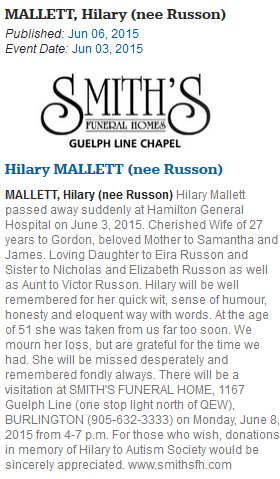
Yesterday afternoon, my sister suffered a massive heart attack and was rushed to hospital. She died late in the evening, never having regained consciousness. She was 51. I will be doing whatever I can to support my brother-in-law Gord, my niece Samantha (who is due to deliver her first baby any day now), my nephew Jimmy and my mother.
There will be a few pre-scheduled items posted on the blog, but I don’t expect to be actively posting anything for at least a couple of days.
Life is too short for you to drink bad wine
To help you avoid drinking bad wine, Amy Otto identifies the three most common causes of wine being unpleasant to drink:
You’ve scanned the wine list to find the perfect match. A few catch your eye. A nice Russian River Valley pinot noir, a Stags Leap District cabernet, or perhaps a New World Sangiovese. What’s not to love?
Your waiter presents the bottle to your table. You nod in approval. The wine is poured; you lean into your glass hoping to catch the lovely aroma, and instead your nose crinkles and puzzlement sets in. The glass is emitting an odor that reminds you of when it rained on that pile of newspapers you were going to recycle. It seemed like the perfect choice. How did this happen?
Despite a winemaker’s best efforts, occasionally you will run into a wine that is flawed. That’s why you try the wine before you commit to the bottle.
A good restaurant won’t object to taking back a bottle that has a clear flaw — that’s what you need to do when you taste the sample from the freshly opened bottle. You’re not trying to determine whether you like the wine, but you are given the opportunity to discover whether the wine has a flaw. Don’t be the asshole who sends back a perfectly good bottle of wine to impress your date or your business associate (and yes, I’ve seen it happen).
Information and Incentives
Published on 8 Feb 2015
What does an increase in the price of oil tell us? What does it signal? And how do we adjust to that signal? The price of oil gives users of oil an incentive to respond — by using less oil or substituting lower-cost alternatives for oil.
The key here is that we let people decide how to most effectively allocate the use of goods and resources. To solve the great economic problem, we need to solve information and incentive problems.
In this video, we take a look at how Nobel Prize-winner Friedrich Hayek described the price system and its approach to solving the information problem. We’ll also continue with our example of oil to show how the price is equal to the marginal value of oil or the social opportunity cost.
When did “scientific literature” transmogrify into bad science fiction?
In The Lancet, Richard Horton discusses the problems of scientific journalism:
The case against science is straightforward: much of the scientific literature, perhaps half, may simply be untrue.
Afflicted by studies with small sample sizes, tiny effects, invalid exploratory analyses, and flagrant conflicts of interest, together with an obsession for pursuing fashionable trends of dubious importance, science has taken a turn towards darkness. As one participant put it, “poor methods get results”. The Academy of Medical Sciences, Medical Research Council, and Biotechnology and Biological Sciences Research Council have now put their reputational weight behind an investigation into these questionable research practices. The apparent endemicity of bad research behaviour is alarming. In their quest for telling a compelling story, scientists too often sculpt data to fit their preferred theory of the world. Or they retrofit hypotheses to fit their data. Journal editors deserve their fair share of criticism too. We aid and abet the worst behaviours. Our acquiescence to the impact factor fuels an unhealthy competition to win a place in a select few journals. Our love of “significance” pollutes the literature with many a statistical fairy-tale. We reject important confirmations. Journals are not the only miscreants. Universities are in a perpetual struggle for money and talent, endpoints that foster reductive metrics, such as high-impact publication. National assessment procedures, such as the Research Excellence Framework, incentivise bad practices. And individual scientists, including their most senior leaders, do little to alter a research culture that occasionally veers close to misconduct.
Installing the forward island on HMS Prince of Wales
The second of the Queen Elizabeth class of aircraft carriers for the Royal Navy is still under construction. Here’s a time-lapse video of the transportation and installation of the forward island:
Published on 26 May 2015
Timelapse video charting the incredible journey of the 680-tonne command centre of the Royal Navy’s latest aircraft carrier – HMS Prince of Wales – as it left its construction hall in Govan, Glasgow this month before being installed on the under-construction carrier in Rosyth dockyard, near Edinburgh.
QotD: The debt we owe to ancient Greece
What more to say? Well, I could say that I am jealous of Jack’s choice of period. My choice of early Byzantium is a good one. Contrary to the general view, this was an age of heroism and genius. The fight the Byzantines put up against the barbarians and Persians and Moslems saved Western civilisation. There are few stories more inspiring than the defeat of the Arabs outside the very walls of Constantinople in 678 and 717. At the same time, nothing compares with what the Athenians achieved a thousand years earlier.
Forget the Egyptians and the Jews. Forget what we are told about the ancient Indians and Chinese. Forget even the Romans. Between about 600 and 300 BC, the Greeks of Athens and some of the cities of what is now the Turkish coast were easily the most remarkable people who ever lived. They gave us virtually all our philosophy, and the foundation of all our sciences. Their historians were the finest. Their poetry was second only to that of Homer – and it was they who put together all that we have of Homer. They gave us ideals of beauty, the fading of which has always been a warning sign of decadence; and they gave us the technical means of recording that beauty. They had no examples to imitate. They did everything entirely by themselves. In a world that had always been at the midnight point of barbarism and superstition, they went off like a flashbulb; and everything good in our own world is part of their afterglow. Every renaissance and enlightenment we have had since then has begun with a rediscovery of the ancient Greeks. Modern chauvinists may argue whether England or France or Germany has given more to the world. In truth, none of us is fit to kiss the dust on which the ancient Greeks walked.
Richard Blake, “Review of Jack England, Sword of Marathon“, RichardBlake.me.uk, 2013.


