Quotulatiousness

January 4, 2015

“Google self-driving cars are timid”

Filed under: Humour, Technology — Tags: , , — Nicholas @ 04:00

The Oatmeal got a chance to ride in one of Google’s self-driving cars, and learned six things from his experience:

2. Google self-driving cars are timid.

The car we rode in did not strike me as dangerous. It struck me as cautious. It drove slowly and deliberately, and I got the impression that it’s more likely to annoy other drivers than to harm them. Google can adjust the level of aggression in the software, and the self-driving prototypes currently tooling around Mountain View are throttled to act like nervous student drivers.

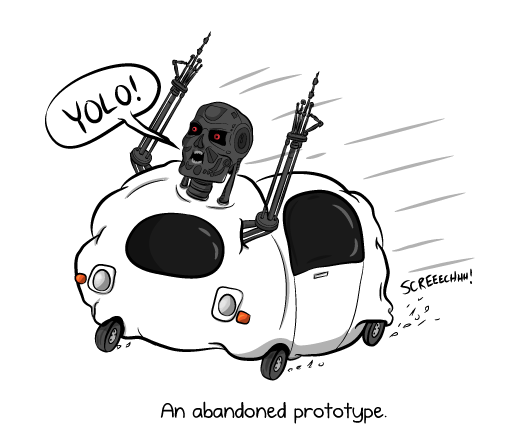
In the early versions they tested on closed courses, the vehicles were programmed to be highly aggressive. Apparently during these aggression tests, which involved obstacle courses full of traffic cones and inflatable crash-test objects, there were a lot of screeching brakes and roaring engines and terrified interns. Although impractical on the open road, part of me wishes I could have experienced that version as well.

An abandoned Google car prototype

Howard Tayler on The Hobbit: The Battle of the Five Armies

Filed under: Books, Media — Tags: , , , — Nicholas @ 03:00

Due to various reasons, we only got around to seeing Peter Jackson’s latest (last?) Middle Earth movie this week. As a result, I’ve been consciously avoiding reading too many reviews on the movie beforehand. I’d heard enough negative things that by the time we actually got to see it, it was no where near as bad as I’d been told. It’s not a great movie, but it’s good enough and I quite enjoyed watching it. Last month, Howard Tayler (of Schlock Mercenary fame) reviewed it and I mostly agree with his opinion:

TheHobbit3If you didn’t enjoy the first two installments in Peter Jackson’s Hobbit franchise, you probably won’t like this one, either, because it doubles down on everything.

If you did enjoy them, this one pretty much sticks the landing. There were bits I didn’t like much (the Sauron/Necromancer “Jefferson Airplane” visual tops that list) but this didn’t feel overblown or too long. It felt huge, and justly so.

Tolkien tells us that there are battles in Middle Earth. Jackson shows them to us. Tolkien tells us that there are thirteen dwarves in the party. Jackson shows them to us. Tolkien tells us that Laketown gets burnt by a dragon, and the survivors become refugees. Jackson shows us all that. The list goes on — The Hobbit is a short novel (by the standards of epic fantasy) because Tolkien does a lot of telling in between the showing. The Hobbit trilogy of films is a long movie (by the standards of genre-fiction films) because Jackson expands on the tells to give us a big show.

In order to make any of that engaging, we need to be seeing it through people with whom we identify. This is why during previous films we’re introduced to Legolas and Tauriel, Bard’s children, Azog, and the whole host of other named characters. Each of the dwarves is his own distinct character, and Laketown is full of the faces of human people who look like they could be our neighbors.

I’m down with all of this. In fact, I’d be quite happy to see the trilogy with an additional 90 minutes of footage, because some pieces felt a bit short.

When companies bought into the open plan workspace model

Filed under: Business — Tags: , , , — Nicholas @ 02:00

In the Washington Post, Lindsey Kaufman recounts her experience when her workplace changed to the “open-office model”:

A year ago, my boss announced that our large New York ad agency would be moving to an open office. After nine years as a senior writer, I was forced to trade in my private office for a seat at a long, shared table. It felt like my boss had ripped off my clothes and left me standing in my skivvies.

Our new, modern Tribeca office was beautifully airy, and yet remarkably oppressive. Nothing was private. On the first day, I took my seat at the table assigned to our creative department, next to a nice woman who I suspect was an air horn in a former life. All day, there was constant shuffling, yelling, and laughing, along with loud music piped through a PA system. As an excessive water drinker, I feared my co-workers were tallying my frequent bathroom trips. At day’s end, I bid adieu to the 12 pairs of eyes I felt judging my 5:04 p.m. departure time. I beelined to the Beats store to purchase their best noise-cancelling headphones in an unmistakably visible neon blue.

Despite its obvious problems, the open-office model has continued to encroach on workers across the country. Now, about 70 percent of U.S. offices have no or low partitions, according to the International Facility Management Association. Silicon Valley has been the leader in bringing down the dividers. Google, Yahoo, eBay, Goldman Sachs and American Express are all adherents. Facebook CEO Mark Zuckerberg enlisted famed architect Frank Gehry to design the largest open floor plan in the world, housing nearly 3,000 engineers. And as a businessman, Michael Bloomberg was an early adopter of the open-space trend, saying it promoted transparency and fairness. He famously carried the model into city hall when he became mayor of New York, making “the Bullpen” a symbol of open communication and accessibility to the city’s chief.

These new floor plans are ideal for maximizing a company’s space while minimizing costs. Bosses love the ability to keep a closer eye on their employees, ensuring clandestine porn-watching, constant social media-browsing and unlimited personal cellphone use isn’t occupying billing hours. But employers are getting a false sense of improved productivity. A 2013 study found that many workers in open offices are frustrated by distractions that lead to poorer work performance. Nearly half of the surveyed workers in open offices said the lack of sound privacy was a significant problem for them and more than 30 percent complained about the lack of visual privacy. Meanwhile, “ease of interaction” with colleagues — the problem that open offices profess to fix — was cited as a problem by fewer than 10 percent of workers in any type of office setting. In fact, those with private offices were least likely to identify their ability to communicate with colleagues as an issue. In a previous study, researchers concluded that “the loss of productivity due to noise distraction … was doubled in open-plan offices compared to private offices.”

I work in the software industry and it’s been nearly 20 years since I last had a private office. Every company I’ve worked for since then has either consciously been moving in the open office direction, or unwilling to spend money to partition open space in whatever office space they had. Sometimes, I even get nostalgic for cube farms…

QotD: Camping in the rain

Filed under: Humour, Quotations — Tags: , — Nicholas @ 01:00

Camping out in rainy weather is not pleasant.

It is evening. You are wet through, and there is a good two inches of water in the boat, and all the things are damp. You find a place on the banks that is not quite so puddly as other places you have seen, and you land and lug out the tent, and two of you proceed to fix it.

It is soaked and heavy, and it flops about, and tumbles down on you, and clings round your head and makes you mad. The rain is pouring steadily down all the time. It is difficult enough to fix a tent in dry weather: in wet, the task becomes herculean. Instead of helping you, it seems to you that the other man is simply playing the fool. Just as you get your side beautifully fixed, he gives it a hoist from his end, and spoils it all.

“Here! what are you up to?” you call out.

“What are you up to?” he retorts; “leggo, can’t you?”

“Don’t pull it; you’ve got it all wrong, you stupid ass!” you shout.

“No, I haven’t,” he yells back; “let go your side!”

“I tell you you’ve got it all wrong!” you roar, wishing that you could get at him; and you give your ropes a lug that pulls all his pegs out.

“Ah, the bally idiot!” you hear him mutter to himself; and then comes a savage haul, and away goes your side. You lay down the mallet and start to go round and tell him what you think about the whole business, and, at the same time, he starts round in the same direction to come and explain his views to you. And you follow each other round and round, swearing at one another, until the tent tumbles down in a heap, and leaves you looking at each other across its ruins, when you both indignantly exclaim, in the same breath:

“There you are! what did I tell you?”

Meanwhile the third man, who has been baling out the boat, and who has spilled the water down his sleeve, and has been cursing away to himself steadily for the last ten minutes, wants to know what the thundering blazes you’re playing at, and why the blarmed tent isn’t up yet.

At last, somehow or other, it does get up, and you land the things. It is hopeless attempting to make a wood fire, so you light the methylated spirit stove, and crowd round that.

Rainwater is the chief article of diet at supper. The bread is two-thirds rainwater, the beefsteak-pie is exceedingly rich in it, and the jam, and the butter, and the salt, and the coffee have all combined with it to make soup.

After supper, you find your tobacco is damp, and you cannot smoke. Luckily you have a bottle of the stuff that cheers and inebriates, if taken in proper quantity, and this restores to you sufficient interest in life to induce you to go to bed.

There you dream that an elephant has suddenly sat down on your chest, and that the volcano has exploded and thrown you down to the bottom of the sea — the elephant still sleeping peacefully on your bosom. You wake up and grasp the idea that something terrible really has happened. Your first impression is that the end of the world has come; and then you think that this cannot be, and that it is thieves and murderers, or else fire, and this opinion you express in the usual method. No help comes, however, and all you know is that thousands of people are kicking you, and you are being smothered.

Somebody else seems in trouble, too. You can hear his faint cries coming from underneath your bed. Determining, at all events, to sell your life dearly, you struggle frantically, hitting out right and left with arms and legs, and yelling lustily the while, and at last something gives way, and you find your head in the fresh air. Two feet off, you dimly observe a half-dressed ruffian, waiting to kill you, and you are preparing for a life-and-death struggle with him, when it begins to dawn upon you that it’s Jim.

“Oh, it’s you, is it?” he says, recognising you at the same moment.

“Yes,” you answer, rubbing your eyes; “what’s happened?”

“Bally tent’s blown down, I think,” he says. “Where’s Bill?”

Then you both raise up your voices and shout for “Bill!” and the ground beneath you heaves and rocks, and the muffled voice that you heard before replies from out the ruin:

“Get off my head, can’t you?”

And Bill struggles out, a muddy, trampled wreck, and in an unnecessarily aggressive mood — he being under the evident belief that the whole thing has been done on purpose.

In the morning you are all three speechless, owing to having caught severe colds in the night; you also feel very quarrelsome, and you swear at each other in hoarse whispers during the whole of breakfast time.

Jerome K. Jerome, Three Men in a Boat (to say nothing of the dog), 1889.

January 3, 2015

Last year, “a Kentucky judge did something no federal judge has done since 1932”

Filed under: Business, Law, Liberty, USA — Tags: , , , , , — Nicholas @ 11:44

It’s been a very long time since a federal judge in Kentucky anywhere in the United States has struck down a “certificate of necessity” (CON) regulation:

Mighty oaks from little acorns grow, so last year’s most encouraging development in governance might have occurred in February in a U.S. district court in Frankfort, Ky. There, a judge did something no federal judge has done since 1932. By striking down a “certificate of necessity” (CON) regulation, he struck a blow for liberty and against crony capitalism.

Although Raleigh Bruner’s Wildcat Moving company in Lexington is named in celebration of the local religion — University of Kentucky basketball — this did not immunize him from the opposition of companies with which he wished to compete. In 2012, he formed the company, hoping to operate statewide. Kentucky, however, like some other states, requires movers to obtain a CON. Kentucky’s statute says such certificates shall be issued if the applicant is “fit, willing and able properly to perform” moving services — and if he can demonstrate that existing moving services are “inadequate,” and that the proposed service “is or will be required by the present or future public convenience and necessity.”

Applicants must notify their prospective competitors, who can and often do file protests. This frequently requires applicants to hire lawyers for the hearings. There they bear the burden of proving current inadequacies and future necessities. And they usually lose. From 2007 to 2012, 39 Kentucky applications for CONs drew 114 protests — none from the general public, all from moving companies. Only three of the 39 persevered through the hearing gantlet; all three were denied CONs.

Bruner sued, arguing three things: that the CON process violates the Constitution’s equal protection clause because it is a “competitors’ veto” that favors existing companies over prospective rivals; that the statute’s requirements (“inadequate,” “convenience,” “necessity”) are unconstitutionally vague; and that the process violates the 14th Amendment’s protections of Americans’ “privileges or immunities,” including the right to earn a living.

The Beeriodic Table

Filed under: Randomness — Tags: — Nicholas @ 11:00

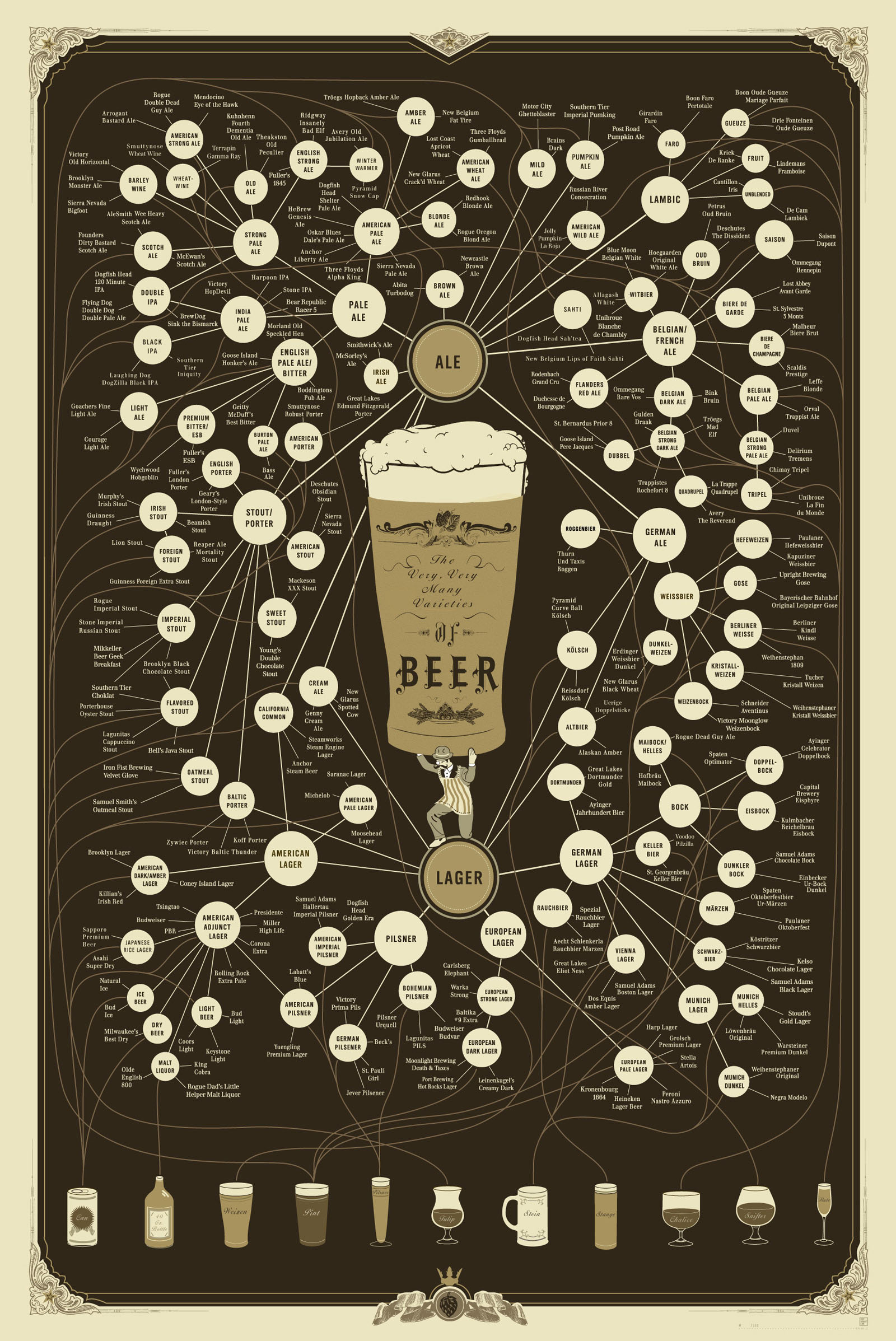
Christine Hurlbut sent me a link to The Beginner’s Guide to Craft Beer which included a neat little “family tree of beer styles” image. Unfortunately, the version they embedded was too small to be useful, so I looked for a larger version. I found a few other beer-centric images, including this one:

Found via a Google search at gunaxin.com (but don't go there directly ... my antivirus software had a field day warning me about the site's contents). [Click to see full-sized version]

Found via a Google search at gunaxin.com (but don’t go there directly … my antivirus software had a field day warning me about the site’s contents). [Click to see full-sized version]

Another find from the quick Google image search was this one at The Urban Diplomat:

The very, very many varieties of beer (via The Urban Diplomat)

The very, very many varieties of beer (via The Urban Diplomat)

Urban Canada – where China’s one-child policy has been religiously observed

Filed under: Cancon, Humour, Politics — Tags: , , , , — Nicholas @ 03:00

I can’t imagine what has gotten into David Warren to distract him from posts on the inner spirituality of the Catholic Church to suddenly turn to a bit of Canadian Ethnography:

… in a DINK household (“double income, no kids”) the rules subtly change, or rather change overtly, and no need remains for any sort of manliness. Indeed, should the woman make a substantial income, perhaps the man should consider living off her. She can claim him for a little break on her taxes, after all. Consider: housework, without kids, is a snip. And when his “partner” gets home, physically and emotionally exhausted from work, burning with the little humiliations she has suffered out there in the “real world,” and seriously hungry into the bargain — he can remind her that they are a “modern” couple. Tasks such as cooking should be shared equally.

This is old hat, of course. For the most part it also applies where the Red Chinese “one child policy” is obeyed, as across most of urban Canada.

I became exceptionally aware of the new arrangements in a visionary experience, twenty years ago. It consisted of attending a “bake sale” for the public school in which my sons were enrolled (temporarily, I assure you). I got to meet the whole “sorority” in my new liberal neighbourhood. (Kingston, Ontario: never go there.) This was mostly an “audio” vision, I should explain, though it had a video component. I’d never seen nor heard before so many whole-earth, left-wing, squeaky-voiced “house husbands,” all in one place. The immediate revelation was that spiritual emasculation actually changes a man’s voice in the same way physical emasculation does.

Among other discoveries was that the men had done most of the baking — which was good, for men often make better bakers. And we turn to the castrati to hit the highest notes.

The women, on the other hand, I could hear roar. The tone in which they addressed their squeakers was beyond instructive. I reflected that if a man spoke to his wife like that, in public, he’d be courting arrest. The feminists had now got exactly what they wanted.

There was more. The “gender” stereotypes had reversed at every other level. These women were now the sexual aggressors. I recall one in particular — an executive in a local “arts” operation — who had previously called me “fascist” as well as “sexist” in reference to something I had written in a newspaper. That she hated me still, I could take for granted. But right in front of her lamentable house-husband she was, unbelievably, “flirting” (although the term seemed over-refined). The wee fellow looked harmlessly outraged. He made sounds such as I imagine a gerbil makes when his mate shoves him aside. On his fidelity, I’m sure she could rely, for no other woman could want him. But she was trawling for something more masculine, herself.

Feminism alone could account for the collapse of the birth rate (which does, incidentally, have economic repercussions); for it operates at so many levels, from the neutering of males, to making females so extremely unattractive. But it cannot account for the rise of feminism. On that, I’m with Marx: it has a chiefly economic causation.

“Secular Stagnation and Cast-Iron Frying Pans”

Filed under: Books, Economics — Tags: , , — Nicholas @ 02:00

At the wonderfully named Worthwhile Canadian Initiative blog, Frances Woolley looks at some of the ordinary human cussedness that prevents wonderfully clear and understandable economic theories from working quite as efficiently as their formulators expect:

1. Economies grow when people buy stuff.

2. Over time, people accumulate more and more stuff.

3. People can only handle so much stuff. Sock drawers get full of socks. Cupboards get full of cups. Bookshelves get full of books.

4. It’s hard to get rid of stuff. Economic models typically assume disposing of unwanted things costs nothing. But life isn’t like that. Sorting out stuff that can be tossed from stuff that is worth keeping takes time and effort.

5. People are “loss averse”. Throwing things away — clothes that don’t fit, vinyl LPs — hurts psychologically.

6. There’s no need to replace perfectly good stuff. True some stuff, like mobile phones, only lasts a year or three. But other stuff, like cast-iron frying pans, lasts for decades.

Taken together, observations 2 through 6 imply that, as people get older, they buy less and less stuff. Combined with observation 1, these observations explain why countries with aging populations experience lower rates of economic growth.

My only quibble is with the final sentence of point 3: bookshelves don’t get full … you just run out of immediate book storage options. Bookshelves are never really full, they’re just temporarily over-booked.

QotD: Scotland and the Scots

Filed under: Britain, Quotations — Tags: , , , — Nicholas @ 01:00

I have soldiered in too many countries and known too many peoples to fall into the folly of laying down the law about any of them. I tell you what I have seen, and you may draw your own conclusions. I disliked Scotland and the Scots; the place I found wet and the people rude. They had the fine qualities which bore me — thrift and industry and long-faced holiness, and the young women are mostly great genteel boisterous things who are no doubt bed-worthy enough if your taste runs that way. (One acquaintance of mine who had a Scotch clergyman’s daughter described it as like wrestling with a sergeant of dragoons.) The men I found solemn, hostile, and greedy, and they found me insolent, arrogant, and smart.

This for the most part; there were exceptions, as you shall see. The best things I found, however, were the port and the claret, in which the Scotch have a nice taste, although I never took to whisky.

George MacDonald Fraser, Flashman, 1969.

January 2, 2015

Debunking the “Broken Windows” theory of crime

Filed under: Law, USA — Tags: , , — Nicholas @ 07:51

In Mother Jones, Kevin Drum looks at the frequent claim on the political right that the “Broken Windows” model of policing was pivotal in reducing urban crime:

The “Broken Windows” theory suggests that tolerance of small acts of disorder creates an environment that leads to rising amounts of serious crime. So if police crack down on small offenses—petty vandalism, public lewdness, etc. — crime reductions will follow. George Kelling was one of the originators of the theory, and NYPD police commissioner Bill Bratton is one of its strongest proponents.

It sounds reasonable, but as Drum points out, it takes credit for improvements that it couldn’t have been driving:

Violent crime 1985-2012So here’s the thing: this is almost certainly wrong. Not even controversial. Just wrong: broken windows policing may well have been helpful in reducing New York’s crime rate, but there’s flatly no evidence that it’s been pivotal. It’s true that crime in New York is down more than it is nationally, but that’s just because crime went up more in big cities vs. small cities during the crime wave of the 60s through the 80s, and it then went down more during the crime decline of the 90s and aughts. Kelling and Bratton can dismiss this as ivory tower nonsense, but they should know better. The statistics are plain enough, after all.

Violent crime big vs small cities 1985-2010Take a look at the two charts on the right. The top one shows crime declines in six of America’s biggest cities. As you can see, New York did well, but it did no better than Chicago or Dallas or Los Angeles, none of which implemented broken windows during the 90s. The bottom chart is a summary of the crime decline in big cities vs. small cities. Again, the trend is clear: crime went up more during the 80s in big cities, but then declined more during the 90s and aughts. The fact that New York beat the national average is a matter of its size, not broken windows.



Now, none of this is evidence that broken windows doesn’t work. The evidence is foggy either way, and we simply don’t know. My own personal view is that it’s probably a net positive, but a fairly modest one.

Who needs a multi-billion dollar espionage agency, when so much intelligence data is on the web?

Filed under: Economics, Military — Tags: — Nicholas @ 04:00

By way of Think Defence, a great visual illustration of the highest risk points of transit in world shipping:

Click to see full-sized image at Think Defence

Click to see full-sized image at Think Defence

The Ottoman Disaster – The Battle of Sarikamish I THE GREAT WAR Week 23

Filed under: Europe, History, Middle East, Military, Russia, WW1 — Tags: , — Nicholas @ 03:00

Published on 1 Jan 2015

The Champagne offensive is still going on the Western Front without any side gaining a decisive advantage. In the Caucasus, Enver Pasha is showing how far he’s willing to go to achieve his goals. Against his military advisors’ recommendations, he decides to send more and more troops to Sarikamish. Without supplies and with temperatures constantly below -20 degrees, thousands of them freeze to death before even reaching the frontline. When the Russians finally encircle the Ottoman Troops, defeat is inevitable.

Works that didn’t enter public domain, thanks to copyright extension

Filed under: Books, Law, Media, Science, USA — Tags: , , , — Nicholas @ 02:00

The Center for the Study of the Public Domain (at Duke Law), lists some of the better-known works that should have become public domain in the United States this year, except for the extension of copyright terms:

Works from 1958 that won't enter public domain

Current US law extends copyright for 70 years after the date of the author’s death, and corporate “works-for-hire” are copyrighted for 95 years after publication. But prior to the 1976 Copyright Act (which became effective in 1978), the maximum copyright term was 56 years — an initial term of 28 years, renewable for another 28 years. Under those laws, works published in 1958 would enter the public domain on January 1, 2015, where they would be “free as the air to common use.” Under current copyright law, we’ll have to wait until 2054. And no published works will enter our public domain until 2019. The laws in other countries are different — thousands of works are entering the public domain in Canada and the EU on January 1.

What books and plays would be entering the public domain if we had the pre-1978 copyright laws? You might recognize some of the titles below.

  • Chinua Achebe, Things Fall Apart
  • Hannah Arendt, The Human Condition
  • Isaac Asimov (writing as Paul French), Lucky Starr and the Rings of Saturn
  • Simone de Beauvoir, Mémoires d’une jeune fille rangée (Memoirs of a Dutiful Daughter)
  • Michael Bond, A Bear Called Paddington, with illustrations by Peggy Fortnum
  • Eugene Burdick and William Lederer, The Ugly American
  • Truman Capote, Breakfast at Tiffany’s
  • Agatha Christie, Ordeal by Innocence
  • John Kenneth Galbraith, The Affluent Society
  • Graham Greene, Our Man in Havana
  • Dr. Martin Luther King, Jr., Stride Toward Freedom: The Montgomery Story
  • Claude Lévi-Strauss, Anthropologie Structurale (Structural Anthropology)
  • Mary Renault, The King Must Die
  • Dr. Seuss, Yertle the Turtle and Other Stories
  • T.H. White, The Once and Future King

What a trove of books — imagine these being freely available to students and educators around the world. You would be free to translate these books into other languages, create Braille or audio versions for visually impaired readers (if you think that publishers wouldn’t object to this, you would be wrong), or adapt them for theater or film. You could read them online or buy cheaper print editions, because others were free to republish them. (Empirical studies have shown that public domain books are less expensive, available in more editions and formats, and more likely to be in print — see here, here, and here.) Imagine a digital Library of Alexandria containing all of the world’s books from 1958 and earlier, where, thanks to technology, you can search, link, annotate, copy and paste. (Google Books has brought us closer to this reality, but for copyrighted books where there is no separate agreement with the copyright holder, it only shows three short snippets, not the whole book.) You could use these books in your own stories — The Once and Future King was free to draw upon Sir Thomas Malory’s Le Morte d’Arthur (a compilation of King Arthur legends) because Malory’s work was in the public domain. One tale inspires another. That is how the public domain feeds creativity. Instead of seeing these literary works enter the public domain in 2015, we will have to wait until 2054.

QotD: The democratization of fame

Filed under: Media, Quotations, USA — Tags: , , — Nicholas @ 01:00

The radicalization of renown is good for America.

In these times of seemingly limited job and business opportunities, celebrity has become a goal attainable by all.

Gaining public attention by performing for the masses once required skills — deft strokes with ochre on the walls of Paleolithic caves, facility with trident and net in the Roman coliseum, recitation of iambic pentameter by the swath from the stage at the Globe.

Talent and practice were needed for popularity from the dawn of time until the debut of America’s Funniest Home Videos in 1990. And even then a contestant had to have steady hands and steely resolve to keep the video rolling while his son pedaled off an improvised plywood ramp trying to leap a row of Tonka toys on his Big Wheel and got whacked in the testicles.

But what does 18-year-old Bethany Mota who still lives at home with her parents (two-page spread, People, pp. 196-7) do? She does “reviews of new makeup, clothes, and other mall finds.” Her YouTube channel has 5.9 million subscribers. She “reportedly makes $40,000 a month.”

There are 10,900,000 teenage girls in America, an estimated 10,899,999 of whom have the same skill set as Bethany. This includes the teenage girl at my house who is presently locked in her bedroom sharing “reviews of new makeup, clothes, and other mall finds” with her 5.9 million Facebook friends. She is about to get pages 196 and 197, torn from People and heavily marked with a highlighter pen, shoved under her door. Bethany Mota, you are a beacon of hope.

P.J. O’Rourke, “Welcome to Showbiz Sharia Law: No talent? Kind of dim-witted? No shame? Perfect. The celebrity industry needs you — just don’t ever veil your face”, The Daily Beast, 2014-05-04

QotD: The co-ordination problem of pure Marxism

Filed under: Economics, History, Politics, Quotations — Tags: , , — Nicholas @ 01:00

… it is interesting to analyze Marx as groping toward something game theoretic. This comes across to me in some of his discussions of labor. Marx thinks all value is labor. Yes, capital is nice, but in a sense it is only “crystallized labor” – the fact that a capitalist owns a factory only means that at some other point he got laborers to build a factory for him. So labor does everything, but it gets only a tiny share of the gains produced. This is because capitalists are oppressing the laborers. Once laborers realize what’s up, they can choose to labor in such a way as to give themselves the full gains of their labor.

I think here that he is thinking of coordination as something that happens instantly in the absence of any obstacle to coordination, and the obstacle to coordination is the capitalists and the “false consciousness” they produce. Remove the capitalists, and the workers – who represent the full productive power of humanity – can direct that productive power to however it is most useful. In my language, Marx simply assumed the invisible nation, thought that the result of perfect negotiation by ideal game theoretic agents with 100% cooperation under a veil of ignorance – would also be the result of real negotiation in the real world, as long as there were no capitalists involved. Maybe this idea – of gradually approaching the invisible nation – is what stood in for the World-Spirit in his dialecticalism. Maybe in 1870, this sort of thinking was excusable.

If capitalists are to be thought of as anything other than parasites, part of the explanation of their contribution has to involve coordination. If Marx didn’t understand that coordination is just as hard to produce as linen or armaments or whatever, if he thought you could just assume it, then capitalists seem useless and getting rid of all previous forms of government so that insta-coordination can solve everything seems like a pretty swell idea.

If you admit that, capitalists having disappeared, there’s still going to be competition, positive and negative sum games, free rider problems, tragedies of the commons, and all the rest, then you’ve got to invent a system that solves all of those issues better than capitalism does. That seems to be the real challenge Marxist intellectuals should be setting themselves, and I hope to eventually discover some who have good answers to it. But at least from the little I learned from Singer, I see no reason to believe Marx had the clarity of thought to even understand the question.

Scott Alexander, “Book Review: Singer on Marx”, Slate Star Codex, 2014-09-13.

« Newer PostsOlder Posts »

Powered by WordPress