
The entire state is oceanside, just like in the video. There are rumors of some vast, undiscovered bogs or swamps or mountains or something out west, but no one would ever go there. LL Bean is in Freeport, and you’re not allowed to be in Maine more than an hour’s drive from there. If we had police, they’d check. Bean’s used to have catalogs filled with shotguns and fishing poles, but now they only sell banana hammock bathing suits for Canadians that go to Old Orchard Beach and think it’s the Riviera, and button-down men’s shirts for ladies to wear.
Maine has various slogans. They used to call it Vacationland, but Mainers couldn’t help themselves, and got to reading the Vacationland road signs while driving to work in the office park in Westbrook, and forgot the signs were for people “From Away” — the charming soubriquet Mainers use when they want to call someone a Masshole, but the guy hasn’t paid his bill yet. Anyway, everyone in Maine went to Disneyworld at the same time, on the same bus, and there was no one left in Maine to direct the tourists from Massachusetts to the best places to icefish in June, or where to find all the huggable bull mooses in rutting season, or how to properly approach a black bear cub. Note: Always get between Mama bear and Baby bear. They love that.
“Maine: The Way Life Should Be,” was another one. It was less of an overt threat than New Hampshire’s motto, it’s true, but it left too much room for rumination on its meaning. I haven’t been to New Hampshire in a while, but if memory serves, their slogan is “Live Free, Or Else,” or something to that effect. Maine’s sounds friendlier, but its ambiguity rankles some. It’s never wise to get the tourists thinking. It smacked a bit of “Your life is bad, and you should feel bad, and we’re here to tell you so.”
Sippican, “Maine Is Totally Like This, Totally”, Sippican Cottage, 2014-02-26
August 20, 2014
QotD: Maine
July 10, 2014
Argentina’s economic woes – tourist edition
How bad is the Argentinian economy right now? So bad that middle class Argentine tourists in Brazil eat at soup kitchens, according to the Wall Street Journal‘s Miriam Jordan:
The state-funded Citizen Restaurant in downtown Rio is accustomed to serving a balanced meal at an unbeatable price to about 5,000 poor residents of this city each day. During the World Cup, however, this cafeteria has been catering to another clientele as well: middle-class Argentines.
“We serve homeless people, drug addicts, blue-collar workers and retirees,” said Jose Barbosa, Rio de Janeiro state coordinator for food security. “This World Cup we have been welcoming Argentine soccer fans, too.”
With the value of the Argentine peso deeply eroded amid the country’s economic woes, many Argentines who have flocked here to root for their soccer team […] say they’re counting every Brazilian real they spend — and hunting for bargains. On Monday, dozens of Argentines lined up alongside Brazilians to buy lunch at the cafeteria, where a meal of black beans, white rice, salad and choice of meatballs or chicken sausage cost 1 real, or about 40 U.S. cents.
“Rio is very expensive — that’s why I am here,” said Fernando Castillo, a 24-year-old bartender from Buenos Aires. With gusto, he dug into his plate of food, which sat on a plastic-blue tray beside a cup of guava juice and a fresh orange for desert, both included in the price. “This is perfect,” he said, “especially at this price.”
“The generous portion keeps us filled all day,” added his cousin, Thomas Castillo.
[…]
To save on accommodations and flights, many Argentines drove to Brazil. In Rio, their campers and cars occupied prime beachfront parking spots until the city evicted them.
It then allowed them to park vehicles and pitch tents in a vast parking lot downtown that abuts the permanent bleachers where Rio’s samba schools perform during the annual carnival celebrations.
Word spread quickly at these parking lots that Citizen Restaurant, within walking distance of the Argentine encampment, offered good Brazilian fare at a bargain-basement price in a clean, safe environment. “It started with 10 of them one day, then 50 of them came and now we’re seeing about 200 Argentines each day,” said Ricardo Chaves, the eatery’s administrator.
June 16, 2014
June 26, 2013
Petitioning to “save” Kensington Market
John Pepall on the claimed 80,000 folks who’ve signed petitions to stop WalMart and Loblaws from moving near the historic area of Kensington Market:
What these people must be saying is that many people who now shop in the Kensington Market would, if the Walmart or Loblaw’s opened, choose to shop at them instead. And they want the City government to deny them that choice.
Just conceivably the petitions could be a kind of voluntary market survey, kindly warning Walmart and Loblaw’s that people won’t shop at their stores. That they will lose money because people prefer to shop at the Kensington Market. But plainly they are not. The petitioners call themselves the Friends of the Kensington Market and claim they are trying to Save the Kensington Market. The big corporations and their big stores are the baddies. And the retailers of Kensington Market are the good guys.
What are they up to then? If they are a statistically significant sample of people who regularly shop at the Kensington Market, they have nothing to worry about. Unless they own shares in Walmart or Loblaw’s. They will continue to shop in a thriving Kensington Market and Walmart and Loblaw’s will struggle and perhaps go away.
Might they? Just might they be people who already shop at the Loblaw’s on Christie or Whole Foods on Avenue Road and, perhaps, fashionable organic farmers’ markets and occasionally go down to Kensington Market for fine cheese or fish, or vintage clothing and a bite at one of its characterful restaurants?
If so, and at over eighty thousand and rising the petitioners must go way beyond the regular household shoppers in the Market, they are basically local tourists who want to restrict the shopping choices of those who live in the Kensington neighbourhood so that they can have a picturesque market to visit when they tire of the Distillery District or funky Queen Street West.
H/T to Colby Cosh for the link.
November 24, 2012
Israel: where the 1970s never ended
Kathy Shaidle reports on her recent trip to Israel:
Folks who say visiting Israel is like traveling back in time don’t know the half of it.
Say: Do you find yourself missing the 1970s — even though, like me, you vowed you never would?
That is: Do you miss litter, graffitti, off-leash dogs, free range cats, smoking on the beach, 13 TV channels, no wheelchair ramps — plus polyester everything?
Because if so, Israel is the 70s with cellphones! You’ll love it! Heck, the same war’s still going on!
Seriously: This shiksa just got back from her second trip to Israel — not a moment too soon, from the looks of things — and I’m here with the first of a series of articles that will go from macro to micro.
PJMedia’s own Barry Rubin literally wrote the book on Israel. I read it before I left and recommend it highly. But he’s a Jew who has lived there for years. I’m writing as a gentile two-time visitor.
To that end, I’ll start off with an overviews of major cities and regions in Israel, then drill down in the coming weeks, to cover specific attractions; define words that don’t mean what you (or more accurately, your dorky grad student nephew) think they mean (i.e., “check point,” “settlement,” “refugee camp”); then offer tips on food, language, manners and more.
July 10, 2012
Tim Harford on Iceland’s economic recovery
From his weekend column:
Iceland managed to create three massive global banks. The economy itself is tiny: Iceland has the same population as Coventry, although arguably the scenery is better. That’s really not big enough to support a lot of globally competitive export industries. Iceland had three: fish, aluminium smelting and tourism. Four if you count Björk. Can you blame them if they fancied dabbling in something a bit sexier, such as investment banking?
Investment banking is sexier than Björk?
I don’t think investment banking even manages to be sexier than aluminium smelting these days, but eight or nine years ago it must have seemed like a great gig. So these Icelandic banks borrowed loads of cash and used it to buy pretty much anything they wanted. In particular, they bought from each other at rather ebullient levels, which made for substantial profits on paper. The whole thing was a classic bubble.
And when the flow of loans dried up?
The banks crashed and there was clearly nothing the government could do to save them – they were far too big. And the party came to a grinding halt.
It doesn’t make a lot of sense.
No. It’s hard to understand why anyone wanted to lend them the money, and just as hard to understand why they thought they could instantly learn the craft of global investment banking.
June 8, 2012
Toronto City Council’s latest collective brain-fart
Terence Corcoran is too kind in his discussion of Toronto’s new ban on plastic bags:
In star-struck liberal green Los Angeles, it took a full-court press by environmental groups, major propaganda efforts, endorsement by the roll-over editorialists at the Los Angeles Times, and deployment of Hollywood stars, such as Julia Louis-Dreyfus and Peter Fonda, to work up the political steam needed to prompt L.A.’s city council to vote last month to ban plastic bags.
In starless Toronto, all it took was a bunch of dumb city councillors who suddenly decided — seemingly out of the blue — to stage a surprise vote.
“Ban the bags,” somebody said. “Good idea. Let’s vote!” Passed: 27 to 17.
No study, no research, no public review, no thought, no concept and no brains. What’s the environmental and fiscal impact of the ban? Nobody knows, although many people say the cost to both the city and the environment will be greater than the cost of using plastic bags.
As I think Adrian MacNair mentioned, one of the most likely outcomes is that people will end up buying less. It’s those little impulse buys that will be curtailed the most, as many folks — especially tourists — won’t have realized they need to bring their own carry bags.
June 1, 2012
This is why I always cheer for whoever is bidding against Toronto to host the Olympics
If publicly funded professional sports stadiums are bad for the local economy (and they almost always are), “winning” the bid to host the Olympic Games is far worse:
The history of the modern Olympics (and of other large-scale sporting events) reveals a consistent pattern. Organizers or local politicians in the host city commission “impact studies,” which almost always promise extravagant economic benefits. Studies performed after the event, however, find no positive effect at all — let alone one approaching the initial estimates. So it isn’t surprising that a PriceWaterhouseCoopers study commissioned by the British government forecasts that the Games would add about $9.4 billion to London’s GDP between 2005 and 2016. That seems like a large number until you realize that the London metro area’s GDP is roughly $712 billion annually. If the Games’ benefits were spread evenly throughout the decade, they would increase London’s GDP level by 0.1 percent each year.
Further, that $9.4 billion benefit pales compared with the cost of hosting the Olympics. In 2002, the UK’s Department for Culture, Media and Sport estimated that the cost would be $2.8 billion. Ten years later, London’s budget for hosting the Games is $15 billion. Costs already run above that figure and are likely to rise to approximately $38 billion, according to an investigation by the TV network Sky Sports. That would easily dwarf the economic benefits that the PriceWaterhouseCoopers study predicts. Security alone will be extremely costly: more British troops will patrol London than there are currently at war in Afghanistan. And these figures don’t count many hidden and indirect costs of hosting the Olympics — most prominently, disruption to business and traffic congestion. Traffic in London is already difficult; with special lanes for Olympics-related traffic, daily commutes will become a nightmare. (London’s transportation commissioner, Peter Hendy, helpfully advises commuters to go to the pub to avoid rush hour.)
Update, 5 June: The good news just keeps on coming for the London Olympics:
The boom to the economy that the Government hoped the Games would bring to the capital appears to become a bust with tens of thousands to tourists spurning the hiked prices, congestion and heightened security.
While bookings for July and August are down by 35 per cent on last year other European capitals appear to be prospering from London’s gloom.
French ministers, who lost the Olympic bid to Britain, might be quietly rubbing their hands with glee not only for dodging the £10 billion Games bill but also with a 50 per cent rise in tourism bookings. Similarly Barcelona and Berlin have seen their tourist numbers soar by 100 per cent over the summer.
This is an example of why, when the announcement was made that Paris had lost out on the bid for the 2012 Olympics to London, Reason titled their coverage “Lucky Paris“.
May 31, 2012
Mugabe’s “ambassador” appointment debunked
It’s a good indicator of how many of us view the United Nations and its doings that a large number of bloggers got taken in by the idea:
Hayes Brown explains in detail. The short version: because of the arcane politics of the UN, Zimbabwe won the right to co-host, along with Zambia, the next meeting of the UN World Tourism Organization’s General Assembly. Brett Schaefer reported that news, which is somewhat outrageous in its own right, on the Heritage Foundation’s blog, adding a sentence:
The United Nations World Tourism Organization (UNWTO), created in 1970 and based in Madrid, identifies itself as the “United Nations agency responsible for the promotion of responsible, sustainable and universally accessible tourism.” It announced last year that Zambia and Zimbabwe jointly “won the bid” to host the 20th session of the UNWTO General Assembly in 2013. Zimbabwe’s president, Robert Mugabe, has been appointed a “United Nations international tourism ambassador” in recognition of the promotion and development of tourism.
Oh, those whacky bloggers. I’d like to take this moment to apologize for spreading unsupported rumours that I sourced from shady and unreliable reports in the National Post and the Guardian.
May 30, 2012
More on Robert Mugabe, your Tourism Ambassador
In the Guardian, David Smith has more on the farcical notion of Zimbabwean president Robert Mugabe as an “Ambassador for Tourism”:
With a line-up that includes Drew Barrymore, David Beckham, Orlando Bloom, and Ricky Martin, the UN’s choice of ambassadors has been known to cause raised eyebrows or the odd smirk.
Seldom, however, has there been such anger, or questioning of the organisation’s credibility, as that greeting the appointment of a new international envoy for tourism: Robert Mugabe.
Improbable as it seems, the Zimbabwean president, who is widely accused of ethnic cleansing, rigging elections, terrorising opposition, controlling media and presiding over a collapsed economy, has been endorsed as a champion of efforts to boost global holidaymaking.
Despite that fact Mugabe, 88, is under a travel ban, he has been honoured as a “leader for tourism” by the UN’s World Tourism Organisation, along with his political ally, Zambian president Michael Sata, 75. The pair signed an agreement with UNWTO secretary general Taleb Rifai at their shared border at Victoria Falls on Tuesday.
Perhaps, like Obama’s Peace Prize, it’s awarded in expectation that Mugabe will do much to improve tourism in the future?
May 28, 2012
UN joke of the day: Mugabe named “international tourism ambassador”
I guess it’s maybe a hint that the UN is no longer serious?
For cognitive dissonance, see under: The United Nations. It’s no longer just a platform for countries with less-than-negligible human rights records to bash Israel and other democratic nations, or the dispatcher of envoys like Kofi Annan to Syria (under whose watch some 800,000 Rwandans were slaughtered) or the patronizing professional busy-body Olivier De Schutter, a Belgian “UN special rapporteur on the right to food,” to lecture Canada. The UN is now an expert on tourism to Africa and deciding who is best suited to promote it.
The UN just announced that its favourite African megalomaniac, Robert Mugabe, and his Zambian sidekick, Michael Sata, have been appointed United Nations international tourism ambassadors in recognition of the promotion and development of tourism. The UN through the United Nations World Tourism Organisation will officially confer the status to the two presidents at a function to be held in Victoria Falls this week and officiated by the UNWTO secretary general Mr Talib Rifai. The honour comes even though the European Union and U.S. have imposed travel bans on Mugabe and many of his senior government officials due to widespread human rights abuses.
February 26, 2012
VisitBritain’s spelling problem
A bit of an embarrassment for Britain’s national tourism agency:
Tourists attempting to follow VisitBritain’s tip to travel to the Welsh region of the “Breacon Beacons” may find themselves rather lost when entering the destination into their satnav.
The misspelling of the Brecon Beacons was spotted by an eagle-eyed tourist on a New York subway advertisement, which was accompanied with a picturesque photograph capturing the countryside of Llandovery, a market town in Carmarthenshire.
The promotional image, which also currently appears in the advertising spaces in front of passenger seats in New York taxis, was promptly posted on Facebook.
June 15, 2011
Preview of the CN Tower Edgewalk experience
H/T to Michael O’Connor Clarke for the link.
June 10, 2010
Photography: locals versus tourists
By way of BoingBoing, here’s a Flickr collection showing the different photo locations chosen by locals and tourists for many cities. Toronto doesn’t show as much difference as many other cities do:
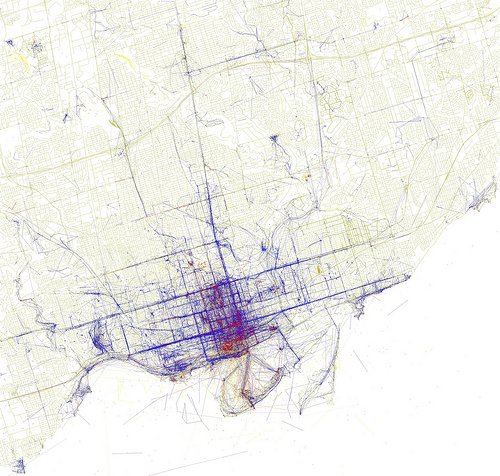
Blue dots are by locals, red dots are by tourists, and yellow dots could be by either (not enough information to determine).
September 22, 2009
According to the Danish tourist agency, Danish women are easy
The Economist reports on a badly thought-out (and recently withdrawn) tourism-boosting campaign by VisitDenmark:
The film, shot in video-diary style, purports to be the work of a Danish woman with a baby: she says that the child is the result of a one-night stand with a foreign visitor and that she hopes the father will see the video and contact her.
It’s nicely acted, gently affecting, completely fake and unintentionally hilarious. This official advertisement for Denmark, meant to be “a good and sweet story about a mature, responsible woman who lives in a free society and shoulders the responsibility of her actions”, instead conveys the message that if you come to Denmark, you can sleep with attractive locals. Is that really the remit of the tourism agency?


