Paul Sellers
Published on 11 Jan 2019Do you think about vibration when you are woodworking? If not, you probably should. In this video, Paul explains why vibration is something you should try to avoid and then runs through reducing vibration while using each of a handful of common hand tools.
For more information on these topics, see https://paulsellers.com or https://woodworkingmasterclasses.com
January 12, 2019
Bad Vibrations | Paul Sellers
November 14, 2018
Scrub Plane – a Historical Perspective – | Paul Sellers
Paul Sellers
Published on 7 Aug 2014In times past, before Stanley Rule and Level cast their first all-metal scrub plane, well used and worn-down wooden smoothing planes were kept as roughing planes for scrubbing off rough surfaces in preparation for more refined work. Longer planes such as jack planes and jointer planes followed to further level and straighten the work before the smoothing plane smoothed out the final surfaces.
The roughing plane had many names including Hunter plane, Scud or Scudding plane; Scurf or Scurfing plane; Cow plane and I am sure others I haven’t heard of and was the forerunner to the original Stanley scrub plane we know today. The wooden roughing plane worked well for centuries but with Stanley’s new fangled all-metal planes came the necessity of metal scrub planes too. In this video I explain a little of the important history behind the development of the scrub plane and the transition from wooden planes to the all metal versions.To find out more about Paul Sellers and the projects he is involved with visit http://paulsellers.com
October 18, 2018
How to Plane CORRECTLY
Matt Estlea
Published on 17 Oct 2018In this video, I explain the best techniques to employ when using a plane in order to get a smooth surface, a controlled cut, and above all a more enjoyable experience!
This is an addition to my ‘Woodworking Basics’ series where I also covered the topics of sawing and chiselling.
Sawing: https://www.youtube.com/watch?v=C5OzZ…
Chiselling: https://www.youtube.com/watch?v=Efxgv…
_________________________________________________________________Videos referenced:
How to Sharpen a Plane Blade: https://www.youtube.com/watch?v=vtCAb…
How to Set up a Plane: https://www.youtube.com/watch?v=J0ZV8…
How to reduce Tearout: https://www.youtube.com/watch?v=6fGqh…
Making a Bass Guitar: https://www.youtube.com/watch?v=wz7dt…
Making a Roubo Workbench: https://www.youtube.com/watch?v=FXKYw…
How to make a Protrusion Stop: https://www.youtube.com/watch?v=I417V…
_________________________________________________________________Support what I do by becoming a Patron! I want to increase the production quality of my videos and thus need to finance some new equipment. Follow the link below to help me out! Thank you in advance! https://www.patreon.com/mattestlea
My Website: www.mattestlea.com
_________________________________________________________________
My name is Matt Estlea, I’m a 22 year old Woodworker from Basingstoke in England and my aim is to make your woodworking less s***.I come from 5 years tuition at Rycotewood Furniture Centre and 4 years experience working at Axminster Tools and Machinery where I still currently work on weekends. During the week, I film woodworking projects, tutorials, reviews and a viewer favourite ‘Tool Duel’ where I compare two cometitive manufacturers tools against one another to find out which is best.
I like to have a laugh and my videos are quite fast paced BUT you will learn a lot, I assure you.
Lets go make a mess.
October 8, 2018
How to flatten the sole of a plane | Paul Sellers
Paul Sellers
Published on 16 Feb 2012Paul Sellers shows how to flatten and shape the sole of a bench plane. This technique is the first step once you have bought a new bench plane or have acquired a used plane. Without this fairly simple step, woodworking planes may not function correctly and may even damage projects or surfaces that you are working on. Also check out this video on sharpening a plane: http://www.youtube.com/watch?v=vvTcRe…
To find out more about Paul Sellers or the projects he is involved with visit http://paulsellers.com
October 7, 2018
Paul Sellers | How to sharpen a handplane
Paul Sellers
Published on 7 Feb 2012Paul Sellers demonstrates how to sharpen a plane on diamond stones using a convex bevel method. To find out more about Paul Sellers or the projects he is involved with visit http://paulsellers.com.
September 27, 2018
How to Setup, Use and Sharpen a Plough Plane | Paul Sellers
Paul Sellers
Published on 7 Sep 2018Need to run some grooves and not sure where to start? Paul shows how to sharpen and prepare the plough plane for use, before showing the basics of how to cut a groove.
For more information on these topics, see https://paulsellers.com or https://woodworkingmasterclasses.com
June 21, 2018
Buying quality used hand tools
I didn’t agree with everything Steve rants about here, but he does make some good points:

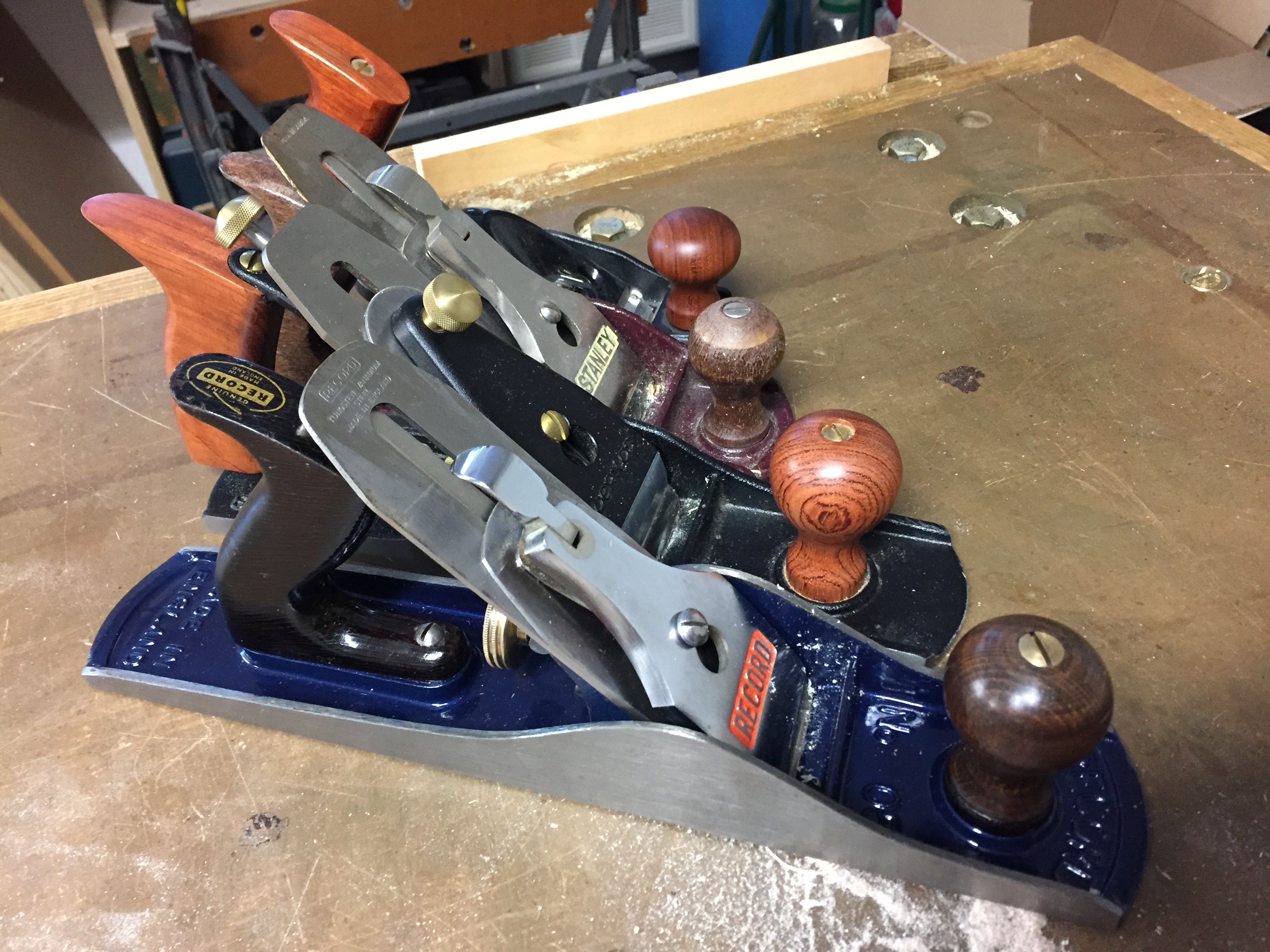
A small selection of bench planes: front to back, a jack plane, a junior Jack, a (garbage grade) #4 smoother, and a #3-equivalent smoother.
I’ve decided to punish humanity with a tool rant.
Back when I still had a real Internet connection, I put a video up on Youtube. In the video, I fixed up a $15 Harbor Freight wood plane, just to see if I could make it work. I got it to function, but I wouldn’t suggest anyone else try it.
A commenter said I should buy planes at garage sales. That set me off. The bag of pet peeves ruptured, and now I must rant.
Garage sales are only good for three types of people: mentally ill hoarders who buy crap, young people who live in poverty, and professional shoppers who snap up the best merchandise and put it on Ebay and Etsy.
That’s it. I will explain.
Say you’re 45 years old, and you decide you want a hand plane collection. To do woodworking well, you really need 4 or 5 planes, and you’re better off with a dozen. Different planes do different things well. Block planes are good for tight spaces and breaking corners. Jointing planes are good for jointing, obviously. Smoothing planes are good for, well, smoothing. Rabbet planes make rabbets. You can’t buy one plane and make it do everything. You’re going to need a bunch of planes.
You’ve already blown it by reaching 45 without collecting any planes. Now you have to catch up. Say you start going to garage sales.
Look at the paper or the web. There are no promising sales this week. Probably. Most of the time, the sales you read about look really bad. Action figures with missing arms and spit all over them, plus things like lamps with torn shades. IKEA furniture that ought to be burned. Maybe you’ll see a good sale in a couple of weeks. You may find 10 sales a year that are worth leaving the house for.
When you go to these sales, 9 of them will turn out to be losers. The other one will have one or two decent items.
To get those items, you will have to get up before the sun rises and do some driving. If you show up an hour after the sales start, the things you want will be gone. Tools go fast. Every city now has a fleet of professional shoppers who raid garage sales as early as possible and take all the good stuff. If you’re not there at the start, you’re dead. And what if you have two promising sales on the same day? You can get to one early enough to score, but you’ll be late for the other one
If you get the items you want, they probably won’t really be the items you want. By that I mean you won’t be able to choose brands and models. Want to collect a set of Stanley type 13 planes? Forget it. You’ll have to take a type 11, a 1990 plane from Home Depot, a Craftsman … whatever happens to be available. You will eventually get items that do what you want, but you’ll have to settle.
If you insist on good tools, you’ll have your woodworking shop equipped in about 20 years. During those years, you will have had to struggle without important tools. You will have had to forgo a lot of projects. You will become farsighted. You may get cataracts. You may get arthritis in your hands. You may need new hips. You’ll feel less like getting things done. The TV and the shuffleboard court will beckon.
You’ll miss out on the fun you would have had if you had bought your tools as early as possible.
You may drop dead, and then other people will buy your tools at your wife’s garage sale.

June 14, 2018
The 3 Hand Planes Power Tool Woodworkers Should Own (How to buy handplanes)
Stumpy Nubs
Published on 17 Jan 2016
June 4, 2018
How to turn a No.78 into a Scrub Plane | Paul Sellers
Paul Sellers
Published on 14 May 2018Preparing rough stock can be time-consuming. A scrub plane can really help ease this process. Old ones are hard to get hold, and new ones are expensive. Paul shows how you can easily convert a No. 78 rebate plane into an excellent scrub plane.
For more information on these topics, see https://paulsellers.com or https://woodworkingmasterclasses.com
April 15, 2018
How to Use a Hand Plane
This Old House
Published on 5 Dec 2015This Old House general contractor Tom Silva demonstrates the proper way to use hand planes. (See below for a shopping list, tools, and steps.)
Shopping List for How to Use a Hand Plane:
– Machine oil, used to lubricate sharpening stone
– Wood block, used to prevent tear-out in end grainTools List for How to Use a Hand Plane:
– Bench planes
– Specialty planes
– Block planes
– Sharpening stone, for sharpening plane irons
– Clamp, used to secure wood block to workpieceSteps for How to Use a Hand Plane:
1. Bench planes are used to flatten and smooth broad wood surfaces and narrow edges.
2. Long bench planes are best suited for smoothing very long surfaces and edges.
3. Specialty planes, such as a shoulder plane or rabbet plane, have plane irons (blades) that come flush with the edges of the tool.
4. Block planes are compact, versatile, and ideally suited for smoothing edges, small surfaces, and end grain.
5. Rotate the adjusting nut to control the depth of cut.
6. Pivot the lateral adjustment lever to square up the iron to the plane body.
7. Release the iron cap and extract the plane iron from the plane.
8. Test the sharpness of an iron by standing it on your thumbnail. If the iron slides off, it needs sharpening.
9. To sharpen a plane iron, start by applying machine oil to the coarse side of a sharpening stone.
10. Set the iron against the oiled stone with its beveled end facing down.
11. Tilt up the iron until its bevel is flush with the stone. Maintain that exact angle as you slowly rub the iron across the stone in a circular motion.
12. After a minute or two, flip over the iron and place it flat against the stone. Rub the iron back and forth to remove any burr from the back surface.
13. Next, flip the stone over to reveal its smooth surface. Apply oil and repeat the sharpening process.
14. Then raise the iron just a fraction of an inch, and make two or three passes across the stone.
15. Repeat the thumbnail test of Step 8 to check the iron’s sharpness.
16. When planing the narrow edge of a board, inspect the direction of the wood grain on the side of the board.
17. Always plane in the direction of the up-angling wood grain. Don’t plane against it.
18. Adjust the throat (mouth) of the plane to increase or decrease the gap between the plane iron and the bed of the plane. The proper adjustment will help prevent tearing out the grain.
19. Decrease the gap when planing end grain, and increase it when planing edge grain or making deep cuts.
20. When planing end grain, prevent tear-out by planing in from both ends toward the middle.
21. Another technique is to clamp a sacrificial wood block to the end of the board prior to planing. Then, any tear-out will occur in the block, not the board.
March 24, 2018
How to Use a Scrub Plane | Paul Sellers
Paul Sellers
Published on 23 Mar 2018Scrub planes can be used for a variety of tasks, from stock preparation and hogging off stock in preparation for the smoothing plane to refining chamfers and texturing the surface.
For more information on these topics, see https://paulsellers.com or https://woodworkingmasterclasses.com
March 20, 2018
How to buy used hand planes- How much should you pay? What to look for…
Stumpy Nubs
Published on 5 Feb 2016
March 15, 2018
Vintage Stanley Planes: Is older really better?
Rex Krueger
Published on 25 Jan 2018Most hand tool collectors and users go way back when they get Stanley bench planes. Older ones are usually more valuable and are often considered to work better, especially when compared to later-model, post-war planes. But this wisdom is almost totally wrong. Stanley planes did start to suck in the 1960s, but the planes they made in the 1950s and before may be the best they ever made. These late-model planes have improved features, thicker castings, easier adjustment and more precise machining. And, these planes are typically ignored by collectors, so you can get them cheap.
Are you thinking about shelling out big bucks for a premium plane? Maybe first, you should check out a late-model Stanley.
February 26, 2018
A few jotted notes on woodworking plane companies
I’ve been dabbling more in the woodworking hand tool market recently, and found myself getting confused about the various manufacturers and their products. Mostly to try to sort out the history for myself, I started taking notes as I trawled from website to forum to auction site, looking for answers. In a very abbreviated and assuredly incomplete and inaccurate thumbnail sketch, here’s how I think the woodworking hand tool market has changed over the last hundred and fifty years or so:
- Until the mid-19th century, most woodworkers made their own tools whenever they could, as the ability of manufacturers to produce economical, dependable tools was limited, and woodworkers (like other skilled craftsman of the early industrial era) were capable of producing most of the necessary tools with only minimal outlay to other trades.
- By the mid-19th century, innovators and inventors were prolific in their proposed solutions to all kinds of problems (some real and many probably imaginary). Among those many, many febrile innovators was a gentleman named Leonard Bailey. Bailey managed to almost single-handedly revolutionize the woodworking market by coming up with a line of hand planes that could out-compete most of the hand-made competitors while taking advantage of the economies of scale offered by mass production. It became more economical for a woodworker to buy a ready-made tool rather than take time away from productive work to fabricate it for himself.
- The Stanley Works of Massachusetts bought Bailey’s company — probably more for the value of Leonard’s patents than for the company’s sake itself — and parlayed that patent protection into becoming the acknowledged standard for woodworking planes.
- Even after the Bailey patents expired, other manufacturers paid backhanded tribute to Bailey by straight-out cloning his designs with very minor changes and putting their own functional copies on sale in direct competition with the original Stanley products … often even using the same or barely concealed names/numbers for their clones (for example, the British company Record generally just prepended a zero in front of the “standard” Stanley model numbers, where a #4 plane from Stanley was a #04 from Record).
- In the British market following the financial crisis of 1929, the government’s imposition of tariffs against inter alia American hand tool manufacturers encouraged many British companies to introduce Stanley clones for both domestic and Imperial markets. To their credit, not all of the opportunistic entrants went for the low-hanging fruit, and some of the British clones were at least as good and in some cases superior to the original products.
- After the Second World War, the market for woodworking hand tools in North America began a rapid decline, although it remained strong enough in Britain to keep many of the clone manufacturers going for another 20 years or so. In response to the softening market, Stanley began to cheapen their manufacturing processes and the product quality began a precipitous decline.
- By the early 1970s, Stanley had almost completely given up the hand tool market in woodworking, and their products were a sad mockery of what they’d been producing just a decade before, but North American woodworkers were inundated with innovative power tools from, among others, Black & Decker and the Sears Craftsman line that promised better/faster/more productive output from amateur woodworking shops than could be done with hand tools alone. That, coupled with the decreased emphasis on “shop” subjects in North American high school curricula meant that youngsters didn’t automatically become familiar with the use of hand tools unless they were already interested and had access to a workshop to indulge that interest.
- The same process of shrinking market requiring “rationalization” and “economization” hit the British manufacturers fifteen to twenty years after Stanley and their surviving American competitors, and the order of the day was ever-shrinking profit margins, smaller markets, and mergers/bankruptcies/take-overs among the tool manufacturers.
- After the financial bloodbath of the 70s through the 90s, it became clear that there was still a small-but-affluent market for quality woodworking hand tools, and a few new entrants made their mark by first copying the best designs of the past and then, hesitatingly, innovating with modern technology beyond what was possible a generation or two earlier.
Here are some notes I jotted down about a few of the key woodworking hand tool manufacturers and their respective rise and decline, based on a very cursory survey of what information is available online at the moment:
STANLEY (USA, UK, CANADA and AUSTRALIA)

A vintage Stanley No. 4 smoothing plane from a recent eBay listing. Even though this is the single most common woodworking plane ever, the example I own is a late-70s piece of crap, so I went looking for a more representative image.
The Stanley Works was founded in 1843 by Frederick Stanley in New Britain, Connecticut.
In 1857, the Stanley Rule & Level Company was founded by Frederick Stanley’s cousin Henry. I imagine most people of the time assumed there was only the single Stanley company, as they produced products in related-but-not-competitive fields.
Stanley purchased Bailey, Chaney and Company in 1869 along with the Bailey plane patents. The Bailey patents were the key to Stanley’s future dominance of the hand plane market.
Stanley Rule & Level Co. purchased the Roxton Tool and Mill Company in Roxton Pond, Quebec (founded 1873). Manufacturing continued here from 1907 until about 1984. From the timing, I assume this was seen as a good way to get Stanley hand tools into the Canadian market without paying tariffs.
In 1920, The Stanley Works merged with the Stanley Rule & Level Company. The initials “S.W.” within a heart outline was introduced at that time. Later references to tools with this mark invariably refer to them as “Sweetheart”, but it’s not clear that the newly unified Stanley used that term in their own marketing until a few years later. The logo and name have been revived in the last decade or so, probably to cash in on the nostalgia factor.
In 1937, Stanley acquired J.A. Chapman (of Sheffield, England). I’m assuming this was a shortcut to getting non-tariff access to the British (and Imperial) hand tool market.
Stanley manufactured planes in Australia from 1965 to the early 1990s in Moonah, Tasmania.
In 2010, The Stanley Works merged with Black & Decker to become Stanley Black & Decker (Stanley Hand Tools is a division of the much larger company).
MILLERS FALLS (USA)

I happen to actually own a Millers Falls #9 smoothing plane (as of Friday). Look similar to the Stanley #4 above? It should, as it’s a near-clone.
Incorporated in 1868 as the Millers Falls Manufacturing Company, renamed as the Millers Falls Company in 1872. Introduced hand planes into its line of tools in 1928/29. Millers Falls chose to compete for the high-end of the hand tool market and managed to carve out a profitable niche for themselves, especially in the hand plane segment. Their futuristic plastic-and-chrome “Buck Rogers” planes of the late 1950s were visually distinctive enough that they kept the company in the black for longer than almost all of their US competitors.
In 1957, Millers Falls acquired the Union Tool Company of Orange, Massachusetts. The Union brand was kept active until 1975 when the Union plant was closed down.
Millers Falls became a subsidiary of Ingersoll Rand in 1962, and closed down their Massachusetts operation in 1982 with a corporate relocation to New Jersey after a buyout.
RECORD (UK)

(front) A Record No. 05 jack plane, a close copy of the Stanley #5
Record was a brand name used by C & J Hampton from 1909. The company was founded in 1898 and incorporated a decade later. The founders, Charles and Joseph Hampton, had left the family business (The Steel Nut & Joseph Hampton Ltd in Wednesbury, Staffordshire) to set up shop in Sheffield. Joseph eventually returned to the family firm, but the sons of Charles succeeded to leadership roles in the younger company.
The first Record planes were offered for sale in 1931 (No. 03 through 08 and three block planes: No. 0110, 0120 and 0220). Record got into the plane business partly due to the preferential tariffs the British government levied on foreign (mainly American) hand tools and the fact that the Stanley Works’ Bailey patents had expired, so there was no legal issue with flat-out cloning Stanley’s plane line.
In 1934, Record took over production of some Edward Preston and Sons Ltd. products (mainly bullnose and rabbet planes). Preston had been acquired by John Rabone and Sons Ltd. (Birmingham) in 1932, but they decided to stick with the rule and level business and offload the plane manufacturing to Record.
Woden Tools Ltd was purchased from The Steel Nut & Joseph Hampton Ltd in 1961 and Record continued to use the Woden trademark for another 10 years (some sources say only five years: take your pick).
Record acquired 50% of William Marples and Sons Limited in 1963, the other 50% being held by William Ridgway & Sons, Ltd. (Parkway Works), also of Sheffield.
In 1972, Record merged with Ridgway to form Record Ridgway Tools Ltd.
In 1982, Record Ridgeway was acquired by AB Bahco of Sweden, but a management buyout in 1985 took it back to British ownership as Record Holdings plc.
In 1988 the company became Record Marples (Woodworking Tools) Ltd.
In 1998, Record Marples accepted an offer from American Tool Corporation and became part of the Record Irwin Group as Record Tools Ltd. Irwin was acquired by Stanley Black & Decker in 2017.
WODEN TOOLS (UK)
Woden Tools was a wholly owned subsidiary of The Steel Nut & Joseph Hampton Ltd, producing planes from 1953/54 in Wednesbury, Staffordshire. (The planes were originally manufactured by W.S Manufacturing (Birmingham), which was acquired by The Steel Nut & Joseph Hampton around 1952.)
C & J. Hampton (Record) purchased Woden Tools Ltd from SNJH in 1961 and continued to use the Woden trademark for another 10 years (some sources say only until 1965).
LEE VALLEY/VERITAS (CANADA and USA)
Founded in 1978 by Leonard Lee in Ottawa, Ontario. The first out-of-town store was opened in 1982 (Toronto West). I think I visited that store in its original location in 1984. The company launched their website in 1997 and added e-commerce features in 2000.
In the early-to-mid 1980s, Lee Valley contracted with Footprint (UK) to produce a line of bench planes to their specifications. The “Paragon” line were sold in Canada by Lee Valley and by Garret Wade in the United States for a few years, but quality issues apparently doomed the venture. In a thread on the Sawmillcreek.org forums, Robin Lee said “Actually – we ‘remanufactured’ many of them here [in Ottawa]… We set out the specs, made some tooling changes, and had Footprint make them for us (and GW). All planes were received and inspected … – and in many cases, fettled and reground… We abandoned the brand shortly after – and formed Veritas tools as our manufacturing company…”
In 1999, the first Lee Valley manufactured plane, the Low-Angle Block Plane, was introduced. The Veritas line of bench planes was launched in 2001. The first shoulder plane was introduced in 2003. In 2014, the Veritas Custom Bench Plane line was introduced, which the company characterizes as the first user-customizable line of planes in the industry.
In 1982, the company began manufacturing its own tools under the Veritas label. In 1985, Lee Valley Manufacturing Ltd. was incorporated and later renamed as Veritas Tools, Inc. Manufacturing is primarily in Ottawa and (possibly) in Ogdensburg, New York.
February 8, 2018
Stock Prep by Hand – Christopher Schwarz
Popular Woodworking
Published on 2 Feb 2017Learn how to process rough stock by hand and make it project ready – it’s not as difficult as you might think. (Excerpted from “Build a Hand-Crafted Bookcase,” by Christopher Schwarz – available at ShopWoodworking.com as a video download or DVD.)