Forgotten Weapons
Published 13 Feb 2023The Remington Rolling Block was a very popular rifle in the 1860s and 1870s, and probably would have been a better choice than the Trapdoor Springfield for the US military. But among the nations that did adopt is were the Papal States. While Vatican City is a tiny sovereign enclave today in Rome, in the 1800s the Pope directly controlled a much larger area, roughly the size of Switzerland early in the 1800s.
Three different models of Rolling Block were adopted by the Papal States in the effort to rebuild their military after a serious defeat in 1860 — rifles, carbines, and musketoons — the latter being what we have today. All three were made by the Nagant Brothers in Liege and can be identified by the Papal crest (the crossed keys of St Peter) on the top of the barrel. Westley Richards in the UK also produced 5,000 rolling block rifles, but these had serious quality problems.
The Nagant Brothers rifles began to arrive in the fall of 1868. They saw service for only a few years, as the departure of French forces in the fall of 1870 (to take part in the Franco-Prussian War) allowed the Italian Army to seize Vatican City without much difficulty. A few survived in the hands of the Pope’s personal guard, but most of these rolling blocks were taken into Italian Army service. They would serve until being replaced by Vetterli rifles, and were eventually sent to Ethiopia as military aid to Emperor Menelik II in the 1880s.
(more…)
May 14, 2023
Arming God’s Battalions: a Papal States Rolling Block
March 23, 2023
History Summarized: Rome After Empire
Overly Sarcastic Productions
Published 11 Nov 2022“It’s gonna take more than killing me to kill me” – Rome, constantly.
Rome “Fell” in 476 … but we still have Rome. How’d that happen, and what does the Pope have to do with it?
(more…)
January 25, 2023
Dinner with Attila the Hun
Tasting History with Max Miller
Published 24 Jan 2023
(more…)
October 28, 2022
The Byzantine Empire: Part 7 – Recovery and Return to Hegemony, 717-1025 AD
seangabb
Published 2 May 2022In this, the seventh video in the series, Sean Gabb explains how, following the disaster of the seventh century, the Byzantine Empire not only survived, but even recovered its old position as hegemonic power in the Eastern Mediterranean. It also supervised a missionary outreach that spread Orthodox Christianity and civilisation to within reach of the Arctic Circle.
Subjects covered:
The legitimacy of the words “Byzantine” and “Byzantium”
The reign of the Empress Irene and its central importance to recovery
The recovery of the West and the Rise of the Franks
Charlemagne and the Holy Roman Empire
The Conversion of the Russians – St Vladimir or Vladimir the Damned?
The reign of Basil IIBetween 330 AD and 1453, Constantinople (modern Istanbul) was the capital of the Roman Empire, otherwise known as the Later Roman Empire, the Eastern Roman Empire, the Mediaeval Roman Empire, or The Byzantine Empire. For most of this time, it was the largest and richest city in Christendom. The territories of which it was the central capital enjoyed better protections of life, liberty and property, and a higher standard of living, than any other Christian territory, and usually compared favourably with the neighbouring and rival Islamic empires.
(more…)
October 18, 2022
CENSORED: The Great Escape from Death Camp Sobibor – October 16, 1943 – WAH 082
World War Two
Published 16 Oct 2022The German Nazis and their helpers are facing increasing resistance, this week in Rome from the Vatican, and at the Sobibor extermination camp from their victims.
(more…)
August 25, 2022
Barbarian Europe: Part 8 – The Franks
seangabb
Published 1 Sep 2021In 400 AD, the Roman Empire covered roughly the same area as it had in 100 AD. By 500 AD, all the Western provinces of the Empire had been overrun by barbarians. Between April and July 2021, Sean Gabb explored this transformation with his students. Here is one of his lectures. All student contributions have been removed.
(more…)
August 10, 2022
Barbarian Europe: Part 7 – The Lombards in Italy
seangabb
Published 31 Aug 2021In 400 AD, the Roman Empire covered roughly the same area as it had in 100 AD. By 500 AD, all the Western Provinces of the Empire had been overrun by barbarians. Between April and July 2021, Sean Gabb explored this transformation with his students. Here is one of his lectures. All student contributions have been removed.
(more…)
July 23, 2022
Barbarian Europe: Part 3 – Barbarism and Christianity
seangabb
Published 1 May 2021In 400 AD, the Roman Empire covered roughly the same area as it had in 100 AD. By 500 AD, all the Western Provinces of the Empire had been overrun by barbarians. Between April and July 2021, Sean Gabb explored this transformation with his students. Here is one of his lectures. All student contributions have been removed.
(more…)
June 21, 2022
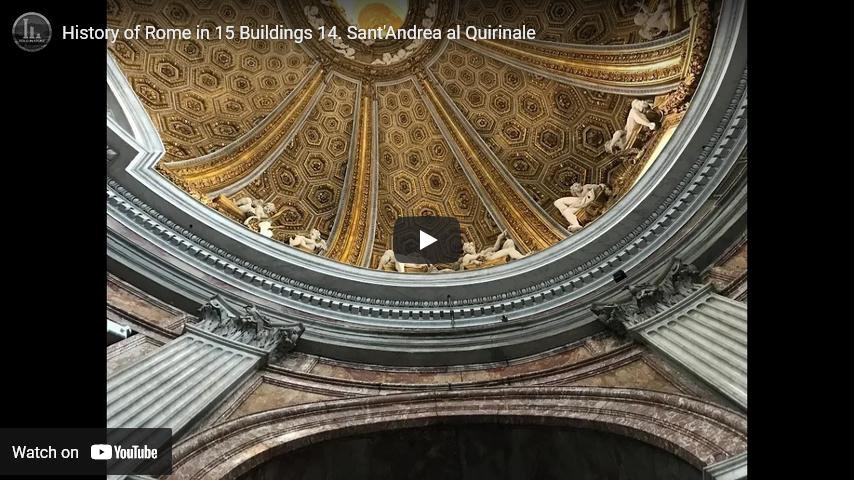
History of Rome in 15 Buildings 14. Sant’Andrea al Quirinale
toldinstone
Published 2 Oct 2018Coke vs. Pepsi. Kramer vs. Kramer. Alien vs. Predator. Everyone loves a rivalry – and so, discussions of art and architecture in Baroque Rome never fail to mention the antagonism between the ebullient Gianlorenzo Bernini and grim Francesco Borromini. This fourteenth episode in our History of Rome follows suit.
To see the story and photo essay associated with this video, go to:
https://toldinstone.com/santandrea-al…
June 16, 2022
Mussolini’s Pope? – The Geopolitics of the Vatican
World War Two
Published 14 Jun 2022Pope Pius XI is the first Pope to guide the Catholic Church through the age of fascism. How has his Vatican responded to Fascists Italy and Nazi Germany, and what is the geopolitical position of the Papacy on the eve of war of World War Two?
(more…)
June 14, 2022
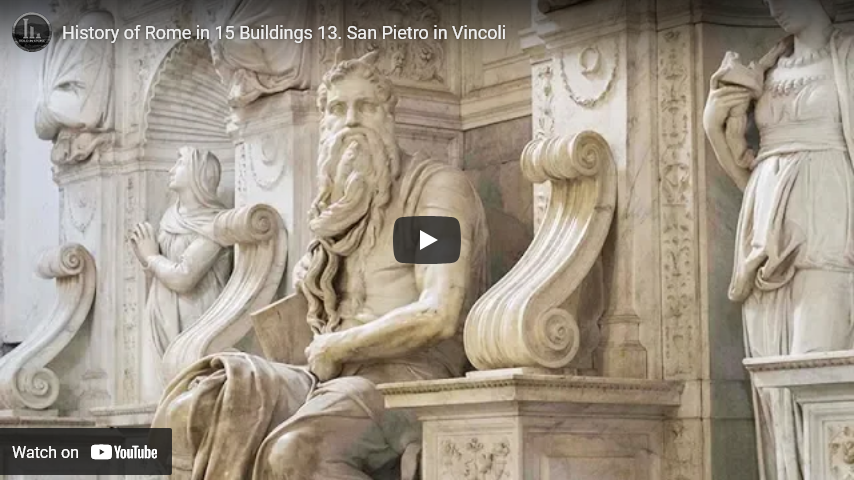
History of Rome in 15 Buildings 13. San Pietro in Vincoli
toldinstone
Published 2 Oct 2018Speech stands at the threshold of the compressed lips. Righteous indignation is written in the lines of the set jaw. The presence of God blazes forth from the eyes. As a work of art, Michelangelo’s Moses is nothing short of awe-inspiring. It sits, however, in the cramped central niche of a rather underwhelming wall tomb, ringed by smaller statues ranging in quality from mediocre to incompetent. This thirteenth episode in our History of Rome discusses the creation of the Moses, and the circumstances that brought it to the church of San Pietro in Vincoli.
To see the story and photo essay associated with this video, go to:
https://toldinstone.com/san-pietro-in…
June 7, 2022
History of Rome in 15 Buildings 12. Santa Maria in Trastevere
toldinstone
Published 2 Oct 2018Wanted: candidate for Pope. Must be a good fundraiser, effective administrator, and shrewd politician. Deep pockets a must. Sanctity negotiable.
The medieval papacy lies at the heart of this twelfth episode of our History of Rome, in which we discuss the catastrophic schism that created the church of Santa Maria in Trastevere.
To see the story and photo essay associated with this video, go to:
https://toldinstone.com/santa-maria-i…
May 31, 2022
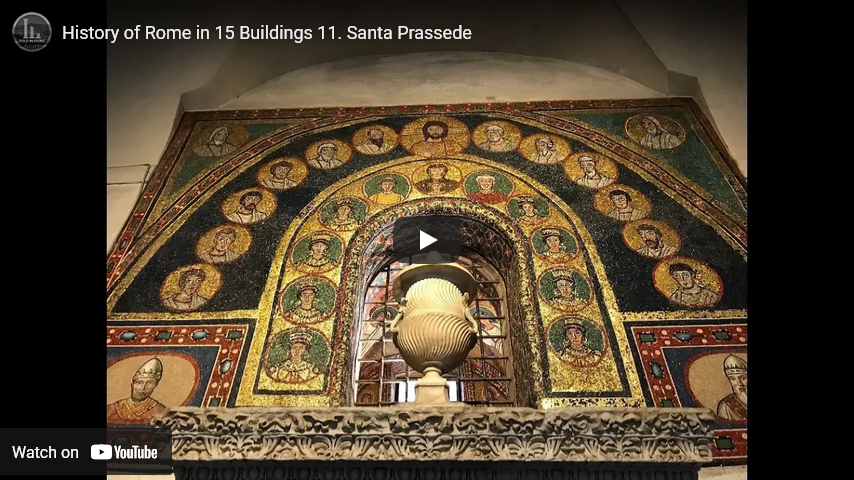
History of Rome in 15 Buildings 11. Santa Prassede
toldinstone
Published 2 Oct 2018After Leo III crowned Charlemagne Holy Roman Emperor in 800, Europe had two notional leaders: the pope and the emperor. In theory, they were the twin pillars of a well-ordered Christian society. In practice, they were usually at each other’s throats. One product of their rivalry was the ninth-century church of Santa Prassede, the subject of this eleventh episode in our history of Rome.
To see the story and photo essay associated with this video, go to:
https://toldinstone.com/santa-prassede/
May 24, 2022
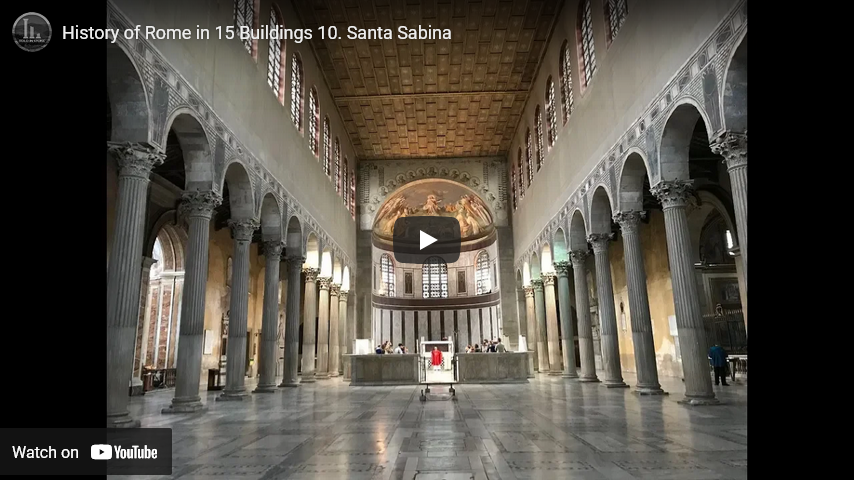
History of Rome in 15 Buildings 10. Santa Sabina
toldinstone
Published 2 Oct 2018Through some combination of military disasters, barbarian migrations, social change, and dynastic bad luck, the Western Roman Empire collapsed in the fifth century. In this tenth episode of our History of Rome, focused on the church of Santa Sabina, we will consider some of the implications of this crisis.
If you enjoyed this video, you might be interested in my book Naked Statues, Fat Gladiators, and War Elephants: Frequently Asked Questions about the Ancient Greeks and Romans. You can find a preview of the book here:
https://toldinstone.com/naked-statues…
If you’re so inclined, you can follow me elsewhere on the web:
https://www.reddit.com/r/AskHistorian…
https://www.instagram.com/toldinstone/To see the story and photo essay associated with this video, go to:
https://toldinstone.com/santa-sabina/Thanks for watching!
February 6, 2022
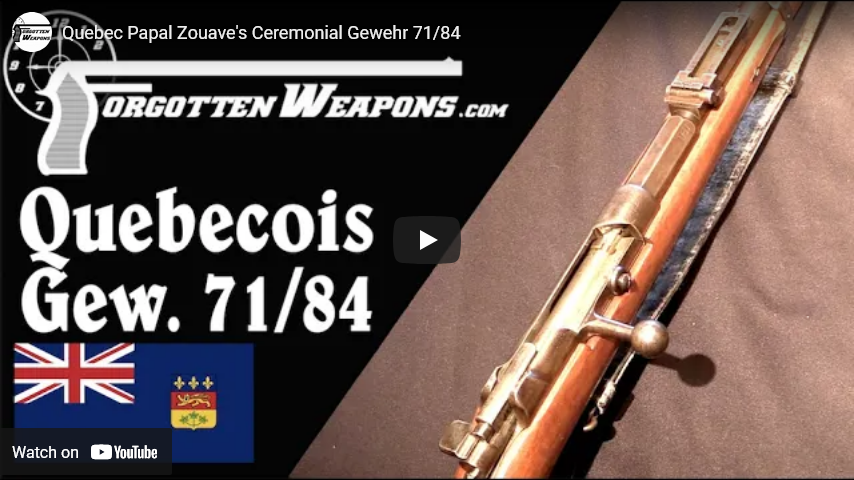
Quebec Papal Zouave’s Ceremonial Gewehr 71/84
Forgotten Weapons
Published 4 Oct 2021http://www.patreon.com/ForgottenWeapons
https://www.floatplane.com/channel/Fo…
Cool Forgotten Weapons merch! http://shop.forgottenweapons.com
Here’s a rifle with an interesting twisting history …
This began life as a German military Gewehr 71/84, made in 1888. It was issued to a unit, but eventually replaced by the Gewehr 1888. It was sold to the Francis Bannerman company at some point around 1900, as part of a big batch of surplus weapons (Bannerman was a massive international dealer in arms and military equipment). Moving ahead a few years, World War One breaks out and prompts the organization of a couple Canadian “Home Guard” units. The Montreal Home Guard has some money, and buys a batch of Savage Model 99 lever action rifles (in .303 Savage, interestingly). The Quebec Home Guard isn’t quite so well-heeled, so they go to Bannerman to see what they can afford. Bannerman sells them a batch of Gewehr 71/84 tube-magazine repeating rifles, in the same configuration as when they were sold off by the German military.
Incidentally, I believe these become the only Mauser rifles formally purchased and issued by the Canadian government, when they are acquired by the Home Guard. At any rate, after the war ends, a subset of those old rifles are given to the Quebec Papal Zouaves, a ceremonial vestige of the Quebecois military volunteers who went to Italy in the 1860s to help defend the Papacy during Italian unification. By this time, the Zouaves are basically just acting as guards in parades, and they crudely cut down the 71/84s, removed their magazines, and fit them with cut-down British Snider bayonets for use as single-shot, blank-firing arms.
Quite the journey, right? And also a reminder that sometimes what looks like sporterized junk is actually something with distinct historical provenance …
Many thanks to Mike Carrick of Arms Heritage Magazine for providing me access to film this example!
Contact:
Forgotten Weapons
6281 N. Oracle 36270
Tucson, AZ 85740