Quotulatiousness

July 28, 2012

Feschuk’s Olympic opening ceremony highlights

Filed under: Humour, Media, Sports — Tags: , — Nicholas @ 11:23

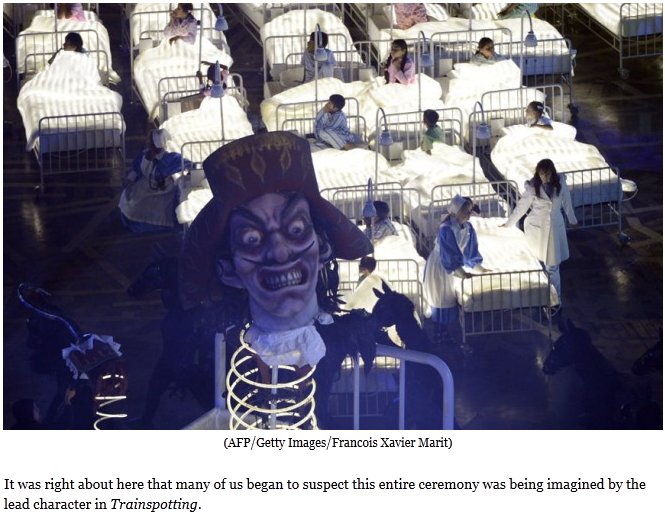
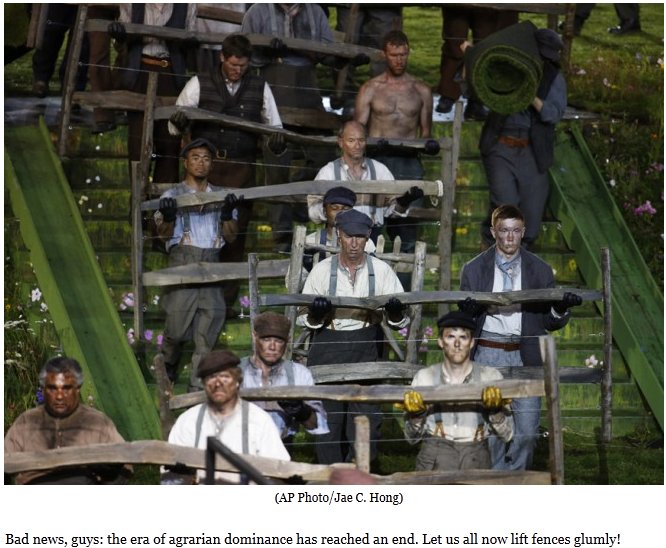
I didn’t watch the opening ceremonies, but I did enjoy Scott Feschuk’s twitter updates during the festivities. He’s collected some of them along with the appropriate photos for Maclean’s:

Clocking in at three hours and 45 minutes, the Opening Ceremonies of the 2012 Summer Games featured many remarkable moments and tophats. Here’s a selection of just a few of the images that captivated the world when the world wasn’t busy asking, “Did they seriously just play a song by Frankie Goes to Hollywood?”

[. . .]

[. . .]

[. . .]

July 27, 2012

Bruce Arthur calls for moderation in regard to the London Olympics

Filed under: Britain, Media, Sports — Tags: , , , — Nicholas @ 11:13

In the National Post, Bruce Arthur tries to encourage all of us, in spite of our memories of what British journalists were saying about the Vancouver Olympics, to avoid being nasty about the London games:

But perhaps we in Canada should restrain ourselves, as a nation. Perhaps we should take the higher road. That is, unless the higher road is crammed with traffic in this built-for-horses-and-carriage town. Or the tube is down again.

The Brits did not treat Canada kindly two years ago, it’s true. The Guardian said Vancouver could be the Worst Games Ever three days in, and they based the assessment on refunded snowboard tickets rather than on the preventable death of an athlete. The Guardian also called our glowing totem poles a collection of ice penises, and even the BBC announcer cocked an eyebrow, as it were. The Times of London called us cursed, while the Daily Mail mocked the escalation of the budget. They were, to be honest, kind of jerks about it.

But that doesn’t mean that Canadians should stoop to a similarly savage brand of mockery, beginning with the Opening Ceremony. It doesn’t mean we should make fun of the leaked details of the event, starting with children in hospital beds, which doesn’t seem terribly festive. It doesn’t mean we should make fun of the fact that Muse will apparently play, and even if they do not, that the official song of the Olympics by Muse is a grating, strutting, whining, overcompensatory sneer of a song.

If Boris wasn’t mayor of London

Filed under: Britain, Media, Sports — Tags: , , , , , , , — Nicholas @ 08:53

Lawsmith imagines what Boris Johnson would write about the London Olympics “major international sporting event” in a “certain major city in the UK” if he were not mayor:

I can imagine his perfect article in this alternative history in my dreams. Written in the Spectator and littered with self-deprecation, references to dead or fictitious Greeks, Liverpool and wiff-waff, Boris would have danced across the pages as he gleefully excoriated the Labour administration for the absurd idea of inviting a bunch of prima donna athletes and bureaucrats, most of them foreign, to compete in an outdoor stadium during the coldest, wettest summer in British history.

He might have pointed out that all this would take place in Newham, a place not altogether unlike Portsmouth and, in any case, one most Londoners consider more alien than Paris, with among the highest incidence of robbery and assault in the entire city. He might have joyfully foretold the pain and suffering of millions of income taxpayers on account of the shut-down of major roads and TfL advising know-nothing tourists to hop the tube at rush hour to make the 10 AM events, and seriously questioned the wisdom of erecting a steel wall around Hyde Park for an entire summer before fouling it up beyond recognition.

In our alternative history he would have savaged, rather than prodded, the implementation of widespread censorship undertaken by a hit squad of intellectual property ninjas; he would have lamented the fact that our police were arresting “marginal” (i.e., possibly innocent) suspects – living, breathing, thinking people – on terrorism charges which they might not be able to prove. If he had really driven it home, he would have pointed out that, under normal circumstances, those arrests would never have been made. He would also have asked why nobody seems to care.

By this point, his oeuvre would have been the most hilarious political essay ever written. He would flay alive in full public view the pathetic, uncritical, fawning news-media industry which crafts its Olympic stories with all the creative flavour of an oak plank, their proxy world to escape from our own inadequacies where professional athletes become “heroes” (seriously, find a different word), washed-up “heroes” become “legends,” and civil liberties violations and government largesse are completely ignored.

July 26, 2012

The “international sporting event” in “the capital of the United Kingdom”

Filed under: Britain, Law, Liberty, Media, Sports — Tags: , , , — Nicholas @ 09:00

Dahlia Lithwick explains why we all need to be careful how we refer to a certain large organized sports extravaganza happening in a major city in England:

At the London Olympics, we’re seeing unprecedented restrictions on speech having anything to do with, erm, the Olympics. There are creepy new restrictions on journalists, with even nonsportswriters being told they should sign up with authorities.

Then there’s the London Olympic Games and Paralympics Games Act 2006. The law was originally aimed at preventing “over-commercialization” of the games, but it seems to have unloosed something of a Pandora’s box of speech suppression. Provisions triggering worries for protesters include sections regulating use of the Olympic symbol “in respect of advertising of any kind including in particular — (a) advertising of a non-commercial nature, and (b) announcements or notices of any kind.” The law further seems to authorize a “constable or enforcement officer” to “enter land or premises” where they believe such material is being produced. It also permits that such materials may be destroyed, and for the use of “reasonable force” to do so.

[. . .]

But it’s not just the Olympic rings that are being protected; it’s also Olympic words. As Nick Cohen recently observed, the “government has told the courts they may wish to take particular account of anyone using two or more words from what it calls ‘List A.’ ” Those words: Games, Two Thousand and Twelve, 2012, and twenty twelve. And woe betide anyone who takes a word from List A and marries it with one or more words from “List B”: Gold, Silver, Bronze, London, medals, sponsors, summer.

Spectators have been warned they may not “broadcast or publish video and/or sound recordings, including on social networking websites and the Internet,” making uploading your video to your Facebook page a suspect activity. Be careful with your links to the official Olympic website as well.

July 24, 2012

Boris Johnson, Mayor of London, welcomes you to the Olympic Games

Filed under: Britain, History, Humour, Sports — Tags: , , , — Nicholas @ 08:12

H/T to Nick Packwood for the link.

July 20, 2012

Fellow Canucks: here’s your pre-Olympic angst schedule

Filed under: Cancon, Media, Sports — Tags: , , — Nicholas @ 10:33

Chris Selley explains what will happen with our Olympic team and the media’s saturation coverage of their every effort:

As I write, Canadians are currently warming up their typing fingers and talk radio voices in anticipation of the traditional Olympic psychodrama. Almost certainly, at some point, there will be a paroxysm of angst over a medal drought. Almost certainly people will extrapolate from that certain lessons: We don’t spend enough on amateur athletics. We spend too much on amateur athletics to deserve these bums. We aren’t winning medals because our athletes have been pampered by the welfare state.

If we do win a lot of medals, that will displease a whole other constituency. There are those among us who deride the whole idea of caring that a Canadian might jump higher or run faster than an Italian as an absurd, unbecoming nationalist spectacle. There are those who think winning, and taking pride in winning, violates our traditionally humble nature. Back in 2010, Star columnist Richard Gwyn deplored the Vancouver organizing committee’s stated intention to top the medal standings as “completely and outrageously un-Canadian.” Globe columnist Lawrence Martin lamented that “at the opening ceremonies and elsewhere, it seemed like we were pushing the idea that we are great.” Heaven forbid!

Then there are those, like flamboyantly anti-Olympic Ottawa Citizen columnist Dan Gardner, who insist that those beaming medal-winners are in fact victims of deranged parents, injurious training regimes and childhood-destroying obsession. (This is often the price of excellence in general, I would argue, although it’s true that concert pianists will have much better knees in their 80s than downhill skiers.) It’s all about the money, people complain, and they’re mostly right.

I certainly agree with the haters about the so-called “Olympic Movement,” as presided over by the International Olympic Committee: It’s a putrid, corrupt, manipulative, corporatist scam masquerading as a triumph of the human spirit. The amount of money spent to bid for and stage the Games is literally indefensible — stomach-turning, even, when you consider the better uses to which it could have been put.

July 19, 2012

“The USOC Can Do Whatever It Wants Because Olympics Act Of 1978”

Filed under: Law, Sports, USA — Tags: , , — Nicholas @ 14:10

At Techdirt, another example of the true modern Olympic spirit:

Ah, the Olympics. The spirit of cooperation. Of athletic competition. Of the essence of global feel-good-ness, where all the Olympic committees of the world come together to put on a spectacle made of the most brilliant athletes in the world.

Oh, and they also like to stifle links to critical pieces (do we have your attention, boys?), by banning their fans from sharing their experiences via social media, and threatening ICANN for refusing to block Olympic-related terms. And, now, Steve M shares a story from the Philadelphia Daily News about how the United States Olympic Committee has won a 30 year battle they didn’t know they were fighting with a gyro shop.

    “Three decades after it burst from the starting block, the Greek eatery Olympic Gyro has received a cease-and-desist email from the USOC, the nonprofit corporation responsible for training and funding U.S. teams. The June 7 notice demanded deletion of the word “Olympic” from the food shop’s title, claiming copyright of the word under a 1978 law.”

This legislative insanity, which I assume is entitled “The USOC Can Do Whatever It Wants Because Olympics Act Of 1978”, basically grants the USOC sole usership of the word “Olympic” in the United States, amongst other travesties.

June 23, 2012

Olympic® bullies

Filed under: Media, Sports — Tags: , , — Nicholas @ 08:53

Seth Godin explains how the Olympics® have jumped the shark:

When a brand becomes a bully, it loses something vital.

So much money, so many egos and so many governments are involved in the Olympics now (and they have so little competition) that it has become a sterling example of what happens when you let greed and lawyers run amok over common sense and generosity.

[. . .]

You can’t build a brand by trying to sue anyone who chooses to talk about you.

Well, they can’t sue all of us. Personally, I never watch the Olympic brand games, and the hype tires me out, but if you want to tweet without using the first person (violating their rules, as if they have the right to tell you what person to tweet in), I think that’s just fine.

June 1, 2012

This is why I always cheer for whoever is bidding against Toronto to host the Olympics

Filed under: Britain, Economics, Sports — Tags: , , , , — Nicholas @ 00:02

If publicly funded professional sports stadiums are bad for the local economy (and they almost always are), “winning” the bid to host the Olympic Games is far worse:

The history of the modern Olympics (and of other large-scale sporting events) reveals a consistent pattern. Organizers or local politicians in the host city commission “impact studies,” which almost always promise extravagant economic benefits. Studies performed after the event, however, find no positive effect at all — let alone one approaching the initial estimates. So it isn’t surprising that a PriceWaterhouseCoopers study commissioned by the British government forecasts that the Games would add about $9.4 billion to London’s GDP between 2005 and 2016. That seems like a large number until you realize that the London metro area’s GDP is roughly $712 billion annually. If the Games’ benefits were spread evenly throughout the decade, they would increase London’s GDP level by 0.1 percent each year.

Further, that $9.4 billion benefit pales compared with the cost of hosting the Olympics. In 2002, the UK’s Department for Culture, Media and Sport estimated that the cost would be $2.8 billion. Ten years later, London’s budget for hosting the Games is $15 billion. Costs already run above that figure and are likely to rise to approximately $38 billion, according to an investigation by the TV network Sky Sports. That would easily dwarf the economic benefits that the PriceWaterhouseCoopers study predicts. Security alone will be extremely costly: more British troops will patrol London than there are currently at war in Afghanistan. And these figures don’t count many hidden and indirect costs of hosting the Olympics — most prominently, disruption to business and traffic congestion. Traffic in London is already difficult; with special lanes for Olympics-related traffic, daily commutes will become a nightmare. (London’s transportation commissioner, Peter Hendy, helpfully advises commuters to go to the pub to avoid rush hour.)

Update, 5 June: The good news just keeps on coming for the London Olympics:

The boom to the economy that the Government hoped the Games would bring to the capital appears to become a bust with tens of thousands to tourists spurning the hiked prices, congestion and heightened security.

While bookings for July and August are down by 35 per cent on last year other European capitals appear to be prospering from London’s gloom.

French ministers, who lost the Olympic bid to Britain, might be quietly rubbing their hands with glee not only for dodging the £10 billion Games bill but also with a 50 per cent rise in tourism bookings. Similarly Barcelona and Berlin have seen their tourist numbers soar by 100 per cent over the summer.

This is an example of why, when the announcement was made that Paris had lost out on the bid for the 2012 Olympics to London, Reason titled their coverage “Lucky Paris“.

May 5, 2012

HMS Ocean heads up the Thames for Olympic security exercise

Filed under: Britain, Military — Tags: , , , , — Nicholas @ 12:15

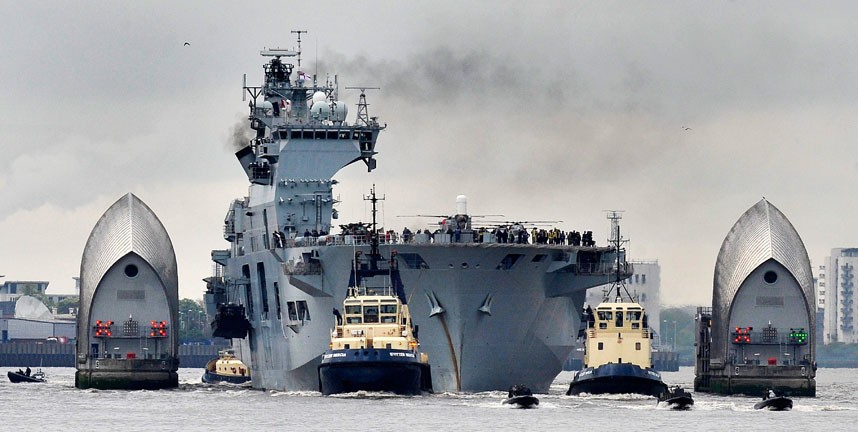
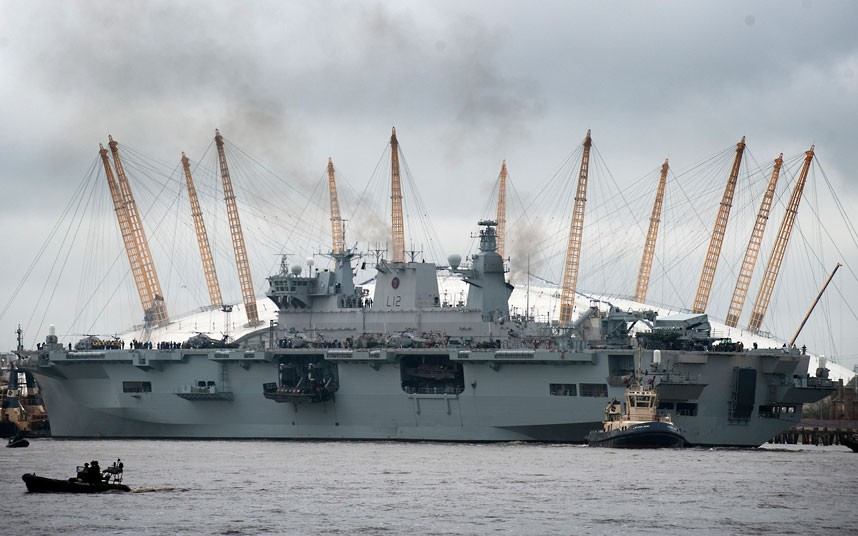
An interesting set of photos in the Telegraph showing the Royal Navy’s largest ship, helicopter carrier HMS Ocean being brought up the Thames for a security exercise in advance of the London Olympics:


A tight squeeze as the tugs work HMS Ocean through the Thames Barrier


HMS Ocean passes in front of the O2 Arena on her way up the Thames

April 30, 2012

New frontiers in border control bureaucracy

Filed under: Britain, Bureaucracy — Tags: , , , , , , — Nicholas @ 09:42

Travelling by air to the UK is a good way to discover the joys of forming queues. The British national pastime of days gone by has been making a stirring new appearance at British airports. The agency responsible is doing everything it can … to suppress information and forbid photography of the queues of people waiting for hours to get through customs:

Heathrow Airport has been ordered by the UK Border Agency (UKBA) to stop handing out to passengers leaflets acknowledging the “very long delays” at immigration, which have become a serious government concern in the runup to the Olympics.

Passengers flying into the airport at the weekend reported having to wait for up to three hours before clearing passport control. But after leaflets apologising for the problem were handed out by BAA, which owns Heathrow, the UKBA warned that they were “inappropriate” and that ministers would take “a very dim view”.

The airport operator was also told to prevent passengers taking pictures in the arrivals hall, according to the Daily Telegraph, which obtained correspondence from Marc Owen, director of UKBA operations at Heathrow. Pictures of lengthy queues have been posted on Twitter by frustrated travellers.

February 7, 2012

“London is too big and too anarchic to be seriously pasteurised by the games. It’s so big, so filthy, so nasty that it could probably eat twenty Olympiads for breakfast and spit out the Ferroconcrete bones.”

Filed under: Britain, Media, Politics, Sports — Tags: , — Nicholas @ 00:40

Faye Planer interviews Will Self in Bristol University’s Epigram on his views about the upcoming London Olympic extravaganza:

I hear that you are unenthusiastic about the prospect of the Olympics this summer. In your eyes, what is the greatest folly of this whole affair?
Rather unenthusiastic is putting it waaaaay mildly: I think the Olympics suck dogshit through a straw. People believe they encourage da yoof to take up running, jumping and fainting in coils — but this is nonsense. They’re a boondoggle for politicians and financiers, a further corruption of an already corrupt self-appointed international coterie of Olympian cunts, an excuse for ‘elite’ athletes to fuck each other, snarf steroids and pick up sponsorship deals, and a senseless hitching of infrastructural investment — if there’s any reality to this anyway — to a useless loss-trailing expenditure on starchitectural bollix. The stadia themselves are a folly. The new Westfield is a temple to moribund consumerism — in ten years time they’ll all be cracked and spalled; a Hitlerian mass of post-pomo nonsense.

If the Olympics did not exist, would it be necessary to invent them?
They didn’t exist for thousands of years. The modern Olympics is a fatuous exercise in internationalism through limbering up and then running down to entropy. The modern Olympics have always been a political football — nothing more and nothing less — endlessly traduced and manipulated by the regimes that ‘host’ them. This one is no different, presenting a fine opportunity for the British security state apparatus and its private security firm hangers-on to deploy the mass-suppression and urban paranoiac technologies in the service of export earning. Some peace, some freedom.

[. . .]

‘Really, one may say that the whole Olympic process was a pasteurisation of the city… the microbes disappeared and from a hygienic point of view maybe that was positive, but really what happened is that the variety was destroyed in the process…’ Manuel Vázquez Montalbán said this about the 1992 Barcelona Olympics. Do you believe that London is being pasteurised too?
No, I’m quite confident that London is too big and too anarchic to be seriously pasteurised by the games. It’s so big, so filthy, so nasty that it could probably eat twenty Olympiads for breakfast and spit out the Ferroconcrete bones.

H/T to Charles Stross for the link.

December 2, 2011

QotD: “Pretty sure we, as a country, were drunk”

Filed under: Cancon, Football, Humour, Media, Quotations, Sports — Tags: , , , — Nicholas @ 12:13

I was at the urinal next to Bob Costas once. It was at the 2010 Winter Olympics, just before the Closing Ceremony, during which Canada said goodbye to the world with a nightmarish glowing dreamscape of giant beavers and plaid-wearing lumberjacks and dancing Mounties and flying moose and looming table hockey players and William Shatner, among others. Pretty sure we, as a country, were drunk.

But Bob Costas was not drunk, because Costas is a sober and professional man who disapproves of you and your shenanigans, probably. Costas is among the great broadcasters of his generation, as witnessed most recently by his stellar on-camera interview with accused Penn State pedophile Jerry Sandusky. And despite some creases in his face, and perhaps a whisper of greying hair, Costas remains youthful, even boyish.

Like just about everything in television, however, that is at least partly a facade, as Costas’ monologue on Football Night in America on Sunday last week demonstrated. As if channeling Andy Rooney in 1978, Costas inferred that touchdown celebrations are basically ruining the minds of our children, with their iPhones and their pornography and their touchdown dances. If life is a football field, it is time to leave Bob Costas’s lawn.

Bruce Arthur, “NFL Picks, Week 13: NFL players can dance if they want to”, National Post, 2011-12-02

July 1, 2011

Duleep Allirajah: “The Most Pointless Sporting Argument Ever”

Filed under: Britain, Soccer — Tags: , , , , , — Nicholas @ 11:32

He’s quite right: this has to be the nadir of international sporting debates:

Where do you stand on the controversial issue of a Great Britain football team? Disgusted that the British Olympic Association is threatening the independence and proud traditions of the home football nations? Angered that the Welsh, Scottish and Northern Irish associations are trying to thwart the Olympic dreams of their young players? Or, like me, do you want to be woken up when The Most Pointless Sporting Argument Ever is over?

If you’re wondering why the proposal for a unified British football team has caused such controversy, let me explain. There has never been a single UK football association. Instead, all four countries — England, Scotland, Wales and Northern Ireland — have their own football associations. Each country is recognised by FIFA as a separate entity even though they are not sovereign nations. It’s one of the residual privileges enjoyed by the nation that invented the game. Although the Brits have minimal influence within FIFA, as the 2018 World Cup bid and the farcical presidential election demonstrated, all four UK nations are represented on the eight-member International Football Association Board (IFAB), which is the sport’s law-making body. The home nations also retain the right to appoint a FIFA vice-president. Although the English FA is keen on fielding a British team in the 2012 Games, the other national associations fear that their independence and FIFA privileges will be jeopardised as a result.

The debate took a farcical twist this week when the British Olympic Association (BOA) announced that an ‘historic agreement’ had been reached with all the home nations to field a Great Britain team at the Olympics. However, no sooner had the BOA made its announcement than the Wales, Scotland and Northern Ireland football associations angrily denied that any agreement had been reached. Oops!

June 3, 2011

The right software tool for the job: Excel is not a database

Filed under: Britain, Media, Technology — Tags: , , , — Nicholas @ 10:05

You know how some people, having mastered a particular software tool, keep trying to fit every task into the one tool they know even when it’s awkward to do? I’ve seen people using Microsoft Excel instead of Microsoft Word or another word processor to produce letters — and people using Word to do spreadsheet-like tasks. The old adage seems to still apply in the software world: when the only tool you have is a hammer, everything looks like a nail.

It’s apparently not just small companies that suffer from this sort of problem:

The London 2012 Olympics is set be a humanoid spectacle of the like never witnessed by the world’s population before. Or something. But disturbing information has reached us at Vulture Central that reveals the organisation’s entire cultural events database is stored in *gasp* Excel.

A job vacancy currently advertised on the London Organising Committee of the Olympic Games (LOCOG) website is offering a competitive salary to someone who can maintain and report on data held in Microsoft’s spreadsheet software.

Now, a small biz with few customer accounts might consider Excel to be fit for purpose. But surely housing an Olympic stadium-sized database on a standalone spreadsheet is bonkers, isn’t it?

That’s a mighty big nail for such a small hammer.

« Newer PostsOlder Posts »

Powered by WordPress