
Quotulatiousness

April 5, 2011

Monbiot: the anti-nuclear lobby has mislead us all

Filed under: Media, Politics, Science — Tags: — Nicholas @ 09:50

George Monbiot has had an uncomfortable year of revelations. Full credit to him for being willing to admit in public that he was wrong:

Over the last fortnight I’ve made a deeply troubling discovery. The anti-nuclear movement to which I once belonged has misled the world about the impacts of radiation on human health. The claims we have made are ungrounded in science, unsupportable when challenged, and wildly wrong. We have done other people, and ourselves, a terrible disservice.

I began to see the extent of the problem after a debate last week with Helen Caldicott. Dr Caldicott is the world’s foremost anti-nuclear campaigner. She has received 21 honorary degrees and scores of awards, and was nominated for a Nobel peace prize. Like other greens, I was in awe of her. In the debate she made some striking statements about the dangers of radiation. So I did what anyone faced with questionable scientific claims should do: I asked for the sources. Caldicott’s response has profoundly shaken me.

First she sent me nine documents: newspaper articles, press releases and an advertisement. None were scientific publications; none contained sources for the claims she had made. But one of the press releases referred to a report by the US National Academy of Sciences, which she urged me to read. I have now done so — all 423 pages. It supports none of the statements I questioned; in fact it strongly contradicts her claims about the health effects of radiation.

I pressed her further and she gave me a series of answers that made my heart sink — in most cases they referred to publications which had little or no scientific standing, which did not support her claims or which contradicted them. (I have posted our correspondence, and my sources, on my website.) I have just read her book Nuclear Power Is Not the Answer. The scarcity of references to scientific papers and the abundance of unsourced claims it contains amaze me.

H/T to Chris Greaves for the link.

Update: Here’s wormme with a remarkably timely example of the sort of thing that George Monbiot encountered:

And Rana included this report, subtitled “Experts warn that any detectable level of radiation is “too much”.”

The only “experts” who would say that are political activists who are either ignorant of science or traitors to it.

“The U.S. Department of Energy has testified that there is no level of radiation that is so low that it is without health risks,” Jacqueline Cabasso, the Executive Director of the Western States Legal Foundation,

There’s only three possibilities here: 1) whoever testified for the DOE did a truly awful job (doubtful), 2) Ms. Cabasso misunderstood the testimony and paraphrased it according to her liking (quite likely), or 3) Ms. Cabasso is a dirty little liar (don’t rule it out).

For chronic (long-term) concerns, the DOE (and NRC) use the linear no-threshold model.

“But what does that mean,” our non-geeks cry. It means it’s assumed that any increase in dose is an increase in long-term risk. No threshold, see?

So is this model true? No. Anyone expert in radiation knows it isn’t true, because we have the whole wide world to look at. And natural doses vary greatly. People pick up between 200 and 2000 mrem/year (2-20 mSv). With absolutely no harm observed at higher doses, so how is there heightened risk? And thousands of Taiwanese picked up 5000-6000 mrem/year (50-60 mSv) for years and years and had a much lower incidence of cancer than usual.

Then why do the DOE and NRC assume risk? Because they couldn’t prove there isn’t. Still can’t, despite the real world examples above.

But that is also true about everything. Marshmallows have killed in the past, and they will in the future. Dihydrogen oxide is the greatest mass murderer of all time.

Ionizing radiation is held to standards that would basically outlaw every other activity and material on earth. Fukushima is proof of that. No one has been killed by radiation, but we’re staring at maybe 25,000 dead. And how much have we heard about non-nuke carcinogens, no doubt swirling around by the ton?

April 2, 2011

Cultural bias and bad reporting

Filed under: Japan, Media — Tags: , , , , , , — Nicholas @ 11:01

Jon sent me this link, which discusses the media coverage of the Fukushima workers:

We hear of Fukushima workers “fleeing” the plant, when what happened is they left for a few hours.

We hear about the appearance of tiny amounts of radioactive iodine in Tokyo tap water — but nothing the next day, when it returns to safe levels.

We hear a thousand commentators mention one measurement that was ten million times normal — but nothing when that turns out to have been a measurement error, made by someone who had little sleep and the weight of the world on his shoulders.

We hear people spinning tales of “worst case scenarios” ten thousand times worse than anything that could plausibly happen — and almost nothing about the fact that the Fukushima reactors endured an earthquake 32 times as forceful as they had been designed for, followed by a tsunami twice as high, and still largely survived.

We hear about “plutonium in the soil” — but not that it’s an amount so tiny that pound for pound, bananas in the grocery store are five thousand times more radioactive.

The London Daily Mail reports that the workers “expect to die,” but not that the worst radiation exposure among all the workers amounts to about as much as 15 CT scans, a dose that not only isn’t fatal, but that has no observable health effects.

A lot of bad reporting seems to come from mere scientific illiteracy.

Not only scientific illiteracy, but willful illiteracy. Combine the need to file a story — the more sensational, the better — with the anti-scientific bias that’s been “baked in” to journalism students for two generations, and this is what you get.

Some of it may be simply that fear sells papers, and a headline that says “Catastrophe imminent” sells more papers than “Catastrophe averted.”

But a lot of it appears to be purposeful — it’s no coincidence that the people spinning the wildest tales of catastrophe have also turned out to be associated with vehemently anti-nuclear think tanks and political pressure groups.

Whether it’s because of ignorance or on purpose, the effect of this misreporting it to keep people afraid.

March 31, 2011

Real world influence of bad science reporting

Filed under: Health, Japan, Media — Tags: , , , — Nicholas @ 09:41

If I seem to be linking to wormme’s blog a lot lately, it’s because he is a great source of practical information . . . and he hates sensationalist media reports even more than I do. Normally, the effect of junk science sensationalism is pretty small: people worry a bit more about stupid things, but generally get on with their lives.

Sensational — and badly mistaken — reporting on radiation is a big exception to that:

Hundreds of people evacuated from towns and villages close to the stricken Fukushima nuclear plant are being turned away by medical institutions and emergency shelters as fears of radioactive contagion catch on.

Medical personnel turning them away.

Hospitals and temporary refuges are demanding that evacuees provide them with certificates confirming that they have not been exposed to radiation before they are admitted.

Do you readers see the error here? If not, this blog is failing you.

When trained, professional medical staff are confusing radiation with contamination, things are really, really bad.

The article goes on to quote some medical experts — i.e., non-insane people.

“If someone has been contaminated externally, such as on their shoes or clothes, then precautions can be taken, such as by removing those garments to stop the contamination from getting into a hospital,”

But what if it’s on the person?!

In my trade, we have a secret special decontamination technique. I’m violating all kinds of unwritten laws by sharing it, but this is an emergency, right? When a person needs general decontamination we always do this first, and it almost always works. Are you ready?

Soap and warm water.

I’ll probably be drummed out of the National Registry of Radiological Protection Technicians for revealing that.

“Free neutrons don’t beam, homie”

Filed under: Japan, Media, Science — Tags: , — Nicholas @ 09:33

The ever-informative wormme has another good post up, this one is about misunderestimating neutrons:

We can’t say for sure TEPCO was monitoring for neutrons there — they’ve made some pretty big mistakes so far — but they’d be hard to miss. All those emergency responders sprawled lifelessly on the ground would have been a clue. From that absolute godawfully unimaginable flux of ground-zero neutrons, doncha know. Because despite “reporting” like this:

…observed a neutron beam…(snip snip)…when a beam of neutrons…

Free neutrons don’t beam, homie. (emphasis added, obviously) Apart from neutrinos and anti-neutrinos, nothing’s harder to beam than neutrons. They like to spread, not bunch. (Okay, Leopold, maybe muons and the like are worse.)

A neutron walks into a bar and says, “how much for a drink?”. Bartender says, “for you…no charge.” The neutron beamed…

March 29, 2011

The evolution of news to sensational entertainment is complete

Filed under: Health, Media, Technology — Tags: , , , , , — Nicholas @ 08:27

Andrew Orlowski gives the media a damn good whacking over their deliberate panic-mongering:

Sensationalism has always been part of the popular media — but Fukushima is a telling and troubling sign of how much the media has changed in fifty years: from an era of scientific optimism to one where it inhabits a world of fantasy — creating a real-time Hollywood disaster movie with a moralising, chivvying message.

Not so long ago, the professionals showed all the deferential, forelock-tugging paternalism of the dept of “Keep Calm And Carry On”. That era lasted into the 1960s. Now the driving force is the notion that “We’re all DOOMED — and it’s ALL OUR FAULT” that marks almost every news bulletin. Health and environment correspondents will rarely be found debunking the claims they receive in press releases from lobby groups — the drama of catastrophe is too alluring. Fukushima has been the big one.

The Fukushima situation has yet to cause any measurable radiological health effects, and workers at the site were far less hard hit by the quake, tsunami and related events than just about anyone in the disaster zone, but nonetheless the nuclear story rapidly eclipsed the tens of thousands killed directly by the quake. TV’s reaction to the crisis shows how at odds it is with a more rational audience, those who know something about radiation, its consequences, and the human body’s capacity to absorb it and recover from it. The crisis for the media is that thanks to the internet, we can now all bypass these conduits for superstition and stupidity.

Thousands of people died in the earthquake and tsunami (28,000 at last report), yet the media coverage has been unrelentingly focused on Fukushima (where there have been no radiation-linked deaths so far). Surely things like this are scary enough to get equal coverage:

H/T to wormme for the link.

Update: Brendan O’Neill finds a perfect example of journalism:

In a post on the Channel 4 News website, Jon Snow, newsreader, Twitterer, cyclist and “pinko liberal” (his words), unwittingly captures the narcissism and ignorance that are fuelling Western fears over the Fukushima nuclear plant. Never mind the 20,000 who have died and the 200,000 who have been made homeless as a result of the tsunami — what Snow wants to know is what will become of the “dumping of radioactive material in sea water off Japan”.

“When will it pitch up off Cornwall?,” he asks. “Never? Do we know? Will it cause cancers? Will it kill eventually?” Perhaps he has a holiday home in Cornwall, in which case he might possibly be forgiven for thinking that the burning issue of Japan’s monumental tragedy is what impact it will have in St Ives.

Snow’s attempt to justify his navel-gazing obsession with the troubles at Fukushima (apparently he can’t get it out of his mind) is telling. Media coverage of the damaged nuclear plant has understandably “overwhelmed the continuing awfulness of the consequences of the natural disaster itself”, he says, because the natural disaster is “somehow more determinable than the unseen, unknown quantity of danger residing in the reactors, or outside them, in Fukushima”. In short, the natural disaster is too much of a done deal, a proven fact, whereas something far more tantalising lurks within Fukushima: dark, mysterious dangers, uncertainties, swirling unknowns that could unleash their fury at any moment against the unsuspecting Japanese and even us Brits.

March 28, 2011

TEPCO still seems to be more a hindrance than a help over Fukushima

Filed under: Bureaucracy, Japan, Technology — Tags: , , — Nicholas @ 12:36

A report from Kyodo News shows that Tokyo Electric Power Co. (TEPCO) is still not fully co-operating or providing all the information needed to clean up the Fukushima reactor sites:

While efforts at containing troubled reactors have not been making rapid progress at its Fukushima Daiichi nuclear power plant, signs were emerging that Tokyo Electric Power Co., in the absence of a top officer, is losing its grip on accurately informing the public about risks from radiation.

On Sunday, the utility, known as TEPCO, announced in the morning that the concentration of radioactive materials of water found inside a turbine building adjacent to a rector housing was ”around 10 million times (that of) water in a normal reactor core” but later corrected the information, saying it ”made a wrong estimation.”

[. . .]

On March 20, TEPCO said, ”There were no increases in radiation levels in adjacent areas.” But increases were logged in various parts of adjacent areas, prompting skeptical reporters to raise a series of questions at a news conference but TEPCO officials remained mum.

TEPCO has been giving a series of news conferences since Fukushima Daiichi got into trouble after the March 11 quake. Attending officials have not been able to provide satisfactory answers to a majority of questions raised, only repeating words of apology and, ”We will check it.” It has left the impression they are unable to reply to questions because they are not given enough information.

[. . .]

But on Saturday, it was disclosed that the company had not informed workers who suffered high levels of radiation at the No. 3 reactor unit about radiation levels of the place where they would be working. The government was also found to have not been informed.

Top government spokesman Yukio Edano expressed his displeasure, telling a news conference, ”We cannot give appropriate instructions unless accurate information is provided swiftly.”

TEPCO is allowed to monopolize the power utility market in Tokyo and surrounding regions by law. As the nation’s biggest utility, it has also been the key promoter of the nuclear power policy and one of the main employers of retiring bureaucrats.

Critics say the company lacks cost consciousness and apparently has no idea about what competition is. It is more like a bureaucracy rather than a business being run, they said.

Radiation: the “Banana Equivalent Dose”

Filed under: Health, Science, Technology — Tags: — Nicholas @ 09:29

A link from wormme leads to this interesting article providing some basic information on radiation:

There is an interesting way of comparing different amounts of radiation, and we’ve now built up all the pieces to understand it. Nuclear physicists and safety engineers sometimes use a unit called the “banana equivalent dose.” This is basically how it’s calculated.

First you take a banana.

Like pretty well everything in nature, bananas are slightly radioactive. Because bananas concentrate potassium, they are more radioactive than a lot of other foods — natural potassium includes some part that is the radioactive isotope potassium-40. That means eating a banana, and thereby ingesting the potassium, adds a measurable radiation dose from the radioactive potassium-40.

Now, before you change to kumquats or something, it’s not much, and bananas aren’t the only source. Potatoes are another food that concentrates potassium. But it does mean we can usefully compare the total dose we get from a banana with other small amounts of radiation. The somewhat-joking term for this is the “banana equivalent dose,” or BED.

Okay, that’s the amusing part, but read the whole thing: it’s informative and non-sensationalized.

Part of the reason I’m posting links to articles like this is that there is a lot of misinformation on all things nuclear and the mainstream media is doing a flat-out terrible job of reporting.

I’ve lived within 10-20 km of nuclear power stations for more than a decade, and I’m not particularly worried day-to-day about the risks due to that proximity. I used to joke with visitors that we didn’t pay for electricity — the walls glowed after dark from the radioactivity. I stopped doing that when I realized people were taking me a bit more seriously than I expected.

March 27, 2011

Panic-mongers still hard at work over Fukushima

Filed under: Health, Japan, Media, Technology — Tags: , , — Nicholas @ 10:58

Lewis Page is less than impressed with the media’s ongoing coverage of the Fukushima reactor clean-up:

The situation at the quake- and tsunami-stricken Fukushima Daiichi nuclear powerplant in Japan was brought under control days ago. It remains the case as this is written that there have been no measurable radiological health consequences among workers at the plant or anybody else, and all indications are that this will remain the case. And yet media outlets around the world continue with desperate, increasingly hysterical and unscrupulous attempts to frame the situation as a crisis.

[. . .]

Nonetheless, in the hyper-cautious nuclear industry, any dose over 100 millisievert is likely to cause bosses to pull people out at least temporarily. Furthermore, the three workers had sustained slight burns to their legs as a result of standing in the radioactive water – much as one will burn one’s skin by exposing it to the rays of the sun (a tremendously powerful nuclear furnace). They didn’t even notice these burns until after completing their work. Just to be sure, however, the three were sent for medical checks.

So — basically nothing happened. Three people sustained injuries equivalent to a mild case of sunburn. But this was reported around the globe as front-page news under headlines such as “Japanese Workers Hospitalized for Excessive Radiation Exposure”. Just to reiterate: it was not excessive.

Reporters clamoured to know more — in particular how could the water in the basement of the reactor building have become so radioactive — no less than “10,000 times normal”. One might note that in general radiation levels 10,000 times normal mean that you could achieve a tiny fraction of an extra percentage point of cancer risk by being exposed for a fortnight or so.

[. . .]

Then there’s the matter of the tapwater in Tokyo. Two days ago, levels of radioactive iodine-131 were found in the city’s water which were above the safety limit for baby milk calculated on the basis of a year’s consumption: in other words, if babies drank such water for a year constantly they would have a tiny, minuscule extra risk of thyroid cancer.

[. . .]

There was never any chance whatsoever that levels of iodine-131 in the tapwater would remain noticeable for a year, which is what would be necessary for any effects at all on the city’s babies. It was really quite irresponsible of the authorities to recommend that infants shouldn’t drink it. (One can’t help noticing that the first such recommendation reportedly came from the city authorities, belatedly followed by the national government. The Tokyo city governor is from the national opposition party and is facing a tough re-election battle. He had previously sought to use the Fukushima situation to cast his political rivals in a bad light over the deployment of Tokyo’s elite Hyper Rescue firefighters.)

I’d also recommend that you keep an eye on the World’s Only Rational Man for his professional take on what the media is currently panicking over at any given moment:

If modern “journalism” wasn’t the single most incompetent industry in human history we wouldn’t be pulling our hair out over this. Where’s the followup to the reports of Cl-38?

How freakin’ incompetent is the entirety of Big Media?!

You’ve had two weeks to learn a minimum about this subject you obsessively “cover”.

“But…but math is hard!” you whine? Then find some dad-gum folks who do this crap for a living rather than cultivate ivory tower media-hounds.

Sorry. Forgive the venting. Tired and P.O.ed.

Apparently going beddy-bye to the thought of runaway nuclear excursions isn’t warm milk and happy stories. Monsters Inc. could have stayed in the scaring business if they’d taken lessons from The Media.

This blogging day began with concern about neutrons. And so it ends.

I wish we still had reporters.

Because I hate journalism.

Once again, wormme is a radiological control technician, so he actually knows what the hell he’s talking about, unlike just about everyone “covering” the news.

March 21, 2011

Japan’s bifurcated power grid

Filed under: Health, History, Japan, Technology — Tags: , , , — Nicholas @ 10:00

Charles Stross points out something I was completely unaware of:

Western Japan and Eastern Japan do not share an electricity grid; because of an historical accident, in the 1890s when they were first getting electric lighting, Osaka, in the west, chose to run at 60Hz and Tokyo, in the east, picked 50Hz. Consequently there’s no grid interconnect between the two halves of the Japanese electricity supply system.

Eastern Japan has had 15 nuclear reactors scrammed by an an earthquake. Some of them may be checked out and approved to start delivering base load again over the coming months, but they all need a thorough inspection at this point — and we know for sure that at least three of them will never work again (not after they’ve had seawater pumped through their primary coolant circuit).

We are now heading into summer. And Tokyo doesn’t have enough electricity to maintain power everywhere even in spring.

Summer in Tokyo is savage: temperatures routinely top 35 celsius with 100% humidity. In a heat wave, it can top 40 degrees for days on end. Back when I visited in late August of 2008, the heat wave had broken and daytime temperatures were down under 37 degrees again — the week before it had been over 42, and joggers had been dropping dead in the street.

Greater Tokyo also has 30-million-odd people, of whom a large proportion — maybe 20% — are 75 years or older.

Elderly folks do not handle heat waves well; they get dehydrated easily and if they don’t have air conditioning they die in droves. Normally it’s not a problem in Tokyo because 80% of households have air conditioning, but with rolling blackouts and insufficient power it’s another matter.

It was bad in France, but the death toll among the elderly in Japan may be much higher.

The nuclear power industry’s technological lock-in

Filed under: Economics, History, Science, Technology — Tags: , , , — Nicholas @ 09:20

Leon Neyfakh looks at how light water reactors became the “default” choice of the nuclear power industry:

Japan’s reactors are “light water” reactors, whose safety depends on an uninterrupted power supply to circulate water quickly around the hot core. A light water system is not the only way to design a nuclear reactor. But because of the way the commercial nuclear power industry developed in its early years, it’s virtually the only type of reactor used in nuclear power plants today. Even though there might be better technologies out there, light water is the one that utility companies know how to build, and that governments have historically been willing to fund.

Economists call this problem “technological lock-in”: The term refers to the process by which one new technology can prevail over another for no good reason other than circumstance and inertia. The best-known example of technological lock-in comes from the 1970s, when VHS and Betamax, two different kinds of videotape, competed in the market until VHS gained a slight lead and then leveraged it to total domination. Whether the VHS format was actually superior to Betamax didn’t matter. After the lock-in, consumers no longer had a choice.

Much more is at stake in nuclear power. Some reactor designs are safer than others in an accident; some are more efficient than others in their use of fuel and produce less nuclear waste. The fact that the industry settled on light water over any number of alternatives was determined in the years after World War II, when the US Atomic Energy Commission and Navy Admiral Hyman Rickover made a series of hasty decisions that irreversibly set the course for how nuclear power plants around the world are built today.

“There were lots and lots of ideas floating around, and they essentially lost when light water came to dominate,” said Robin Cowan, a professor at the University of Strasbourg and the University of Maastricht who wrote a 1990 paper in The Journal of Economic History about the nuclear industry’s technological stagnation. “The market tends to choose a dominant design before it’s optimal, and it tends to under-explore.”

March 20, 2011

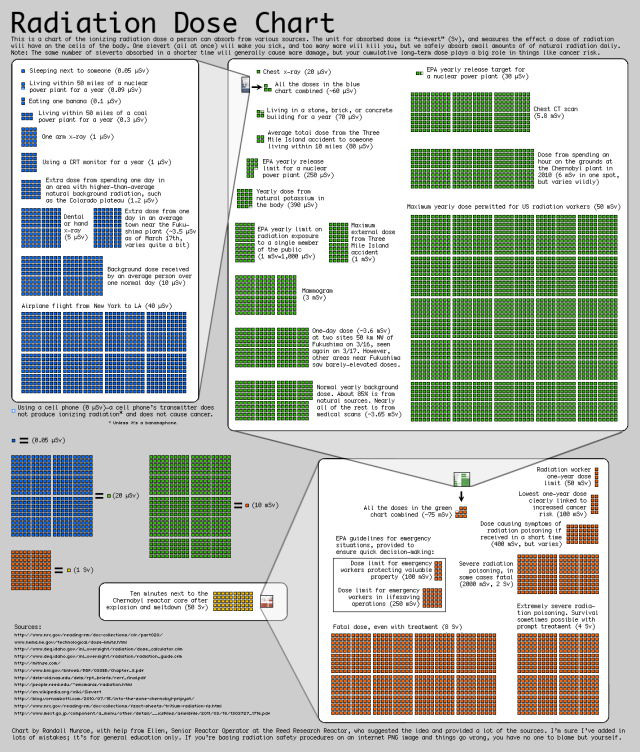
Visualizing radiation by xkcd

Filed under: Health, Science — Tags: , — Nicholas @ 12:09

Radiation dose chart
Click for full-size image

Note the warning at the bottom of the image:

If you’re basing radiation safety procedures on an internet PNG image and things go wrong, you have no one to blame but yourself.

Fuller explanation here.

March 19, 2011

Trying to sort out truth from speculation at Fukushima

The only thing that is certain about the Fukushima situation right now is that both the operating company (Tokyo Electric Power Co. aka TEPCO) and the Japanese government have been ridiculously slow to provide information. They may or may not be actively concealing what they know, but they’re taking far too long to share what they do know with the rest of the world.

Inline update: New Scientist has a timeline of Japanese nuclear cover-ups and accidents. [end update]

wormme is a radiological control technician, so he’s very well informed about the overall picture — in a way non-specialists are not — and he’s had an epiphany about Fukushima:

See the light bulb above my head? Lesson Learned!

My first post on Fukushima is still the most widely read. Alas. I’m a radiological control technician who wasn’t paranoid about a radiological situation. Never good. Never acceptable. So I’ve been “hotwashing” myself ever since.

Where did I go wrong? What was the first cause, the primary mistake? I had to know in order to answer the most important question of all:

How do I never make that mistake again?

I turned a nifty phrase in “incalculable danger”, got generous links . . . then steam began venting and cores melting and hydrogen exploding and fuel pools leaking and spent fuel smoldering, all at once, with my brain sprinting like a hamster on a wheel and making about as much progress.

How did Fukushima have several quiet days after the event and only then have the Hellmouth open?

No lesson learned.

Then a couple of days ago we learned the site went six days without electricity. That monstrous tsunami took out the electrical backups, the backup-backups, and the backup-backup-backups in one fell swoop.

And I thought, ”well, that explains most everything”.

But still, no lesson learned.

It’s only now, right now, the realization: I wrote the post assuming that they had electrical power.

Not even an assumption, really. It wasn’t even a consideration. Of course they had power. They couldn’t possibly not have power.

But they did not have power.

Lesson Learned: the Japanese are different from Americans.

He also has interesting and highly informative posts (earlier than the one quoted above, so perhaps to be read with that in mind) on radiation poisoning, stuff that can cause a meltdown, some crappy radiological terminology, characteristics of radiation(s) and shielding(s), why the spent fuel is a bigger problem than the reactors, nuclear triage, time, distance, and shielding, spent fuel pools, first notes on the “Event Summary” file, and how NOT to wear a respirator.

October 19, 2010

UK defence cuts announced

Filed under: Britain, Economics, Military — Tags: , , , , , , , — Nicholas @ 12:57

As I blogged yesterday, quoting a Guardian article, the British government will be cutting their armed forces substantially:

I want to be clear there is no cut whatsoever in the support for our forces in Afghanistan.

The funding for our operations in Afghanistan comes not from the budget of the Ministry of Defence but instead from the Treasury Special Reserve.

So the changes to the Ministry of Defence that result from today’s Review will not affect this funding.

That will help the morale of the troops on the ground in Afghanistan, but the army overall is still being reduced.

Our ground forces will continue to have a vital operational role so we will retain a large well-equipped Army, numbering around 95,500 by 2015 that is 7,000 less than today.

We will continue to be one of very few countries able to deploy a self-sustaining properly equipped Brigade-sized force anywhere around the world and sustain it indefinitely if needs be.

And we will be able to put 30,000 into the field for a major, one off operation.

In terms of the return from Germany half our personnel should be back by 2015 and the remainder by 2020.

And tanks and heavy artillery numbers will be reduced by around 40%.

The garrison in Germany is a relic of the Cold War, and it’s amazing that they’ll still be there until 2020.

We will complete the production of six Type 45 destroyers one of the most effective multi-role destroyers in the world.

But we will also start a new programme to develop less expensive, more flexible, modern frigates.

Total naval manpower will reduce to around 30,000 by 2015.

And by 2020 the total number of frigates and destroyers will reduce from 23 to 19 but the fleet as a whole will be better able to take on today’s tasks from tackling drug trafficking and piracy to counter-terrorism.

Those are the same Type 45’s that haven’t actually had effective main armament, according to The Register.

We have decided to retire the Harrier which has served this country so well for 40 years.

The Harrier is a remarkably flexible aircraft but the military advice is that we should sustain the Tornado fleet as that aircraft is more capable and better able to sustain operations in Afghanistan.

RAF manpower will also reduce to around 33,000 by 2015.

Inevitably this will mean changes in the way in which some RAF bases are used but some are likely to be required by the Army as forces return from Germany.

The retirement of the Harrier is a simultaneous victory for the RAF against their two most dangerous enemies: the army and the Fleet Air Arm. The Harrier was the one aircraft that could provide both naval and ground support, and was therefore considered readily dispensible by the fighter jocks in the Royal Air Force.

We will build both carriers, but hold one in extended readiness.

We will fit the “cats and traps” — the catapults and arrestor gear to the operational carrier.

This will allow our allies to operate from our operational carrier and allow us to buy the carrier version of the Joint Strike Fighter which is more capable, less expensive, has a longer range and carries more weapons.

We will also aim to bring the planes and carriers in at the same time.

That is probably finis for carrier operations in the Royal Navy: but expect both of these ships to show up again in the fleet of India within 5-10 years.

. . . we will retain and renew the ultimate insurance policy — our independent nuclear deterrent, which guards this country round the clock every day of the year.

[. . .]

…extend the life of the Vanguard class so that the first replacement submarine is not required until 2028;
…reduce the number of operational launch tubes on those new submarines from 12 to eight…
…reduce the number of warheads on our submarine at sea from 48 to 40…..
…and reduce our stockpile of operational warheads from less than 160 to fewer than 120.

September 16, 2010

Army, RN, RAF, and Trident replacement: pick any three

Filed under: Britain, Military, Politics — Tags: , , , , , — Nicholas @ 10:03

The British coalition government has declared that they will retain the nuclear option (that is, buy replacements for their current Trident submarines), but still seem to think that you can take £20bn from the Defence budget (in addition to the 10-20% savings you’re already demanding be made) and still have three viable services. Perhaps it’s a strange form of new math:

The £20bn replacement of the UK’s Trident nuclear deterrent could be put off until after 2015, according to reports.

The BBC said ministers were considering delaying the planned 2014 date in an effort to reduce short-term costs and head off a pre-general election political row.

The Ministry of Defence (MoD) said no decisions had yet been taken on the future of the submarine-based missile system, which is currently the subject of a value-for-money review.

It has been formally excluded from the ongoing strategic defence and security review (SDSR) but the Treasury has made clear the under-pressure MoD budget will have to pay for it. An influential committee of MPs yesterday warned that that decision would have very significant consequences for future defence spending.

Just as the coalition took office, it was mentioned that the previous Labour government had committed to spend £37bn on various new weapon systems, but had not actually provided the funding to make those purchases. Add a Trident replacement bill on top of that and there is no way to successfully pay the bills out of the current military budget.

There are always economies that can be made in military spending: it’s not unreasonable to assume that savings of 10% can be found in any military force. 20% is pushing the envelope too much unless a scaling-back of commitment is also part of the reduction. 20% cuts, no reduction in tasks, and the Trident replacements (even if you reduce the fleet from four to three) can’t be done.

Update: Lewis Page thinks the Trident replacement is essential:

Proper new Trident, with submarine-launched ballistic nukes, is the right call for the UK. Its cost is tiny compared to UK government spending — just half of a single year’s Department for Work and Pensions budget would buy new Trident boats, arm them, crew them and cover their running costs for decades.

Compared to the MoD’s much smaller budget the costs look bigger, but they are still small — and ICBM submarines represent far and away the best value for money in the MoD. For perhaps £20bn to £30bn in acquisition costs you get an unstoppable, unfindable nuclear hammer capable of shattering a nation in an afternoon. When one reflects that we have spent the same money to get the Eurofighter — a wildly expensive and now rather oldfashioned pure air-to-air platform — new Trident looks like a steal.

One major reason that the Eurofighter is such poor value for money, of course, has been repeated delay so as to achieve short-term savings in the past. This is also true of nearly every other procurement project in the MoD: cumulatively, past politicians failing to grasp nettles are now costing us billions every year. It has to stop, and stop now — as a taxpayer, quite frankly I don’t see why I should pay still more billions down the road just to keep Mr Cameron in Downing Street and Mr Clegg in the Cabinet today.

September 5, 2010

No longer “underhand, underwater and damned un-English”

Filed under: Britain, Military, Technology — Tags: , , — Nicholas @ 12:38

BBC News looks at the newest nuclear-powered attack submarine in the Royal Navy, HMS Astute:

It is the stealthiest sub ever built in the UK, able to sit in waters off the coast undetected, listening to mobile phone conversations or delivering the UK’s special forces where needed.

The 39,000 or so acoustic panels which cover its surface mask its sonar signature, meaning it can sneak up on enemy warships and submarines alike, or simply lurk unseen and unheard at depth.

The submarine can carry a mix of up to 38 Spearfish heavyweight torpedoes and Tomahawk Land Attack Cruise missiles, able to target enemy submarines, surface ships and land targets, while its sonar system has a range of 3,000 nautical miles.

[. . .]

HMS Astute itself should never need refuelling over the next 25 years, thanks to the latest nuclear-powered technology which means it can circumnavigate the world submerged.

It even creates the crew’s oxygen from seawater as it sails, meaning that the air on board is no longer heavy with diesel fumes, as submariners used to complain of older vessels. The only limit to how long it can stay underwater is the amount of food on board, enough for 90 days at sea.

Rather a big step up from the diesel-electric clunkers we bought from them, wouldn’t you say? H/T to Adrian MacNair for the link.

« Newer PostsOlder Posts »

Powered by WordPress

