Quotulatiousness

July 11, 2011

The Euro: who’ll be the first to leave?

Filed under: Economics, Europe, Government, Greece, Italy — Tags: , , — Nicholas @ 11:15

With all eyes on Greece recently, the troubles of Italy come as a sudden shock to many:

Greece, Ireland, Portugal, (maybe) Spain…and now Italy? Contagion. The hope on the part of the EU and ECB was to contain the contagion by throwing money at it, but every time they fill one sink-hole with Euros another one opens up. It’s been obvious for a long time that the Eurozone was simply a bad idea, and this crisis has exposed the rotten underpinnings for all to see. Europe wanted to have a currency union just like the United States, but they are finding out the hard way that a monetary union without a fiscal-policy union just won’t work. European countries are not like US states — they have different langauges, different work rules, different governing philosophies…different cultures. The big question in everyone’s mind is…now what? Some countries must default, and a default will probably require leaving the Euro and going back to the sovereign currency. But no one knows exactly how this will work, or what the consequences will be.

Some people are floating the idea of a Euro-Bond, but I find that a little nonsensical absent any fiscal-policy union backing it. But of course this may be the point to the enterprise: to “force” Europeans into a closer union without having to go through the messy (and time-consuming) processes of holding a vote. The EU project has never really been a democratic enterprise from the very first — the Eurozone was implemented without the say-so (even over the protests of) its citizens. If I Eurobond is floated, I expect it to be another example of droit de Seigneur on the part of the Eurozone elite. (And it probably won’t work, and will piss away a lot more good money after bad, but none of that has stopped them so far.)
May 10, 2011

“The recent recession was probably the last nail in the coffin of the proposal for a common Canada-U.S. currency. “

Filed under: Cancon, Economics, USA — Tags: , , , — Nicholas @ 10:22

Stephen Gordon explains how the Canadian economy has benefitted from the independent Canadian dollar:

Let’s think about what would have happened over the past few years if a monetary union had already been in place. Instead of generating an appreciation of the Canadian dollar, the commodity boom would have drawn in larger and destabilizing flows of investment. As it was, the appreciation of the Canadian dollar tempered the flow of capital, and kept inflation under control.

When the recession hit and commodity prices fell, our floating currency gave us a 20 per cent exchange rate depreciation in the space of five months. This sort of stimulus would have been unavailable under a monetary union — as Spain is now finding out, to its great cost.

For reasons that Paul Krugman explains here, Canada has always been an interesting case study in international monetary policy. Canada’s decision to adopt a floating exchange rate in 1950 — several decades before the post-war Bretton Woods system of fixed exchange rates collapsed — was an unorthodox reaction to a situation with which we’ve become familiar: sharply fluctuating commodity prices.

January 6, 2011

Orders of magnitude, US dollar version

Filed under: Economics, Randomness, USA — Tags: — Nicholas @ 07:53

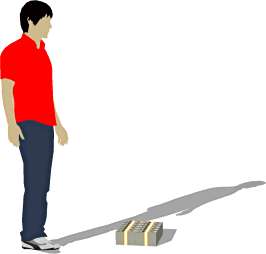
Page Tutor provides a very useful visual reference to the terms Million, Billion, and Trillion:

Believe it or not, this next little pile is $1 million dollars (100 packets of $10,000). You could stuff that into a grocery bag and walk around with it.

H/T to Tim Harford for the link.

August 27, 2010

Redesigning the American dollar bill?

Filed under: Economics, USA — Tags: , , — Nicholas @ 08:22

Gerard Vanderleun isn’t over-enthused by the notion:

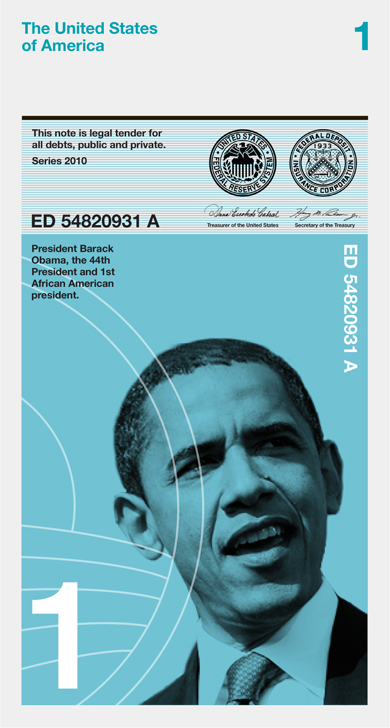
The ObamaBuck-U: A New Bill to Inspire Confident Recovery

I’d advise these sooper-genius designers to design the ObamaBuck with a lot of room for extra zeroes. Gotta plan for the forthcoming Weimarization of the US economy.

What else are these hamstrung colonized minds designing in the way of currency? Here’s there list. You can smell the overheated whiffs of sanctimony just reeking from the stack:

$1 – The first African American president
$5 – The five biggest native American tribes
$10 – The bill of rights, the first 10 amendments to the US Constitution
$20 – 20th Century America
$50 – The 50 States of America
$100 – The first 100 days of President Franklin Roosevelt. During this time he led the congress to pass more important legislations [sic] than most presidents pass in their entire term. This helped fight the economic crises at the time of the great depression. Ever since, every new president has been judged on how well they have done during the first 100 days of their term.

When was the last time these fools took a history course? Third grade? Where are these drool-cup designing dolts based in the US? San Francisco, where else? The town where the homeless defecate freely on the street and where the artists defecate freely in their brains.

If nothing else, the proposed designs would do one useful thing: they’d stop Americans from sneering at the design of Canadian banknotes!

June 8, 2010

Are we ready for “a serious debate about returning to the gold standard”?

Filed under: Cancon, Economics, Government — Tags: , , , , — Nicholas @ 13:02

The more I read of Maxime Bernier’s thoughts, the more I wonder how long it’ll be before he’s drummed out of Stephen Harper’s party: he’s far too sensible. Here, for example, he outlines what it is that central banks do to your money, and why it’s a bad deal for ordinary Canadians:

All this guessing about setting rates has nothing to do with capitalism and free markets; it has more to do with central planning and government control of the money supply. In a monetary free market, the interest rate would be determined by the demand for credit and the supply of savings, just like any other price in the economy.

Government control over money has serious consequences that few people seem to be aware of.

One of them is that central banks are continually increasing the quantity of money that is circulating in the economy. In Canada for example, if we use the strictest definition of money supply, it has increased by 6 to 14% annually during the past dozen years. The situation is about the same everywhere.

The effects of constantly creating new money out of thin air have been a debasement of our money and a dramatic increase in prices. The reason why overall prices go up is not because businesses are greedy, or because wages go up, or because the price of oil goes up. Ultimately, only the central bank is responsible for creating the conditions for prices to rise by printing more and more money.

With all this, it’s surprising that he has (so far) managed to stay in the Conservative party, which doesn’t appear to actually believe in anything much anymore . . . other than the need to stay in power.

Update, 9 June: His speech (from which the article linked above was drawn) gets positive reviews.

June 1, 2010

Another local outbreak of counterfeit bills in Toronto

Filed under: Cancon, Law — Tags: , , — Nicholas @ 14:08

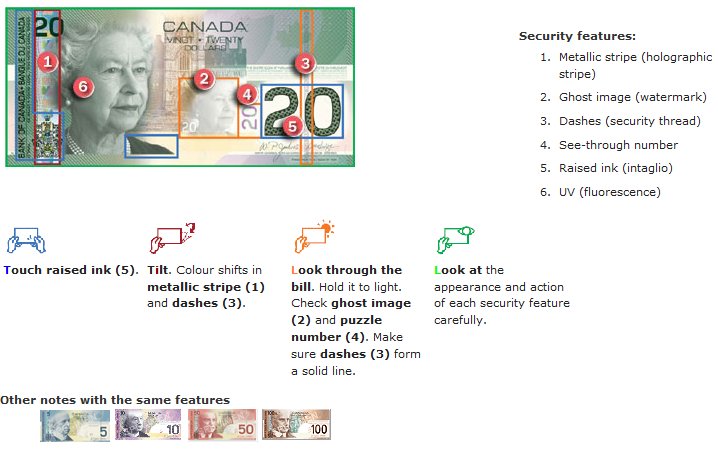
I was just down in the convenience store in my clients’ office building in downtown Toronto and heard from the store owner that there are lots of counterfeit bills appearing today. She showed me an example $10 bill, which looked fine except it was missing the metallic strip on the left side of the bill.

Here’s a guide to recognizing the differences between real and counterfeit Canadian bills from the Bank of Canada:

May 30, 2010

QotD: The first great back-to-the-land experiment

. . . the plundering, the lack of invention, the barbarians and above all Diocletian’s red tape did for Rome in the end. As the empire disintegrated under this bureaucratic burden, at least in the west, money lending at interest stopped and coins ceased to circulate so freely. In the Dark Ages that followed, because free trade became impossible, cities shrank, markets atrophied, merchants disappeared, literacy declined and — crudely speaking — once Goth, Hun and Vandal plundering had run its course, everybody had to go back to being self-sufficient again. Europe de-urbanised. Even Rome and Constantinople fell to a fraction of their former populations. Trade with Egypt and India largely dried up, especially once the Arabs took control of Alexandria, so that not only did oriental imports such as papyrus, spices and silk cease to appear, but those export-oriented plantations in Campania became the plots of subsistence farmers instead. In that sense, the decline of the Roman Empire turned consumer traders back into subsistence peasants. The Dark Ages were a massive experiment in the back-to-the-land hippy lifestyle (without the trust fund): you ground your own corn, sheared your own sheep, cured your own leather and cut your own wood. Any pathetic surplus you generated was confiscated to support a monk, or maybe you could occasionally sell something to buy a metal tool off a part-time blacksmith. Otherwise, subsistence replaced specialization.

Matt Ridley, The Rational Optimist: How Prosperity Evolves, p. 175

« Newer Posts

Powered by WordPress