Forgotten Weapons
Published on 17 Feb 2019Get your copy here:
https://www.wetdogstore.com/NEW-FN-BR…Anthony Vanderlinden is a noted FN collector and author of a book on FN Mauser rifles as well as this volume on FN’s Browning pistols. Both are excellent reference works, with a remarkable amount of contextual information in addition to the very specific detail that appeal to the collector. This work begins with about 70 pages on the history of the FN company, detailing its work in firearms, automobiles, and other products through the Great War, the Great Depression, World War Two, and other events. It then spends a period discussing unique and interesting FN pistols, like the presentation guns made for FN’s celebration of producing a million Browning pistols and the guns used by Gavrilo Princip and his cohorts in the assassination of the Archduke Franz Ferdinand. There are then sections on FN’s association with John Browning and on Browning himself, and on the markings and proofs used by FN throughout its history.
The remaining bulk of the book is broken up into chapters covering the development, production, and use of each model of Browning pistol produced by FN (namely the 1899/1900, 1903, 1905, 1910, 1922, Baby Browning, and High Power). These chapters do an excellent job of providing information on the early development of the guns as well as the commercial and military production, often broken down by the different contracts for each model. For instance, the 1922 chapter includes sections on Yugoslav, Dutch, Mexican, Greek, Turkish, French, Romanian, Danish, Finnish, and German procurement of those pistols. For the historian, the context presented does an excellent job of explaining each gun’s significance in larger events. For the collector, the attention to the details of differences in marking and production between each different variant is thorough and very useful.
My only real complaint would be that the book is entirely in black and white. While that does not really hinder the purpose of the photographs in showing variations and such, color photographs would make it nicer to look at. The book was first printed in 2009, with a revised and expanded second edition printed in 2013. That second edition is available direct from Wet Dog Publications for $67.95 plus shipping, and also from Amazon.
http://www.patreon.com/ForgottenWeapons
Cool Forgotten Weapons merch! http://shop.bbtv.com/collections/forg…
Contact:
Forgotten Weapons
PO Box 87647
Tucson, AZ 85754
March 17, 2019
Book Review: FN Browning Pistols by Anthony Vanderlinden
February 12, 2018
The Browning High Power pistol finally ends production after 82 years
Kyle Mizokami reported on this last week:
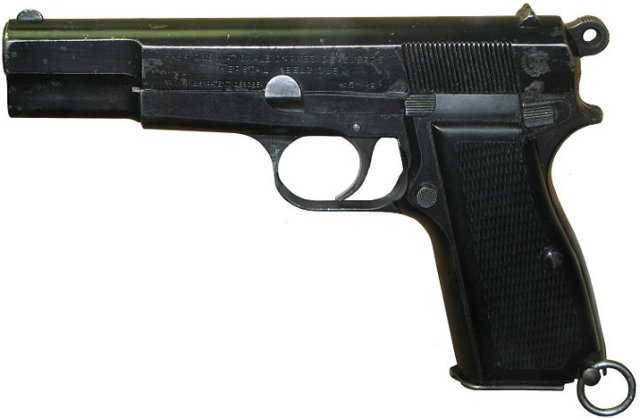
Small arms manufacturer Browning has ended production of the Browning Hi Power semiautomatic handgun. The legendary pistol served in armies worldwide, from Nationalist China to the British Special Air Service and was one of the first high capacity pistols ever invented. An invention of prolific arms designer John Moses Browning, the Hi Power was the inventor’s last pistol design.
As noticed by The Firearm Blog, the pistol‘s product page was quietly changed to include the words, “no longer in production” and the prices were removed. The Hi Power pistol was in continuous production for 82 years.
The Hi Power was the brainchild of American small arms legend John Moses Browning, a prolific inventor who also created the M2 .50 caliber machine gun, still in use with U.S. military forces today. He also invented the M1911 handgun, the U.S. military’s standard sidearm for nearly 70 years, and literally dozens of other pistols, shotguns, rifles, machine guns, and even a cannon. Browning was working on the Hi Power when he died in 1926, and the gun was eventually finished and sold by his manufacturing partners in Belgium in 1935.
The Hi Power had little in the form of commercial success before World War II, but was used by both sides during the war. Belgium’s surrender to Nazi Germany saw plans for the gun smuggled out of the country to Canada, where they were built for Nationalist Chinese forces and British and Canadian paratroopers and special forces. The tooling left behind in occupied Belgium went on to produce handguns for German military forces, particularly paratroopers and the Waffen SS. After the war the gun was sold to civilians and armed forces, particularly those belonging to NATO, and eventually more than 50 armies and 93 nations adopted the Hi Power as their standard sidearm. More than a million Hi Powers were eventually produced.
August 4, 2017
Experimental Lightweight Browning High Power
Published on 3 May 2017
One of the handguns that resulted from the post-WW2 interest in standardizing arms among the future members of NATO was a lightweight version of the Canadian produced Browning High Power. Experiments began in 1947 to create first a lightened slide by milling out unnecessary material, and then additionally with the use of machined and cast aluminum alloy frames. The first major batch of guns consisted of six with milled alloy frames, with two each going to the Canadian, American, and British militaries for testing.
This would reveal that the guns were in general quite serviceable, except that the locking blocks tended to distort their mounting holes in the alloy frames under extended firing. The cast frames were generally unsuccessful, suffering from substantial durability problems. The program was cancelled in 1951 by the Canadian military, and the last United States interest was in 1952. The example in today’s video is one of the two milled frame guns sent to the US for testing.
December 14, 2015
The eternal “Ma Deuce”
Strategy Page on one of the longest-serving (and still serving) weapons in the US arsenal:

M2 machine gun (via Wikimedia)
A U.S. Army facility that is upgrading older 12.7mm (.50 caliber) M2 noticed that a lot of the guns coming in were quite old. M2 production began in 1921 and some three million have been produced since then. No one every kept track of how long M2s lasted. That question was recently answered when an M2 came in with serial number 324, meaning it was produced during the first year and was 94 years old. The serial number was on the receiver, the heaviest component of the M2 (25.5 kg/55 pounds in the most common version) and the one component that rarely wears out. In contrast the barrel is worn out after about 3,000 rounds and most other components eventually need replacement because of wear or damage. But the receiver is quite a sturdy block of machined metal.
Unfortunately for 324 the extent of the latest M2 upgrades means that it is often considered cheaper to scrap pre-World War II M2s rather than perform a number of accumulated fixes and modifications. But since 324 is the oldest to show up so far it will be displayed as a museum piece.
The M2 has lasted so long because it proved to be the most reliable and durable machine-gun of any caliber ever produced. That durability meant receivers would, if they could avoid battle damage or accidents, serve on and on. The army is seeing proof of that as more and more quite ancient receivers come back for which are mandatory and army-wide upgrades. Because of thus a lot of weapons NCOs have been checking their inventories and as they did that the word began spreading on the Internet (even army armorers have their own online forums) that there were a lot of very old M2 receivers out there.
January 29, 2015
Browning’s solution to the handgun problem
Last week, Tam saluted John Moses Browning on the occasion of his birthday, and celebrated the problem he solved:
So, the problem with a self-loading pistol is keeping the action closed until the bullet has left the muzzle and pressure in the chamber has dropped low enough that the brass case will be ejected neatly, as opposed to being transformed into a spray of shrapnel in the shooter’s face.
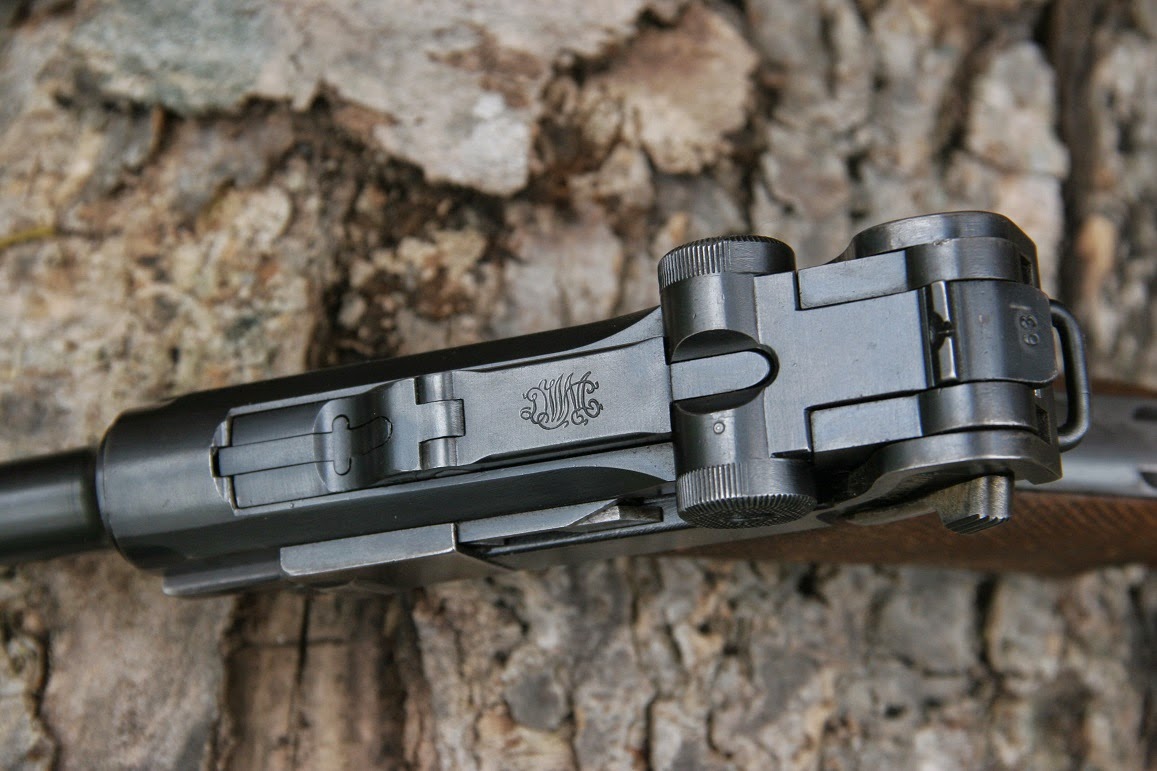
Early autopistols relied on complex mechanical setups, like the well-known Borchardt/Luger mechanism derived from Maxim’s toggle joint, to provide mechanical disadvantage against which the recoil had to work.
It would not shock me to learn that the two main parts of that toggle required more separate machining steps than an entire modern pistol slide. Further, the entire works were exposed to the great outdoors. Friend Marko once jokingly called it “The perfect handgun for a gunfight in a computer clean room.”
So, what are our choices to hold the breech closed for that crucial fraction of a second? Well, there’s spring pressure, but you can only add so much of that before the action can’t be worked by human hands. You can also add weight to the breechblock.